
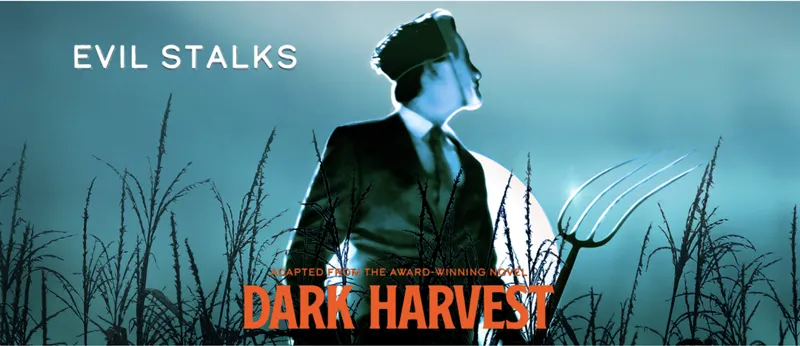
Dark Harvest (David Slade, 2023)
In 2005, David Slade unleashed Hard Candy on the world. It was a phenomenon in both horror and independent film circles. It's also the film that announced Elliot Page was going to be a major talent for the foreseeable future, before they became a darling of young Hollywood in Juno. In 2007, Slade directed a film that gave us vampires as feral, animalistic mass murderers with an entire town at their mercy during a month of darkness in 30 Days of Night. Ironically enough, he was tapped to direct a very different variety of vampire film in The Twilight Saga: Eclipse as well. Since then, he's been directing episodes of loved and respected television series, and a segment of the horror anthology, Nightmare Cinema.
Slade, like many other directors of his generation, got his start as a professional director in music video. Whatever else might be said about David Slade, he can craft a memorable image, and a cohesive visual motif. Hard Candy is full of color that give further credence to the name. The single location, two character film is visually interesting and even beautiful at points. 30 Days of Night takes a different tack in visual style, with most of the colors are drained of their depth and vibrance, except for the reds and the whites. It also has a few memorable images.
He's back to horror cinema with Dark Harvest, a film based on a novel of the same name, by Norman Partridge. The summary reads, "In a small Midwestern town, a deadly annual ritual unfolds when the mythical nightmare, Sawtooth Jack, rises from the cornfields and challenges the town’s teenage boys in a bloody battle of survival."
There are some good performances here. Casey Likes is a capable and believable lead. Emyri Crutchfield is great as his partner in crime and romantic interest. Ritchie, the protagonist, and Kelly, his romantic interest are characters that are believably cynical about their situations in this town, but are characters we want to root for. Jeremy Davies is very good, as usual, as a father in an impossible position and it was fun to see Luke Kirby get to have some fun with chewing the scenery a bit.
Overall, the story is good, due to the ending, it's a bit disappointing. I haven't read the source novel, though I've now gotten my paws on it so I can remedy that. It feels we, as an audience, are denied information related to what's going on behind the scenes, behind the curtain of this town in order to justify a sequel. What's here is intriguing, and especially in the first half, it's compelling. It's enjoyable, as the story unfolds. It's a bit frustrating in the conclusion though. Apparently, the tone of the book is very much that of a fairy tale, so it doesn't get too deep in the building of mythology, and this fails the film to a degree. There's some disconnect between how well that works in a novel and how it can work in a film. In the film, it feels like there was too much left on the table, and as if there is a reticence on the part of the writers to further explore the ideas and themes it is working with.
Part of the reason it's frustrating is that what we do get is interesting. There's a smart mixture of folk horror and slasher film in tone and content. There's some good writing and an intuitive, smart imagination behind the creation of this town, and how this yearly Halloween ritual effects it. The Americana aspect feels familiar, but the rest helps it feel fresh and inventive. At the same time, the familiarity works against making clear that this is, essentially, a fairy tale. Between Norman Partridge's original story and Michael Gilio's screenplay, the film succeeds in creating a tone that's interesting, and does a good job at hinting that there's a larger mystery at play, behind the annual ritual of chasing down Sawtooth Jack. It just never fully explores Sawtooth Jack or the ritual.
It's because all of that works so well that it feels like a bit of cheat to leave unanswered what it does as it ends, and it's clearly ended in a way that suggests a possible sequel. I will say, that aside from what it leaves out, it does find a way to set up a possible sequel that's also interesting and different. It's not just a jump scare, telling the audience the killer/villain isn't dead and will therefore be back. It subverts the usual tropes and suggests an inversion of the story and perspective, should there be a sequel. If this were a set up for continuing the story in a sequel it would be smart, and leaves room for a more interesting sequel than 99% of those we get in the genre.
That being said, there is a lot to like here. David Spade brings his flair for strong imagery and interesting visual storytelling. The color and overall look are interesting. It is in a high contrast color palette, with deep blacks, bright lights and deep, vibrant colors. There are a handful of memorable images throughout and use of visual storytelling to communicate pieces of the story and plot economically. All of the night shooting looks particularly good. Overall, it looks great, point blank. Between Spade, the cinematography by Larry Smith, the art design by Mike Mulhall, costume design by Abby O'Sullivan and production design by Patti Podesta, it looks like every penny is on the screen. All of this gives it the feel of being made on a bigger budget than it probably was, and it helps create this sense of reality that's grounded, but in which the supernatural aspects of the story are absolutely possible and at home.
Even as the film looks great, the ending can't help but bring up the question about whether a more fantastical visual style would have helped sell the fairy tale aspect and helped dissuade some of the disappointment the ending creates. The combination of there being a certain level of realism built into the visual style, along with the inclusion of some allusions to the racism of the real America of 1968, it seems to be reaching for the suggestion that this town exists in our 1968, not in a completely fantastical midwestern town in a fantastical world, even if that town is cut off (by choice) from the rest of the country. It creates an expectation that we're going to get an explanation of why the town is cut off, the origin of the overarching authority in the town and this ritual the film is centered on.
As a creature, Sawtooth Jack is an interesting, inventive creation, and the character design works well. It's a good example of restraint and simplicity. Because digital effects have freed filmmakers from the realm of physics and the restraints of practical, physical special effects, there is very often an instinct to try to go "bigger" and "more" with creatures. Like the story, and the town it takes place in, the simplicity of the character's design makes it feel familiar, and still new at the same time. If there's anything that gives away the low budget of the film, it's that a few of the shots of Jack feel digital. That's not in any way a knock on either David Slade or the digital effects team. Marvel spends hundreds of millions of dollars to make their movies, but infamously, they don't give the effects people enough time to do their best work, and there are shots in some of their films and television that are worse than anything in Dark Harvest. Because of the degree to which Sawtooth Jack's design feels both familiar, but still different, and because there are some different, interesting things about the character, it has the potential to be one of the iconic characters in horror. A little more time and money in those digital effects would help push him over that line.
Even with a few slightly dodgy CGI moments, the way Slade and company mix digital and practical effects helps sell the reality of the film, and the practical effects are all well done. J. R. Kenny and him team do good work.
Ultimately, this is a really well made film, in technical terms. Unfortunately, it ends up feeling like it was intended to be the first half of a story. It's possible the intention to set up a sequel has been there since the screenplay adapting the novel was commissioned. As I said, it feels like there's an opportunity to create a story in two parts, and that story could be genuinely excellent. This is a very good first part of a story. This isn't one I'd give a blind recommendation for, but I would say if you can enjoy a horror film that is doing something a little different, playing around with genre and laying some interesting ground work, this is worth a shot. It's hard not to give it an immediate recommendation, because it is so well made, but the issues with the story left it as somewhat unsatisfying.