
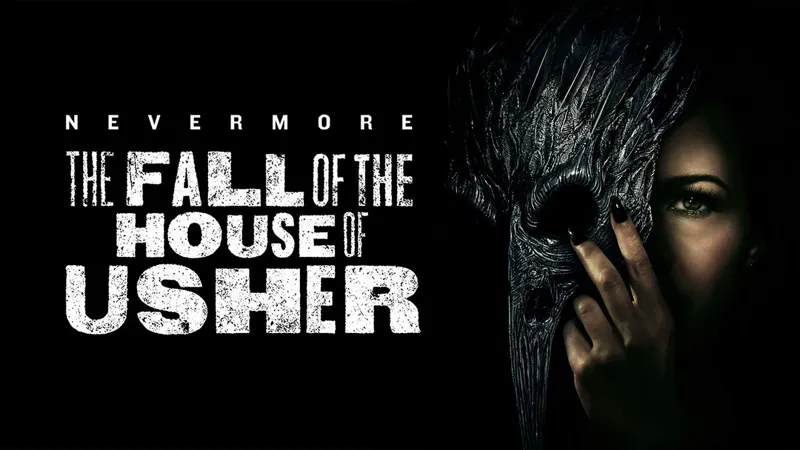
The Fall of the House of Usher
The Fall of the House of Usher isn’t going for the same emotional depth and weight of its predecessors like The Haunting of Hill House or Midnight Mass, but that’s not necessarily a bad thing, nor does it lack any sense of emotional drive or insight. It lacks the emotional weight of Hill House or Midnight Mass, but it ups the entertainment factor, and is a more direct social commentary in some ways. Even as it takes liberties with Poe’s original works, it understands how much of that work is built around simple tales of morality, as told through tragedy.
House of Usher understands the balance between well thought out, well directed, cool scares and putting dedicated actors in front of a camera with a good premise, and letting them work is going to result in something that will pull viewers in. There was a lot said about the monologues in Midnight Mass, both good and bad. I don’t mind a monologue, performed well, and it fit the overall style themes and content in that series. There are far fewer monologues in House of Usher, but it's still driven by people in rooms talking, with the occasional well directed scary bit in between. There will certainly be an instinct among some to look at House of Usher and say, “It’s just popcorn entertainment. Trying to talk about it as if it’s Shakespeare is ridiculous.” That’s the point though. It’s not Shakespeare. It’s not reaching for the level of emotional tragedy Midnight Mass or Hill House was. It’s not dealing openly with as big a theme as personal as religious faith. It's dealing with the larger, more wide scale consequences of greed and lust for power. It’s often scenes of actors talking about what amounts to corporate law or corporate intrigue, and they make it have weight and convey the sense of the consequences that can come from their decisions. The writers have done a good job at telling a story about greed, ambition, and lust for power. As common a story as that is, the Flanagan and his troupe are elevating it to an uncommon level of quality on screen.
It seems like Flanagan has gotten to a point of comfort and trust with the troupe of actors he’s built that they are all at their best when they’re working together. Bruce Greenwood isn't a new addition, having been in Flangan's adaptation of Stephen King's Gerald's Game, but Carl Lumbly is. The scenes of the two together are the heart of House of Usher, and they are delicious. Even casual movie and tv watchers have seen Greenwood in scores of television shows and films at this point. He’s always been a decent actor. He knows the job, and does it without being a distraction. He’s always seemed to be among the cadre of interchangeable, conventionally handsome white male actors who can be cast as husbands, corporate assholes, dirty politicians, and do the job without distracting from who ever they've been cast to support. Either experience has brought him to a new level or he's never been given the opportunity to show he's this good. Carl Lumbly has had a few roles that have given him a chance to shine, but the scenes with Lumbly and Greenwood together, are excellent, and they’re just two people, sitting in an empty room, talking. There’s a scene with Mary McDonnell and Carla Gugino that’s the same. They are scenes with veteran actors, doing that thing that hasn’t changed in all the time that people have been acting out fiction in front of audiences, no matter what new technological wonder has come along, and killing it.
There are a handful of scenes with cast members playing younger versions of those characters, sitting around a kitchen table in a small apartment. Willa Fitzgerald has had other roles in television and film, and she’s never been as good as she is here. She may give the most terrifying performance in the series, including those characters with a more supernatural bend or origin. Like Greenwood, she’s been fine in her other work, but here she gets a chance to show she's an actor capable of real depth, if given the opportunity. Whatever else happens with her career, she’s going to have House of Usher to point to as evidence that there is much more to her than than the pretty face it now seems she was cast to be in other projects. Zach Guilford, and Malcolm Dupin are also excellent in those scenes and the dynamic between the three is enough to base a whole separate series around.
If anything House of Usher demonstrates why professional actors are necessary in film and television, and why studios need to come to a deal with SAG-AFTRA. Without people who can dedicate their professional lives to being this good, you never get a film or television show this good. It takes time and effort to get this good, and that doesn’t happen when actors who aren’t A list, household names can’t make a living. House of Usher is as entertaining and intelligent, and that comes across because of the skill this cast has in making the words come off the page and be alive. There's a simple premise, but all of these characters are layered, and the cast succeeds in communicating a good deal more than what's the words alone.
House of Usher is almost perfectly designed to give each member of the large ensemble cast their moment to shine, and not a single one of them fails when given the opportunity. It’s inviting tomato throwing by making the comparison, but Flanagan shares a certain understanding of balance with some of the best to do it, like Scorsese. The love of actors is a common thread, and there’s an understanding that when a film has to take the audience away from just letting great actors do their work, what’s on screen needs to be visually interesting, and it needs to convey something to the audience. Film obsessives and casual film goers have made a lot of the bravura technical acumen of people like Scorsese, Brian De Palma or Stephen Spielberg through the years, but it has left out that it’s equally important for a filmmaker to have the understanding of when there’s room for that kind of technical mastery, and when to sit the camera in one place and let the audience watch actors do what they do. Part of the overall mastery directors like Scorsese demonstrate is that they understand this balance, and their best films are built around it. We remember things like the single take shots in Goodfellas, but things like Robert De Niro standing in front of a mirror in Taxi Driver are just as, if not even more iconic. House of Usher shows Flanagan has mastered that balance as well, and it suggests that as good as his work has been so far, his best work may be yet to come. He's has given us things like the memorable sequences revealing the secret of “the bent neck lady” or the long one shots in Hill House, and he’s also given us the other moments (like the monologues in Midnight Mass) by letting actors do what has made acting a profession that creates cultural icons, and just be great actors. House of Usher feels like the work where Flanagan has gained mastery of that balance, and as a result is going to be something that rewards repeated viewing, because he's not in as much of a hurry to announce his mastery. The subtlety, in combination with the understanding for the need for that balance is going to produce even greater works in the future.
Taken in the context of the rest of his work, it also makes sense that House of Usher isn't reaching for the gut wrenching emotional depths of Hill House or Midnight Mass. Hill House was a meditation on family, Midnight Mass was concerned with faith. House of Usher is about the American Dream, and really, the way it inherently corrupts even the institution it claims to exist to uplight and empower, the family. It feels colder and more distant, because these are colder, more distant characters, and Flanagan isn't asking us to sympathize with them. He is, as he does in all of his work, asking us to recognize the complicated nature of their humanity, but he's not asking for us to feel sympathy for them or empathize with them. Most of these characters are barely capable of empathy or sympathy themselves, and that's part of the point of the whole story. They were doomed from the beginning. Because the people shaping their most basic values are obsessed with wealth and power, they were robbed of the ability to exercise those aspects of their humanity. This isn't a story about whether the characters are going to make the decisions to prevent tragedy. It's a story about the inevitably of tragedy, because of who these character are, by virtue of the name they share, but also because of who they are individually.
There have been comparisons between House of Usher and Succession, in that they both depict an ultra wealthy family, tearing each other apart for the share of what they believe their inheritance is or should be. Where Succession is more Shakespearean tragedy via Christopher Guest, Usher is a Shakespearean tragedy by way of Edgar Allan Poe. The nods and easter eggs related to Poe's work are sprinkled liberally throughout, and for fans of Poe's work, it's an added bit of joy and fun to recognize them as the series progresses. Flanagan isn't just tossing in empty references for fans though either. He's weaving the themes, ideas and characters from individual Poe works through the episodes, as part of the larger narrative. It's not fan service for the Edgar Allan Poe Cinematic Universe. It's something individual, of Flanagan's creation, while simultaneously being one of the more loving tributes to Poe's works, not least of which is the sense of tone and atmosphere central to Poe's work being so memorable after over a century of imitators.
House of Usher doesn't have the depth of emotional impact as Mike Flanagan's previous series, but that's not necessarily a bad thing either. By virtue of not being designed to rip out and beat to pulp the hearts of viewers, House of Usher maybe the most re-watchable of Flanagan's limited series so far. There's a degree of emotional commitment to deciding to sit down and go through the saga of "the bent neck lady" again or to watch a romance which has been carefully crafted to engage audience hopes of both romance and redemption, only to watch those hopes immolate before our eyes. One of the benefits of House of Usher being centered on characters who are colder, more distant and who are greed and status obsessed, is that the "eat the rich" schadenfreude of it all is more plainly entertaining. It's no mistake or coincidence Flanagan's Usher's so closely resemble the real life Sackler's, who exploited opioid addiction for an empire worth billions and then bought themselves out of being held accountable. In comparison to his other works, this seems like Flanagan's recognition that the same flawed, complicated humanity that made us invest in the characters from Hill House, Bly Manor, and Midnight Mass causes catastrophic levels of pain and destruction when mixed with this depth of greed and hunger for power. It would be grotesque, in a very different way, to ask the audience be as emotionally empathetic and sympathetic toward the Usher's as Hill House asked us to be toward the Crain's. The consequences of the foibles, mistakes, deceptions and resentments of the Crain's fell on the Crain family. The Usher's are falling on the population of the entire planet. We should get a little enjoyment in seeing them come to tragedy, even as we can recognize how its as much a product of their flawed humanity. Until we can get a little something like justice in real life, it's cathartic to be able to get it fiction.
The marriage of the Poe and Flanagan's sensibilities is a good one, and apt. Mike Flanagan is positioning himself as the foremost authority on American tragedy in today's cinematic storytelling landscape, and Poe's clear obsession for romancing tragedy and horror are an excellent partner for his sensibilities.