Memorable Watches, 2021
It seems like the "Best of the Year" list is something almost every publication or film critic or film industry journalist writes. Dear Reader, I haven't seen enough of the films released this year to even come close to deciding I have any idea of what the "Best of the Year" are. I also think time is the thing which really tells us what the best films in any given year are, and having had precious little of it pass between the release of many of the films and the writing of these lists, it's impossible to know which are the best. Often, it takes a few years for some of the best films from a particular year to bubble to the surface.
It's also worth mentioning that COVID has completely screwed things up in the movie business, so there were some films that made their initial festival releases in 2019 that didn't get any kind of release until this year, which would have technically made them movies for a 2019 list, but no one would have had the opportunity to see them until this year. Being that I'm not situated in a way where running around to film festivals is in my budget, I got to see them this year. This is also true of some of the films technically released in 2020.
Finally, for the most part, I'm not really interested in just adding my voice to a chorus of hundreds of thousands of millions of people suggesting the same five or ten movies. I enjoyed the hell out of Spider-Man: No Way Home, absolutely. No one needs a suggestion to go see that though. The box office numbers are pretty clear about this. There will be one or two exceptions to this, because the experience was so strong I can't leave them off in good conscience, but overall, I'd rather be suggesting things the average movie goer or casual film nerd might not have seen or had recommended to them yet. I'll add some of those higher profile films I did really enjoy to the bottom of the list, but I'm not going into them much, because I'm sure you can find 50 other people who've already said what I probably would. For this same reason, I'm going to be including at least two limited series.
If there is anything I can say about my experience with movies in 2021, as a whole, it's that this is the year the impact of progress toward women having opportunities behind the camera was most prominent. It's absolutely possible my own unexamined biases and attitudes have prevented this from being true in the past, but this year, the majority of the most fulfilling experiences I had were with films written or directed or written and directed by women. They weren't necessarily the most enjoyable films, because some of them tackle some hard subjects and themes which aren't always necessarily enjoyable, but they were the ones which most substantially provoked an emotional reaction from me and/or had me thinking most about them in the days or weeks after the credits rolled. If there's one thing this list does show, it's that I really enjoy a big swing. Doing something ambitious, with an original story or an existing franchise, is something I really respect.
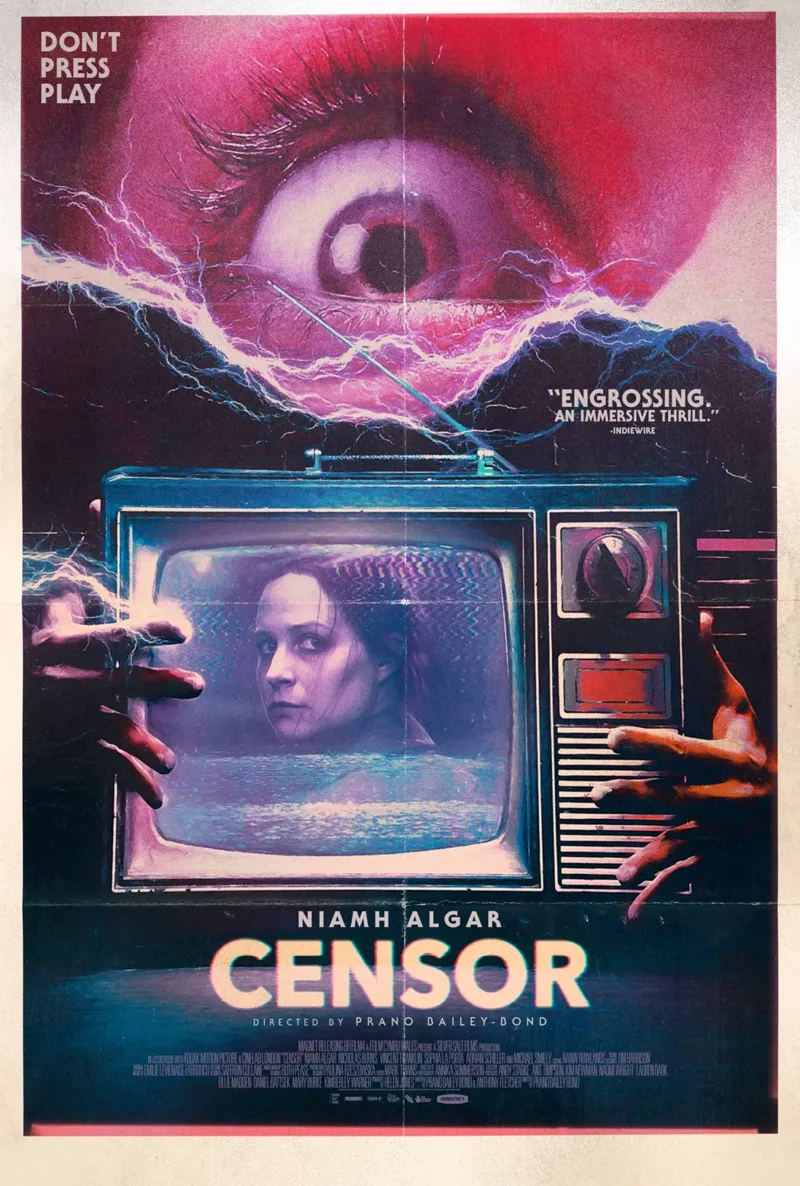
Censor (Prano Bailey-Bond, 2021) - I wrote a long piece about Censor in October. It blew me away, on every level. The amount of confidence and technique which have gone into this film, as a first feature, is something to sing about. So here I am Dear Reader, singing to you the praises of this film. As much as this isn't necessarily a "feel good movie," I felt a sheer, unadulterated excitement when it was over, not only because of how successfully the film bowled me over, but because I knew I'd just seen a film by a filmmaker who is going to be doing great things in what I hope will be a very long, very prolific career. The surreal aspect of the film isn't the only thing which has brought about comparisons to The Shining. The fullness of Prano Bailey Bond's vision in every detail also fits in with the connotations of auteurism which are connected with any piece of Kubrick's work. It's not the kind of film The Academy is going to recognize, but Niamh Algar's lead performance is stellar, and in combination with Bailey-Bond's all encompassing vision, it's a special film with a whole lot on it's mind, communicated in ways which are at the same time beautiful and emotionally hard hitting. I can not wait for Prano Bailey-Bond to get behind the camera again.
Saint Maud (Rose Glass, 2019) - Another first feature that felt like a knockout blow to my psyche on first viewing and has been nearly as rewarding each time I've seen it since. The central performances from Morfydd Clark and Jennifer Ehle are excellent. Heartbreaking in many ways, and disturbing in others. This is one of the films COVID took a toll on. It premiered on the festival circuit in 2019, and then basically disappeared for a year. This has caused some consternation within the horror community, as to whether or not it's a horror film. As with a number of the more independent, artistically minded films of the last five or ten years, it's less about the jump scare or the elements popularly associated with a traditional horror film and more about character, story and the quality of the filmmaking overall. Rose Glass seemed to have been more interested in making the most impactful film she could than she was with making a film most easily nested into a specific genre category, and it shows. When it was finally available for home viewing, it was exclusively through Epix. What buzz this little gem of a British drama/horror was able to generate was long quiet by the time the majority of potentially interested audiences were able to see it. Utterly engulfing and insightfully disturbing, Saint Maud cements Rose Glass as another writer/director whose next film will get a watch from me, no matter what it is.
The Stylist (Jill Gevargizian, 2020) - Another film which wasn't technically released in 2021, but wasn't available for the majority of audiences to see until 2021. Also another first time feature which has a writer/director who is also a woman. The Stylist fits in well with the history of outsider anti-heroes/protagonists, but there's both a particularly feminine take on the tradition and an obvious love for horror films which make it something different from the very long line of those films we've seen in the past. If there's another film which it most shares DNA with, it's Lucky McKee's May, and that film also has a special place in my heart. On the surface, this is a film about a hair stylist who has lost her sanity. Dig a bit deeper and it's a film about the isolation created by the way normative standards play out in female relationships. Jill Gevargizian succeeds in doing the most with the least in this film. Even as it's lacking in budget, it's still able to conjure an enticing visual style and Gevargizian obviously knows how to use every dollar. Najarra Townsend gives a performance worthy of the long line of star making turns her male counterparts have had in other outsider protagonists films. People like Michael Rooker and Robert DeNiro have had their careers explode because of their performances in films like Henry: Portrait of a Serial Killer and Taxi Driver, and unfortunately The Stylist hasn't garnered that same type of attention, but it should. It eschews some of the gritty realism of those films, instead turning toward something slightly more stylized, favoring the window into the protagonists world view more than the "objective" view of the camera, which is part of what also makes it something special and different, even as it's part of that storytelling tradition.
Promising Young Woman (Emerald Fennell, 2020) - Yet another film released in 2020, but not available for the majority of audiences to see until this year. Being one of 2020's most discussed and most divisive films, I almost decided to leave this off the list, but I didn't technically see it until January of 2021, and it's among the films which most stuck with me this year. Carey Mulligan is phenomenal as Cassie, one of the "promising young women" the title is alluding to. The entire cast is great, even when they're only showing up for a few minutes, and the casting is definitely one of the reasons this film works as well as it does. It's reason alone to see the film. Beyond that, this is another instance of a first feature which is so confident and so assured, and delivers so provocative an experience, I can't wait to see what else Emerald Fennell can do. There is a definitive and gorgeous visual style, as well as a confidence with character and story which anchor the whole endeavor. I have one significant quibble with the film (and I say quibble because it's not significant enough to change my respect for it). The producers required Fennell tack on the ending, and it muddles the overall message of the film. Without it, it's clearly a film which is about the degree to which women don't get to live with fantasy and mythology in the same way men do, specifically because of what the story is grappling with. By tacking on this ending, it makes the film seem like it's trying to have it's cake and eat it too. This is still a film worth watching, because of the quality of the performances, the quality of the filmmaking overall and the depth of response it provoked, which was why it was so divisive. My suggestion is to watch the film, give yourself over to it as best you can, let it take you on the journey it has in store, and then go read up on the responses to the film, and what both Carey Mulligan and Emerald Fennell had to say when the film was released. A good deal of it is thought provoking and worth reading. I have a draft of a long piece about it I'm going to come back to in the coming weeks, now that the controversy has settled and feelings aren't quite so hot all around.
Candyman (Nia DaCosta, 2021) - Nia DaCosta's resurrection of the Candyman mythos was another divisive film in 2021. It's also a film which was pushed from a 2020 release to a 2021 release because of COVID, which due to the content of the film, definitely affected its reception. And it's yet another first time feature from a writer/director who is a woman. This was basically guaranteed to be somewhat divisive as it's a new take on one of the most respected characters in horror, which reached the popular pantheon in one of the more critically accepted films of its generation. I have no doubt this film is going to be recognized for the astonishing accomplishment it is, but it's going to take a while. Our current cultural/political moment isn't able to examine the film as it is, for what it is. What I see is a shocking level of discipline, story craft and vision. Had this exact film been directed by a man both critics and audiences already had a relationship with, this would have been recognized. On top of the intelligence in the subtext, the metaphor and the cultural critique the film is presenting, its miraculous as a piece of storytelling. What this film successfully packs into its one hour and thirty one minute run time, without giving anything short shrift (for those paying attention, at least) is astonishing. Very few of the criticisms I've read/seen aren't derived from missing details the film provides or being unwilling to engage with the film because of its thematic elements and it's cultural critique. There isn't a wasted second in the film, and the way it puts together the pieces leading to its conclusion are on a level of writing and filmmaking which is rarely brought to a film meant for a mass audience like Candyman is. Everything is there. It trusts the audience to pick up the pieces as they take the journey, and if this was by a more well known filmmaker, a good deal of the criticism of this film wouldn't have fallen on the filmmaker, but would have been recognized by more critics and audiences as the result of their expectations for what a film like this can be. Strictly from a storytelling standpoint, this is a marvel of a film, because of just how well it manages to pack so much into its ninety minutes, without leaving any loose ends and not taking a single, cheap, convenient shortcut to get there. I'm certain this is a film whose reputation and impact is only going to grow as the years pass and people are able to see it multiple times and give it the space to exist, away from the noise of its initial release and reception. This is one of the smartest horror films in the last decade, and not just because it tackles things like gentrification and institutional racism intelligently, but also because of brilliance with which it's story is constructed and the execution of that story as a piece of cinema. It's not holding audiences hands. It's careening through its story, giving the audience the experience the central characters are having, and crashing to its conclusion, with the same sense of shock the characters have, and that's both part of the point of the story and the purposeful design of the way the story is told. I walked out of this film spinning, and it took me a day or so to put together whether or not it all actually worked, and this is not something anyone expects from a major franchise horror film. All the pieces are there. It answers all the questions it poses. It seeds all the fruit it bares, but it does so at a breakneck pace and without stopping to point to each detail as they're being presented. On top of all this, the performances are all excellent. Yahya Abdul-Mateen II, Teyonah Parris and Colman Domingo are stand outs in the leads, but even the performances for the characters who only come through for one or two scenes are excellent. Nia DaCosta and company brought the level of filmmaking prowess to a franchise film, a sequel, what's now referred to as "existing IP" that is currently being decried as being absent from this variety of film, and people were unable to see it for what it is, because it is a film existing in relation to an already established franchise. It is exactly the quality of filmmaking the most ardent critics of franchise films and IP say is absent.
The Matrix Resurrections (Lana Wachowski, 2021) - Lana fucking Wachowski... Holy shit. What a flex. I went into The Matrix Resurrections with basically no expectations. The first two films in the original trilogy are, for me, among the greatest actions films ever made. The third film was underwhelming in comparison, but has this odd combination of things I absolutely adore and things I genuinely don't care about or kind of dislike. What I didn't expect was to be so emotionally impacted by coming back to the story of Neo and Trinity. We all remember The Matrix trilogy because of just how incredible they are as both action and science fiction films. They are meticulously crafted in filmmaking technique and in storytelling, twisting philosophy and cultural critique in with crowd pleasing, revolutionary big budget filmmaking. It's easy to forget about the love story at the center of all of this. It's easy to forget Keanu Reeves Neo isn't the only hero in these films, and in fact, there's a gender reversal in the first film, with Trinity being the one who is saving Neo, first from the Matrix itself, then it's her kiss which cements the Sleeping Beauty-esque moment of awakening the protagonist from what is about to be his final slumber. Lana Wachowski and her stellar cast have somehow crafted a new perspective on the Matrix mythology centering that love story, making Neo and Trinity equal parts of the whole, while also commenting on the place the first trilogy has taken in our culture (for good and ill), the state of art as commerce and the importance of storytelling in human life, into one of the most joyful and hopeful movie experiences I've had this year. This isn't just "more of the same." This is a logical expansion of the story, while also being a comment on the story and a big does of hope as an act of transgression. I love how much this is a Matrix movie and how much it is very much not a Matrix movie, in equal measure. I love how uninterested it is in being another ground breaking action film. I love how interested it is in being an action movie about something other than groundbreaking action sequences. I love how much it both shows reverence for what the original trilogy was and what that trilogy accomplished and still acknowledges what that has wrought twenty years later. The film itself feels like an act of love, created by an adult with a healthy amount of self reflection. I love the new characters. I love the new takes on the old characters. Lana Wachowski and company have fashioned a film as transgressive as the original, but in a completely different way, as well suited for the cultural moment as the original was when it was released. Like every Matrix sequel, it's been controversial among critics and fans. To my mind, this is another titanic accomplishment in filmmaking. Watching the film, it feels like Wachowski effortlessly accomplished what hundreds of other franchise films weren't even capable of thinking to attempt. I'm completely in awe of Lana Wachoski, once again.
Fear Street - (Leigh Janiak, 2021) I'm fudging this one a bit. Netflix released this trilogy of films, one week at a time, over three consecutive weeks. This is an instance of the whole being greater than the sum of its parts. All three are enjoyable films, but when taken together as a single story, this trilogy is outstanding. On the most superficial level, this is a fun, engaging story. Reading it a bit more closely and look at the subtext reveals it's also a brilliantly written comment on gender, heteronormativity, class and power. This is one of those few instances of a filmmaker being able to create something for everyone. If you're not a raging bigot, there's no reason not to be able to enjoy the films as a fun, lovingly made horror trilogy. The protagonists are lesbians, and there's no getting around it, so bigots are going to bigot and that's just going to make them uncomfortable. Too bad for them. If you're inclined to look for the subtext and look at what a film has to say about the world it exists in, there's a whole lot of that as well, and it's shockingly well interwoven in its comments on gender, heteronormativity, class and power. It doesn't feel preachy either. All of it is presented matter of factly, as just the story of two generations trying to survive what seems to be a curse on their town. Leigh Janiak had only directed one other feature film before taking on the responsibility of directing this trilogy of films, back to back to back. Again, this is a new young woman director, brining a level of assurance, craft and understanding of the medium and genre that further demonstrates why any kind of gender gap behind the camera makes no sense where capability and talent are concerned. She weaves what easily could have been an incoherent mess of timelines, themes, complicated narrative and ideas into a crowd pleasing tapestry. It is also equal parts love letter to the horror genre and roadmap to how genre can be used to better tell the stories of people who've been marginalized or sidelined. In the middle of all of that, it also manages to find a way to bring a more historically accurate representation to the perspective of witches. I can only imagine that reading this description would make it seem as if there is no way that Fear Street isn't an overstuffed, frantic mess, but that's what's so amazing about it. It does all of this, not just coherently, but it manages to make it fun, entertaining, touching and at times, creepy and scary.
The Wolf of Snow Hollow (Jim Cummings, 2020) and The Beta Test (Jim Cummings, P.J. McCabe, 2021) - I'm cheating a bit, again, by putting both of these films together. The Wolf of Snow Hollow was released in 2020, but again, it was in the midst of the pandemic, and also didn't receive a full, nationwide release, so I didn't get to see it until this year. It put Jim Cummings on the list of writer/directors whose work I was going to see immediately. I watched The Beta Test within the first few days it was available on VOD, and was not at all disappointed. He's also the star of both films. Cummings is doing something extremely interesting. In a way, he's writing and performing these characters almost as a satirization of the particular kinds of masculinity they carry into their lives and interactions. These are broken men, who aren't likable, and at the same time, Cummings writing and performances are very, very funny, and excellent at communicating the way the characters inability to acknowledge their efforts to live up to the unreal concepts and understanding of masculinity are the source of what makes them so unlikable and the source of their conflicts. There is a reality and honesty to the way his writing and performances treat this as both matter of course and an absolute blindspot for these characters. He's not writing or performing these characters as if there is an excuse for their often terrible behavior, but he's also not treating them as cartoon characters or merely as object lessons. He's treating the audience like we are capable of the dual understanding that these are terrible people, who are still deserving of our understanding (not excusing them, but recognizing their humanity), and he's doing all of this extremely well. There's also a intelligence in being able to treat these characters like they should be laughed at, because of how ridiculous they are in their self seriousness is and how much that contributes to their being terrible, instead of just pointing fingers at them and yelling about how terrible they are. Again, like Fear Street, there's nothing preachy about it, it's just self evident in the characters and the stories. Additionally, both films begin with their feet firmly planted in genre traditions, and then manage to subvert expectations in interesting and entertaining ways. One of the reasons I'm putting these two films together is that there is a clear similarity between them. Beyond Cummings playing both leads, the obvious voice in the script, they are clearly akin. It's also clear Cummings is trying to figure out how to expand his abilities for cutting observation, comedic writing and timing, and genre manipulation so as to also deliver the most satisfying film possible, and I'm looking forward to seeing how he does this over time. I get the feeling that if Jim Cummings makes ten films and they were to be watched consecutively, it would almost seem like he was making the same film over and over again, until you went back and compared film one to film ten. There are definite surface similarities between these two films, but there are also some significant differences, and the evolution will be exciting to watch as it continues. It's also possible Cummings doesn't even realize he's deconstructing the negative effects of masculinity's social norms and could go completely off the rails in the future. Either way, both of these films are absolutely worth visiting because of how well they work in doing so.
Sator (Jordan Graham, 2019) - Equal parts eerie, frightening creepfest and gut punch meditation on generational trauma, Sator is an act of obsession from Jordan Graham. He spent seven years making the film, six of which were in post production due to self financing, and essentially doing all of the post production work by himself. He built the cabin featured in the film, by himself. He cast his grandmother, whose real life obsession with the Sator she believed watched over her, was the basis of the film and lead to her commitment in a psychiatric facility in the midst of his post production. As a film, it effectively spins from dread and atmospheric terror to melancholy and heartbreak. There are some sequences in the film which are perfectly tuned to induce a peak sense of dread and fear. As the product of a multigenerational obsession, it's a jaw dropping accomplishment. This is not a film for the general horror audience. It's probably not a film for general audiences, at all. It is, however, like sitting through a series of someone else's nightmares and being psychically connected to their feelings as they experience them. There's none of the gore, violence and kinetic drama most audiences associate with and expect from a horror film. This is an extremely quiet, extremely patient film, and all of its dread and terror are built on that patience and the stillness resulting from it. The singularness of the experience is one of the best reasons I can give to see this film. Aside from this, I want Jordan Graham, and people who approach film and storytelling with the sense of humanity he approached Sator to make more films. It's an incredible demonstration of what the capabilities of film are, as a medium.
Spontaneous (Brian Duffield, 2020) - Well, if you had told me in January of 2021 that it would be the year a movie about people spontaneously exploding was going to reduce me to a near blubbering mess, I wouldn't have believed you. 2021, like 2020, was a year a whole lot of things which shouldn't be true became true though. Spontaneous is both very funny, and lovingly heart wrenching, while still being a film which features a number of instances of people just popping like blood bags. I consider it a near miracle to be able to pull all of this off in the same film, and Brian Duffield succeeds in doing just that. Katherine Langford and Charlie Plummer anchor the cast as the two high school seniors who find each other in the midst this unexplained phenomenon, and try to cope with it together as their classmates continue suddenly blow up. Originally conceived as an allegory about school shootings, being released in 2020 also made it all too easy to relate the film to the pandemic we were all experiencing. I initially avoided this film, because it just seemed like a run of the mill teen horror comedy in all of the trailers and marketing. It was word of mouth which attracted me to it, and I couldn't be happier this was the case. This is a delightful film, with a depth of emotional intelligence many of the more serious minded films that have attempted to tackle such heady material lack. It left me with a bit of the kind of emotional exhaustion which can feel cleansing and freeing.
Midnight Mass (Mike Flanagan, 2021) - Mike Flanagan is a writer/director who has slowly made his way to superstar status within the horror genre. The Haunting of Hill House and Doctor Sleep are probably his more recognized works outside of the horror genre, and for my money, The Haunting of Hill House is possibly the best thing Netflix has ever financed. Midnight Mass is now among my favorite limited/mini series, on Netflix or anywhere else. Somehow situated between Stephen King and Shakespeare without being cloyingly pretentious, Midnight Mass unfolds expertly, giving viewers a host of characters ranging from the lovingly imperfect to the perfectly distasteful, while always focusing on the humanity of its characters. Using genre traditions to explore issues of faith and community, Flanagan once again manages to zero in on some very real aspects of human frailty and shortcomings, and understanding very well that the most dangerous creature is the human which is incapable of interrogating themselves honestly. He doesn't skip out on some of the things which make human beings beautiful either, and the contrast, the gray area in which we most live, is the majority of where Midnight Mass takes place. It manages to be about memory, the stories we tell ourselves, the secrets we hide and a number of other things at the same time. Somehow intensely classical and traditional on the one hand, while being something fresh and innovative at the same time, Midnight Mass is sure to be something I'll revisit multiple times in the future.
Sharp Objects (Jean-Marc Vallee, 2018) - The "prestige television" explosion has yielded some series which have become among my favorite things in moving pictures. It's also produced some projects whose popularity could not confound me more. Sharp Objects grabbed me from the first few minutes, and it's one of the things I saw in 2021 I probably think back to the most. Amy Adams is phenomenal. Patricia Clarkson and Henry Czerny are equally good. I was not prepared for the places this was going to go and the depth of impact it was going to have. I was expecting a somewhat overwrought melodrama, not a finely tuned machine which was going to run itself along every emotional cord I have. It's all wrapped around a murder mystery, but to say it's a murder mystery doesn't begin to express what it is or what it has to say. Jean-Marc Vallee died very recently, and this alone demonstrates we lost someone who had to capacity to be among the best cinematic storytellers in the world.
Slaxx (Elza Kephart, 2020) - Listen, would I try to tell you to watch a movie about killer jeans if I didn't absolutely believe it's entertaining and pretty intelligent? I know. It's a movie about killer jeans. I get why you would be hesitant. Here's the thing though... This movie is one of those instances of a filmmaker using some of the sillier and more ridiculous aspects of the horror genre to make a really smart, insightful and entertaining film. Accept how ridiculous the premise is, and go with it. There's a satire in here about materialism, consumerism, and how that works out on a global scale that is very much worth your time, because it also succeeds at being entertaining and funny.
Lucky (Natasha Kermani, 2021) - Directed by Natasha Kermani, and written by star Brea Grant, Lucky is a head cracking allegory about the degree to which violence against women is an accepted part of the world we live in. When I say head cracking, I mean it. This is unsubtle, and I'm fine with that. Brea Grant comes up with some interesting ways to play with this, while Kermani understands how to present it on screen, and the combination is both thought provoking and a well made film. Where it goes in the third act is a really smart pay off, and takes the film to a place beyond just being a preachy screed. It needs to lay the foundation in the first two acts to get there, which it does well, and Grant is always engaging to watch, so when we get to that third act, it carries the impact the idea deserves.
Black Bear (Lawrence Michael Levine, 2020) - Aubrey Plaza is possibly the most interesting actor around right now, in terms of the combination of their level of talent and how far they're willing to jump in their choices of project. Black Bear is a great example of why I feel this way. There's a very strong Cassavettes influence here, which I did not know to expect, but what I got was captivating and engrossing. I was completely on board within the first few minutes. Simultaneously about love, loyalty, artistic ambition and obsession, it was a harrowing ride, and was thought provoking for a few days after. Also, Aubrey Plaza is fan-fucking-tastic, as are Sara Gadon and Christopher Abbott. This one is among the weirder entries, but if you're a fan of film, it's worth the jump.
The Columnist (Ivo Van Art, 2019) - This one wasn't released in the US until this year. This is entertaining, fun, creative satire. Katja Herbers stars as a columnist who finally loses it after dealing with a deluge of abuse and misogyny online, and decides to hunt down her trolls. Somehow, this manages to be both surprisingly dark and surprisingly light and funny too. It may be a cultural difference, but visually, it feels like it should be a comedy or a lighthearted comedy/drama, and it is that at a number of different points, but it also ends up being darker than one would expect from that tone and this color pallet. It makes for a winning combination, and the film does a great job of making it extremely fun to watch Katja Herbers (who gives a great performance), until the consequences start to look like they're coming to call, and then, like her character, we as an audience realize what we've been rooting for all this time. Well done, entertaining and has something smart to say.
Alone (John Hyams, 2020) - This is a classic thriller set up, done to near perfection. A recently widowed traveler is kidnapped by a cold blooded killer, only to escape into the wilderness where she is forced to battle against the elements as her pursuer closes in on her. Julie Wilcox and Marc Menchaca are fantastic, and John Hyams direction keeps this entire film humming with tension and anxiety. This film is proof that it's not always necessary to reinvent the wheel, and if you focus in on the basics of character, story, cinematography and pace even a story people have seen a few thousand times can be memorable and rise to the top, becoming the best of their memories of that story.
8 1/2 (Frederico Fellini, 1963) - I've been reading about Fellini's influence for a good portion of my life. It always seemed like his films were for "those people," the people who had film degrees or who went to experimental films once a week in Manhattan or LA. Honestly, I was kind of worried I wouldn't be able to get it, and I'd feel somehow inferior. Finally though, I realized that's actually bullshit, so I sat down to watch the film I've seen referenced as having influenced a number of the directors I most admire. In the rarest of instances, it lived up to the hype. A pretty astonishing achievement. Emotions, ideas, everything, wrapped up in this surreal soup of a film, which had me hooked in every single second. All I can say is watch it. Sooner rather than later. It's not for "them." It's for anyone whose been alive a little while and also loves movies. Just jump in, it's fucking great.
Also definitely worth seeing:
The Dark and The Wicked (Bryan Bertino)
Underwater (William Eubank)
Mare of Easttown (Brian Englesby)
Dune (Denis Villenueve)
Malignant (James Wan)