
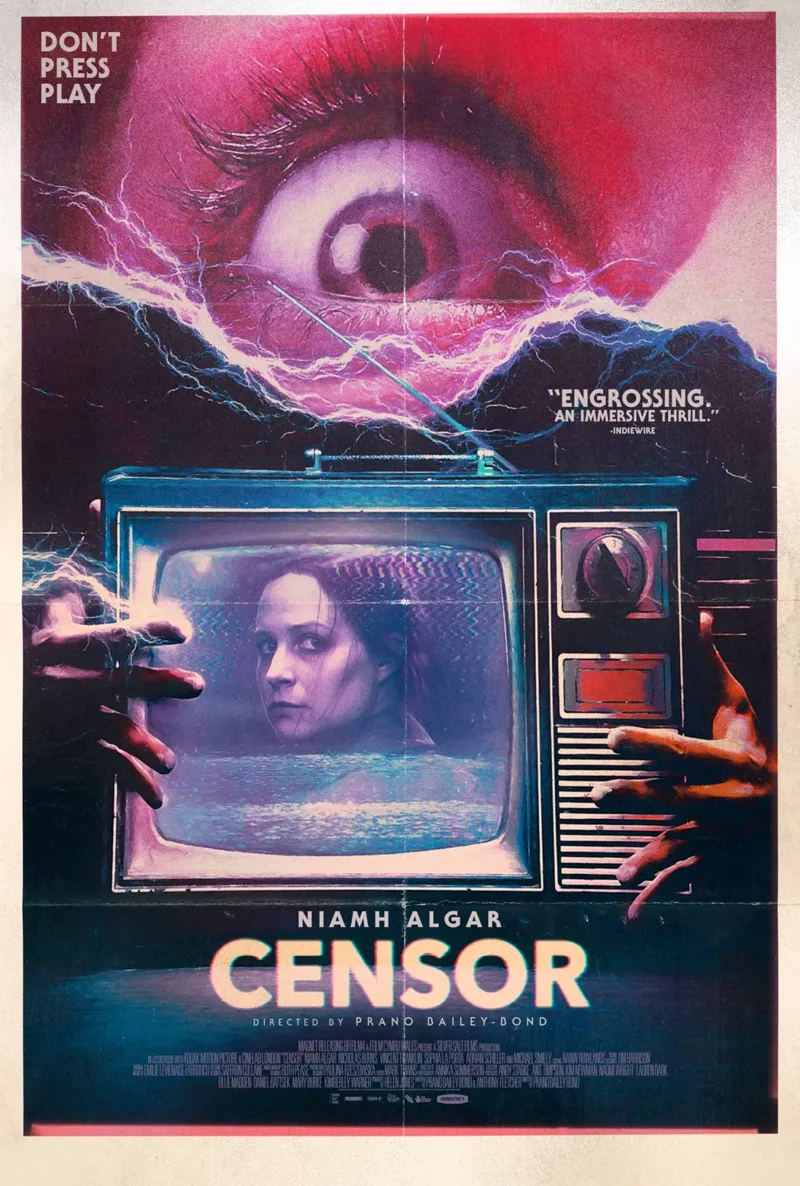
Prano Bailey Bond's Censor and Repression of the Monstrous
*Note: This review will contain extensive spoilers, as it discusses the film in depth.
Film censor Enid takes pride in her meticulous work, guarding unsuspecting audiences from the deleterious effects of watching the gore-filled decapitations and eye-gougings she pores over. Her sense of duty to protect is amplified by guilt over her inability to recall details of the long-ago disappearance of her sister, recently declared dead in absentia. When Enid is assigned to review a disturbing film from the archive that echoes her hazy childhood memories, she begins to unravel how this eerie work might be tied to her past.
So goes the synopsis for Censor, according to the website. What it doesn't say is the feature debut of writer/director Prano Bailey Bond is an enthralling psychodrama, wrapped in the trappings of a horror film. Bailey Bond takes on the concept of censorship with a courageous, unusual and unfortunately rare perspective. Centering the narrative in the 1980's during the height of England's Video Nasty era, she challenges the concepts of objectivity and morality as they pertain to capitalist, patriarchal and parochial Western countries. She does so by creating a compelling character study of a woman who is a devout believer in the system which declares itself capable of objectivity and morality simultaneously.
Enid's existence is very narrow, very controlled. She is utterly dedicated to her work as a film censor, a position elevated in importance due to the controversy surrounding Video Nasties. She's obsessive, to the point of having very little else in her life. She has no social life. At one point, one of her coworkers even makes a comment about it being unlike her to leave on time, so we understand this is a pattern of behavior observed by those around her. In addition to her obsessive focus on her work, she is unable to remember the events of the day her sister disappeared when they were both children. It's clear very early in the film, Enid has a distant and strained relationship with her parents.
Even in her appearance, there's a level of drab severity. She wears very conservative clothing, blouses buttoned to the neck, loose fitting pants, her hair tied back in the tightest of buns, little or no makeup. Enid's entire sense of identity is entangled in her work and her belief in the idea that it is protecting people. Enid goes to work, returns home to a small, drab apartment, reads the newspaper, listens to the news (a good deal of which is about Video Nasties) and repeats the process again each day.
Naimh Algar is excellent at Enid. She brings a range of deft subtlety, crazed intensity, and tragic vulnerability to the character. Algar shows an ability to project Enid's use of competence as part of the armor to protect her from her guilt, with a fierce intelligence covering a tragic sadness. She's also able to realistically portray Enid as someone whose life is somewhat ruled by obsession, without realizing what those obsessions are or even that they rule her. Algar is able to convey all of this, in subtle and more dramatic ways as Enid is effected as this armor of self deception begins to crack and fail. She gives an outstanding performance.
We first see Enid following a screening of a film with a coworker, where they are attempting to evaluate the film we've just seemed. It serves to show us Enid is utterly dedicated, as well as detail oriented.
The opening credits come after and are a montage of bits of some of the bloodier moments of obviously low budget horror films and shots of Enid working, all as we hear the audio of newscasts about Video Nasties. For those who've lived through one, it's the clear, unmistakable hyperbole and nearly ironic self importance of a moral panic. For those who haven't, it's at least very clear this is a controversy which has consumed the country.
We go from the credits to a close up of Enid's face as she watches what we're then shown is a film involving someone getting an injection in their eyeball, and then cut to a small room with six people sitting around a table. They're discussing a film, presumably what Enid was just watching, and debating whether or not it can be allowed with required cuts or whether the film is to be rejected altogether. The discussion quickly turns to the possibility of children seeing the film. It's clear Enid is one of the more stringent voices. She is one of two women in the room.
The first crack in Enid's facade comes when there is a brutal murder in London, with one detail similar to a film Enid didn't reject. A journalist makes a connection between the murder and the film because both involved an act of cannibalism, and the journalist also knows Enid and one of her coworkers evaluated this film. The film is called Deranged, and the killer is claiming he has no memories of killing his wife and children, and apparently consuming some part of them. Due to this, the press has dubbed him The Amnesiac Killer. This is the first time we see Enid experiencing intrusive memories related to the day her sister disappeared.
Enid begins to get threatening, harassing phone calls at home. Tellingly, when one of her fellow censors says, "It's bad luck, it could have happened to any of us," Enid's response is, "If I'm here to make decisions, it can't be bad luck." It's a perfect line, and encapsulates both Enid's faith in the system creating an inability to see its shortcomings and failures, as well as Bailey Bond's thesis. Enid might not have made a mistake. There may be no connection between the film and the murder (which we'll later come to find out is the case), and still, the censors are themselves only human, and subject to the same shortcomings, frailties and brokenness as the public they're claiming they can employ an objective perspective to protect.
None of this is helped when a producer (played by the always excellent Michael Smiley) of films which have been struggling through the Video Nasty controversy, named Doug Smart, comes through the office. He's a very stereotypically slimy, sleazy producer character, commenting on her physical appearance and that he would love to put Enid in some of his films, should she get tired of banning them. When Enid comments that she's not interested in being raped and murdered on film, he replies that the public would probably love it. Where he is referring to the popularity of graphic films, as an audience member, we can't help but also connect it to the harassment Enid's been experiencing through the phone calls at her home, and the press waiting at her job, after she was exposed as one of the people who let through the film wrongfully connected to the murder which is all over the news. The producer comments to her boss that a director, Frederick North, has asked for her to evaluate one of his films. It's essentially to be intimated that because Enid let through the film supposedly connected to this murder, that she is a lighter touch as the censors go. This exchange represents an intrusion to the narrow, simple world Enid has built for herself. Naimh Algar is obviously an attractive young woman. It's also obvious Enid goes to some lengths to present herself in a way which calls no attention to this fact. This advance calls attention to this fact, in the space where she has done everything to build her identity based on her competence, and it also calls into question her dedication and confidence. The assumption by this producer and director that she is less interested in following guidelines to the letter because of the controversy in the news is another cut in this armor she's built for herself. These are also intrusions because they're not coming from coworkers or her boss, but from an outsider, and it's clear part of the reason for Enid's effort in narrowing her life so much is specifically to limit the number of people she needs to keep her facade up for. She wants to practice this facade in the smallest number of different contexts possible.
The next crack in Enid's emotional/psychological armor comes when she sits to examine a film Don't Go in the Church for evaluation. It's the film the producer had mentioned having her evaluate and it appears to very closely imitates the events of the day her sister disappeared. We cut to her in the bathroom, vomiting in the toilet. When she comes out, the male coworker she'd been viewing the film with is waiting. He attempts to console her, both because she has obviously had a strong reaction to Don't Go in the Church and because of what she's experiencing as the result of essentially being saddled with the responsibility for The Amnesiac Killer. Enid though, is hyper focused on why The Amnesiac Killer might not be able to remember what he'd done, and though her coworker has no idea this is the case, it's clear Enid is so clearly disturbed by this because of the emerging memories about her sister. It's also clear this coworker has a romantic interest in Enid, and asks/tells her he would listen to anything she wanted to talk about over drinks. It's a sweet moment, but Enid has no reaction and ignores that he's asked her at all.
We cut to Enid staring at a television showing the white noise/snow in her apartment. The camera slowly closes in on the television and the empty signal, which slowly dissolves into a sequence which is possibly a dream, but could also be a delusion/hallucination. It shows Enid as a young girl, where her sister disappeared. She sees a man walking through the woods, and finds a piece of paper in her hand. On the paper is written the name of the film Don't Go in the Church, and the name of the director, Frederick North. The location in her dream/hallucination is identical to the one she saw in the film earlier in the day. This sense of Enid projecting herself through the television screen is a mechanism Bailey Bond employs repeatedly throughout the film.
We next see Enid entering a video store, and observing someone returning a video, which the clerk/proprietor then hides behind the counter. It helps here to have some knowledge of the Video Nasty era. There was a strong black market in Video Nasties, and there were regular raids on video stores for selling or renting them. Enid basically cajoles the proprietor into giving her a different film from the same director. When we see Enid watching the film, it's clear she is fixating on the actress in it. Enid then goes to her parents, attempting to convince them the actress, Alice Lee, is her sister. Through her parents comments, we learn Enid has wrongly identified someone as her missing sister previously. We also get a comment from her father, about having attempted to have her sister declared dead so that this would stop, and Enid having "always run off to do what you want, just like the day you ran off with her."
Again, we find Enid in front of a television with empty signal playing, obviously having watched the film she got from the video store again. This time, she's clearly asleep and we see a dream sequence, in the same wooded location, just outside a very small cabin. Enid sees her sister as a child, but she then becomes the actress from the film, and Enid sees her go to a hulking man, whom Enid had seen on a poster for Beast Man as she entered the video store, waiting for her inside the doors of the cabin. Enid, still a child, chases her into the cabin, enveloped by light and fog.
We cut to Enid going into a storage room at her offices. She finds the print for the film Don't Go in the Church and writes down the address on the label. She goes to the address, and it's the home of the producer, Doug Smart. He answers the door with a hammer, clearly intending on swinging the clawed end should he have to. After reminding him they met at the censors office, he remarks about, "People taking exception with some of his films." When she's inside, she recognizes the living room as having been a set in a rape scene in one of Smart's films. When she sees a headshot for the actress, Alice Lee, who Enid has come to believe is her sister, she makes a comment about how they look similar. Smart says she's right, and maybe that's why he thought he'd seen her before. As they continue to talk, he says the sequel to Don't Go in the Church is currently filming and in relation to the films lead, Alice Lee, "It'll be her last film. She's come to end of her shelf life, that one." This seriously distresses Enid. Enid begins saying Frederick North kidnapped Alice Lee, but the Smart ignores her and begins making sexual advances toward her, and when she rebuffs him, he begins to get physically aggressive. In her attempts to push him away, Enid shoves him backward, and he falls on a coffee table, where an award he'd been showing her was sitting. The award ends up killing him in pretty gruesome manner. Enid is obviously incapable of dealing with this, and says, "Thank you for the whiskey, I'll see myself out," as if she is meeting some standard of polite manners.
Smart was telling Enid that Alice Lee has aged out of being the young starlet, but Enid is taking something more nefarious from it. He's being a stereotypically sleazy producer, and she's reading it as an admission they plan to kill Alice Lee as part of some conspiracy Enid has envisioned involving the disappearance of her sister. He believes Enid has shown up at his apartment at some relatively late hour of night because she does have some interest in being in his films, which is also why he thinks she's asking about looking like Alice Lee, and why he makes a sexual advance toward her. At no point does the film suggest Enid has gone to his house intending to do him harm. Even as he understands himself to be under serious enough threat to answer the door with a weapon, she is both a woman and a censor (a representative of this movement which considers itself Britain's moral arbiters), which to his mind would makes her no threat to his safety, she ends up killing him, justifiable as it may be, because of his misinterpretation of her motives. He doesn't see the interaction from her context. Neither of them is paying attention to what the other is actually saying. It's a sly piece of filmmaking.
We then find Enid again in her apartment, clearly having showered, sitting on her couch wrapped in a towel, staring into the empty signal of a television. Her phone rings, and again, it's another disgusting, threatening call berating her, presumably because Deranged, the film supposed to have driven a man to kill his wife and children and consume some part of them. She sets the receiver down, and again, the snow filled television fills the frame, then dissolves away to Enid walking into her coworkers viewing a film which seems to be starring Alice Lee and the actor who was Beast Man in the poster she'd seen earlier. One of the coworkers attempts to talk to her, but she looks a bit lost and leaves, causing him to comment Enid has "lost the plot." She goes and retrieves a file, with an address for Frederick North, from what is apparently an archive, despite the protestations of the archivist that she's not authorized to take it. Despite what we've seen in the last few minutes, Enid tells the archivist, "Everything is under control, Valerie." As Enid is leaving she passes one of her coworkers reading a newspaper article to the other, which states the Amnesiac killer" has said he's never seen the film in question. Whatever similarities there were between his crime and the film Deranged are completely coincidental. Enid's spiral, the harassment, the threats, all of it due to a coincidence, a journalist making a connection which had no basis in reality in order to help circulation and a public being fed non-stop fear mongering based on concepts which haven't been proven to produce the outcomes they claim, all supported by as part of a system which claims objectivity.
We're again shown the television in Enid's apartment, this time with a scene of a woman being tied to a bed, and again, the camera slowly pulls in, as if we're going into the screen, then dissolves, revealing Enid as she's pulling up to a trailer in a wooded area. Enid exits the car, and see a woman looking at her from the window of the trailer. It's at this point the aspect ratio is beginning to change as well, shrinking in from the sides. She goes to pick up a rock, but the woman is coming out of the trailer, so Enid drops it, in an almost comical attempt to be nonchalant. Enid inquires as to whether it's the film shoot with Alice Lee, to which point, the woman who has come from the trailer informs Enid she's late, and introduces herself as Debbie, who will be doing makeup. Half the cast hasn't shown up, and production is all over the place. Debbie then has Enid change into a dress, matching the one Alice Lee is wearing in a photo, and goes about fixing Enid's hair. While Enid sits, she sees a tabloid paper on the makeup table, with a picture of her, where we'd seen her in the video store earlier. The headline reads, "Censor's Depraved Video Nasty Habit." Enid hides it by dropping it under the makeup table, dropping it on the floor, as someone knocks on the door, asking if the sister is there and informing Debbie the producer still hasn't arrive. She comments to Enid, "So weird... Dougie never misses a gory murder scene."
Outside the trailer, Enid asks Debbie what they've got planned for Alice Lee, and Debbie obviously has no clue what she's talking about. Enid is then sent to the shoot. She comes across Frederick North, sitting in the dark in the woods. She asks him about Don't Go in the Church, and the scene with the two girls. She wants to know where it came from. North tells her it was inspired by a true story, and all of his ideas are drawn from real life. Enid tells him that's not what happened. North responds that people think he creates the horror, but it's already out there, in all of us. It's in Enid. She responds it's not. He picks up a camera, watching her through it, telling her to commit, to access her darkest impulses and to take control of her story. When he tells her to piss off because she's not taking his direction, she begs to see her sister, which North takes as Enid playing the character. When he tells her to let her darkness free, she's saying he's always been the bad person, it's never been her. Content with the malice she's showing him, he sends her to the cabin, a set where the actress playing Alice Lee's older sister would be shooting the next scene. Keep in mind, the aspect ratio has slowly been shrinking the entire time, now getting very close to that square shape movies used to need to be edited to in order to fit a television screen, as opposed to the shape of televisions now, which changes specifically to present films in an aspect ration closer to what they'd been intended to be seen. It's clear North is talking to her about being an actress, appearing in the film he's shooting. Again though, what Enid is hearing is in a completely different context.
We're now seeing a 1:1 aspect ratio, the square which would have been cut to fit a television screen. When she enters the cabin, she finds the actor who was Beast Man on the poster she'd seen earlier. He embraces her and tells her he's been waiting for her for such a long time, she's always been in his heart. Then he goes, producing Alive Lee, holding her by the hair. He tells Enid to let the rotten thing inside her be twisted and to let it out. She knows she is evil. She finds an axe on the floor, chops him in the chest with it, and he falls backwards, his head going through a television tube. As Enid stands over him, a face appears in the wound, with the man's voice, declaring he is the evil, and Enid begins repeatedly swinging the axe into his chest.
It's at this moment, we again hear Frederick North, calling cut, and the aspect ratio expands back to the now standard 16:9 widescreen. Alice Lee sits on the floor screaming at Enid, Patrick North is in utter shock as Alice Lee runs out. Enid proclaims it North's fault, and cuts his head off with the axe. Enid catches up with Alice Lee as she runs through the woods. Alice is obviously terrified, Enid telling her she was trying to protect her and to make things right. When Enid says Alice is her sister, Alice responds that it wasn't real. Enid says it has to be, and Alice says she has a sister, and it's not Enid. At this point, Enid basically assumes a fetal position, crying in the mud, repeating, "You have to be her. Please be her."
We get some distortion, as if from a video tape, and Enid produces a remote, like one we saw her using in her offices, and the aspect ratio returns to the 1:1 used for television. A light begins to show on Enids face, then we see backlit fog in the forest, and Alice Lee emerging from it. She is smiling at Enid, and says she wants to go home because Enid has come to save her. As they drive away, under bright sunlight, Enid driving, Alice Lee smiling and leaning against the passenger window, a radio broadcast states Video Nasties have been eradicated completely, the crime rate in Britain has dropped to zero, the streets of Britain are safe at last, the employment rate is at a record high (where we get the equivalent of a skip in a video tape, showing Alice Lee's screaming face in a blue lit night for a fraction of a second), the criminals are all locked up, there's nothing to be afraid of anymore. We see the car arriving at a house, and Enid's parents coming out, standing in front of it, under a rainbow. They're smiling and waving. Enid sends Alice Lee up to them where all three embrace, smiling widely, but we start to get more tracking skips, showing Alice Lee begging to be saved, and Enid's parents looking horrified. Finally, we see Enid from behind as she approaches the trio, she looks over her shoulder, smiling into the camera, before it cuts away and we see a video tape, ejecting from a VCR with the label CENSOR.
Censor succeeds in giving audiences a thoroughly interesting, fully fleshed out character to take this journey with. Enid belongs in that rare canon of characters who are imperfect, in ways which necessarily about their inability to meet the standards of traditional standards and norms. When the film begins, Enid is very much the living representation of the kind of traditional standards for women, especially as it relates to this period in time, when it was becoming normal for middle class white women to join the work force. She's the chaste, properly modest woman, and at least as her perspective toward her work would suggest, a nurturing force. She's not necessarily nurturing in the sense of being a mother, but more in the sense of her perspective, being nurturing toward society as a whole, by protecting it from the evil influences of these corruptive films. This is why, in a sub culture as patriarchal as conservative politics, women have often been at the forefront of this variety of moral panic calling for censorship. This kind of right wing perspective finds it perfectly natural and politically expedient to elevate the voices of women where there are claims of the need to protect children. In this worldview, it's both the duty and fitting the "essential nature" of women to protect children from corrupting influences, as well as having preternatural understanding of what is or isn't corrupting and what children need to be protected from.
As the film progresses though, we find Enid can't be both this standard bearer for this patriarchal perspective and also have any connection to herself and her own history. Enid's journey through the film is about the cost of her history and the repressed aspects of her person overwhelming the guise she's built to give meaning to repressing these things. As much as Enid has been shaped by her inability to remember what happened on the day her sister went missing, there is the question of whether this inability to remember is in service of her being able to continue wearing the identity she's built. It's as true that this created identity is a response to her guilt and her repressed memory as it is the repression of her guilt and the repression of her memory is in service of being able to continue seeing herself as being a capable, competent agent of the enforcement of these patriarchal standards. Where most films would present a character as clearly being either a product of their guilt and inability to face it or the motivation for status and acceptance producing the repression, Enid feels like a much more real and dynamic character in how much these aspects are compounding each other and are essentially in conversation. All of these things are true for Enid, at the same time, it's not as simple as either/or.
She has built her life in service to repressing what are generally the healthier ways for society to express it's monstrous instincts, ideas and aspects, in part because she has constructed her identity in part by repressing even the acknowledgement of their existence within her, and as a way to find meaning, status and recognition. In this way she also mirrors the greater conservative movement's drive to limit access to the arts and as a result, deny a more rich, rewarding relationship with the arts. It's undeniably healthier for us to explore the aspects of ourselves we find frightening, dangerous or reprehensible through artistic expression than it is to wholly repress them. Their repression and a sense of alienation from them, as if all human beings don't experience thoughts, ideas, desires, instincts which aren't just contrary to social norms, but which are troubling to us individually, makes for a fertile ground for manipulation through the kind of superficially simplistic rhetorical strategies the conservative movements in England and in the United States have more or less always used. This alienation from ourselves, helps to insure we continue to be alienated from or willfully ignorant to any number of other things as well.
The current uproar over Critical Race Theory here in the United States is very much related to this. To accept how thoroughly our history is shot through with a racism much more vicious, sustained and dehumanizing than white America has previously understood would be to open the door to understanding this same strain of virulent dehumanizing perspective has been passed down to us, above and beyond the material consequences. To accept this kind of history makes us not at all the country we must believe we are for us to have become individuals we need to believe we are while existing within it. The "I don't have a racist bone in my body" statements are an expression of this inability to exist as both who we need to believe we are, and what our history says about us. The simplification of racism to the point of "whether or not one thinks or says racist things," completely separate from the reality of continued participation in the social norms and standards producing undeniably racist outcomes, is an example of the same kind of repression and alienation. "This monstrous thing cannot exist in me," must be preserved to such a fanatical degree, there is no ability to recognize the prevention of a perspective which doesn't take this as unquestionable becomes the kind of individual, personal racism whose existence is being denied, through using the social, political and economic status whiteness comes with to repress Black voices and perspectives which have a different perspective.
We see this as well where criminal punishment is concerned. We can only believe crushingly severe penalization is warranted if we can only believe we are incapable of violations of the social norms or moral standards being violated. We have a morality for violence, and the overwhelming majority of us can't believe we would ever commit an act of morally reprehensible violence, in part because we have to believe this in order to believe in our own decency. We have to believe we're good people, because if we're not, we're capable of the things bad people do, and if we're capable of the things bad people do, it starts to become much murkier ground to so harshly penalize people we have categorized as unmistakably bad. A real, in depth, substantial excavation of what we see as the morality of violence is basically non-existent. We just don't question our assumptions about it. We don't thoroughly interrogate what we think of as justifiable violence and unjustifiable violence. To do so would be to end up having to confront the reality that we're all capable unjustifiable, deplorable violence given the right circumstances, stressors and experiences.
One of the more interesting ways we see this playing out, especially in relation to Censor is in the way arts education has been targeted over the last 40 years. National and local governments in western nations have found every opportunity to cut arts education, while giving increasingly large budgets to defense, policing, and as a way to offset corporate tax subsidies. It is impossible to be involved in the creation or criticism of the arts, especially the various forms of narrative arts, without some level of self reflection, because it becomes impossible to avoid dealing with the existence of perspective. In creating, we are doing so from a perspective. In interrogating or engaging in criticism, we are doing so from a perspective. Even a basic education in the arts gives people the tools to begin to interact with forms of artistic expression and creation beyond the superficial and to understand the concept of perspective, which by default, causes some level of self reflection for anyone who cares about or finds an artistic medium a source of passion. We stop being able to see ourselves solely as passive observers, and come to realize that no matter the medium, creative arts are a method of communication. Someone is communicating something to us, and how we react to it says as much about us as the art says about the artist.
The creative arts are another way which we can safely express that within us which is monstrous, as well as what we fear in others. They are a safer way for us to examine these things. Because of our shared cultural heritage, there is a deep similarity between the UK and the US in the degree to which we see repression of our acceptance of our monstrousness, the things within us we deem bad or immoral is a tool of manipulation. Those who gain power, wealth and status using this manipulation wouldn't find it to their advantage for us to explore it. To explore it, to have a better understanding of it, to come to understand that none of us are immune to the monstrous would be to remove this power to manipulate us. The degree to which the arts can communicate ideas, perspective and human experience across the boundaries which help to make us succeptible to this manipulation is another threat to them.
This is the real motivation behind the arguments about the arts being "political," especially those like film and music which are treated as arts for "the masses," as opposed to "high art" which is treated as the space for the elite. It's not at all a coincidence that we see things like CRT being attacked in schools at the moment we're also seeing the same networks attacking the examples of popular art which come from the perspective of people who have been marginalized, people who have classically been locked out of access to disseminating their art to the culture as a whole. Creating the art has been less a hurdle than access to things like distribution. Now, because of shifts in political awareness, cultural norms and the openness of the internet, we see a push for the institutions which have always conveyed status to give access to a more diverse variety of perspective, as well as a greater ability to bypass those institutions. The more we engage with the perspectives and stories of people who don't share our experience, the more practiced and more reflexive it becomes to see through someone else's eyes. The more of these perspectives and experiences we come to have some ability to engage with, the harder it is to other them, to be able to dehumanize them and depict them as monsters, especially if we're individually well acquainted with the things within ourselves we find monstrous, however grudgingly.
James Ferman ran British Board of Film Classification which was responsible for deciding what the public was or wasn't given access to on video, the entity Enid would have worked for. In 1974, following a screening of The Texas Chain Saw Massacre at the British Film Institute, he's been famously quoted as saying, "It's alright for you middle class cineastes to see this film, but what would happen if a factory worker in Manchester happened to see it?" We can see this idea about lack of familiarity and education in the arts as an excuse for censorship. Ferman is essentially saying it would be fine for people who have some level of engagement with cinema as a language, as well as filmmaking technique and criticism to see the film, but it isn't acceptable for people who don't have access to these things. It's important to note, The Texas Chain Saw Massacre is a film which lacks the explicit gore and violence horror films are so often associated with. It's a comparatively bloodless film, but the style and power of the filmmaking have also assured its regularly considered one of the most horrifying and artistically successful horror films of all time. At the time, British censors banned the film outright, because the lack of graphic depictions of violence meant they couldn't find specific scenes or frames to cut from the film. Their stance was that the film, in total, was too intense and terrifying. Essentially, the tone and the atmosphere were too monstrous to allow even adult audiences to see it. It was too artistically successful in its aims for it to be seen by a public without the language to understand what made it successful, essentially.
In Censor, Enid is completely cut off from these monstrous traits within herself, but she can't maintain this. When this facade, this identity which is maintained in order to repress and deny the fullness of who she is breaks, what she's been repressing comes out in shocking violence, and she has to construct a new reality to deny it. It's a delusion, in part because it denies the reality of what she's already done and what she's doing at the end of the film, but this is also what requires her to form the delusion. She's still incapable of facing the the monstrous within herself, and her inability to do so is creating an ever widening, concentrically growing radius of harm. This is a basic truth of human behavior. When we are incapable of admitting we have monstrousness within us, despite the entirety of human history suggesting basically all of us do, we construct realities which reframe our own monstrous acts and instincts as something else. This is part of how we commit monstrous acts repeatedly. It's a central part of why anyone whose experienced a relationship in which they are repeatedly abused by their partner understands the true meaning, power and harm of what lies behind the sentiment, "Look what you made me do." It's a reframing of reality. The abuser cannot allow for this monstrousness they've committed, it can't be something which is part of themselves, and reality has to be reframed in order to find the source of this monstrousness outside of themselves.
We see this same delusion at work at the collective level when we see the claims of right wing commentators, pundits and political figures waving away repugnant actions and speech by saying, "The left made them do it." There's an effort getting underway which claims the over representation of conservatives in the ranks of vaccine denial and deaths as a response to a plot by a perceived left elite. No doubt this will be an idea regularly referenced in the coming months. Without it or something like it, there might have to be some level of reckoning with the fact that the right has essentially been convincing its most reliable voting bases to risk their lives for what seems to be, on the surface, short term rhetorical gain. As this is becoming increasingly clear, those whose institutional, political or economic power is built on the manipulation of the conservative self identity are going to need to create a reliable psychological deterrent which prevents full recognition and acceptance of the reality that listening to people whose power is based on this manipulation resulted in many thousands of people dying unnecessarily. It's also an understanding of the degree to which the conservative base is going to be in search of a community accepted psychological deterrent, because they can't allow themselves to believe they've been manipulated by people they've give power to define and shape what conservative self identity is. Wide scale recognition and acceptance of this fact within the ranks of the right would mean a collapse of the American right on an unprecedented scale. This is, of course, aside from the wider conversation about the number of lives COVID denial, vaccine denial and basic prevention denial has cost outside the ranks of conservatism and the right alone.
We see this same thing at work in the regular infantilization of the rank and file among the American right. "The left made you do it," has become a routine declaration. What's rarely addressed is the assumption the rank and file are incapable of the complexity of thought which would mean they could both have an antipathy for the left, and to conceive of their self interest as something separate from the immediate emotional satisfaction of acting on this antipathy. Where it's certainly true there are wide swaths of what the American right perceives as "The Left" that take a perspective that reeks of paternalism and superiority complex toward the rank and file of the right, it's no less paternalistic and superior to suggest these are people incapable of decision making and forming a sense of self identity which isn't wholly driven by a petty, immature sense of rebellion or shallow defiance. It suggests people aren't capable of understanding they don't like A, B or C, and this antipathy doesn't have to be the sole motivation in their decision making about large scale political issues or issues of individual identity as it works within group membership. This is the same variety of thought that feminists did or said X, Y or Z which is why incels commit murders, Jews have (insert any action, every community or individual has taken in human history) which is why they're targeted with antisemitism. It is to excuse or erase from the equation that the individual in question chose to assign themselves membership in or was born into a community which encouraged monstrous behavior. It can't be that every individual is capable of monstrous acts and within a community which encourages monstrous acts, it's more likely any individual within that community may do so.
In Censor, Enid sees herself in community with the conservative movement of the 1980's, as is evidenced by the zeal with which she takes up the idea that she is "protecting the public," another form of infantilization and it's intrinsic righteousness is a central tenet of the right, either through a belief in divine selection or through the mythology of Britain's history as a "civilizing" force in world history. In the US, we have both the belief in divine selection and the mythology of American Exceptionalism.
Enid's monstrousness is excused in reaction to the monstrousness she sees in this filmmaker, Frederick North, as an avatar for the evil of the creators of horror films, but after engaging in her own monstrous behavior, she creates a personal mythology, a delusion, which excuses or hides this monstrousness. Her entire self identity, including as a member of this conservative movement, would be impossible if she were to take ownership of this monstrous instinct she has acted on. Prano Bailey Bond gives audiences a specific marker for these sequences when Enid has fully retreated into her delusion, this mythology she's creating, in the changing aspect ratio.
When the film is in the standard 16:9, Enid is having some interaction the reality in the context of the film. When it changes from 16:9 and begins to shrink, we are seeing her perspective collapse into a reality completely of Enid's making. Even as she may be interacting with reality, the aspect ratio is telling us Enid, in her mind at least, is existing in a context and perspective completely separated from the reality we're seeing. It's a cinematic representation of the degree to which Enid must narrow her context in order to be able to continue existing as she is. At the beginning of the film, we see Enid has a life which already exists in a narrow, small world. She has her work, her apartment and the occasional interaction with her parents. The only way for her to narrow her context further, in order to exist in a reality which allows for the violence she has just committed, is narrowing it to the confines of her own mind. By the end of the film, we're seeing an entire delusional reality Enid has created, with the very quick, short intrusions of the reality outside of her perspective.
It's a simple visual metaphor, demonstrating that Enid, and by proxy, this variety of censorious conservatism has to narrow their perspective in order to exist in the reality and context they do. Essentially, their perspective dictates they cut off the information being presented from outside of this perspective, and that comes with a context which would cause the need to change change perspective. Whether Prano Bailey Bond necessarily meant to also make a direct comparison, the reality we're experiencing today demonstrates the result of this instinct for the protection of this limited perspective is violence. Enid's inability to recognize the violence within herself, in order to protect the perspective she has on who she is and what her place is, ultimately causes this violence to be exhibited. Enid has to create an entire reality, a delusion, to explain the violence she's done to the people she's demonized, in this case Frederick North and the actor starring in his film.
As an audience, we may understand why Enid commits this violence. When she kills North and The Beast Man, we can see what perspective she is acting from, understand her reason, but this isn't justified violence. Even the death of Doug Smart, the producer, isn't necessarily what we consider justified. We as the audience can see his death is accidental, and she was absolutely justified in trying to fend off what clearly was headed toward being an attempted rape, but societally, he's done nothing which would suggest murder would be a justified response or even punishment. Society might say he doesn't deserve our sympathy, but he didn't necessarily deserve to die, especially where we find the more conservative perspectives Enid has taken as the morality of the community she self identifies with. Their rhetorical stances call for the most severe punishments of violent crime, including rape, until the rhetorical meets the reality, and a man who is a member of one of their favored groups has committed attempted rape, rape or sexual assault, then the perspective changes significantly. Doug Smart is a man who was out of favor with this conservative community in life, because his work had been chosen as part of the moral panic they were inspiring, but in every other way, Doug Smart would be very much among the variety of men we see the right defending. The events of Smart's death are the tipping point in Enid's increasing detachment from reality. Smart is a kind of monster, but he's a different variety of monster than Enid had decided, even before this interaction in his house. She's gone to his house, because she's already decided he is a monster and what kind of monster he is. Smart's death pushes Enid fully into the world of her delusion because she is confronted by her own violence, despite it not being her responsibility, and because it also threatens her continued ability to be part of this community she's chosen. She speaks to his corpse as if he's alive and she didn't just watch him die. It's not in the ironic key we'd often see in actions films or even in many horror films. She's speaking to his corpse because she's already creating an alternative reality in her perspective. Everything her identity is founded on, self protection from what would be monstrous within herself and protecting the public of what is monstrous in others, is now threatened. This is why the narrowing of aspect ratio begins in the next scene, demonstrating Enid's narrowing of perspective. She is shutting out anything which doesn't come fully into agreement with the perspective she has created.
By doing so, she also objectified Alice Lee on a more fundamental level than Doug Smart had. Smart, as grotesque as he is, recognizes Alice Lee is an individual separate from his needs. That he's talking about the Don't Go in the Church sequel being her last movie, and no longer hiring her, he's acknowledging she can exist outside of his needs, even as his reasoning is rooted deeply in sexism. Enid erases from her perspective the possibility Alice Lee may be her own person, and essentially forces Alice Lee to become the object of gratification for her sense of self protection. For Enid to be able to keep her delusion, Alice Lee can't even be given the agency to recognize who she is. If the actor who played The Beast Man was Alice Lee's friend, as she tells Enid after Enid's killed him and Frederick North, it would mean Alice had the agency to decide who is and isn't her friend. He can't be Alice's friend. He has to be involved in this kidnapping conspiracy Enid has created as part of her delusion. Enid rejects this. Alice has to be Enid's sister. Alice has to have been kidnapped and held against her will. Enid then kidnaps Alice Lee, committing the crime she's projected onto the people she's killed. Enid is erasing her ability to perceive Alice Lee as anyone other than who she has to be, for Enid's sense of self to remain intact. In her refusal or inability to recognize her own violence and monstrousness, Enid is committing the same sin/crime she must believe she's saving her sister from. Alice Lee even says to Enid, "I have a sister, and it's not you." If Enid gets her way, she's going to leave Alice Lee's sister experiencing a sense of loss and grief too, but none of this can matter. Alice Lee can't exist as Alice Lee for Enid to be who she believes herself to be.
This is the coup de grace in Censor's indictment of the social and political systems of power and the conservative movement, using Enid as a representative of those entities. They will construct a rhetorical identity around the claims of trying to protect people, but their protection itself becomes the source of harm done to those they claim to be protecting. They erase the reality of people's lives and construct fictions, delusions based in who the people they claim to protect have to be for their fictions and delusions to have some sense of logic, outside of manipulating the public's fears of otherness. It's not possible to both protect an agrarian and rural people's future and well being and refuse to attempt to do everything possible to mitigate climate change or to enact and uphold laws and regulations which favor large corporations involved in agriculture. All of the available evidence suggests it's impossible to create and continue to strengthen a tax code which will both allow for unlimited, virtually untaxed wealth and still protect the well being and future of anyone other than the already incredibly wealthy. It's impossible to credibly insist on meritocracy as the method of class mobility and economic success, and undermine every attempt to prevent discrimination of every form from being rooted out. It's impossible to both champion freedom of speech and use governmental entities to prevent speech based on perspectives which challenge power, dominant ideologies and demographic majorities.
In this way, Censor shrewdly demonstrates the impossibility of power being both objective and the source of moral arbitration, despite the protestations of the conservative instinct in western politics. The only possible way to be both, is to narrow the perspective so severely, it erases from consideration any other possibilities which fall outside of this narrow perspective, which results in the failure to be either objective or moral. It creates a cycle in which power becomes immorally punitive in order to preserve superficial appearances. The film gives no sense of Enid's qualification for her position as a censor, other than her absolute dedication to the endeavor and the perspective which believes it's necessary, a perspective held and advanced by those in power at the time. Everything about this is superficial, essentially. Enid's qualification, this loyalty to power, is a superficial level of consideration about the necessity of her job. Enid's entire journey as a character is about the breakdown of the superficial construction of an identity designed to fill this purpose. Censor ingeniously creates a story which gets at the kind of ineffable truth only storytelling can. It goes beyond the questions of qualifications, which we often get bogged down in where discussions about the use of power are concerned, and forces a confrontation about just who would seek the power.
Enid is a censor because she is so horrified by the violent and monstrous within herself. It's her refusal and inability to face them within herself which becomes the motivation for her own horrible, violent and monstrous actions. What the films ends up saying is that giving power to those who claim or may even themselves believe they want power to protect us is a recipe for disaster, especially when they are given it out of a superficial sense of loyalty to power. When this is the qualification, we never know what is driving this ambition, and in a world where we are incapable of coming to terms with and dealing with our own monstrousness, on the individual and collective levels, we are guaranteed to give this power to people whose inability to recognize this will result in continued harm.
Prano Bailey Bond has created written and directed what is one of the most shrewd genre films since Get Out, albeit much more slyly. The comparisons to Kubrick and Lynch are apt, and are well earned. The success of the film in each of its multiple layers is remarkable.