
Fangoria Asked, I Answered...
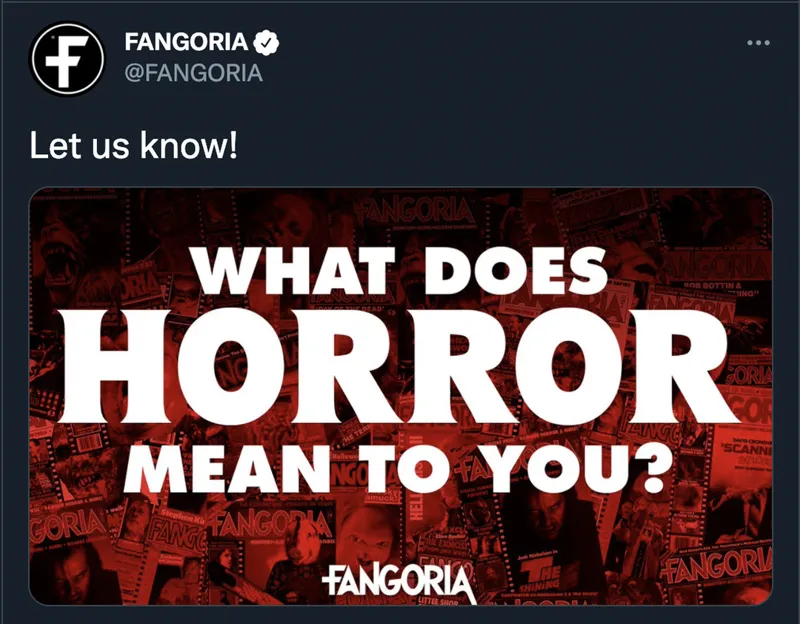
Fangoria, the world's most recognized horror focused print magazine, has been posting this on their Facebook and Twitter feeds. It's been something I've been asking myself recently. Why this lifelong obsession? When the world is on fire, things are terrible and terrifying, why do I find comfort in the genre of storytelling which concerns itself with scaring the hell of its audience, and plumbing the depths of the most terrible and horrifying?
Storytelling is how we work things out, how we make sense of things. We make sense of ourselves through the story we tell about where we're from and what we've done, what we've been through. We make sense of the world around us and the context we live in through history, a collection of events we form into a story about what came before us. Cave paintings about predators out in the wild were horror stories. The Greek tragedies are full of horror stories. Horror is part of the story of how we understand the world. Right now, the United States is collectively struggling with this exact thing. The story we've believed about our history is being revealed to have been lacking in accuracy (to put it charitably). As a result, it means an upheaval, a challenge to what many people have believed the country is and has been, and as a result, what their own story means in this context.
As a kid, horror was the place I got to engage with stories about people I understood, not so different from those in my life, facing things beyond what they could understand, and more often than not, surviving. Back then, I wasn't aware there never came a point in time when you could count on understanding the world around you. I wasn't aware the secret was that you just kind of accept how little you understand and fumble around doing your best. At the time, it was comforting. I might not understand the world around me, but I could make it through. I could understand the world through someone else's filter and start to learn how to see what I was supposed to do next. Horror was, at the same time, where I started to learn the adult world acted like they knew what was going on or as much as possible, avoided anything which put into perspective how little they really knew about what was going on, restricting their lives to have parameters where they felt somewhat comfortable in the belief they knew the rules and what to expect. In horror, people were terrified, but they kept going and if they kept going, the evil was vanquished (most of the time).
Horror also means community and friendship to me. It was about getting together with friends and either all getting scared together and then dissecting every detail of the how and why and what or having a good laugh at how terrible the films were. Some of my most memorable theater experiences involve being in a packed theater, and a few hundred people being completely absolutely silent as some tense scene unfolds and the collective gasps, screams or laughs when the moment comes filmmakers either release whatever horror it is we've been waiting for or give us something to laugh at ourselves over by faking the audience out. Action films can be rousing, and exciting which are fun in a group, but it's not quite the same. Comedy comes close, but to be honest, it's rare for me to find a comedy which speaks to my specific tastes in humor, and more often than not, it's the horror comedy which gets there. Standing right at the nexus of that which recognizes the horrible, but still celebrates the absurdity and often ridiculous in our reactions to the horrible is the variety of comedy I tend to enjoy, and you find it in horror comedy more than any other variety of comedy.
It was also the place where imagination didn't have a ceiling. Frankenstein was a horror story, but so was The Stand. Kafka's The Metamorphosis was as much a horror story as Night of the Living Dead or Brahm Stoker's Dracula. The only rules in horror were that whoever was creating whatever it was, they had to try to unsettle the audience in some way. It meant limitless opportunities for what one could tell a story about, how they could structure it. It could be as literate and classical as it could be punk and grubby, in your face, sneering at tradition and whatever "good taste" was supposed to be. As someone interested in writing and storytelling, this was extremely appealing.
Many of us are coming to be aware of a history that includes white riots in Tulsa, Oklahoma which killed hundreds of its Black citizens, stealing everything that didn't burn. Last year, the largest sustained protest movement in the nations history erupted as the history of police brutality and the criminal punishment system's stark racism was highlighted by yet another Black man being killed with a chilling nonchalance while it was filmed by a teenager. For many of us, the history of systemic racism is being revealed more and more. The revelations about mass graves at "residential schools" in the United States and Canada are adding new dimensions to the already horrible story of the treatment of indigenous people at the hands of white settler governments. We're being put in a position where we have to ask questions which are disconcerting, discomfiting and reckon with truly horrible aspects of our history we've been shielded from.
This speaks to what horror has come to mean to me as an adult. Horror is a reflection of one of the most beautiful things about human beings and human creativity. It's the place we go to ask the questions we don't have language for or that we're too afraid to ask directly. Horror is what taught me to look at more than just the surface and superficial. It's very easy to ask why something like Pier Passolini's Salò, or the 120 Days of Sodom or Pascual Laugier's Martyrs and ask why they exist. On the surface, they're repulsive, revolting, disgusting and horrible in the most fundamental sense of the word. It's easy to understand why the initial reaction to films like these is that self proclaimed arbiters of public morality would deem them dangers to society, without artistic merit, the likes of which should never be made or exhibited.
It's too easy though, isn't it? It becomes fairly obvious, relatively quickly, for anyone who is willing to take a little time and look deeper that it's very often the same self styled arbiters of public morality who aren't willing to engage with the reality of how atrocious human beings really can be and how the context we live has been shaped by this. What applies here is the cliche of the nearly circular Venn diagram of people who want the history of things like the Tulsa Massacre, mass graves of indigenous children and the history of systemic racism to be swept back into the abyss of ignorance and people who would find even the teaching about the existence of a films like Salò or Martyrs grounds for expelling whatever individual or entity had the gall to just alert students to their existence.
What's under the surface of films like these is what's important, and one of the beautiful things about human beings and creativity. The drive behind the creation of Salò and Martyrs is beautiful, no matter how ugly and repulsive the surface of the artistic creation is. The questions about how, why and who are an example of some of our best instincts and attitudes, and the way storytelling can expand our ability to extend our humanity to others. It's the willingness to look at these things which are so horrible, so disturbing, we can barely stand to look at them where they stand in reality and history. It's the attempt to be able to work these things out without an escape which shields us from how horrible they are, in the best way we can. It's Passolini and Laugier adding their two cents to the already established story we tell ourselves about these things, and the history of artistic exploration related to them. That impetus, to not just let the already established story protect us, but to confront us, in the service of expanding our ability to extend our understanding of the world and the parameters of our empathy, is beautiful.
The majority of us are never going to experience anything like what's depicted in films like Salò. We can watch something like Schindler's List and come away heartbroken, disconcerted, and closer to what we understand about very real horrors of the world. There's also a degree to which Schindler's List let's us off the hook though, isn't there? We can all imagine ourselves as Schindler. It's who we would want to believe we would be. Salò leaves us no such comfort. It fills in the gap between those saved by Schindler and those who weren't. It confronts us with the fact that we're not all going to be a Schindler or be in the kind of position he was. Many of us are going to be the guards in Salò, exactly the kind of idea we attempt to shield ourselves from. It also expands our imaginations to places we would never take them without being guided there. It takes us beyond the sense of moral outrage and moral shame of atrocities like The Holocaust, and it brings us that much closer to the depth of the terror, degradation and inhumanity which is the reality. Our minds and our bodies protect us from the being able to imagine something like it. Being presented with it removes this protection.
When you've seen Salò, the adventures of Jack Bauer take on a very different tone. It's not as easy to cheer on the torturing avenger, no matter the reason you've been asked to accept. It's harder to tell yourself the reason is good enough. When you read about Abu Ghraib, our ability to put ourselves in the position of the people at the mercy of their captors has been expanded. Our ability to recall or imagine something other than a self satisfied sense of justified vengeance or victory is challenged. Our sense of perspective is expanded in a way that goes beyond the moral and theoretical. It becomes something more visceral and emotional.
When you've seen Martyrs, it's much harder to uncritically accept superficial assertions about concepts of purity, and the reasons they exist and enforced, especially for women. It's much harder to accept claims about the ability to foist the needs of faith on people who haven't consented to beliefs of the same faith. It's much harder to push back a sense of what it is accept harm visited on the powerless for the needs of the powerful. How much of a difference is there between the patient facing death and/or suffering, denied care or treatment for the profit of a health insurance company and what Anna is subjected to for this unidentified group of very wealthy people looking to gain something from her suffering? Not much. Martyrs wipes away the socially acceptable excuses. In essence, it takes all of the middle men. On one end is the person being subjected to pain and degradation, on the other is the people who hope to gain something from it. What responsibility there is for people in between is placed in its correct perspective. It becomes much harder to accept claims about who needs to suffer, why and questions what benefit there is to suffering become much more real. If ever there was a film which puts into question what's beyond the assertions that our suffering makes us stronger and is therefore necessary, it's Martys, because it clearly takes those questions a step further to ask exactly who we need to be stronger for and why.
To sit through something like Martyrs is to have to be confronted with questions about how the bodies of indigenous children ended up in mass graves at "residential schools" in a way we aren't before we've been confronted with a film or other storytelling like it. We don't have to be prodded to go the step further than asking the mechanical questions about the physical circumstances. It makes the next set of questions inevitable. For what purpose? Who benefitted from this? How many people were aware of this? Simple answers aren't acceptable anymore. Scapegoats become much harder to pass off.
We don't walk away from films like John Q or even Erin Brokovich with the same expansion of emotional perspective as we do from something like Martyrs, even as they skirt many of the same ideas. Those films confirm our already existing beliefs, ideas and feelings. Martyrs pushes us beyond that safety, into a confrontation with those questions we wouldn't normally choose to have.
It's not just that horror asks these kinds of questions about systemic, social and economic power and violence either. It also the place we go to ask more personal questions about our daily lives and relationships we can't ask in the same way through other genres and mediums. We can take films like Hereditary, and The Babadook as examples.
Hereditary is a bruising, befuddling, emotionally battering exercise in confronting the audience with messy, difficult issues of grief, family, and the interweaving of upbringing and mental illness. How do we tell the difference between mental illness and inaccurate or wrong narratives passed from parent to child? How do we make room for the people we love when confronted with the all consuming immediacy of grief? How much of our self identity is shared as part of family? Where does the line between healthy self interest and harmful selfishness fall? It doesn't just ask these questions, it gives us the space to be able to know that sometimes there aren't any right answers. Sometimes we're not able to see all the factors contributing to what difficulties we're facing are. It puts us in the position to be able to see ourselves in the characters, and to also acknowledge sometimes these characters, and by proxy we, are sometimes hurting people we love as we're being subsumed by the pain we're experiencing. It doesn't leave us with simple, pat answers to these questions. It leaves us unsettled, with these questions unresolved, what we make of them ends up being up to us.
There are a number of similarities in The Babadook, but it puts us in the position to see some of similar experiences through the eyes of a single mother. What are the limits of what one person can shoulder in a deeply individualistic society, where our homes are the scope of our ability to support each other? How much room is there for people who aren't able to easily shape themselves to social expectation? What happens when these things collide? How much does the shared reality of a home shape our individual reality? If our ability to connect with and love each other isn't the thing which is going to pull us through, what else do we really have? Where do lines of responsibility fall for people who are experiencing mental illness? Where does the line fall for the rest of us to make room for people who have mental illness or are neurodivergent? How much of what we deem either mentally ill or neurodivergent is a response to our own shortcomings? Is expelling the things about ourselves which are difficult or threaten our well being the only way to deal with them or is there a path to making peace with them and learning to live with them as a part of our lives that doesn't have to threaten our well being? These are questions millions of people deal with and there are no simple, one size fits all answers for. Through a film like The Babadook, we get a chance to ask them with enough of a distance they're not loaded with the same sense of immediacy when we ask them about our own lives.
This is what horror has come to mean to me. It's the space we have to be safe in using creativity to ask ourselves and each other the questions we can't face directly. It's not about facing our fears, so much as it is going a few steps further and asking the questions our fears prevent us from asking, and being presented with the things we won't allow ourselves to face in reality. It's about challenging ourselves and each other, expanding the scope of our humanity in ways we can't by ourselves and using creativity to do so in ways we're least likely to harm each other in the process. It's about doing all of this in a way which is almost covert too, because it's done through the genre which is at the same time among the most aligned and taken least seriously. It's about some of the most important questions we can ask with narrative, and being able to do it in a way which people never expect, and therefore subverts already established emotional and psychological defenses.
Comments (1)
I'm always interested to read your examinations of horror as a genre because I've never been able to embrace it. It feels like most of my friends are fans so I find myself frequently needing to explain my opposition and the first thing I always say is, "it might be more entertaining if real torture didn't exist." It's never fictional or proximal to me because I always think, well this stuff really happens to someone, somewhere throughout history and for me it's a HUGE problem that this type of media feeds the appetites of real-life sadists. It's nice to read analysis of this genre that includes an eye toward humanity because I think I'm still a long way from believing that these realistic depictions don't desensitize us to real-life depravity and I can't help but find the newer interactivity brought in by gaming to be another layer of disturbing. Thanks for presenting undiscovered viewpoints - keep up the good work!