
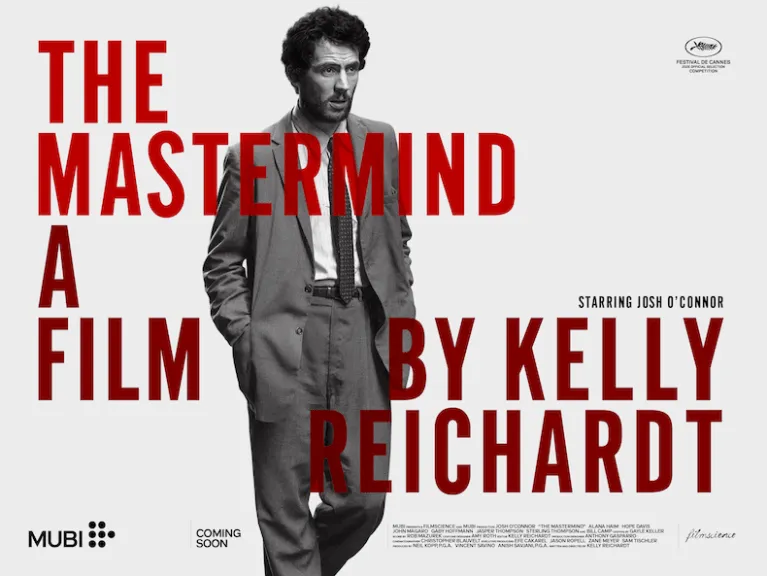
The Mastermind (Kelly Reichardt, 2025)
Kelly Reichardt is one of the unsung heroes of American cinema. Her filmography is an exploration of people who are on or near the margins, people the film and television industry don't usually have time for. Reichardt gives them time. Her films are contemplative, more interested in spending time with those characters than they are a zippy plot designed to excite social media musings and theories. They are films about people who want something more out of their lives, and either their path to deciding what that is or attempting to get it.
With The Mastermind though, Reichardt is looking at a slightly different kind of character. Not only is this a male lead, where the majority of her films center women, if he's on the margins of society, it's by choice, not circumstance. Set in 1970, The Mastermind follows Josh O'Connor playing James Blaine Mooney, a man in his mid-thirties who comes up with a plot to steal some modernist pieces from the local art museum. There's a self made desperation about Mooney. He comes from a privileged background, and yet, between conversations with other characters and what we see Mooney doing, there's a self destructiveness mixed with his selfishness. O'Connor is excellent as Mooney. Between Riechardt's screenplay and O'Connor's performance, JB Mooney has the feeling of dozens of people you've known.
He certainly fits with Reichardt's filmography in being a character looking for something better, but the question is, what exactly is better? There's a sense Mooney has experienced the unrest of the 1960s, and instead of adopting the collectivist instincts of a good deal of its counterculture, he seems to have adopted a "fuck the man" ethos to excuse whatever he chooses to do or not do, regardless of its consequences to those around him. There's a rebellion in what we see of JB, but there's also no sense he knows exactly what he's rebelling against. Reichardt inserts a number of scenes with newscasts playing in the background, but at no point does Mooney seem at all interested in it. It is just that, background in a number of scenes, noise that has no effect on him. JB Mooney's story, could have been told at any time, and the only thing that would have changed would be the technology he does or does not have to interact with in the attempt to commit this crime, the wardrobe and the vehicles. O'Connor simultaneously imbues Mooney with an awkward charm, conveys the way he's learned to use this as a manipulation, and the clueless nature of his selfishness. His awkwardness isn't a lack of social skills or intellect. He's not consciously attempting to con anyone. He's not demonstrably mean, nasty or abusive, but his selfishness is no less profound. The two people who seem to see him most clearly are women who've spent some degree of time in proximity to him, and in both cases, they leave JB with no illusions about the fact that they won't be involved in rescuing him from this latest debacle.
As is often the case with Kelly Riechardt films, there's a somewhat ambiguous conclusion. As much as anything else, this ending is what gives the film an interesting timelessness. It's an ending that fits for 1970. It could also have worked if the film were set in 2003, 2010, 2020, 2025 or what little of 2026 has passed. Reichardt pulls off an interesting narrative trick with this ending. Though it is a film which could be set in any of those years, it is also an ending about the degree time catches up with all of us. His obliviousness to everyone and everything around him, except for how they might aid him, is essentially a time bomb, ticking down to the moment the greater reality crashes in.
The film is beautifully shot. Though it's almost certainly digital photography, it recalls the warmth and color tone of the films of the sixties and seventies that are its obvious influences. In a way, it contributes to the sense of realism for the time period. We, as an audience, would never have seen a film from the period that looks more like traditional digital photography. It also has a classic jazz score that is easily one of the best scores of 2025. The unusual syncopation, making a horn the equivalent of the compositions lead character, the ability to mix the calm and cool with an underlying sense of tension... jazz scores like this one have been matched with some of the great crime and suspense films of all time for good reason.