
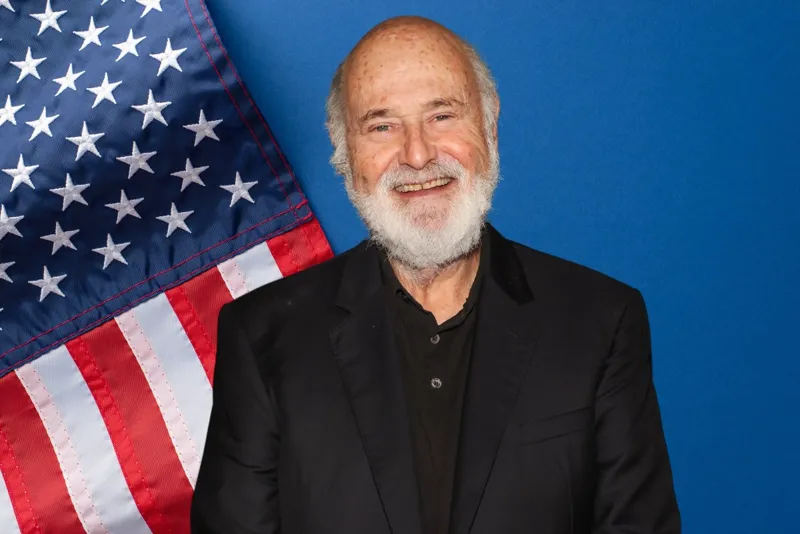
Rob Reiner (March 6, 1947 - December 14, 2025)
For those of us who came of age in the eighties and nineties, Rob Reiner was about as influential to our relationship to film and culture as Steven Spielberg, George Lucas or in the case of us horror fans, Wes Craven and John Carpenter.
That might seem like a hyperbolic claim, at first. Reiner didn't direct any of the major "blockbusters" that defined and shaped the business of film for basically the entirety of our lives. He did, arguably, direct one genre defining masterpiece that is still being slavishly imitated today, Spinal Tap. The Office, What We Do In The Shadows, Abbott Elementary... the history of the mockumentary is completely different without Spinal Tap. It demonstrates the genre has the ability to knit itself into our culture and language. It makes it accessible and acceptable to the mainstream. It was successful, financially, as a cheaply made independent film, but unlike Star Wars or Jaws, E.T. or Raiders of the Lost Ark, rarely is there mention of its financial success.
Bringing up the box office numbers where those other films are concerned is always part of talking about their impact. They're used as evidence of just how widespread that influence is, on the movie business, and on culture more broadly. You don't have to bring up box office numbers when you talk about the impact of Rob Reiner's films though. It wasn't necessary. You just had to know people talk. I knew half the punchlines from Spinal Tap before I saw it, because it was just part of the lexicon. It became part of how people communicated. It wasn't just some weird uncle, counter culture obsessed uncle who referenced it regularly either. People my parent's age and the older siblings of friends were as enthusiastic about telling me I had to see Spinal Tap as they were about Star Wars, Citizen Kane and Casablanca. And Spinal Tap it wasn't just theirs either. After a certain point, Spinal Tap became part of the language of my generation as a result. It could be quoted in conversation as a shorthand, without missing a beat, and we all knew what the person who'd used it was getting at.
As a teenage boy in those years, if someone pulled up with a newly installed sound system in their car, rattling through the stats of wattage and amperage, I could look at them and answer, "So, what you're saying is, it goes to 11?" and what I was communicating was understood by everyone who heard it.
Spinal Tap wasn't the only one of his films to do this either. It's possible there is no other piece of media that is as responsible for making the female orgasm an acceptable a topic in "polite conversation," meaning it stopped being something that had to be spoken of in hushed tones or angry shouts. "I'll have what she's having," didn't become so immediately recognizable just because the scene itself, in terms of comedic scenes in films, is practically perfect. It became part of the lexicon because it described something much bigger, in a way people could handle, and because it works that well as a scene. Maybe it didn't exactly reveal something new, because there had been plenty of women talking about women's experiences with sex in media of different kinds already. The sexual revolution of the sixties and seventies had introduced that, but that scene did reveal the ridiculousness of our inability to still talk about sex like rational human beings, in a way we could all laugh at. It made no bones about how absurd that is, without skirting the ugly part of the reality, that the desire to experience pleasure during sex had been cordoned off as a territory only men were allowed to traverse, in a way that made the absurdity undeniable. The mockery highlighting that absurdity though, was undeniable because there was also warmth in it. It was laughing with the audience, not at them. It was such an effective, undeniable scene, that the cultural reaction when the likes of Jerry Falwell (whose "Moral Majority" was a genuine political force at the time), tested the waters to see if that scene was fertile donation fodder, they were mocked. Unless you were born and raised at the televangelist teat, they were either going to laugh with us or they were going to get laughed at. It was Nora Ephron's writing, Meg Ryan and Billy Crystal's performances, but understanding why it was funny, knowing how to make the most of the joke, and going for it 100%, says a lot about who Rob Reiner was, as a person and an artist. Whether or not you'd even seen the movie, you knew what it meant when someone said, "I'll have what she's having," and the pop culture segments on every talk or news show were talking about women's orgasms, on network television.
You can write off When Harry Met Sally as another saccharine entry in the rom com genre, but acknowledging its larger illuminates this as shallow.
Stand By Me also crossed the generational barrier, and brought a different important idea to a point of undeniability. It was released in 1986, in the midst of the Reagan years. "Make America Great Again," can exist as an idea because of the mythology of Reagan era America. It was when the fifties became conservative America's Valinor, Valhalla, and Avalon. If you think Reagan's ubiquity as a young actor in the years of the western dominating television and film in the fifties, his campaign's reliance on the iconography of the cowboy and a "law and order" platform aren't related, I would like you to please contact me immediately about an opportunity with this new, life changing investment called the NFT.
Reagan and the conservative coalition his campaign stitched together created the mythology of the fifties as a past utopia we could return to. Part of doing this, was appealing to a time when the Boomer generation could remember the world feeling simple. It was a black and white world, in more ways than not. It was black and white television shows, with simple answers about right and wrong, a whole social order unquestionably delivering happiness and contentment, by bringing everyone an existence where roles were clearly, easily defined. If there were people of color at all, they were either comic caricatures, there to serve the protagonists, providing audiences with a laugh once in a while or a way for the protagonists and the audience to feel good about their idyll musings about the unfairness of the world. It turned the experience of the fifties from an actual experience and a time where records and documentation could tell us what was happening, to a kind of mass false memory of everyone being Wally and the Beav, watching westerns on television.
Stand By Me, in the midst of all this being cemented, was a rebuke to that idea. It portrayed a fifties that was no utopia. It's often referred to as one of the great "coming of age" movies, but it rarely gets its due for being a film that like the way When Harry Met Sally undeniably injected the idea of women's sexual pleasure into a new cultural context, Stand By Me cut a giant hole in the efforts to turn the fifties into a narcotic. For those of us who were kids, we loved to see The Goonies or E.T., so we could see ourselves as being the heroes, riding around on our bicycles, having adventures and beating the bad guys. Even with those films representing pictures of parents mired in the reality of Reagan's America, for a lot of us, Stand By Me represented part of our reality we hadn't seen on screen much and it was a reality from our parents childhoods. There were Ace Merrill's in the world, long before Michael Meyers, Freddy Krueger and Jason Vorhees. Stand By Me couldn't have so truthfully represented them if there hadn't been.
The news and the world of adults were constantly droning on about the way media was affecting us, as if we couldn't recognize right from wrong in the most basic fashion, and as if we couldn't tell reality from fiction. Stand By Me was a reality from the fifties a lot of us could recognize though. It was painted in a certain degree of sentimentalism that accompanies nostalgia, but it was a bittersweet nostalgia of maturity, not a narcotic meant to blot out the reality. In the same way that The Black Phone cut through today's narcotic version of nostalgia to present a picture of childhood in the seventies and eighties that reflects the truth of its violence, Stand By Me reflected the violence and horror a whole lot of us experienced or lived with on a regular basis.
People, towns and families had been being shuttered out of access to the American Dream before we were even born. The results, including the inability to admit or address it then, weren't so different from the results we were experiencing. The news in the eighties and nineties was saturated with stories about violence "in the ghetto." Those of us who recognized the experiences of the kids in Stand By Me knew that violence had no borders, and that angry, lost, resentful, violent adults produced angry, lost, resentful and violent children, especially when those adults were men and those children were their sons we had to coexist with, somehow. Seeing the body of a dead kid wasn't the totality of the loss of innocence that made Stand By Me so bittersweet. That the movie was focused on a cast of white kids, to whom this violence and its consequences were native, stood as evidence against the racist narratives presenting violence as something only "those people," so often portrayed by Black or other people of color on television and in film then. It presented evidence this violence, especially violence among youths, wasn't an exclusive product of "the ghetto" as the news and current events commentary suggested. It was the recognition that mortality was something a whole lot of kids have to contend with long before the world of adults claims to believe they should, and the adult world was just too busy, for a million reasons, to do much about it.
Rob Reiner didn't just chatter and yammer about the truth as a person with a platform that made his voice large enough to reach a large audience. This can always be swatted down, pushed aside and more or less ignored. He used storytelling to make truth undeniable in a way that permeated culture. "You wanna see a dead body?" became suffused into our lexicon, because of the truth made undeniable in the film that originated it. It may have been a story by Stephen King, and Keifer Sutherland may have been superb in bringing Ace Merrill to life, but Reiner understood why any of that mattered. He understood why The Body, King's original story mattered, and why it should be made into a film being released in 1986.
If people like Stephen King and Rob Reiner could have enough experience with that truth to be so able to deftly portray it, it meant there was a way to survive that violence without it breaking you, and it wasn't only by lying about or ignoring it.
We changed the way movies and television are written because people like Rob Reiner instilled their work with truths in a way that become part of how we communicate. The degree to which Spinal Tap, Stand By Me, When Harry Met Sally, Misery, The Princess Bride and A Few Good Men reveal and remind us of truths, good and bad, causes them to become part of our language. Dialogue infused with pop culture references has the ring of truthfulness because of this. We call it "meta" now, but one of the things often lost in those conversations, and lost on writers who use it as a cheap way to try to get their audience to buy into their characters, is that the things that become part of that lexicon do so because they are part of works that speak truth.
Reiner was a loud, opinionated artist, of very humble artistry. The culture around film is obsessed with directors who infuse their work with a recognizable style, and if there is a recognizable style to Rob Reiner's works that have been so influential on culture, it was that dedication to Truth.
As a writer and someone who loves the narrative arts, I can't really think of a better legacy to aspire to, than being remembered for telling the truth in a way that undeniable.