
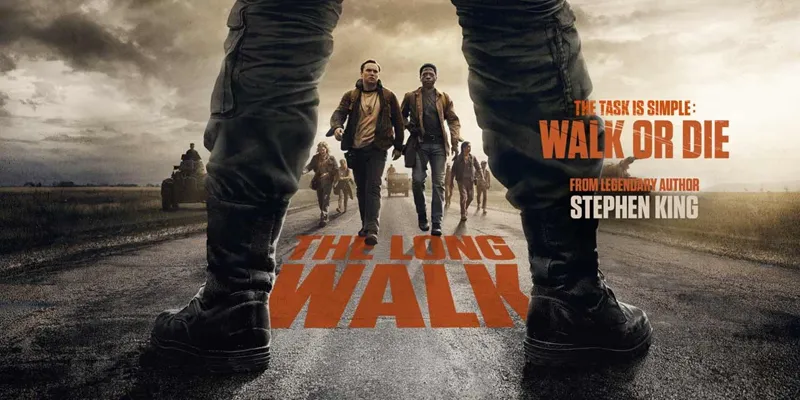
The Long Walk (Francis Lawrence, 2025)
[Note: I don't spoil any specific events in plot of the film here, but I am talking about it in a way that describes and details its thematic bent, which may be more than some would like to know ahead of viewing The Long Walk. The plainest thing I can confer is that it's worth seeing, and thematically interesting.]
The older I get, the more appreciation I have for the fact that genre storytelling, at its best, takes a simple premise and through the telling, expands it into something more artful and more truthful than its premise would suggest possible or probable.
The Long Walk is an honorable example. Based on an early Stephen King novel (written under his then pseudonym, Richard Bachman), it is one of the more straightforward examples, like Carrie, of King's talent for taking high concept genre premises and making them something more honest and truthful. On the surface, The Long Walk is a story about a dystopian society, staging a brutal display as simultaneous distraction from and reminder of the depth of its willingness to use brutality as a means of social control. The film follow fifty young men, who've entered a lottery to be part of this competition, being broadcast throughout the nation. It is called, The Long Walk, because that's exactly what it is. They walk until there is only one left. The victor is rewarded with riches and any wish that isn't a direct challenge to the political and social order. The forty-nine others won't survive.
The idea of the walk, trudging, the idea of just putting one foot in front of the other on the journey of life, is a metaphor so well worn, so overused as to have surpassed the description of it as trite or cliché. Every street corner preacher or dime store philosopher has used it. It's easy to understand why it would be easy to dismiss. I didn't make a point to see it in theaters, in all truth, because even being familiar with the source material, I didn't have much confidence it would translate well to the screen. I was wrong.
There also is a perception among those who haven't engaged with King's work that his genius is simply for the scare, the grizzly, the things in the darkness. This isn't completely unfair, as there is genius in his deployment and understanding of them, but this has always been the less prominent ingredient in inspiring millions to be consistent readers of his work. King's real genius has always been in his drive to reveal the darkness of human nature, the way we organize ourselves and societies, and to contrast them with what we recognize as the light and beauty of human beings and being human. His catalog is full of characters who are decent people, who are often deeply flawed, realistically trying to do the best they can, no matter how terrifying and fantastic the situation they're facing. King's horror, unlike what detractors of the genre as a whole would believe, finds the enactment of cruelty and engendering of despair as the truest evil in the world, whether its source is human or otherworldly. In more ways than not, he's been a champion for, and chronicler of, the degree these confrontations reveal the greatness within the average person, because of their dedication to a sense of dignity and compassion. His heroes are not made of unusual stuff. They're average people, who choose the good fight, because they'd rather die than live without the dignity of choosing otherwise. This is the real source of King's popularity, the foundation for the dedicated fandom around his work. We can look to novels like Carrie, short stories like Apt Pupil, to reveal he doesn't look on those who lose this battle within themselves, give in to this desire for cruelty and creation of despair, with too self righteous or mean spirited a perspective either. When characters do lose this internal battle, it is a tragedy. It is as much the result of being human as those decisions which raise his characters to heroism. There is never a victory in choosing to enact cruelty or engender despair in a Stephen King story. In his work, the way this internal decision informs how they choose to act in the face of terrible and terrifying options is the source of all heroism or tragedy of human experience. There is an honesty, truthfulness and compassion to his understanding and portrayal of how we make those decisions that makes him the writer he is, with the impact on culture he has had.
This is true of The Long Walk, which is what elevates it beyond the realm of cliché, making it something more than the word pulp is generally associated with. Like mammals, pulp comes in all different sizes, shapes and temperaments.
Francis Lawrence and the team who've brought The Long Walk to the screen seem to have a solid grasp on this, because they understand the elegance of the premise's simplicity is the source of what allows for a more interrogative kind of storytelling. What results is a deceptively nuanced, complex examination of the necessity for hope and a sense of awe as tools for survival in a world where cruelty is cheap and easy. They understand the power of the story is in the fact it isn't the stuff of trite truisms, dismissive in the way of what we now call toxic positivity, an emotional narcotic too many films and novels deal in. Nor is it something which one naturally comes to by either magic or genetic inheritance. It a choice, behind which one must put effort and determination. It is hard won through the individual desire to preserve our dignity, but it can't be won alone, and it can't be preserved through willful ignorance of the need to defend it when the breaking point is reached.
The Long Walk demonstrates this by following the perspective of Garraty, number 47, (Cooper Hoffman) and McVries, number 23, (David Jonsson) as they begin this trek with forty-eight other young men, the interactions and dynamics which grow from it. Through the run time of the film, the characters we do get perspective on, who have some level of interaction with Garraty and McVries, inform each other. The characters who choose to find their sense of dignity, their sense of who they are, in something other than the degree they are in competition, last the longest, because of that choice. At first, this seems incongruous, given the nature of the competition. But it's through the depiction of the sense of solidarity and the conflicts these young men create and experience, how those are rooted in the circumstances of the world outside of the competition, the film demonstrates the artful nature hidden beneath the simple premise. There is both madness and inevitability in these characters attempting to preserve their sense of dignity in these conditions, depending on what they've founded that sense of dignity in.
There is a winner, but there isn't a victory. In the end, the ability to find hope and awe, a sense of beauty or joy in the moment is key to being the winner. It's a direct contributor to survival. There wouldn't be an ability to persevere without it, but the journey can only be continued with dignity, a sense of self intact, by realizing and accepting when the time has come to face the agents of the cruelty and despair that shape the world, including but not limited to, this competition that is The Long Walk. Anything else would be a betrayal of everything that's come before, and everyone who made preservation and survival possible.
There's an uncanny, subtle honesty to the way all of this is woven together, and in its ambiguous ending. It is victory and defeat, simultaneously. It's survival, yes, but it's more than that too. In the end, it comes what one must do to preserve the ability to live with one's self in the continuation of the journey. It is equal in being as intimately personal as possible, and grand act of higher principle, depending on the perspective of the those who witness it.
It is very easy to imagine a film based on this same premise and novel becoming monotonous, especially but not only, in the visual sense, but it never does. Filming on location, as opposed to a sound stage, is crucial to this. Director Francis Lawrence and Director of Photography Jo Willems use changing landscape, changing weather, time of day, to preserve a consistently interesting evolution of image. It strides the line of realistic and stylistic in a way that the overall image quality is excellent, in terms of use of color, presentation of color, shot composition and the like. Again, subtlety is key here, as there isn't anything showy or flashy to the approach, but there is a sense of scale, depth and contrast too few films not relying on pure visual spectacle lack. In truth, even some of the todays film reaching for visual spectacle lack this basic visual understanding. Lawrence and editors Peggy Eghbalian and Mark Yoshikawa, insure the pacing never lags either.
Cooper Hoffman and David Jonsson are charismatic, believable, and excellent in their lead roles. The contrast between their personalities, as well as the degree they compliment each other feels natural and earned. The supporting cast all contribute respectfully to creating a compelling, interesting story and viewing experience too. This isn't the kind of film which afforded anyone, in a lead or supporting role, an easy, breezy job as an actor. All of them have moments which could have, but didn't, detract from the overall impact of the film.
My single gripe, related to casting, is that casting directors need to put Judy Greer in meatier, more expansive roles. She's a damn fine actress, always compelling to watch, no matter what's being asked of her in the role.
I'd add Francis Lawrence to the relatively short list of directors who are adept at bringing Stephen King's work to the screen, and I'll be taking the journey of The Long Walk with Garraty and McVries again, I'm sure.
As of now, The Long Walk is available via Video On Demand. I would suggest consulting justwatch.com though, as it may be available on a streaming service by the time you're reading this.