
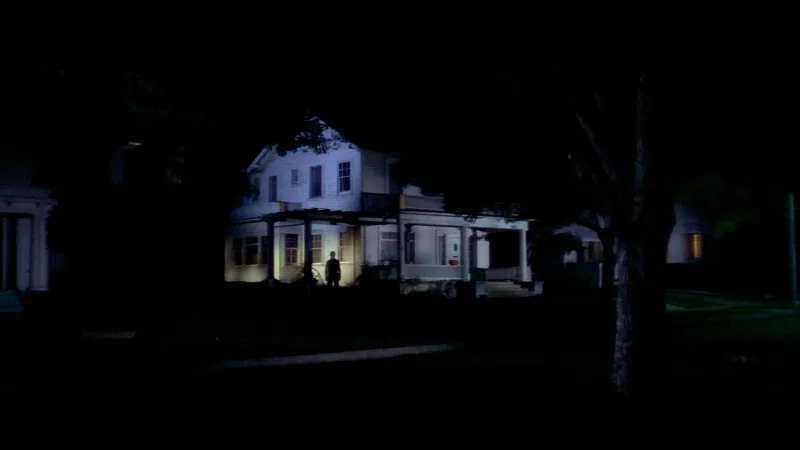
John Carpenter's HALLOWEEN, The Suburban Utopia Mythology and Satanic Panic
NOTE: There will be no attempt to avoid spoilers for the 1978 Halloween.
On the surface, John Carpenter’s Halloween is an elegant, stylish, low budget horror film. It's charismatic cast, and an iconic villain help it achieve a level of financial rare for any low budget film. More than forty-five years later, it is still influencing new filmmakers, still resonating with new audiences as they discover it. When we consider that it’s an original screenplay and story, not based on a previous literary work, this puts it in a very small class of horror films. It inspires thousands of imitators, becoming a sub genre unto itself within the broader horror genre. The horror genre births hundreds of low budget films every year. For just over forty-five years now, a question has hung over it's success and continued influence, "Why Halloween?"
If we want to understand why this film has such a depth and breadth of cultural permeation, we can start with the fact that it's well made. Low budget or not, John Carpenter's formal approach to storytelling on film, the talent of the team he worked with, along with his grasp of how to craft suspense, creates an experience audiences enjoy and are looking for in a horror film. This would explain its initial success. It doesn't explain its staying power. To understand this, we have to ask the question, “What is it speaking to in audiences?” Looking at the history of the horror genre broadly, we can find films that have the depth and breadth of impact Halloween has is a result of speaking to some over arching set of sociopolitical fears or anxieties. The most often used example is the atomic age, when fears about nuclear weapons and new technology permeated society, resulting in a decade of speaking to or from those fears.
Halloween was, for a long time, lumped in with the tens of thousands of films that imitated it (Friday the 13th) or imitated films that imitated it. By placing it in the context of its time, meaning both what has lead to the period it's created and released, as well as the period of time follow it, we can see the ideas and fears its symbols speak to. The story of Halloween's creation has been become part of the lore of horror fandom, as has the story of its initial success, and the careers it spawned. There’s been some recognition that it’s among the earliest films to use the suburbs as setting, but not much exploration of what that means for the audience, in terms of the sociopolitical reality it speaks to and what audience fears its speaking to.
I am not suggesting John Carpenter and Debra Hill conceived Halloween as a "political movie" in the way the phrase is used today. They have both clearly and repeatedly stated (though to our collective loss, Hill passed away in 2005), it is a film conceived with the intention of making as good a suspenseful and scary film as they could, based on the simple concept of babysitters being stalked and killed on Halloween night, within the confines of a limited budget. The idea about someone stalking babysitters on Halloween, came from producer Irwin Yablans, who was just looking to get a low budget horror film made that would produce a profit. Hill and Carpenter wanted to make the best film they could, out of both artistic ambition, and the desire to be given the opportunity to make more movies. Yablans was looking to make some money. Despite whatever lofty artistic philosophy some of us might have or want to expect from filmmakers, this combination of goals and ambitions has produced some of the most influential films in the mediums history.
I am suggesting Carpenter and Hill, being in their twenties at the time, were people influenced by the time and place they existed, as is true of any storyteller. There is a kind of alchemy in the process of telling a story, where the sociopolitical reality that of their environment influences the storyteller, who in turn creates symbols that speak to it, intended or not. Because the audience shares that reality, they respond to these symbols, and the story they tell. We know from both of their careers, and interviews over time, Carpenter and Hill were aware of the world around them. They were not apolitical people. Later in his career, Carpenter goes on to make a few explicitly “political” films, They Live, Escape from New York, and Escape from LA being the most obvious, so it’s not a stretch to believe an awareness of sociopolitical reality, and a desire to think about and comment on it is part of who he is as a filmmaker, even if Halloween wasn’t conceived with that intention. For her part, many people who worked with Hill have confirmed her to not only have been a person deeply aware of the people around her, but the greater world outside filmmaking, and she also goes on to produce a few films with more explicitly political content, including the Escape films Carpenter directs.
Halloween, when we look at what the characters symbolize, and the way the story uses them in the context of the time it is created and released, emerges is an indictment of mythology of the suburban utopia. This myth is created directly following WWII, and it quickly becomes the the dominant, central mythology, not just in US pop culture, but essentially in US national identity. It grows from the overlap of white supremacy and Christian patriarchy, that we would now refer to as white, Christian nationalism. It's important to understand, the suburbs are created from this mythology. This mythology doesn’t spring from the suburbs, after they’re established, it is the mythology they are established to attempt to make or to shroud reality, depending on your perspective. They are the promise of a social order that will provide safety, material security and stability, without people of color or any other group this white, Christian patriarchy holds as Other. It extends immediately into pop culture and mass media because there is a newly exploded population of a white middle class, who can afford to own homes, and as importantly, have other expendable income. As a result, the television enters nearly every home in the nation, with surprising speed. Because of this new ocean of expendable income, the funding model for television dictates this suburban middle class is the audience it most needs. The funding model for television dictates they are the primary audience, and what emerges is programming and advertising that supports the mythology this new white middle class has moved to the suburbs to experience. It solidifies, quickly, as the suburban mythology we can still recognize today.
It is a myth which presents the home, and very specifically the “traditional, nuclear family” as the fount of safety, security and stability. It is, within this mythology, the only source of these things, in the sense that there aren't representations of other "modern" units of primary social organization in pop culture or mass media. It cannot be overstated how important racism is to “safety” as a sociopolitical concept in the US framework. Our political and social structures are built to recognize this "nuclear family" as the primary unit of social structure The conservative Christian perspective, presents the father as the final authority and disciplinarian. Representations of this in mass media, until comparatively recently and with few exceptions, are absent of people who do not fit the white, Christian nationalist vision of normalcy. It has been white, Christian, straight, cis and able bodied, with very few exceptions. This was the dominant perspective and portrayal of American identity, as late as the 2010s. To understand this mythology, it has to be understand that suburbs are a response to the combination of The Second Great Migration, the Civil Rights Movement, the Supreme Court decision, Brown vs Board of Education. They are the destination of “White Flight” which was a period of this white, middle class Americans leaving cities in response to the growing Black population in US cities, their demands of that population for equality, including but certainly not limited to, the integration of public schools.
In the sixties, the suburban utopia myth comes under scrutiny, in part because feminism starts to find footing in the national consciousness, and directly challenges the gendered aspect of the social order the suburbs were created to maintain, and is central to this mythology being presented as utopian. In part because this newly minted middle class has had the economic ability to provide education and leisure, a larger percentage of women and girls start asking questions about exactly why they might be willing to subscribe to the narrow and restricting gender roles this suburban utopia mythology requires, in relation to their experience with them. Basically, you have a new generation of educated young women whose interests expand beyond simply finding a husband and making babies as soon as possible, and they have time to talk to each other, share their experiences and ideas, without the pressing necessities of domestic duties or the looming threat losing their social status should they be found doing so. They are also aware that suburbia is not a utopia, because they have experienced its reality.
By the seventies, feminism has permeated the culture thoroughly enough that a body of research into its claims exists. What that research shows thoroughly undermines the mythology of suburban utopia. This research provides a body of evidence showing surburbia is not a bastion of safety, security and stability. Particularly, a new body of research reveals domestic violence, sexual violence and child abuse are committed by men known to the victims at rates that are undeniable. These are not, as popular imagination had held before, problems of “Stranger Danger." The threat to social order, as this suburban myth held, is from people of color with some sense of racial grievance, who are most dangerous to white women and children. This new research provides overwhelming evidence the source of danger to women and children is their husbands, brothers, neighbors, sons, pastors, and other men who are known to them, and this holds true whether its cities, rural areas or most importantly to understanding Halloween's continued appeal, the suburbs.
Feminists recognized the depth of disruptions this presents to social order, but many underestimated the threat it presented to the sense of national identity. They also didn't have the luxury to ignore the ferocity of response to that disruption. Their critique of mass media on the whole is supported by the evidence, though because of the nature of art and storytelling, it's often hard to delineate where a particular work stands in relation to feminism and the necessary disruption it causes. Halloween is as successful as it is, and continues to exert influence today, not because it was a reactionary response to feminism from a patriarchal perspective, but because it takes the evidence revealed by feminism's claims and applies them to this suburban story. It is taking the evidence of the research resulting from feminism's rise as fact, and demonstrating the suburban mythology is exactly that, a mythology with little relation to reality. By definition, it is an indictment, and assault on the myth of suburbia that was at the heart of American identity, and that we are still wrestling with today. Whether or not it is a "feminist film" is another question, but it does take feminism, its claims and what it unearthed seriously, and is speaking to the reality that inclusion of that evidence reveals.
If we take one of the cultural phenomenons that comes after Halloween’s release, we can see how potent the symbols the film is using are in the way they speak to the collective consciousness. The Satanic Panic is a response to many of the same conditions Halloween is speaking to, but where Halloween is an indictment of the suburban mythology, Satanic Panic is a kind of manipulating threat, a fantasy warning of the illusory dangers of departing from following that mythology, especially in it’s attempt to create a kind of psychic, emotional punishment for women who have decided to find some level of meaning and fulfillment outside of the patriarchal roles within the suburban utopia mythology.
It is possible to look at Laurie Strode, the protagonist, as the product of feminism. There was, for a long time, a critique of the slasher sub genre broadly, holding that is a sub genre of reactionary response from the white, Christian nationalist point of view. This is based in the way the sub genre treats the female characters who violate the gender norms that worldview requires. The victims are young people having premarital sex, drinking, doing drugs, while making a particularly prurient display of punishing young women who violate those norms, by committing sins like having strong opinions about things, and being sexually independent. This anti-slasher feminist perspective holds that Laurie Strode survives Halloween because she's not engaging in these behaviors. If we look at Halloween as being set in the suburbs where this conflict between feminism and a white, Christian sense of identity is the primary battleground over national identity, there's another way to look at her character as well. Both John Carpenter and Debra Hill always held Laurie's survival is a simple factor of observance. Annie and Linda's focus and attention is on the men in their lives, their boyfriends. Laurie's is elsewhere. There is a way to read Annie and Linda's focus on the men in their lives as part of their being in concert with this suburban utopia mythology. The defining relationship we see Laurie have is with Annie, and we see the level of pressure Annie puts on Laurie to find a male to dedicate her time and attention to. This would square with the pressure for conformity that is part and parcel for maintaining suburban utopia myth, because it can only be maintained if the perspective is narrow enough, anything outside of it is either rendered invisible or punished. It is possible, in this way to read Annie and Linda as being victims because of their desire to center proximity to men in their lives.
Laurie is the only one of these teenage girls whose sense of focus and identity isn't tied to a male in her life. From what the film provides, her focus is in academics and economics. She is presented as a caregiver, making money babysitting, and caregiving is a traditional role in the white, Christian nationalist worldview, but it's also true this was a non-professional job available to teenage girls at the time, and Annie at one point says, "You must have a small fortune saved up from babysitting," which also suggests Laurie isn't frivolous with her money in other ways either. One of the advances feminism does achieve is widening the belief that education can and should be a vehicle for women's independence, intellectually and financially. In the feminist view, women seeking degrees should be taken as seriously as their male counterparts, and not treated as being on campus to attain their "Mrs." It also become clear by this time, through the research on domestic violence and child abuse, that the lack of financial independence the suburban utopia myth creates, means many women are essentially trapped in proximity to men who abuse them and/or their children. Laurie can be seen as a character dealing with the reality of still living a place where this suburban myth is dominant, and doing her best to put herself in a position to have the variety of independence mainstream feminism was advocating for. In this reading, Laurie's survival is the result of having internalized the feminist perspective, and taking practical steps to achieve that independence, and not putting so much focus on being in proximity to a man. If there is a sense of Annie and Linda being subject to punishment, in this reading, it's because they have chosen to make proximity to men the center of their attention and actions.
The degree to which Satanic Panic, just a few years after Halloween's release, is a reaction to this change in focus feminism encourages and attempts to create social, political and economic space for, cannot be overstated. Serves the purpose of undermining the desire for any independence that doesn't conform to the standards of white, Christian nationalism, and by extension, to preserve the suburban utopia myth as the primary source of national identity. It is the central point from which all of Satanic Panic springs.
I’ve written previously about Michael Myers becoming an iconic character with the depth of permeation he has in culture, because he is a symbol of the fear of the violence borne out of masculinity. I contend it is a fear we all have, and it’s not relegated to women specifically, though feminism and feminists were the first to push into the national consciousness that it is something which has sociopolitical roots. This then suggests there can be sociopolitical solutions and preventions. The way the Michael Myers is presented in the film, allows him to be both anyone and no one, similar in many ways to the way we have conceived of, and avoided investigating, the violence that comes from the concepts of traditional masculinity. The inclusion of a mask, a concept which has its own symbolic meaning. Depending on the context, it can be to reveal or to hide the "true self." There is the fact that the mask is recognizable as male, but not any man simultaneously. It’s a man, in a mask of any man and no man, at the same time. The formless coveralls, which suggest a connection to pursuits then (and still) associated with masculinity. The lack of speech symbolizing a repression of expression. The only expression we see from Michael is violence or the involuntary grunts of pain. The lack of a clear motive, but his actions hint at some sense of obsessive possession of the women who are his fixation, first his sister, and then Laurie. The stalking as a means of intimidation and discontenting. The targeting of the people he sees her with, as if there is some retribution for her attention being given them. The fact that men are no less safe from the violence of whatever this internal logic we can only see the vaguest outlines of. The degree of performance and presentation he engages in. Michael could be any man, and what we see from him in the film has emotional and psychological connections to what was being learned about the reality of violence against women and children.
Michael is both known and unknown to the characters in the suburban town of Haddonfield. He is, after all, one of its sons. He is also white, which assails one of the foundational assumptions of suburban mythology as it was established. It is not the presence of people of color or queer people or a member of any group Othered by the white, Christian nationalist perspective that authored that mythology. He’s a white guy, with his own reasons for killing people, whether or not those reasons conform, and crucially, does not conform to those patriarchal norms. In this mythology that creates the suburbs, there is no accounting for Michael Myers. It requires this internal violence be invisible, and the illusion of an external threat be primary.
Michael is also a thing of folklore and myth to the residents of Haddonfield. If we consider the first film alone, without the hackneyed attempt to suggest Laurie Strode is Michael’s sister (which comes along in the sequel, Halloween II in 1981) there’s only the vaguest sense of a motive. There is a sense of logic, but it’s not one we really understand. Why does Michael go through the trouble to take headstone of the sister he murdered fifteen years before? It is a consequential amount of effort. Why set up this grisly funhouse of horrors for Laurie to find? Again, there is forethought and effort evident in the fact that it exists. Why is he making the fact that he’s stalking Laurie known to her, at all? Why did he come back to Haddonfield, at all? It is, in many ways, similar to our understanding of the violence of masculinity.
It mirrors the sense of masculine violence we live with. There’s a vague shape of an outline of reasoning, but because we have resisted in depth research and discussion of masculinity as one of the primary sources of this violence, we don’t have too strong a grasp on it. It's a hole where a more coherent reasoning should be. We know it exists, and it is dangerous, it does not particularly care about who its victims are. In our real lives it will give any number of a thousand justifications, to the degree all justifications are rendered meaningless. They become a kind of veil or mask themselves. In 1978, this had gone from apocryphal folk knowledge which women might speak about amongst themselves and men might feel instinctively, to solidified, researched fact accepted by social and political institutions. It was the beginning of the acceptance that many more men than we'd previously been willing to believe were violent, and those who were, rarely presented themselves as violent men, outside of the home or proximity to their victims. They hid behind the characterization created by the myth of suburban utopia, essentially as a costume and mask.
Satanic Panic will come later, and assaults this recognition of just how much violence and abuse women and children are facing in the home, by essentially trying to obscure it and distract from it. It creates an illusion or what's better described as a mass delusion, suggesting what results from the growth of women's independence is the source of the real danger to children. It is locating that danger in the industries which are providing the childcare that the mythology of the suburbs requires as one of women's primary roles. Halloween is presenting Michael Myers as a symbol of the violence of masculinity within the suburban setting, and Satanic Panic is an attempt to create something more frightening, more immediate and more inescapable to distract from the reality of the violence of masculinity. John Carpenter and Halloween present Michael, in being a symbol of masculine violence, as the real bogeyman that does actually exist, as opposed to the bogeyman that was a vague jealousy from or inability to control their baser desires from people of color. Satanic Panic tries to create a modern fiction based in the mythology of white Christian nationalism to overshadow this man shaped violence, with Christianity's ultimate bogeyman, Satan and the supposedly vast network of servants he has.
We can look at the characters of Dr. Loomis and Sheriff Brackett as symbols of institutional authority. Loomis represents the institution of medicine broadly, but specifically and importantly, the field of psychiatry, and by extension psychology. Sheriff Brackett obviously represents law enforcement, but it’s also important that Brackett is the only parent with any real role in the film. We see Michael’s parents for a few seconds, as the opening scene concludes. We get an even shorter appearance from Laurie's father, and then he's gone from the film completely too. Brackett represents both law enforcement, and the patriarchal father figure.
Despite the gravitas Donald Pleasance gravitas that his presence and performance brings to Dr. Loomis, if we look at the film as it treats Loomis and Brackett, they are ineffective to the point of near uselessness. Three people are murdered, while they’re bumbling around in the bushes. Both Brackett and Loomis somehow don't see the station wagon with the logo of the Smith’s Grove Sanitarium on it, sitting in plain view on the street, less than one hundred feet away. This is seems to be an oversight in the script, that creates an issue with the filmic geography, but what we’re interested in is the way the film speaks to audiences on a symbolic, subconscious level. It should be noted that, in the sense of filmic form and structure, the geography of Halloween is a mess. It is one glaring, obvious way the film can be very credibly criticized from a formalist perspective, that is inarguable. The geography of Haddonfield, as presented, makes absolutely no sense, but that has not in any way stopped it from creating the response in audiences that it has. It does not "break the reality" or "take people out" of the film. For those majority of those who do notice it in their first viewing, it's quickly swept away in the suspense of what follows. The overall quality of Halloween, along with its symbolic power, make it a non-issue. It's become the source of good natured jokes among fans and critics. At the same time, we can consider this turns Haddonfield into a dreamlike geography, a space that can't exist in reality, which would on a symbolic level, be in concert with the idea that Halloween is an indictment of the utopian myth. It says the myth of suburban utopia not only doesn't exist, but can't, because there is no geography that can contain it.
Loomis has been treating Myers (or attempting to) for fifteen years, and from a scientific standpoint, not a word that comes out of his mouth concerning Michael has any relationship to an approach based in medical science. Whether it is the failure of the field of psychology at the time, a lack of knowledge/ignorance, due to a failure of perspective in the field or an individual failing of Loomis’, the language he uses to describe Michael is the clearly the only language he has, and it is a moral language, with deeply Christian undertones. He at one point refers to Michael saying, “He has the blackest eyes… the Devil’s eyes.” When Michael initially steals the station wagon and escapes Smith's Grove Sanitarium, Loomis yells, "He's gone! The Evil is gone from here!" We, as an audience buy into what Loomis is saying, despite its nonsensical nature, specifically because of Pleasance presence and talent as a performer and because his character is a doctor of psychiatry.
This mirrors revelations the feminism had brought to the forefront. Psychiatry and psychology have a long, troubling history where the treatment of women are concerned, that in many ways can be included in the descriptions of the violence of masculinity. The fields perspective toward women and treatment was so deeply mired in a patriarchal perspective, that well into the fifties and sixties, treatment is only degrees away from medieval torture. Among these failures, is the blatantly clear degree to which many women were suffering psychological and emotional consequences of traditional gender roles, the most severe of which are psychological, physical, sexual and economic abuse at the hands of men in their lives. So deep was the grasp of patriarchal values and perspectives on the field, this distress was attributed to their being women, failing to meet the standards of those roles, instead of it being attributed to the actions of these men toward those women. The 1950s, in tandem with the establishment of this suburban utopia mythology, is the era of the explosion of both valium prescriptions and diet pills. Diet pills to help women conform to beauty standards created by the same mass media institutions which established the suburban utopia mythology as dominant, and valium to help women not care about the distress caused by patriarchal gender norms.
Satanic Panic turns these new revelations and the acceptance that women’s mental health is adversely effected refusal to acknowledge their need to have lives they find fruitful and fulfilling whether or not that means fitting into the patriarchal gender roles, and turns into a failure. Indirectly, the focus on daycare and childcare facilities as the source of hidden danger, is an accusation against women, who in this white, Christian nationalist perspective, are central to suburban utopia mythology. In its manipulative, vindictive way, Satanic Panic presents a narrative which finds daycares and other childcare facilities as a worse option than violence ignored by the suburban utopia mythology. Essentially, “If you women were home, where you belong, your children wouldn’t be vulnerable to this nationwide network of Satanists who want to use them in sex rituals and sacrifices.” As ridiculous as this is, it clearly worked.
The history of child psychology is awash in these same problems. We are to this day operating programs and schools for “problem children,” that are routinely found to be incredibly abusive, even by today's standards, and if we look into the past, the history of "reform schools" is inexcusably monstrous. Resistance to the possibility that aspects of our social order are in themselves damaging to the well being of no small number of children, is still severe. In this, we find a combination of medicalization and resistance to new scientific evidence, which has created a patchwork of institutional and perspective failure. There are still states that allow the operation of “conversion therapy” programs, which treat any sense of identity not in conformity with heteronormative, patriarchal beliefs as mental illnesses that can be “treated away.” They are proven to increase suicide attempts, and yet, they are still legal. I can personally attest to the way these failures in perspective, rooted in the failure to adhere to the spirit of inquiry that is the foundation of science, can shape an individual’s life and experience where they intersect with education, family, psychology and psychiatry.
The Satanic Panic is a direct result of the perspective failures in child psychology. Without them, it would not have been able to propagate. The failure of the fields of psychiatry and psychology to understand the degree to which a child is conditioned to, and in many ways needs to, be in agreement with adults desires, wants and perspective, along with how attuned children are to read these, is one of the factors most responsible for the Satanic Panic. For Satanic Panic, conservative Christianity weaponizes that failure in perspective. Satanic Panic essentially turns the understanding of these fields failures to protect children from abuse by people known to them, into a weapon to coerce these fields into conformity with its worldview.
After the discovery of how endemic child abuse was, the phrase, “Listen to the children,” took on specific meaning. If a child reported abuse, it was to be taken seriously, because the research had illuminated the degree to which schools, mental health professionals, and medical professionals had played roles in downplaying or ignoring abuse, and to a large extent, created a kind of secondary system of cover and for the people abusing them. One of the pillars that lifts Satanic Panic to national attention and allows it to becomes a phenomenon that manipulates the sense of compassion toward children is the mental health fields lack of understanding of child psychology. It is an ouroboros of perspective failure and manipulation, where the people interviewing children in daycares and childcare facilities believe there have been instances of some kind of abuse, not understanding how their questioning signals to children what they believe and want to hear, and as a result, children telling them what they want to hear. Crucially, the Satanic Panic and its purveyors screamed, “Listen to the children,” but they refused to believe a network of Satanists abusing children, sacrificing children and animals, flying them out of the state or the country and any number of other claims children were making, left zero physical or verifiable evidence. When children were claiming to have been stabbed, had organs removed and so on, but there were no scars, and medical imaging said their organs were still very much intact… there should have been more questions about what was going on.
Additionally, the research into violence against women and children revealed the degree to which law enforcement disregarded their safety and well being, in favor of the patriarchal order. In the conception of suburban utopia mythology, law enforcement is a primary source of order and stability. It is, specifically, the promise of safety and order that creates the suburbs, rooted in centuries old fictions about Black criminality. It is no less clear today than it was in the 1950s that law enforcement is the first line of defense against changes to the social order which threaten this mythology, the social order it protects, and the pipeline of wealth it provides, no matter the cost. We are still refusing to acknowledge this reality, which ironically, threatens social stability more than acknowledging it and taking effective steps to address it would.
In cases of both women and children being abused at home, the research found it was not unusual for police to blame the victim. If your father, uncle, husband, beat you… you should learn what you need to do so he doesn’t have to beat you, and so on. At most, the abuser would be told to go for a walk or drive to “cool off.” The research made clear that it was remarkably common for law enforcement to treat matters of physical abuse as the purview of the patriarch, which in their perspective meant it was none of their business. We have yet to be able to fully excise the “What were you wearing?” mindset involving cases of sexual assault, and as has become incredibly clear since the emergence of the #MeToo movement, men with power and wealth are still able to commit horrifying acts of assault and abuse for decades. In many of these cases, law enforcement had been made aware of various different kind of violence by men who’d continue to victimize women for years after.
Brackett is a failure, as a symbol of law enforcement and as a patriarch, within the suburban utopia mythology. He is not only unable to protect the town of Haddonfield, but he’s also unable to protect his own daughter. He doesn't even bother to call Annie to tell her there may be a reason to take extra precautions. He is the symbol of patriarchal father and law enforcement, simultaneously, and in him, Halloween is suggesting they are both ineffective and useless. The argument could be made that Brackett is doing the best he can with what he has, and maybe that’s true, but it doesn’t change that he’s useless. Considering he is taking his cues from Loomis, even if these institutions collaborate, they are still failing.
The Satanic Panic would turn the anger and disappointment related to both medicine and law enforcement into weapons. When doctors found no evidence of the abuses children claimed, including as I alluded to before, having had organs removed in secret Satanic rituals, purveyors of The Panic either called them incompetent or accused them of being part of a vast network of secret Satanists. If other doctors believed they’d found evidence of sexual abuse (based on what are now discredited theories), it would be used in whisper campaigns to accuse those who hadn’t. The same was true for law enforcement. In not being able to find physical evidence of any kind for what would have had to be thousands of murders and abductions according to the claims, to not even be able to find animal carcasses or no physical evidence in locations where rituals were supposed to have taken place, sometimes involving people in the hundreds, law enforcement also became targets of ridicule and suspicion.
Anyone who pointed to this miraculous lack of evidence was accused of being in on this local, national or international conspiracy, depending on which version the accusers subscribed to. Like Mothman or Bigfoot, there is no way to produce evidence that something doesn’t exist or didn’t happen. A thing has to exist or happen to leave evidence.
Halloween makes another crucial indictment of the suburban utopia myth in the scene following Laurie Strode discovering the bodies of her friends in the Wallace house. After Michael has stabbed her in the shoulder, and she’s fallen over a railing, injuring herself on the stairs below, she limps to the house next door. She begins frantically banging on the door, screaming for help. After a long moment, a porch light turns on, and then off again almost immediately. No one answers the door, ignoring the screams of a teenage girl clearly desperate and in a state of terror. This speaks to another aspect of the suburban utopia, in the way it is presented in mass media. The suburbs are a place where not only does everyone know their neighbors, they’re friendly and interested in each others well being. Like domestic disputes, conflicts between neighbors are usually the result of misunderstanding and are amiably resolved by the end of the episode.
The reality unearthed by feminism and the research resulting from its claims, painted an entirely different picture, one much closer to what Halloween presents in this scene. Carpenter himself refers to this in the podcast, Halloween Unmasked, for which he was uncharacteristically forthcoming. In it he talks about having grown up in Bowling Green Tennessee, itself a suburban college town. He cites as part of his decision to set the film in the suburbs, the hidden violence in them. He refers to this idea saying, “It was an open secret. Everyone knew. But they didn’t really talk about it. They just said, ‘Oh, that poor woman in that house over there, her husband drinks too much. You know, that kid, he’s got it real tough at home.’” Carpenter is describing what the research had proven. Women and children who’d been victims of various forms of violence were often known to their neighbors as having been victims, and abusers were known to have been abusers. Because of the dominance of this suburban utopia mythology, and the patriarchal perspective at its core, nothing was done about it. As with law enforcement, it was treated by neighbors and members of the community as a matter “in the home,” which meant the patriarch, often the abuser, was the final authority. Never mind the social and economic structure which prevented women from leaving abusive husbands, fathers and the like. “It’s not my business,” won out far more than this sense of shared well being presented by the mythology of suburban utopia.
If we take the rest of the indictment Halloween is making against suburban utopia myth, this scene toward the end of the film closes the final door for help or protection. The violence of masculinity can and will invade any space, in the Shape of Michael Myers. Authority is useless in providing protections against. And now, there isn't even the community itself to turn to. It's using this symbology to say to audiences, "In suburbia, you are alone with this violence you know is real, and no one is coming to help." It is making an indictment of the suburban myth which wouldn't come into popular consciousness until the 1990s. It's speaking to the isolation of the suburbs, where community and civility are a thin veil over a reality of isolation, resulting from the sense of each home being it's own domain, each man having reign of his own fiefdom. Halloween is saying the order this myth is created from, does not work, and is presenting a condensed reality through its symbolism.
Satanic Panic works to obscure this. It turns the attention from the patriarchal structure to the attempted solutions to its failures, as the source of abuse. By focusing on daycares and other childcare facilities, it targets anxious mothers, many of whom are feeling some sense of guilt that they are failing at their responsibilities as parents and caregivers, based in this suburban utopia mythology. It removes the sense of achievement or security which is promised by earning income. It also means the national dialog related to the safety of children and the home more broadly, changes. With these allegations run rampant, it no longer seems the men in these suburban strongholds are the greatest source of danger. Instead, it’s some shadowy, conspiratorial organization that is among them, but who are somehow impossible to identify. The greatest bogeyman in Western culture, Satan, is back to collect his share of souls. What it is designed to do, is to sow mistrust in everything outside the home. The dangers of masculinity’s violence were clear and becoming understood, but some boor with a bad temper is better than the existential, spiritual evil of a Satanic cult you couldn’t even identify or hold accountable in any way, right?
We can see another accusation against the suburban mythology in what is missing from Halloween as well. Parents. Though Brackett is the only parent given more than a few seconds consideration, and he fails to do his patriarchal duty in protecting his daughter. The threat Michael Myers presents is to children and minors. Parents and any influence from there are essentially absent from the film as even Brackett is presented as being more associated with law enforcement than in relation to being Annie's father. It is teenagers, who are children themselves, being the source of childcare. At no point does Halloween even bother to explain where any of the parents are. It's assumed they're at parties celebrating the holiday, but it's never even referenced. They are just absent.
It would be easy to jump to the conclusion that this is Halloween taking an accusatory swipe at the new reality, with both parents being in the workforce, and therefore being absent. It shouldn't be dismissed that the only parent given any role is essentially an absent father, who fails to protect his daughter. Whether we take it as a given necessity that Brackett would be out attempting to protect the town, he fails at both, and this is one of the central tenets of the social contract on patriarchal terms. Safety. He can provide it neither to Haddonfield as a the highest authority in law enforcement, the sheriff or as a father to his own daughter. All of Halloween's accusation, its indictment, is layered on patriarchal structure and the institutions mired in it, specifically medicine (in the form of psychiatry) and law enforcement. I don't think it's a coincidence they are held responsible (or as irresponsible, if you prefer) in the perspective Halloween has toward them, due to their part in creating the reality unearthed by the research into domestic violence and child abuse.
This is the primary target of Satanic Panic. This sense of absence is the reason it takes root, and the focus of its efforts to create a need to return to the time when the myth of suburban utopia was still intact, and dominant. Working women, who have the economic power to make decisions not based on whether they have a male, be it a father or husband, to financially support them and be the defining center of their lives, disrupts the entire order the mythology is meant to uphold and maintain. If women have career options, different economic circumstances available to them, they get to make their decisions independently, and it upends the contract that patriarchy requires. It shreds the ability of this social order to fulfill its contract with men, who are essentially promised a domestic servant, children, childcare, and to be the de facto ruler of their domestic domain. What they give for this, is to accept the tenets it requires of men, labor, to protect this order, and to restrict their realm of thought and activity to these spheres. In the way it is assaulting the suburban utopia myth through its symbology, Halloween is saying that this myth is not meeting the terms of its own contract. It is saying the structure itself has failed to protect women from the violence they actually face, which is what the nation had just come to understand.
In looking at at the period after Halloween, when Satanic Panic becomes a force in the culture, it becomes clear these are active and fertile fears and anxieties at the time of Halloween's release, because they are clearly there to be manipulated and exploited. Where Halloween takes on the reflective role storytelling and art can often have, giving the audience as sense of identification, a way of seeing themselves and their fears by reflecting them back to the audience, Satanic Panic uses those fears as a combination of punishment, manipulation and exploitatoin, as an attempt to reestablish the primacy of that suburban utopia mythology.
Whether or not its intentional, Halloween is an indictment of the social order this mythology helps maintain. It's symbolically presenting a narrative outlining its failures, all the reasons it does not, and never did what it promised. It is speaking to the audience, essentially saying that if they've lost confidence in the suburban utopia mythology, they're right to. Satanic Panic comes along a few years later, and is created by conservative Christianity, meant to evoke guilt in women who've rejected the suburban utopia myth, threatening the social order which gives this white, Christian nationalist perspective power. It instead attempts replace the reality of the facts presented by the research, with a collective delusion, an illusion, a lie relying on white, Christian nationalism as a protection to an imagined danger.
It’s clear, through this perspective, that even as Carpenter and Hill were hoping just hoping to make a good movie that managed to make a profit, they and the audience were simultaneously experiencing the same challenge to the social order and the mythology protecting it. What they ended up creating spoke to the fears and anxieties arising from the increasing evidence that not only was it a myth, but that it was means of obfuscation that caused harm.
We’re still wrestling with this mythology, and if anything, the white, Christian nationalism that created it is even more evident and out in the open. We can see a remarkable degree of similarity between Satanic Panic and a number of the conspiracy theories within conservative circles in the last few years. Q-Anon, the attempts to fight an accurate portrayal of US history under the rubric of some conspiratorial set of "woke elites," the claims about election interference, the attempts to ban books from libraries due to claims of attempted indoctrination by queer people, the outrageous claims about children being subjected gender reassignment surgeries in schools. They are all remarkably similar in their intent to create shared delusions, with nothing that meets a logical or reasonable standard of evidence. "The Woke Mind Virus" is a bogeyman of a national, conspiratorial network, somehow capable of simultaneously of exerting incredible power, and leaving no evidence of such. It has become the dominant and driving perspective of the Republican Party, and if Donald Trump has a belief system, other than, "What's good for me?" it is this white, Christian nationalism and its mythology. The "America" Trump promises to make "Great Again," isn't an America that ever existed at all, but is indeed, a promise to return to dominance and primacy of this suburban utopia mythology as the center of national identity. Included in this is the inclination to obscure and ignore what lies outside its frame. This conflict over whether to return to this mythology is why Halloween still speaks to us today, and why we're experiencing an assault on an evidence based concept of shared reality to re-establish that mythology.
It resonates today, because that battle is still being waged. We are responsible for which side we choose.
