







Michael Myers: The Shape of Masculinity's Violence
NOTE: There will be spoilers for the original 1978 Halloween. There will be no attempt to avoid them. This is written with the assumption the reader has seen the film.
The original Halloween is an achievement in independent filmmaking. It spawned three characters who have become part of the pop culture pantheon in Michael Myers, Laurie Strode, and Doctor Loomis. It remains one of the most profitable independent films of all time. The depth of its penetration in cinema culture, and in American culture more broadly, can be seen in how far beyond the subculture of dedicated horror fans, people will recognize both the mask and the theme song, even if they haven't seen the film itself.
John Carpenter wrote and directed the original Halloween and through a minimalist approach built suspense from the opening frames to the final credits. With his partner Debra Hill guiding the creation of Laurie Strode, her friends Annie Brackett and Linda Van Der Klok, Carpenter focused in on slowly ratcheting up the suspense. Throughout, we follow Laurie Strode or Doctor Loomis, and get glimpses of Myers stalking Laurie as she goes about her Halloween day. I’ve also written a long piece about Laurie Strode, and what her place should be alongside the list of the great heroines in film.
Carpenter creates two distinct characters in Michael Myers and The Shape, as the screenplay refers to him following the opening scene. When Michael becomes The Shape, we end up with a near perfect metaphor for some of the worst of the violence which springs from masculinity. It would seem some of this wasn't purposeful, so much as the convergence of Carpenter's own fears and we share as a society. By translating his own fears to the screen, both conscious and subconscious, Carpenter created symbols which speak to the fears we all have related to masculine violence. We may have not been collectively ready to face those fears, but Halloween was speaking to them, and the phenomenon of its success is proof they were there. Part of the beauty of the film, and part of why it speaks to us with such impact, is that Carpenter doesn't explain it too thoroughly. We don't know why Michael is doing what we see throughout the film. There is some sense of a logic, a reasoning we're not privy to, but Halloween isn't interested in the "why."
Not that there isn't an appropriate time and place to ask "Why?" where masculine violence is concerned. Prevention depends on it. Those are conversations for sociologists, psychologists, policy makers etc. Halloween is fulfilling one of the things we need art to do by reflecting our hopes and fears back to us. It is speaking to things we may not fully understand, so that we can begin to reckon with them.
Halloween begins with the birth of The Shape. It posits the idea that the violence of masculinity is seeded in childhood. Michael Myers ceases to exist, as a six year old boy, when he gives in to this unconscious instinct for violence.
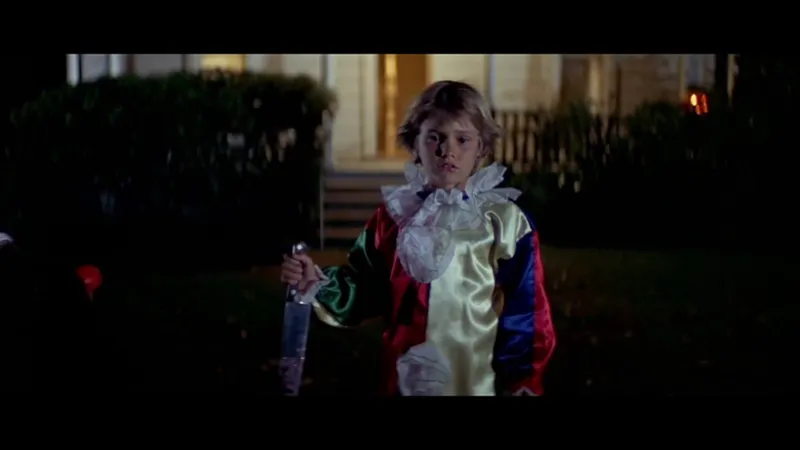
We’re introduced to Michael Myers through his point of view as he kills his older sister, and then as he meets his parents in front of their house. It’s revealed we’ve been seeing through the eyes of a child. Not a young man, but a six year old boy in a clown costume, holding the large blood covered kitchen knife. The scene feels brutal, despite the fact that it is usually mentioned in company with a tradition of gore soaked slashers, Halloween achieves this while being comparatively bloodless. This opening scene is presented as one single, unbroken point of view shot. We see all of this through Michael's eyes, until he meets his parents and it's revealed we've been watching through the eyes of a child, as he murders someone. It sets up the Michael Myers mythology perfectly.
The next opens as we follow the events around Michael escaping from a psychiatric institution for the criminally insane, where we're told he hasn’t spoken a word in fifteen years. We jump directly to his psychiatrist, Dr. Sam Loomis on the way to pick Michael up to have him transferred. A conversation with the nurse who is driving reveals Loomis is adamant that Michael is never released and he should spend the rest of his life institutionalized. After Loomis repeatedly refers to Myers as “it,” the nurse says, “Don’t you think we should refer to it as him?” Loomis responds, “If you say so,” suggesting he’ll go along with her suggestion, but isn’t going to believe Michael is a him. To Loomis, Michael is an It. When they pull up to the hospital, patients are everywhere, in the road, on the lawn, in spite of it pouring rain. Long story, short, Michael jumps on the roof of the car, scaring the nurse into jumping out and allowing Michael to steal it.
Following Michael's escape, Loomis heads to Haddonfield, Myers childhood hometown, convinced Myers is heading there. He enlists the town’s sheriff, informing him of Michael’s escape. The sheriff is skeptical, but Loomis is adamant. At one point, they check Michael’s childhood home, to see if he’s gone there. You can see the exchange behind the link below, and how it helps to set up a sense of mystery and mythology around Michael.
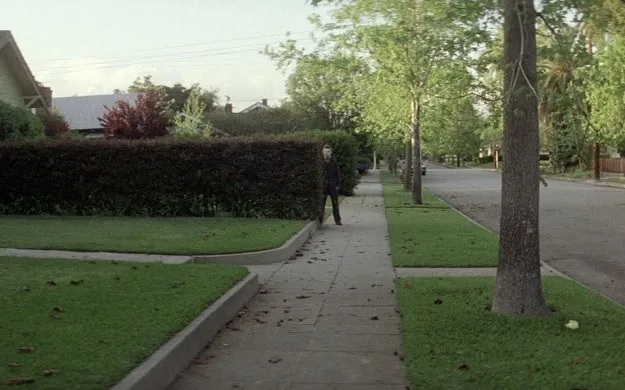
By the time we get to the scene between Loomis and the sheriff at the Myers house, as an audience, we already know Michael has been back to his childhood home. We’ve already seen him get his first glimpse of Laurie Strode. As she’s talking with Tommy Doyle, a boy she’s going to be babysitting later that night, she has to stop and drop off a key, because her real estate agent father is trying to sell the house. We see Laurie approach the front porch through the window in the front door, and as she turns to leave, a shoulder and head partially appear in the frame. There is the kind of musical “sting” which has become standard in slasher films, followed by the sound of Michael breathing in the mask. It’s an effective moment, both in giving the audience a quick fright, and in laying the groundwork to build the suspense. Michael has indeed come home. We then get a shot of Laurie walking down the sidewalk, she sings, "I wish I had you all alone, just the two of us" (something Jamie Lee Curtis made up on the day), and again, Micheal steps into the frame, watching.
The remainder of the film is Michael stalking Laurie, then killing Laurie’s friends (who Michael has seen Laurie walking home with after school), Loomis giving more speeches about the otherworldly evil that is Michael Myers, and the finale.
In the finale Michael creates a kind of macabre tableau for Laurie to find, including the bodies of her friends and the headstone from his sister’s grave. So begins Michael attempting to kill Laurie and her fighting for her life while protecting the children she’s babysitting. Laurie survives, Michael is shot six times by Dr. Loomis, and falls off a second floor balcony. When Loomis walks over to check on his handiwork, he sees Michael’s body on the lawn below. Calling back to a conversation she’d had with Tommy Doyle earlier, Laurie says, “It was the bogeyman, wasn’t it?” Loomis looks to her and says, “Yes, as a matter of fact, it was.” When he turns to look at the lawn again, Michael has disappeared. The look on Loomis’ face suggests he expected as much. Then, in an interesting and effectively creepy piece of filmmaking, Carpenter begins showing the different locations Michael has been. At the same time, the sound of Michael breathing through the mask is heard over the brilliant main theme music. It's a very smart, effective way to end the film, speaks to the ever presence of The Shape and is a major part of the way Halloween speaks to our unconscious fears about masculine violence.
https://youtu.be/guY4cuELvLw?t=153
It’s a very simple story. That it seems cliche now is due to it’s influence. It's a film with an almost never ending list of imitators. It established what went on to become the core elements of the slasher sub genre, even as it’s a film light on blood and gore in comparison to its imitators. Friday the 13th would come later, adding a good bit more gore and the elements of punishment against teens transgressing against puritanical norms.
That the suspense is so well developed is one reason the film became a pop culture touchstone and spawned a million imitators, but the other two reasons it struck such a nerve are Michael Myers and Laurie Strode. As Halloween established the basic foundations of the sub genre, Laurie Strode became the standard for the Final Girl trope. Laurie is smart, observant, resourceful, determined and tough.
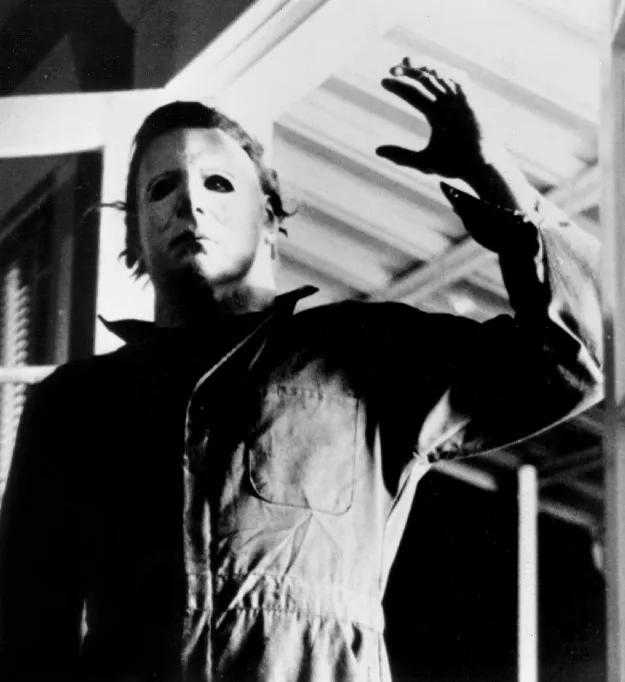
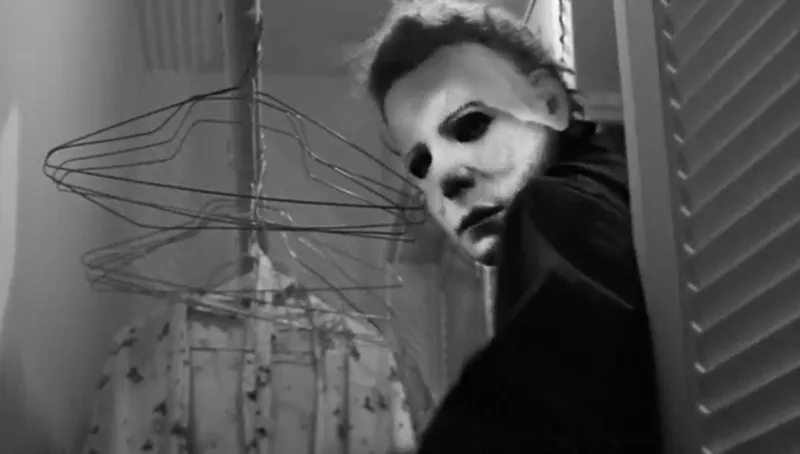
Michael Myers, or The Shape if you prefer, was catapulted into iconic status with Halloween's success. In many ways, the character is ready made for it. The blank, expressionless, featureless white mask. The formless, monochromatic mechanics coveralls. The almost mechanical, but graceful physicality of Nick Castle’s performance. The steady, patient stalking. All of this comes together to create a character who scared audiences out of their wits, but also captured their imaginations. What is it about this character, who never speaks a word, and only shows the slightest hints of not being a murderous automaton that strikes so much fear in people? What makes Michael Myers so much more memorable than the thousands of other film villains who are forgotten by pop culture or film culture more specifically?
It comes down to an idea in the screenplay which is also expressed visually, that would have sounded ridiculous had it been added to the dialogue. It’s the perspective the film takes on the Michael, and we can see it in the directorial and editorial choices Carpenter makes. In all of the screenplay, other than the dialog, Carpenter called Michael “The Shape,” as in “Laurie looks out the window to see The Shape staring back at her.” I’m going to be referring to him as The Shape for the duration, because it does capture the unspoken characteristics which struck such a chord in audiences. It gets to something in our subconscious. If we stop thinking of him as Michael Myers and begin thinking of him as The Shape, something about the character and his popularity begins to become clearer.
In an interview for the podcast “Halloween Unmasked,” a celebration of and deep dive into Halloween, Carpenter said part of his intent for the film was trying create a feeling of evil lurking in the suburbia which people usually thought of as safe. Bringing the terror out of the woods or some gothic mansion and into suburban homes and putting teenagers in danger is a key to Halloween's initial success and why it speaks to audiences. In that same podcast, Carpenter refers to the fact that the suburbs were always presented as some kind of safe utopia, but as he was growing up, there was always a hidden violence. He refers to the idea that everyone knew the kid whose father beat him and in this house over here, that man beats his wife.
He’s right, and Carpenter created a nearly perfect metaphor for a specific danger lurking in suburbia. For a long time, feminist critique held that Halloween was a film with a distinctly patriarchal value system. The claim had been that Laurie survived because she was the virginal member of trio of teenage girls. Other versions of the same criticism have held that all slasher films are interested in portraying anyone who has sex, drinks or does drugs as deserving of punishment, especially girls and women. The claim is that it's derived out of the puritanical basis of our collective value system as a nation, and the presentation of this violence against these young women has a prurient quality not afforded the male characters.
None of these really hold up with Halloween though, and they seem kind of simplistic where the film is concerned. It is a spot on critique for many horror films, and no shortage of those in the slasher sub genre. The Friday the 13th series that followed, became the template for its generation of slasher films, it more rightly deserves lives up to this criticism. Many of the Halloween sequels do fit that description, as it's forty-five year span sees the series fit itself to the trends of the times. This criticism doesn’t quite fit the 1978 original when we look at it individually, separated from the cheap imitations.
Debra Hill said on many occasions before her death that there wasn’t any kind of morality being imposed on Laurie, Annie or Linda. Laurie gets high with Annie on the way to their babysitting jobs, a sin many a teenager would suffer the ultimate price for in the slasher films that followed. It’s also made clear through conversations with Annie that Laurie isn’t some virginal prude, abstaining from sex out of any sense of moral righteousness. She’s shy, which squares with the fact that her character isn’t one who is taking many risks. Annie and Laurie also have the most realistic relationship in the film, capturing one of the realistic dynamics which can and often do arise in teenage friendships. Laurie's priorities are elsewhere, but she's not immune to the draw of teenage hormones and rule breaking.
Carpenter has always stated that being averse to risk organically leads to Laurie being more observant. It’s being observant, resourceful, and determined which saves her life. Annie gets stuck trying to climb out of a first floor shed window. Resourcefulness doesn’t seem to be a characteristic that can be attributed to her. Linda, well… she's comic relief and it's totally impossible to describe her as observant. It leads very directly to her demise. The Shape throws on a sheet with her boyfriends glasses over top of it, and despite the several inches of difference in height, Linda doesn’t catch that it’s not Bob under the sheet.
Neither Annie or Linda take Laurie's fears seriously when she expresses what she's observed or is observing in the moment, because they've internalized the illusion that they live in a safe utopia. Laurie is obviously aware danger can exist in that world, and as the film progresses, it's the same illusion of safety she's fighting within herself, just as she is within her friends.
Contrary to the criticism, The Shape is amoral or at least operating on a sense of morality or reason we never have access to. There's no concern for the morality of his victims. In the perspective of the film, The Shape isn't concerned with anything but the obsession with Laurie. It’s not a coincidence that Laurie is who The Shape encounters at his home, and is the one for whom he creates a grizzly house of horrors, adorned with the bodies of her friends and his sisters headstone. The obsession with Laurie is the only obvious sense of reason we get for The Shape's actions. There is some sense of some kind of logic, but it's never within our grasp as an audience. It's not a logic or reasoning we understand, but there is the rough outline of one is his behavior. Leaving out the hackneyed, shoe horned narrative brought about in 1981’s Halloween II making Laurie and Michael siblings, and instead sticking with the original film, the obsession comes simply from Laurie walking up on the porch of his childhood home. If there's anything that can be inferred, it's that he’s punishing the others for being close to her when he isn’t or punishing her for being close to them, by making a show of the fact that he killed them, dressed up in the most extreme version of a Halloween prank. There's been enough forethought to steal the headstone, and to stage the bodies, so there is a sense of logic, but when we're confronted with what he's done with it, we still can't make out exactly what it is. Whatever is driving Michael, isn't a conventional morality or any kind of logic or reasoning originating from it.
At the same time, killing her friends and creating this horrifying tableau with their bodies is a mirror of behavior common in abusive relationships. Abusers will often show jealousy toward the other people in the lives of their victims and will try to find ways to isolate their victims from their other relationships through threatening the victim or threatening and intimidating the other people in the victims life. It's about control and possession, leaving them no avenue of escape. The Shape gives a wordless demonstration of this obsession.
Carpenter didn’t fully understand he was doing it, but he did make The Shape a representation of some of the worst aspects of masculinity, which are a danger lurking in what otherwise looks like a safe and quiet suburbia. It is a danger spilling into living rooms and across well manicured lawns, and too often visited on women and teenage girls who are the subjects of obsession. There is a real truth in what he's presenting, and the truth of it is also amoral. The men who embody this kind of masculinity are amoral, because the masculinity they are employing is amoral. This masculinity has no interest in the way it effects the world around it, other than wresting control and is intensely, singularly focused on fulfilling itself. The film, and as a result, the filmmakers aren’t dedicated to upholding the kind of patriarchal norms the feminist critique has held against it for so long. It’s a film which presents the logical ends of those worst parts of masculinity as being an avenue for true evil, because they are so inherently obsessed with the self, they have no morality. The self and its fulfillment are the morality, in total. Halloween exists in agreement with the feminist perspective about male violence which the critique arises out of, but not the particular critique itself.
The consequences are anything but amoral, unfortunately for everyone who shares proximity with the men who engage in these behaviors.
The Shape is the reality this kind of masculinity expects men to become, down to the expressionless, emotionless mask. It’s the furthest logical conclusion to the way that traditional masculinity expects men to restrict all emotions other than anger. The way that it makes domination a primary value. The way that it accepts violence as a solution so quickly. The way these dovetail with the primacy of competition. We live with that reality daily, a fact understood in psychology and psychiatry.
The singleminded quality of The Shape goes along with the social indoctrination of masculinity as well. When we consider the way we portray success in the men we have historically held up as role models, it’s common for those men to lead lives where they are focused so specifically on their goal, that basically everything else ceases to exist for them. From Bing Crosby being one of America’s biggest stars and being a horrific, abusive alcoholic at home, to the likes of Lee Atwater, developing the racist "Southern Strategy" campaign playbook that has become ever present in conservative politics, then admitting before his death, he basically didn’t care what the greater social or political repercussions were, as long as he won, because he wanted the recognition and status. Atwater didn't care what it took to get there.
We praise and uplift this version of successful men who will have nothing stop them or prevent them from reaching their goal, and again, a sense of morality is secondary, if not completely absent. Reaching the goal is, itself the fulfillment of the needs of masculinity, whether or not the goal or the means of reaching it have any moral standing. We celebrate the single minded, ultra determined men who will do anything to achieve. It's a storytelling trope we love, whether the subject is reality or fiction, and a pernicious factor in many of the most violent actions men commit.
The trope of the man whose willing to bend or break any rule to achieve his goal, and is celebrated for it, is common to almost every genre of storytelling in western civilization. Think of the number of law breaking law enforcement agents we’re presented with as heroes. Their heroism is presented as arising from the fact that they’ll break the law to catch someone, who broke the law. There's also he way we present the stories of titans of industry who’ve used illegal or deeply immoral/amoral tactics to achieve the success they chase, and are communicated as “complicated heroes," positioned as deserving of our respect and admiration. We’ll argue the ends justify the means, but we’re very often missing that the means end up shaping the man, who will then justify any means. Like the discussions of violence that purposefully avoid masculinity's part, we'll praise Citizen Kane or There Will Be Blood, but studiously avoid their relationship how masculinity shapes the actions of these characters.
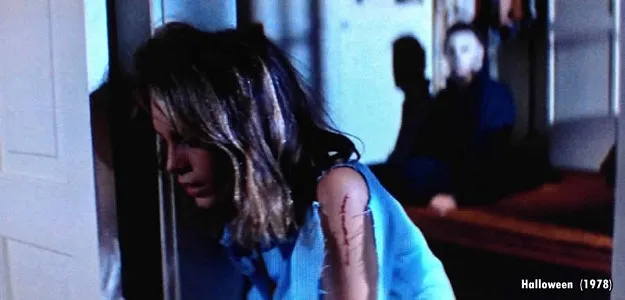
Masculinity's violence is also represented in the way The Shape uses the traditions and norms of the Halloween holiday to do something akin to gaslighting Laurie and his other potential victims. Gaslighting is one of the most destructive behaviors of the worst of masculinity. Showing up in the post coitus bedroom where Linda waits for Bob, covered in a sheet, pretending to be Bob after killing him seconds before. Staring as she speaks to him, to the point of unnerving her. Standing in the yard next door to Laurie’s house, staring up at her window or standing outside of Laurie’s school, staring through the classroom window. Watching Laurie and Annie walking home from behind the hedges next to Annie’s house. It's Halloween. What's so strange about a man in a mask? All of it could be written off as a prank, until it can't be. “It’s just a joke.” “You’re just being hysterical.” On any other day of the year, none of this would be acceptable and Laurie, Annie and Linda would have been deeply unnerved. Laurie is more or less told these exact things when she does bring up having seen The Shape. In her attempt to protect Tommy Doyle, says essentially the same things to him when he sees The Shape standing across the street, and then later carrying Annie’s body into the house. It all speaks of the kind of prankster quality of the holiday, infused with the malevolent sneer of gaslighting.
Hiding under the guise of Halloween pranks is what gets Laurie that close to him. It’s the phone call Laurie gets from Linda while The Shape strangles her with a phone cord that finally brings Laurie to him and the house of horrors he's created for her. If Laurie hadn’t thought it could possibly be a prank, despite her own instincts telling her things were off all day, she wouldn’t have crossed the street. If she’d have thought the call was the sound of someone dying and not a prank, she’d have called the police. Instead, it’s Halloween, so the chances of it being a prank are exponentially higher, everyone we see her interact with has been telling her she's seeing things or playing pranks on her, and Laurie feels she has to go check. With The Shape, it's all a non-verbal form of gaslighting. It all causes Laurie to question her own reality, which is the purpose of gaslighting.
Beyond these, it’s the unknowable aspects of The Shape which make him most frightening. We don’t know why he’s doing any of this. We don’t know what is happening behind the mask. If any of our questions could be answered, we’d have something we could pin this on, an explanation. If we could see him smile as he commits these acts of violence, say it’s a deep sadism. If we could see him grimace in pain and/or revulsion, we could say it was some obsessive compulsion driving him. The pieces and the clues are there. None of them are directly spelled out though. The Shape never rips off the mask and goes into a monologue to explain why all this pageantry or why Laurie.
We treat the violence of masculinity in real life in much the same way. Despite all of the evidence we have, we refuse to acknowledge there is an aspect of masculinity's process of socialization that creates shocking violence, even as we do have men and women who explicitly outline the connections, not to mention evidence in the form of research and statistics. As a result, this violence seems unknowable, and what half hearted answers we accept are incomplete and unsatisfactory. Under the surface, behind the mask of unrealistic, emotionless rationality, it’s the lessons of masculinity driving men who themselves can't (or won't) acknowledge this is the case. Like The Shape, they’re acting on a subconscious set of directives which feel imperative and urgent, like instincts, and they have no idea why. When we restrict expression within masculinity to those associated only with anger and rage, this is what we get. Because the rest of us will accept incomplete excuses or half formed explanations, the men laboring under these conditions don’t even make it to real self reflection most of the time.
Through the years, there’s been a lot written and said about this idea that the mask and the coveralls help to create a perception of a void behind them or beneath them. It’s true, and part of what makes The Shape such a frightening character. That’s only half the story though. A void suggests an emptiness which can never be filled. The featureless mask and the coverall’s are also representative of being anything or anyone, while being a void at the same time, and this is the truly horrifying thing about The Shape’s appearance.
There is no template, no particular visual cues which delineate a man willing to perpetrate the violence of masculinity’s worst aspects on others and one who isn’t. It can be Bill Cosby. It can be Matt Lauer. It can be Bill O’Reilly. It can be Ted Bundy. It can be Lonnie David Franklin Jr. It can be the black sheep uncle or the trusted priest. From the most expensive hotels and neighborhoods in the country to burned out buildings used as squats in the poorest neighborhoods, and certainly the suburbs in between, they are there. This is something we’re coming to face as women continue to insist, “Yes, all men" or, more to the fear Halloween is speaking to, "Maybe not all men, but how are we to know which ones?" As has become part of the conversation and understanding, there’s no way to just look at someone and tell they have some kind of catastrophically dangerous conception of masculinity driving them.
This is the other side of the coin from The Shape being a void. It’s not just a void, it’s also a stand in. From a distance, the mask itself could be any man. In the same way there’s only a very vague understanding of why he’s stalking Laurie, it’s so often the same with the kind of violence hiding in homes and small towns. There’s only the most vague sense of why it happens. Everyone knows Chris drinks too much, and sometimes, that ends with him beating his wife. Well, Kevin is a teetotaler, and he beats his wife and his kids too. John is depressed because he’s unemployed, so he has a short fuse. Ed has a short fuse because he’s very successful and his job is extremely demanding and high pressure. The Shape just happened to be Michael Myers, but it could just as easily have ended up being any number of men in a small town, suburb or big city.
The men who commit these acts of violence (and many others) will always give a reason. Collectively, they’ll give a few million reasons. Those reasons aren't satisfying though because they're really excuses, for reasons they themselves don't even understand. The reasons they give always leave some feeling of never being the full story. It’s the classic example of “See what you made me do…” These excuses and "reasons" don’t hold up under scrutiny, and more often than not, we may not be able to put a finger directly on it, but we know, if for no other reason than it is men who commit an exponentially higher rate of violence, masculinity is part of what’s creating it. The featureless aspect of the mask represents a masculine face and shape, and even though we have fought so hard to deny it, we know that violence could be lurking in any random man we see.
That violence isn’t just reserved for women either. Michael kills a mechanic early on in the film, so that he can take the man’s coveralls. He kills Bob, Linda’s boyfriend because Bob is there or because he has a place for Bob in the grizzly tableau he’s going to make for Laurie. Again, there may be reasons for The Shape to employ this violence, but even those reasons are all about opening the opportunity for future violence. They are about control of the environment.
The featureless mask can also represent masculinity robbing men of individual identity. It's this sense of "manliness" which has to be met, standards lived up to, no matter the individual, their own moral compass, their own background or their psychological make up. It doesn't matter what else you are, you're expected to be a "man" within the standards of your class and status. You're expected to enforce that standard on other men. It doesn't matter whether or not you want to or whether this is a part of your self identity. Deciding not to participate can invite The Shape, this violence of masculinity, to visit violence on you. There is, within the circles of masculinity, the understanding that not participating in its rituals and taking part in its policing can invite violence. It’s as much that The Shape is hiding behind the faces of men in every town and city as it is that it takes away who he is. In this way, The Shape is simply those men who choose "being a real man" as the primary aspect of who they believe themselves to be. That featureless, identity-less visage is hiding behind all of their faces, demanding they be willing to administer violence at its will.
Halloween distills all this into one entity, The Shape. The fictional town Haddonfield we’re introduced to doesn’t have men who beat or rape their wives or abuse their children or are given to acts of violence in defense of their masculinity when challenged by other men in the bars, living rooms, garages, and so on. Haddonfield has The Shape, as if this violence is inescapable. If all those men disappeared or were rehabilitated, and the picture perfect suburb of our fantasies suddenly existed, from it would emerge The Shape, because that suburb still exists within the context of the larger society. It suggests that even if we could somehow strip the violent men out of our lives, cities and towns or the violence out of those men, we would have this specter of masculinity to fear, because at some random point in time which only made sense to them, another Shape would take their place.
This is even alluded to when Loomis goes to the graveyard and finds the gravestone for Judith Myers, Michael’s sister, has been stolen. As they’re walking to the grave site, the cemetery caretaker tells a story about Charlie Bowles, who some years earlier, killed his entire family with an hacksaw. Like Michael killing Judith, no one knows why Charlie Bowles killed his wife and two daughters. The caretaker is telling this story, specifically in relation to not being able to understand where this shocking violence came from. Charlie Bowles is The Shape of masculinity's violence in Russelville.
This also applies to Loomis insistence that Michael Myers is the personification of evil. It’s the way we treat the violence of masculinity. In the same way the men who commit violence come up with a million reasons for it, as a culture and society, we’ve doggedly refused to really examine why there is such a connection between masculinity and violence. Depending on our own backgrounds, we’ll always find an excuse in the perpetrators background. If we’re from the kind of background that affords us life in suburbia, we find reason for this violence in poverty (which violence is surely tied to, but we’ll ignore the intersection of masculinity and poverty). We might also find an explanation which says too much wealth and privilege leads to a lack of empathy (without also recognizing the interplay between wealth and masculinity, much less the consistent message given to boys where strength and emotions are concerned across class lines). Only recently has masculinity’s direct involvement in these issues started being given a hearing outside of niche academic circles or in the fields related to domestic violence. We've treated this violence as some kind of magic, some kind of supernatural force we have no ability to effect or change.
We end up with this very vague, featureless, man shaped space, both anyone and no one simultaneously, in our discussions and attitudes about violence, because we won't just admit and begin to interrogate exactly why there is such a strong connection between masculinity and violence. We have long accepted vague attributions of biology as an answer. We've come to learn it doesn't provide answers we thought it did. Genetics aren't as straight forward as proponents of that idea suggest either. Despite what purveyors of disinformation would have us believe, we don't have any evidence to suggest simply introducing testosterone explains it fully either.
Another thing that makes Michael such a strong symbol of the violence of masculinity is that he commits his first act of violence at age 6, which is when the identification with gender starts to become most solid in boys. Nothing in the film suggests there was anything unusual or abnormal about Michael prior to Halloween night, 1963. It’s that night, when he kills his sister that he becomes The Shape, and coincidentally, the same age boys tend to start being more aware of the expectations of gender and masculinity. Micheal no longer exists after that night, which is why he goes directly to acquire a mask before going about his grizzly business when he's escaped fifteen years later.
Small towns across the country with the idyllic looking homes that line their streets are often hiding terrible violence, and the overwhelming majority of it comes at the hands of men. It was a kind of truth which was beginning to make its way to expression and the start of confronting it began in the 1970’s. Feminism as a cultural force had taken hold in the late ‘60’s and early ‘70’s. With John Carpenter and Debra Hill having grown up in this same small town America, it’s impossible for them to not know the kinds of secrets hiding in homes within their communities. It was the kind of knowledge that was ubiquitous and secret, at the same time as Carpenter alludes to in Halloween Unmasked. Every town has them. “Oh, that family has problems. I feel so bad for those kids/that woman.” We, as a culture were willing to participate in keeping it secret. When Carpenter decided to write a story about the danger hiding in those small towns, he may not have known he was writing a near perfect avatar for the real life danger that exists in them, but he did.
Maybe this is part of how The Shape is created though too. It was during the years we were still much more likely to keep the secrets of this hidden violence of masculinity, and we may have been talking very directly about the inequalities between the genders in many ways, but we weren’t talking about the specific relationship many parts of masculine socialization have with violence. The Shape ends up being an instructive metaphor for the relationship between masculinity and violence. Halloween isn't directly interested in imposing a patriarchal value system on women, but is instead is a pretty damning exhumation of violence surrounding masculinity and how poorly we’ve even reacted to it, much less attempted to do anything about it.
The Shape is terrifying because the idea of him is lurking in our subconscious minds long before we ever see the film. Halloween just puts this idea on screen, and gives us a narrative reflecting our own questions about it. That is why it still has relevance and why it still has the capacity to creep audiences out 40 years later.