
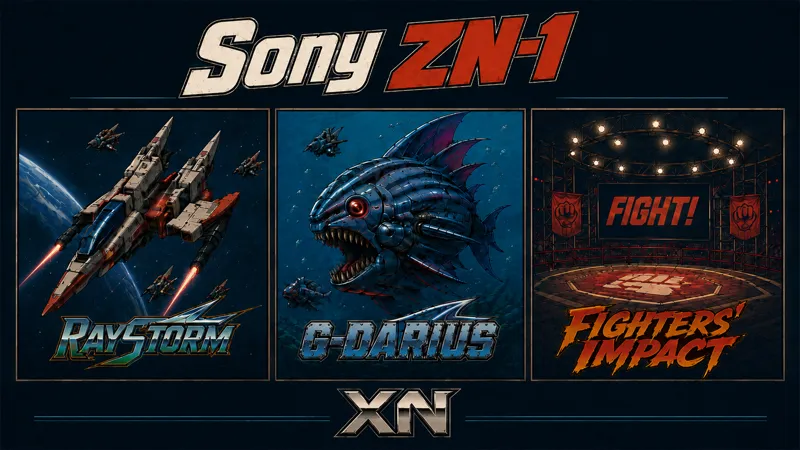
ZN1-TaitoFX1B & More
Big news for Sony ZN-1 arcade fans on MiSTer: the first of the fragmented ZN-1 cores, ZN1-TaitoFX1B, is ready.
It’s a major milestone—and it also lays out the road ahead for the entire ZN-1 family.
Why isn’t ZN-1 just “one core”?
The Sony ZN-1 (1995) is a PlayStation-based arcade platform: R3000A CPU, PSX-style GPU, and the works. But each licensee paired that common chassis with its own sound and I/O hardware.
Capcom used QSound. Taito shipped two different boards: the FX-1A with YM2610B and the FX-1B with its “Taito Zoom” hardware. Tecmo and Video System used the standard PSX SPU, while Raizing, Atlus, and Acclaim each went with their own sound hardware.
The limitation is: the DE10-Nano’s Cyclone V FPGA has a hard limit of 41,910 ALMs. The PSX foundation already consumes a significant portion of that budget, and each additional sound system is substantial.
The Taito Zoom hardware alone—an MN10200 CPU, a 48-channel ZSG-2 sample chip, and a TMS57002 DSP for reverb and chorus—takes roughly 10,900 ALMs. That’s enough to consume most of the remaining headroom by itself.
When I tried to combine every ZN-1 sound board into a single do-everything core, the result was 44,908 ALMs, about 7% over the FPGA’s limit.
There’s no seed sweep or timing trick that can magically recover 3,000 ALMs. The hardware simply cannot fit together in a single bitstream—and that’s before accounting for sound boards that haven’t been implemented yet.
So the honest, robust solution is to split ZN-1 by publisher and sound hardware: one lean, fully fitting, timing-clean core for each board family.
You pick a game, MiSTer loads the appropriate core, and each core has enough room to implement its hardware properly instead of trying to squeeze everything into one oversized bitstream.
What’s in ZN1-TaitoFX1B?
This first core targets the Taito FX-1B / FX-1Z “Taito Zoom” board and includes the complete Zoom sound system:
MN10200 sequencer CPU
ZSG-2 sample engine
TMS57002 DSP wet path for reverb and chorus
Everything is bit-matched against real hardware captures.
Playable, with full music:
RayStorm
G-Darius — multiple revisions, plus G-Darius Ver.2
Fighters’ Impact
The core comes in at 99% FPGA utilization, with every clock timing-clean for both setup and hold.
New: MiSTer-CRT-Adjust
You asked for it, and it’s here: CRT Adjust is now built into the ZN-1 cores.
From the OSD, you can nudge the analogue picture to fit your tube perfectly—without the CRT losing lock and with zero impact on HDMI.
It’s off by default, so nothing changes unless you enable it.
On ZN1-TaitoFX1B, you get:
H-Size
H-Position
This is currently the most tightly packed core in the family at 99% FPGA utilization, so V-Shift was the one feature sacrificed to keep every clock timing-clean.
The roomier cores—Capcom, TaitoFX1A, and TecmoVSys—will carry the full set:
H-Size
H-Position
V-Shift
This is all thanks to the excellent MiSTer-CRT-Adjust module by rmonic79. Huge thanks for building it and making it so clean to integrate.
https://github.com/rmonic79/MiSTer-CRT-Adjust
Also added by request: cleaner interlaced video on HDMI
CRT Adjust is for the CRT users —but HDMI users asked for some help too.
Several ZN-1 titles run in 480i (interlaced), which can produce the classic “comb” and flicker artifacts on modern flat panels, especially during motion. By request, the OSD’s Video & Audio menu now includes several options to clean that up:
Deinterlacing: Weave / Bob — Switch from Weave to Bob to reduce interlace combing in moving 480i scenes.
Render 480i as 480p — Renders interlaced content progressively for a more stable, flicker-free HDMI image.
Sync 480i for HDMI — Improves 480i sync and handling for HDMI displays that particularly have compatibility issues with interlaced modes.
These options are shared across the entire ZN-1 family, so every core benefits regardless of which titles you’re running.
Between CRT Adjust for the tube crowd and these new HDMI options for flat panels, both sides now have the tools to get the ZN-1 picture properly dialed in.
Install
Copy the contents of releasesArcade/ to your MiSTer SD card’s Arcade/ folder. This will place the .mra files (and alternatives/) directly in Arcade/, and cores/Arcade-XNZN1TaitoFX1B_20260814.rbf in _Arcade/cores/.
Provide your own ROM sets—nothing copyrighted is included. The cores are completely independent, so you can install whichever ones you want.
Note: This is the first XelaNotPu release submitted for review for inclusion in theypsilon’s Update All and Downloader process. Once accepted, the core will be installable and kept up to date automatically through Update All.
If you’d like to support the tooling that makes MiSTer distribution possible, consider backing theypsilon on Patreon: https://www.patreon.com/theypsilon
The road ahead: the rest of the ZN-1 family
ZN1-TaitoFX1B is just the beginning. Here’s what’s coming as the split rolls out:
ZN1-Capcom (QSound) — Street Fighter EX / EX Plus, Star Gladiator, Battle Arena Toshinden 2, Gallop Racer. QSound and DSP are working. Audio artifacts remain.
ZN1-TaitoFX1A (YM2610B) — Psychic Force, Super Football Champ, Magical Date. Boots and plays with PSX SPU sound effects today; YM2610B music is in progress.
ZN1-TecmoVSys (PSX SPU) — The SPU-only titles from Tecmo and Video System, including Dead or Alive ++, Gallop Racer 2/3, Aero Fighters Special, Flame Gunner, and more.
…and more soon — The Raizing (YMF271), Atlus (YMZ280B), and Acclaim (ADSP-2181) sound boards are on the roadmap as those chips are implemented.
Every core ships as a clean, self-contained release with its own complete source: no ROMs, no copyrighted data—just FPGA logic.
Thank you all for the support.
More soon.
Disclaimer
All product names, company names, project names, platform names, hardware names, game titles, logos, trademarks, registered trademarks, copyrighted materials, source code, and other intellectual property referenced in this post are the property of their respective owners.
This includes, but is not limited to, MiSTer, MiSTer FPGA, MiSTerFPGA, MiSTer-devel, PSX_MiSTer, Analogue, Analogue Pocket, openFPGA, MAME, The MAME Project, GitHub, Intel, Altera, Sony, Sony Computer Entertainment, Sony Interactive Entertainment, PlayStation, Capcom, Taito, Tecmo, Eighting, 8ing, Raizing, Video System, Atlus, Racdym, Takara, Acclaim Entertainment, Gremlin Interactive, Atari Games, Metro, Enix, Namco, Square, Arika, MOSS, Amuse World, Tamsoft, D3 Publisher, Sunsoft, Activision, GAPS, I.T. Planning, Jorudan, Panasonic, Matsushita, Yamaha, ZOOM, Texas Instruments, NEC, Mitsubishi Electric, Renesas Electronics, and their respective parent companies, subsidiaries, predecessors, successors, licensors, developers, publishers, distributors, and rights holders.
Sony ZN-1 and Related PlayStation-Derived Arcade Hardware
References to Sony ZN-1 in this post may encompass the original Sony/Capcom ZN-1 architecture and closely related manufacturer-specific arcade systems derived from the first-generation Sony PlayStation/ZN architecture.
These include, where applicable:
Sony ZN-1 and Capcom Sony ZN-1 hardware
Taito FX-1 / FX-1A hardware
Taito FX-1 / FX-1B hardware
Tecmo TPS / Tecmo Play System hardware
Eighting / Raizing PlayStation-derived ZN-1 hardware and associated game boards
Video System PlayStation/ZN-1-derived hardware
Atari, Acclaim, Atlus, Metro, and other game-specific or manufacturer-specific implementations built around Sony ZN-1 or closely related first-generation PlayStation-derived arcade technology
Manufacturer-specific ROM, sound, I/O, protection, storage, control, and daughterboard implementations used with these systems
These systems share substantial architectural ancestry with the original Sony PlayStation and Sony ZN platform, but they are not necessarily electrically, logically, or functionally identical to one another. Individual implementations can differ significantly in ROM mapping, memory configuration, sound hardware, auxiliary CPUs, DSPs, protection systems, I/O hardware, storage devices, control interfaces, clocks, board layouts, and game-specific peripherals.
The use of the collective terms ZN-1, ZN-1 family, or PlayStation-derived ZN-1 hardware in development discussions is therefore intended as a practical architectural grouping and should not be interpreted as a claim that every referenced PCB is an identical Sony ZN-1 motherboard configuration.
Referenced ZN-1-Family Software
Documented, dumped, preserved, reported, prototype, location-test, unreleased, or otherwise historically associated software for Sony ZN-1 and closely related first-generation PlayStation-derived arcade systems includes, but is not limited to:
Capcom / Sony ZN-1 and associated implementations:
Battle Arena Toshinden 2; Judge Dredd: The Game; NBA Jam Extreme; Star Gladiator Episode:I Final Crusade; Street Fighter EX; Street Fighter EX Plus; and their known regional, revision, prototype, location-test, or alternate versions.
Taito FX-1A:
Psychic Force; Psychic Force EX; Super Football Champ; Magical Date; Magical Date EX / Magical Date: Sotsugyou Kokuhaku Daisakusen; and their known regional, revision, prototype, location-test, or alternate versions.
Taito FX-1B:
Fighters' Impact; Fighters' Impact A; RayStorm; G-Darius; G-Darius Ver.2; and their known regional, revision, prototype, location-test, or alternate versions.
Eighting / Raizing and related ZN-1-derived hardware:
Beastorizer / Bloody Roar; Bloody Roar 2; Brave Blade; and other documented software using Eighting/Raizing PlayStation-derived arcade boards or closely related ZN-1-family configurations.
Tecmo TPS / Tecmo Play System and associated hardware:
1 on 1 Government; Cool Boarders Arcade Jam; Dead or Alive ++; Flame Gunner; Gallop Racer; Gallop Racer 2; Gallop Racer 3; Monster Farm Jump; Shanghai Matekibuyuu; Tecmo World Cup Millennium; The Block Kuzushi; Tondemo Crisis; and other documented, regional, revised, prototype, location-test, or specialized TPS software.
Other ZN-1 / first-generation PlayStation-derived arcade implementations:
Aero Fighters Special / Sonic Wings Limited; Heaven's Gate; Primal Rage 2; Logic Pro Adventure; Bust a Move 2 / Bust-A-Move 2 and other documented titles implemented on manufacturer-specific hardware derived from, compatible with, or closely related to the Sony ZN-1/PlayStation arcade architecture.
This list is intended to identify software relevant to the broader ZN-1 hardware-development and preservation effort. Classification of individual games can vary between PCB documentation, emulator source code, surviving hardware, manufacturer terminology, and historical references. Inclusion in this disclaimer therefore does not assert that every title uses an identical Sony-manufactured ZN-1 motherboard or identical supporting hardware.
Alternate regional names, translated titles, revisions, prototypes, bootlegs, location-test builds, and manufacturer-specific versions remain the property of their respective rights holders. References to a title do not imply that every known version, revision, prototype, regional build, location-test version, or unreleased build has been publicly released, completely dumped, preserved, implemented, or verified as operational.
Hardware and Technical References
References to Sony ZN-1, COH-series Sony arcade motherboards, PlayStation-derived R3000A-compatible CPU hardware, PlayStation GPU/GTE architecture, PlayStation SPU hardware, system RAM, VRAM, sound RAM, BIOS/boot ROMs, game ROM boards, mask ROM, EPROM, EEPROM, Flash ROM, NVRAM, SRAM, DRAM, SGRAM, CPLDs, PALs, GALs, FPGAs, security devices, protection logic, game-specific ASICs, JAMMA interfaces, JVS or proprietary I/O where applicable, analog controls, trackballs, steering controls, light-gun interfaces, rhythm-game controls, and other game-specific peripherals are provided solely for identification, technical documentation, commentary, interoperability, preservation, educational, and research purposes.
References may also include manufacturer-specific hardware such as Capcom ZN-1 ROM and QSound-related boards; Taito SROM PCB-A, ZROM PCB and other FX-1-series boards; Panasonic/Matsushita MN102-series processors; ZOOM ZSG-series audio hardware; Texas Instruments DSPs; Yamaha sound devices; NEC microcontrollers; Eighting/Raizing sound and ROM boards; Tecmo TPS game boards; Video System game boards; IDE or ATAPI storage devices used by particular configurations; and other auxiliary processors, DSPs, ROM boards, sound boards, I/O boards, protection devices, and storage hardware associated with individual ZN-1-family games.
The presence of such additional hardware is significant: manufacturer-specific ZN-1 implementations can extend or replace portions of the standard PlayStation-derived audio, storage, control, I/O, and game-ROM architecture. References to a game as “ZN-1” therefore do not imply that its complete arcade implementation consists solely of standard PlayStation hardware.
References to FPGA implementations, MiSTer FPGA, DDR memory, SDRAM, M10K memory blocks, altsyncram, HDL, RTL, clock domains, memory controllers, ROM loaders, address decoding, bank switching, bus arbitration, DMA behavior, interrupts, audio implementations, input mappings, protection emulation, source-code repositories, emulator behavior, hardware specifications, compatibility research, reverse engineering, and related technologies are likewise provided solely for identification, interoperability, preservation, documentation, educational, and research purposes.
Scope Clarification
Taito FX-1A and FX-1B are PlayStation/ZN-derived arcade systems and are relevant to ZN-1-family development, but their manufacturer-specific supporting hardware must not be assumed to be interchangeable.
In particular, FX-1A and FX-1B use different supporting sound/ROM-board arrangements. FX-1B titles such as RayStorm, G-Darius, and Fighters' Impact therefore require consideration of hardware beyond the common PlayStation-derived CPU/GPU foundation.
Similarly, Tecmo TPS, Eighting/Raizing boards, Video System implementations, Capcom ZN-1, and other related systems can contain manufacturer-specific ROM, sound, I/O, storage, timing, or protection hardware that must be independently documented and implemented for accurate hardware reproduction.
Sony ZN-2 and systems based on ZN-2 are separate from the ZN-1 scope unless explicitly discussed for comparison or shared architectural research. This includes Taito G-NET, which uses later ZN-2-derived hardware and should not be interpreted as part of the ZN-1 software catalog merely because it shares PlayStation-derived architectural ancestry.
Likewise, Namco System 11, Namco System 12, Konami GV, Konami GQ, Konami System 573, and other PlayStation-derived arcade platforms may share architectural concepts or Sony components but are separate arcade hardware families and are not represented as Sony ZN-1 hardware unless explicitly stated in a comparative context.
Intellectual Property and Preservation
All associated characters, artwork, music, sound effects, voice recordings, audiovisual materials, game data, regional versions, software revisions, location-test versions, prototypes, undumped software, unreleased builds, cabinet designs, control systems, PCB layouts, schematics, hardware designs, software, firmware, and other copyrighted or proprietary materials remain the intellectual property of their respective rights holders.
This is an independent, non-commercial hardware-preservation, research, documentation, and interoperability project.
The use of any names, titles, trademarks, copyrighted materials, hardware identifiers, or technical information does not imply sponsorship, authorization, endorsement, affiliation, licensing, partnership, or association with Sony, Capcom, Taito, Tecmo, Eighting/8ing, Raizing, Video System, Atari, Acclaim, Atlus, Namco, MiSTer, the MiSTer project, or any other manufacturer, publisher, developer, rights holder, hardware project, or software project referenced herein.
No ownership of third-party intellectual property is claimed.
No copyrighted game software, ROM images, disk images, CD-ROM images, hard-drive images, BIOS files, proprietary firmware, copyrighted sound data, MCU program data, protection-device data, security-chip data, cryptographic keys, proprietary source code, copyrighted artwork, or other proprietary game data is provided with this post unless its redistribution has been expressly authorized by the applicable rights holder or license.
Any compatibility information, hardware descriptions, reverse-engineering findings, implementation details, preservation information, or references to incomplete, experimental, prototype, unreleased, location-test, undumped, partially dumped, or otherwise unavailable software are presented on a best-effort basis.
Such references should not be interpreted as confirmation of public availability, ownership, authorization, legal redistribution rights, preservation status, completeness, emulation status, FPGA implementation status, compatibility, or future support.
Hardware classifications and game associations may be revised as additional original hardware, documentation, source material, ROM dumps, PCB analysis, or preservation research becomes available.
All rights are reserved by their respective owners.
Source Code: Github
Comments (9)
Any status updates on this reaching update all? I tried doing it manually but I assume I didn't have the right files in terms of the software so I was waiting like you said for approval on update all, thanks for your work!
great work! Thanks. Can you try to make an experiment Retromod M64 Core?
@XelaNotPu great work! I'd really like to invest funds and info for the NAMCO SYS (TEKKEN TAG) core work. How can I contact you about this?
Great work on the new ZN-1 cores and CRT Adjust! One question: is User I/O DB15 support already implemented in these new cores, or is it still planned for a future update? I use a DB15 zero-lag setup on my CRT arcade cabinet, so this feature would be very useful for me.
User I/O support in the next system11 release and others after.
Thank you very much, great games added, looking forward to testing it.
Very cool, been looking forward to Ray Storm! Thanks dude 😎
Amazing 3 class games all working in one shop thanks mate.
Thanks. I look forward to checking it out.