



From Retail Console to Arcade Platforms: Part 1
One of the easiest misconceptions about SYSTEM11 and SYSTEM12 is that they are simply “PlayStation hardware with arcade ROMs.”
They are not.
The original MiSTerFPGA PlayStation core gave us an excellent foundation: the R3000A CPU architecture, GTE, MDEC, GPU, SPU, DMA system, memory architecture, and the rest of the core PlayStation hardware.
But turning that foundation into accurate Namco SYSTEM11 support required much more than replacing a CD image with arcade ROMs.
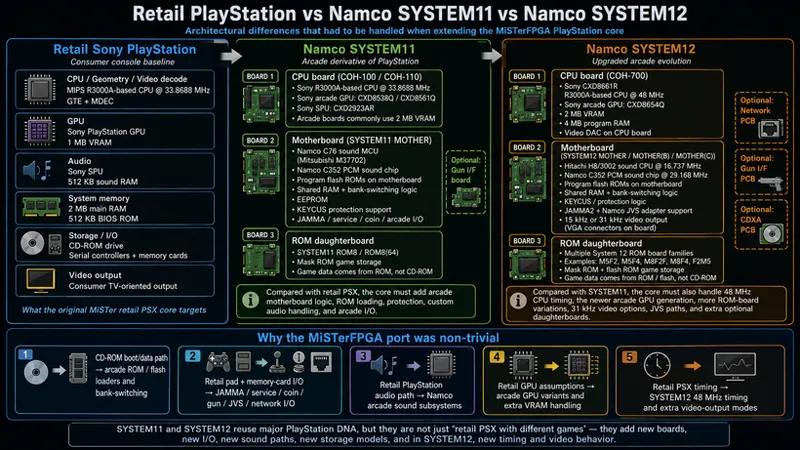
SYSTEM11 introduced an entirely different arcade environment around the PlayStation-derived CPU/GPU hardware: dedicated ROM boards, bank-switching logic, Namco’s C76 sound MCU and C352 PCM hardware, KEYCUS protection, EEPROM behaviour, JAMMA inputs, coin/service logic, light-gun interfaces, and hardware-specific memory and timing behaviour.
And then came SYSTEM12.
SYSTEM12 pushes the architecture further with the 48 MHz CXD8661R CPU, CXD8654Q arcade GPU, 2 MB of VRAM, different memory arrangements, Hitachi H8/3002 sound control, a faster C352 audio subsystem, multiple generations of ROM daughterboards, additional protection logic, 15 kHz and 31 kHz video paths, JVS support, network hardware, gun interfaces, and other game-specific expansion boards.
So the development path was really:
Retail PlayStation core → SYSTEM11 arcade platform → SYSTEM12 arcade platform
Each step required identifying which parts of the original PlayStation architecture could remain intact, which needed to become configurable, and which needed entirely new hardware implementations around them.
That means implementing and debugging things like:
• Arcade ROM and flash loading instead of the PlayStation CD-ROM data path
• ROM banking and address decoding
• SYSTEM11 and SYSTEM12 motherboard behaviour
• Namco sound CPU and C352 communication
• KEYCUS and other protection mechanisms
• JAMMA, service, coin, gun and JVS I/O
• Arcade-specific GPU and VRAM behaviour
• SYSTEM12’s 48 MHz timing
• Multiple SYSTEM12 ROM-board layouts
• 15 kHz / 31 kHz video behaviour
• Network and optional daughterboard interfaces
• And, most importantly, getting all of those systems to behave together with cycle-sensitive FPGA logic
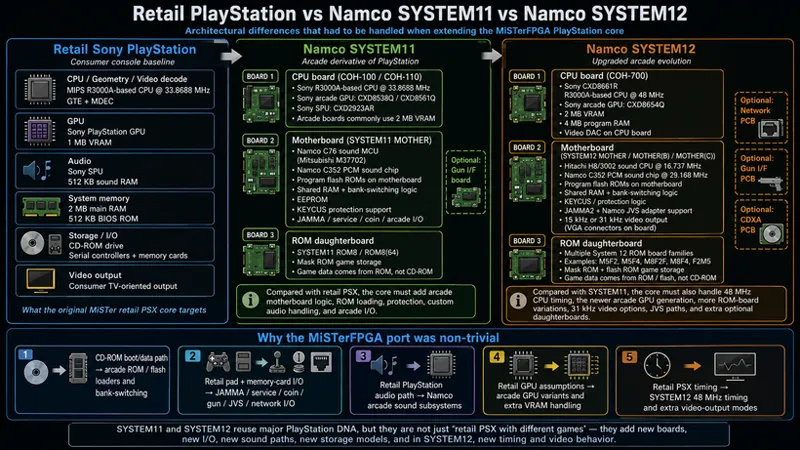
The image above gives a simplified architectural view of just how much changes between the retail PlayStation, SYSTEM11, and SYSTEM12.
They share a huge amount of PlayStation DNA, which is exactly what made the original MiSTer PlayStation core such a valuable starting point.
But supporting these machines accurately means recreating the arcade hardware surrounding that PlayStation DNA, not simply loading a different game.
That work is what has made it possible to use the PlayStation core as a functional foundation for games like Tekken, Tekken 2, Soul Edge, Tekken 3, Soul Calibur, Ehrgeiz, Fighting Layer, Libero Grande, Tekken Tag Tournament, and the rest of the SYSTEM11/SYSTEM12 family.
There is still refinement ahead, especially as we continue validating edge cases across the enormous variety of SYSTEM12 ROM boards and peripheral configurations, but the underlying architecture has come a very long way.
As always, thank you to everyone testing builds, reporting issues, comparing against real hardware, documenting boards, and supporting the project.
More SYSTEM12 core development updates soon.
Disclaimer
All product names, company names, project names, platform names, hardware names, game titles, logos, trademarks, registered trademarks, copyrighted materials, source code, and other intellectual property referenced in this post are the property of their respective owners.
This includes, but is not limited to, MiSTer, MiSTer FPGA, MiSTerFPGA, MiSTer-devel, PSX_MiSTer, Analogue, Analogue Pocket, openFPGA, MAME, The MAME Project, GitHub, Intel, Altera, Sony, Sony Computer Entertainment, Sony Interactive Entertainment, PlayStation, Namco, Namco Limited, Namco Hometek, Bandai Namco Entertainment, Bandai Namco Holdings, Namco System 12, Arika, Atlus, Metro, MOSS, Raizing, Eighting, Square, TOMY, Mitsubishi Electric, Renesas Electronics, and their respective parent companies, subsidiaries, licensors, developers, publishers, distributors, and rights holders.
Referenced Namco System 12 game titles include, but are not limited to:
Documented, dumped, preserved, reported, prototype, location-test, or otherwise historically associated Namco System 12 software includes, but is not limited to… Aerosmith: Quest for Fame; Aqua Rush; Attack Pla-Rail; Bust a Groove: Arcade Edition; Bust a Groove 2: Arcade Edition; Derby Quiz My Dream Horse; Ehrgeiz; Fighting Layer; Ghoul Panic; Golgo 13; Golgo 13: Kiseki no Dandou; Golgo 13: Juusei no Requiem; Gunbarl; Kaiun Quiz; Kart Duel; Libero Grande; Mr. Driller; Oh! Bakyuuun; Paca Paca Passion; Paca Paca Passion 2; Paca Paca Passion Special; Point Blank 2; Shin Nihon Pro Wrestling Toukon Retsuden 3 Arcade Edition; Soul Calibur; Super World Stadium ’98; Super World Stadium ’99; Super World Stadium 2000; Super World Stadium 2001; Techno Drive; Tekken 3; Tekken Tag Tournament; Tekno Werk; Tenkomori Shooting; Truck Kyosokyoku; Um Jammer Lammy NOW!; and other known, region-specific, revised, prototype, location-test, unreleased, undumped, or not-yet-preserved software developed for or demonstrated on Namco System 12 hardware.
Alternate regional titles, spellings, revisions, and names—including Ghoul Panic / Oh! Bakyuuun and Point Blank 2 / Gunbarl—refer to their respective regional or hardware-specific releases. References to any title do not imply that every version, revision, prototype, or regional build has been publicly released, fully dumped, preserved, implemented, or verified as operational.
All associated characters, artwork, music, sound effects, voice recordings, audiovisual materials, game data, regional versions, software revisions, location-test versions, prototypes, undumped software, unreleased builds, cabinet designs, control systems, hardware designs, software, and derivative works remain the intellectual property of their respective rights holders.
References to SYSTEM12 MOTHER PCB, SYSTEM12 MOTHER(B) PCB, SYSTEM12 MOTHER(C) PCB, SYSTEM12 CPU PCB, COH-700, GP-15, SYSTEM12 ROM PCBs, SYSTEM12 M4F6, SYSTEM12 M5F2, SYSTEM12 M5F4, SYSTEM12 M8F2F, SYSTEM12 M8F4, SYSTEM12 M8F6, SYSTEM12 M10X64, SYSTEM12 F2M5, SYSTEM12 networking hardware, gun-interface hardware, CDXA hardware, game-specific I/O boards, KEYCUS devices, KC-series protection devices, C352 audio hardware, H8-series processors, Sony PlayStation-derived processors and graphics hardware, CPLDs, PALs, FPGAs, Flash ROM, mask ROM, EEPROM, NVRAM, SDRAM, SGRAM, JAMMA, USB-link hardware, light-gun interfaces, analog controls, steering controls, rhythm-game controls, HDMI, DDR memory, M10K memory blocks, altsyncram, FPGA implementations, emulation behaviour, source-code repositories, hardware specifications, software cores, compatibility research, and related technologies are provided solely for identification, technical documentation, commentary, interoperability, preservation, educational, and research purposes.
This is an independent, non-commercial hardware-preservation and interoperability project. The use of any names, titles, trademarks, copyrighted materials, or technical information does not imply sponsorship, authorization, endorsement, affiliation, licensing, or association with this post, its creator, the MiSTer project, or any related hardware or software development project.
No ownership of third-party intellectual property is claimed. No copyrighted game software, ROM images, CD-ROM images, BIOS files, firmware, sound data, MCU program data, protection-device data, security-chip key data, encryption keys, proprietary source code, or other proprietary game data is provided with this post.
Any compatibility information, research findings, hardware descriptions, implementation details, or references to incomplete, experimental, prototype, unreleased, or undumped software are presented on a best-effort basis and should not be interpreted as confirmation of availability, ownership, authorization, preservation status, or future support.
All rights are reserved by their respective owners.
Comments (5)
Very good, good job man.
Street fighter ex series please 🥲
Awesome write up. I own all the original Tekken PCBs (Even the Tekken 2 alpha version - almost every PCB you see there is the beta version). Even with AI assists this is a huge effort, and your sharing of this info in such an easy to digest manner really helps preservation. Cheers!
Hi, For SYSTEM11, would you consider re-enabling the core-specific Video & Audio menu and adding CRT geometry controls similar to JTFRAME/Jotego — especially H-Position, V-Position and horizontal size/width — for native 15 kHz analog output? I use MiSTer in a real arcade cabinet with a fixed 15 kHz CRT, so being able to centre and size the image directly from the OSD is extremely useful. Also, have SYSTEM11's native 15 kHz timings and active video area been compared against a real PCB? Thanks for your work! 😉
Hello, yes I hope to add this function to all releases soon. Thank you for your support.