




Sympathetic nervous system activity
The sympathetic nervous system (SNS) is associated with the fight-or-flight response. At least two elements of this response have practical implications for strength training but they are not widely considered. Here is a quick summary.
.
#1. The sympathetic nervous system affects excitation-contraction coupling
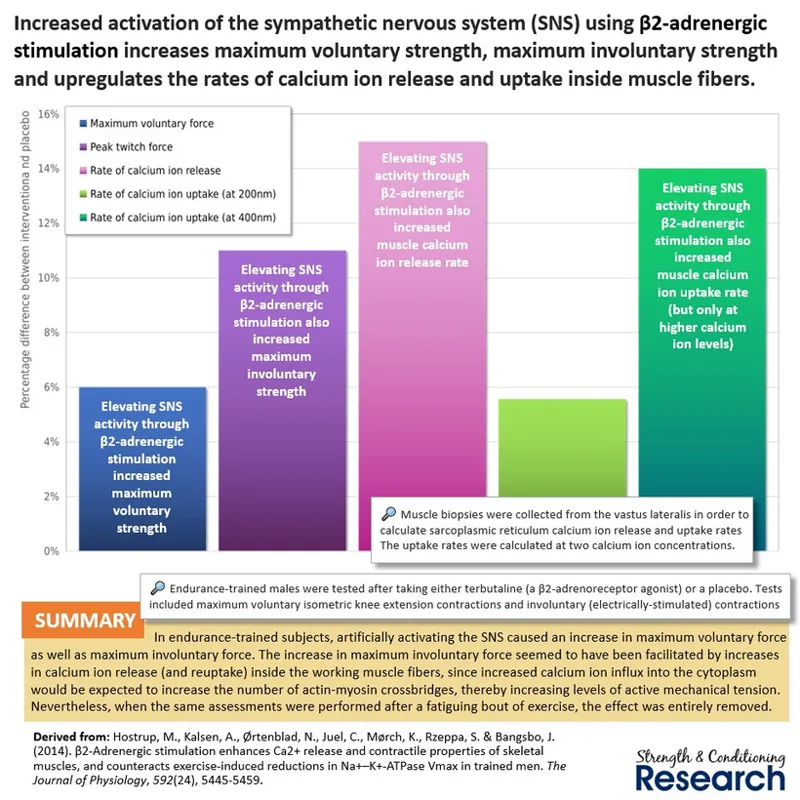
Excitation-contraction coupling involves the release (and reuptake) of calcium ions from the sarcoplasmic reticulum into the cytoplasm. Increasing the activation of the sympathetic nervous system causes an increase in the release and reuptake of these calcium ions, enhancing excitation-contraction coupling and increasing the formation of actin-myosin crossbridges. Evidently, this subsequently increases the amount of active mechanical tension that is generated by the muscle fiber.
.
#2. The sympathetic nervous system increases spinal excitability
When sympathetic nervous system activity is increased, there is an increase in the amplitude of persistent inward currents (PICs) in the spinal cord motor neurons. These act to perpetuate motor unit firing after a motor unit has been recruited.
.
#3. The sympathetic nervous system is affected by static stretching
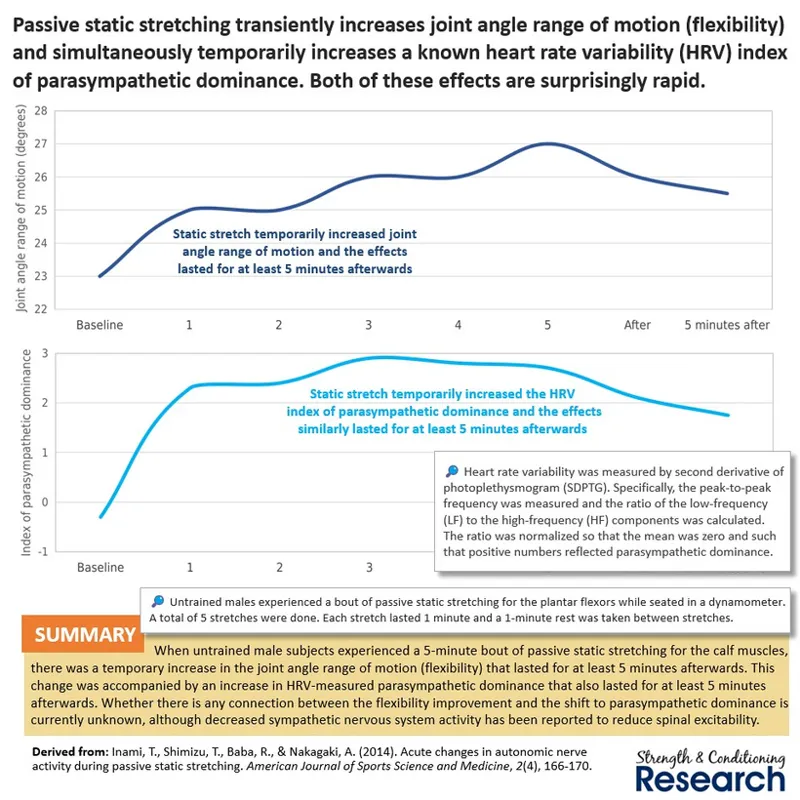
Interestingly, parasympathetic dominance is increased very quickly by a bout of passive static stretching, albeit the mechanism by which this occurs is unknown.
.
Importantly, the magnitude of persistent inward currents can be temporarily reduced by a bout of static stretching, as indicated by reductions in the size of the tendon vibration reflex. Whether this reduction in spinal excitability is caused by the increase in parasympathetic nervous system dominance produced by the static stretches is unknown at this stage but is certainly a logical conclusion.
.
#4. The sympathetic nervous system is affected by posture
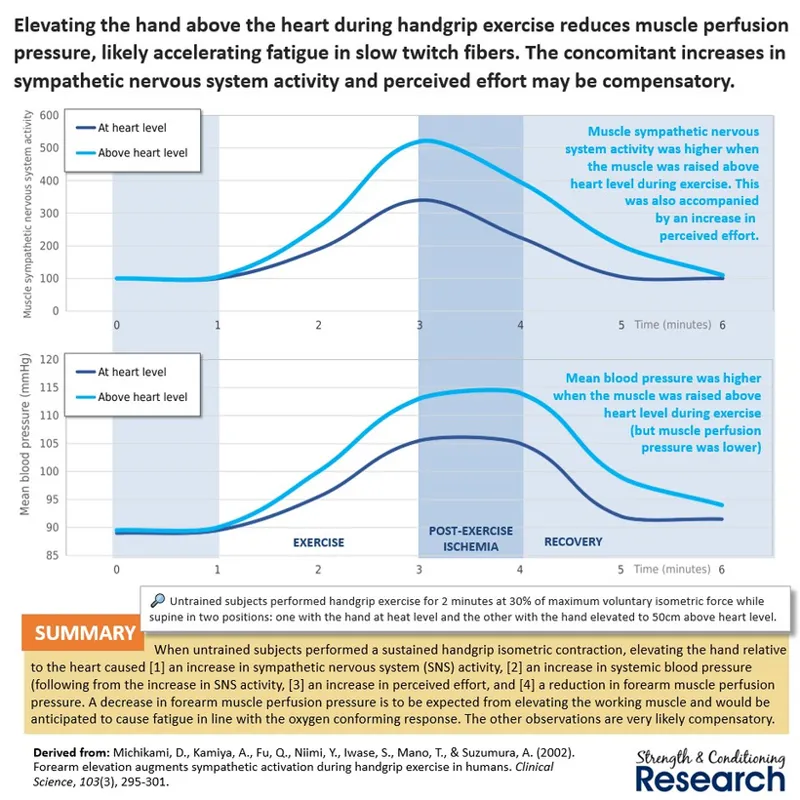
Activity in the sympathetic nervous system can be affected by the posture in which an exercise is performed. When handgrip exercise is performed with the hand elevated above the heart, there is an increase in sympathetic nervous system activity that causes an increase in systemic blood pressure, likely to compensate for the reduced levels of muscle perfusion pressure in the elevated hand muscle.
.
Again, the increase in sympathetic nervous system activity that occurs when the arm muscles are elevated and contracting most likely also causes an increase in persistent inward currents of the motor neurons of the spinal cord, thereby leading to an increase in the level of spinal excitability, sustaining and potentially even increasing levels of motor unit recruitment in the elevated muscles.
.
Conclusions
The sympathetic nervous system (SNS) is associated with the fight-or-flight response. Elements of this response have practical implications for strength training. Specifically, increasing SNS activity causes the release of epinephrine (adrenaline) and norepinephrine. Releasing epinephrine increases calcium ion release and uptake inside activated muscle fibers, leading to the formation of a larger number of actin-myosin crossbridges and thus greater active mechanical tension. Even so, the amount of epinephrine release needed is quite large for meaningful increases in actin-myosin crossbridge formation to occur, which likely limits the practical implications. Releasing norepinephrine increases the amplitude of persistent inward currents (PICs) that are located in the motor neurons of the spinal cord and which act to perpetuate motor unit firing after a motor unit has been recruited. Consequently, when SNS activity is increased, there is an increase in the amplitude of PICs that contributes to an increase in spinal excitability (and possibly also to an increase in motor unit recruitment). In practice, we can see that passive static stretching decreases SNS activity and also temporarily decreases the amplitude of PICs, thereby reducing spinal excitability. This reduction in spinal excitability could possibly contribute to the well-known temporary reduction in muscular strength that occurs immediately after static stretching bouts. Conversely, elevating a muscle above the level of the heart during exercise increases SNS activity and also temporarily increases the amplitude of PICs, thus increasing spinal excitability.
Comments (5)
Is it correct to say that arousal/stimulation of sympathetic nervous system activity can be treated as a fitness component in fitness-fatigue model? Just as PAP?
Of course, yes
Chris, what is your IG account? I cannot find you on there. TY
Prescription stimulants, such as Adderall, increase sympathetic nervous system arousal. If I understand correctly, someone on this medication might require a lower volume? Also, wouldn’t this mean that the first set becomes even more disproportional in terms of stimulus?
Merry Christmas, thank you so much for the work you do