







Insufficient sleep causes atrophy
In a previous article, we analyzed how insufficient sleep might produce negative effects during strength training workouts by affecting the magnitude of the stimulus for various neural and peripheral adaptations. In this follow-up article, we will look at how insufficient sleep affects muscle mass directly, irrespective of exercise.
.
#1. Effects of insufficient sleep on muscle mass
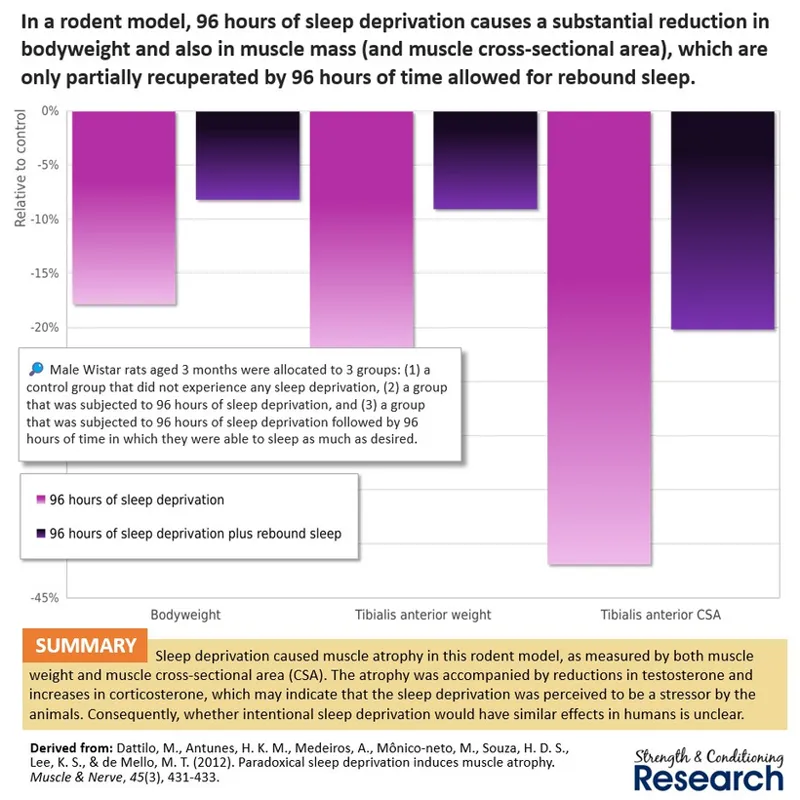
Insufficient sleep can be categorised as either sleep deprivation or sleep restriction. Sleep deprivation generally refers to one or more nights without any sleep. Sleep restriction (also called partial sleep deprivation) refers to one or more nights with less than the normal amount of sleep. When sleep deprivation or sleep restriction occur for more than one night, this is often called "persistent" sleep deprivation or restriction. In animal models, persistent sleep deprivation has been shown to cause atrophy directly.
.
#2. Fiber type-specific effects of insufficient sleep
When predominantly fast twitch and predominantly slow twitch muscles are measured after a period of insufficient sleep, the predominantly fast twitch muscles display far more atrophy than the predominantly slow twitch muscles.
.
Importantly, this phenomenon is attributable to very large reductions in the size of fast twitch muscle fibers and minimal changes in the size of slow twitch muscle fibers. Immobilization and caloric restriction do not produce this fiber type-specific atrophy. Moreover, the atrophy produced by immobilization and caloric restriction is not spared by nutritional interventions, while the fast twitch fiber-specific atrophy caused by insufficient sleep appears to be greatly affected by the presence of dietary leucine.
.
#3. Insufficient sleep reduces myofibrillar protein synthesis and likely also increases muscle protein breakdown
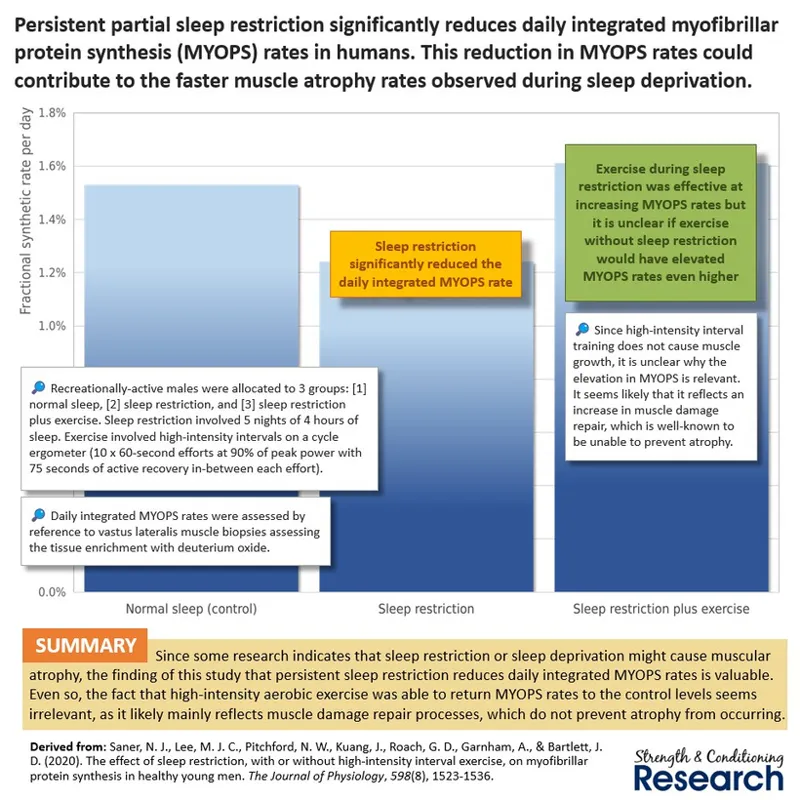
Muscle size is maintained by the balance between MYOPS rates and myofibrillar protein breakdown (MPB) rates, so either reductions in MYOPS rates or increases in MPB rates could be responsible for atrophy. In humans, persistent sleep restriction definitely reduces daily integrated rates of myofibrillar protein synthesis (MYOPS) but its effects on muscle protein breakdown are still unclear.
.
Mechanical tension during strength training workouts stimulates an increase in muscle fiber size by increasing MYOPS rates, while MPB rates are not greatly affected. Muscular atrophy during detraining, bed rest, or immobilization is caused by a reduction in MYOPS rates, while MPB rates are not greatly affected.
.
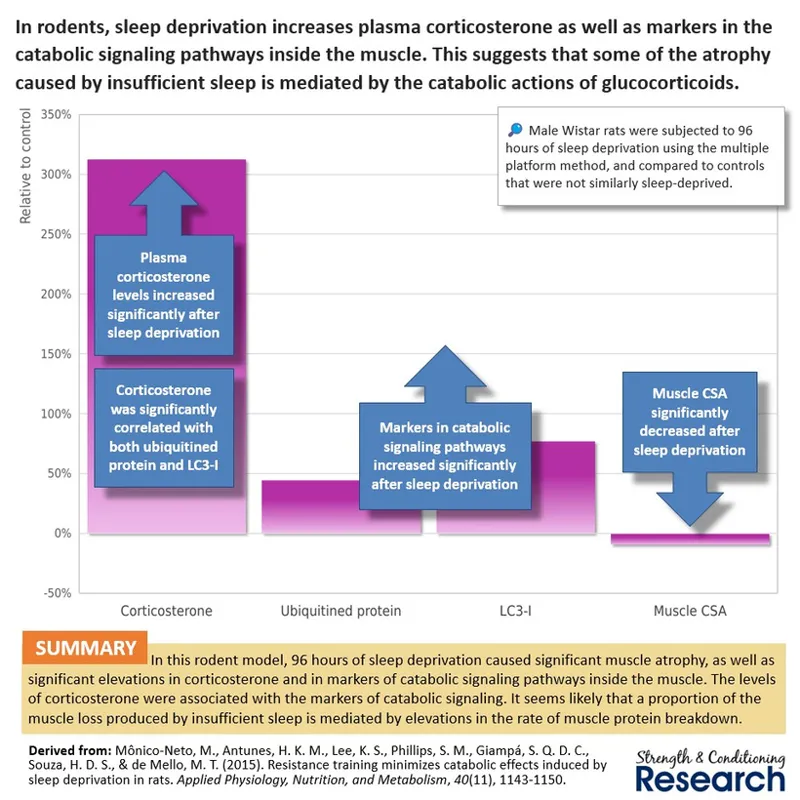
However, it does seem likely that insufficient sleep causes an increase in muscle protein breakdown rates based on animal studies. The elevations in glucocorticoids caused by the lack of sleep appear to stimulate catabolic signaling pathways leading to muscle atrophy.
.
#4. Insufficient sleep causes muscle damage
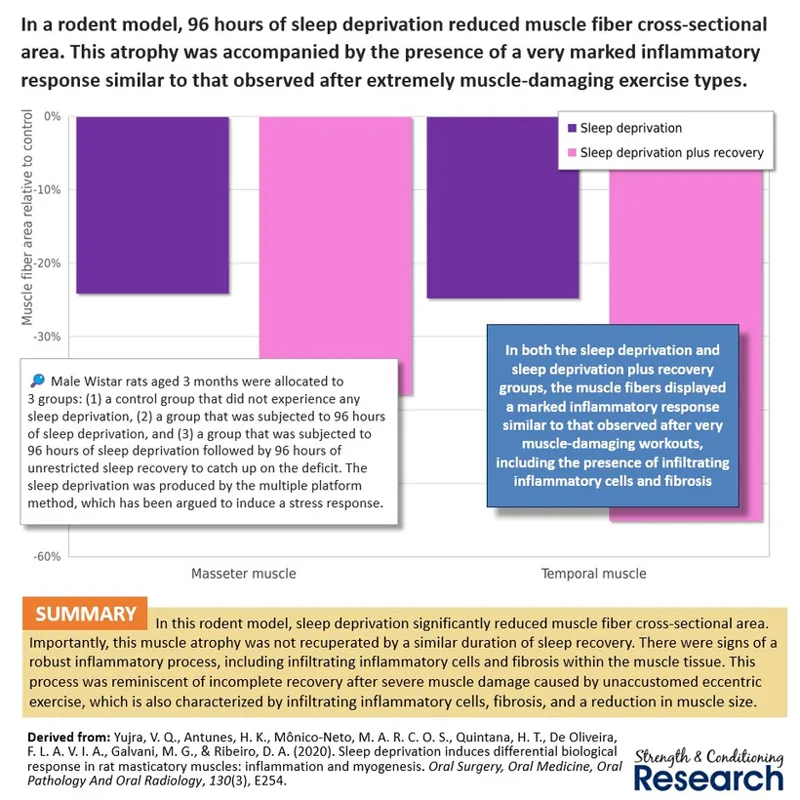
Curiously, insufficient sleep is associated inflammation, structural muscle damage, and even fibrosis that is more prevalent in the slow twitch muscle fibers than in the fast twitch muscle fibers, even though the atrophy affects the fast twitch muscle fibers to a greater extent.
.
In this way, the nature of the muscle damage response appears to reflect situations where muscle damage is not completely repaired after very intense eccentric training programs that produce high quantities of oxidative stress and inflammation (read more).
.
#5. How does insufficient sleep produce muscle atrophy and muscle damage?
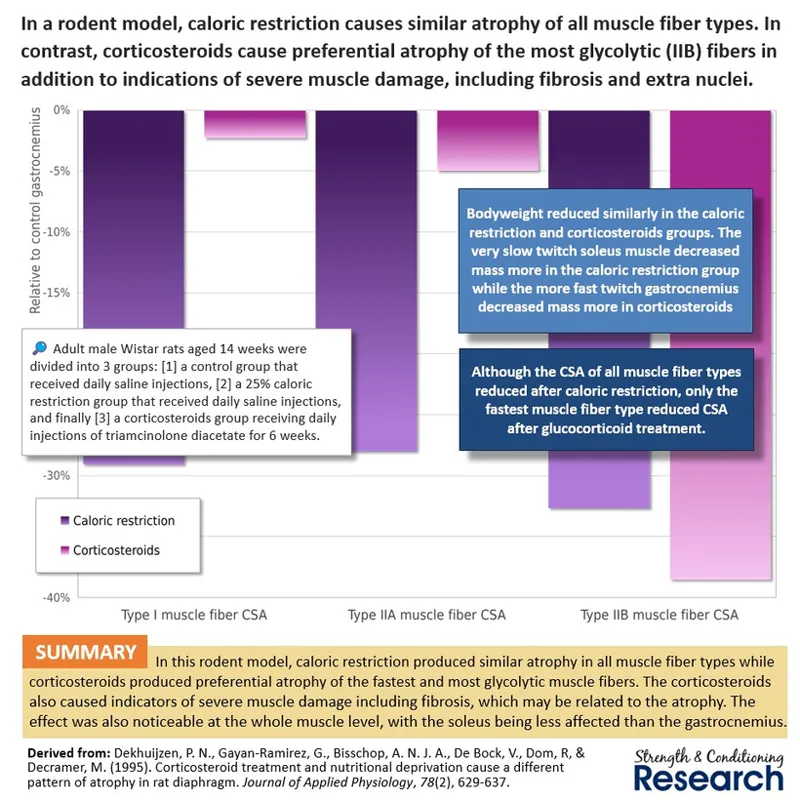
Several lines of evidence point to glucocorticoid production as the mechanism by which insufficient sleep causes muscle atrophy and damage. Firstly, while immobilization and caloric restriction cause atrophy of all fiber types similarly, glucocorticoids only produce atrophy of the most glycolytic muscle fibers (in exactly the same way as insufficient sleep).
.
Secondly, while glucocorticoids are well-known for their catabolic activity that increases muscle protein breakdown rates, there is also data showing that they decrease muscle protein synthesis rates. This is exactly what happens with sleep deprivation.
.
Thirdly, the provision of dietary leucine can mitigate the muscle atrophy effects occurring subsequent to glucocorticoid administration (in the same way leucine mitigates the muscle atrophy that is observed in response to insufficient sleep).
.
Fourthly, glucocorticoid administration causes inflammation and muscle damage that is more prevalent in slow twitch muscle fibers, even though it also causes muscle fiber atrophy that is only noticeable in fast twitch muscle fibers.
.
Observations of greater muscle damage in slow twitch muscle than fast twitch muscle as a result of glucocorticoids can be supported by the fact that myofibrillar sensitivity is also more impacted by glucocorticoids in slow twitch muscle compared to fast twitch muscle. Losses in myofibrillar sensitivity and muscle damage are both calcium ion-related fatigue mechanisms. This suggests that glucocorticoids stimulate calcium ion-related fatigue mechanisms, likely by way of causing mitochondrial dysfunction that increases oxidative stress.
.
Conclusions
Insufficient sleep can be categorised as either sleep deprivation or sleep restriction. Sleep deprivation generally refers to one or more nights without any sleep. Sleep restriction (also called partial sleep deprivation) refers to one or more nights with less than the normal amount of sleep. When sleep deprivation or sleep restriction occur for more than one night, this is often called "persistent" sleep deprivation or restriction. Insufficient sleep of a high enough magnitude has been shown to cause atrophy in both animals and humans. It seems likely that insufficient sleep causes atrophy by increasing production of endogenous glucocorticoids (GCs) like cortisol. Insufficient sleep and GC administration share four key features: [1] insufficient sleep and GCs only cause atrophy of fast twitch fibers (immobilization and caloric restriction affect slow and fast twitch fibers), [2] atrophy caused by insufficient sleep and GCs can be partly rescued by dietary leucine (atrophy caused by immobilization is not), [3] insufficient sleep and GCs both cause atrophy by reducing muscle protein synthesis and increasing muscle protein breakdown (atrophy caused by immobilization mainly works by reducing muscle protein synthesis), and [4] insufficient sleep and GCs cause oxidative stress, an inflammatory response, and muscle damage that is more pronounced in slow twitch fibers (damage is less apparent and not so influenced by muscle fiber type during immobilization and caloric restriction).
