


Latissimus dorsi regions
The latissimus dorsi can be divided into multiple regions, vertically. Conventionally, we recognize upper (thoracic), middle (lumbar), and lower (pelvic) regions. However, given the very similar leverages of the middle (lumbar) and lower (pelvic) regions, these are often combined into the lumbopelvic region. Many opinions have been put forward regarding whether these regions can be targeted with different exercises. Here is what we know.
.
#1. Latissimus dorsi regions have very different internal moment arm lengths (IMALs) according to the plane of motion
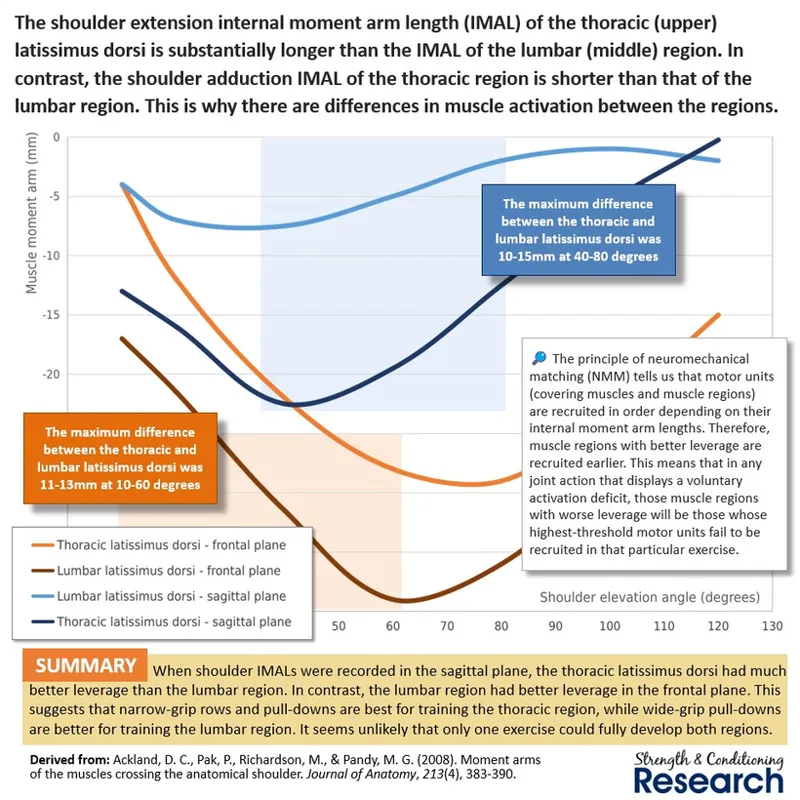
The upper (thoracic) region of the latissimus dorsi has far better leverage than the middle (lumbar) region in sagittal plane shoulder extension. In contrast, The middle (lumbar) region has far better leverage than the upper (thoracic) region in frontal plane shoulder adduction. As you can see from the following infographic, the magnitude of the difference in the IMALs between the regions is very large. It therefore seems highly unlikely that the upper region is fully activated in frontal plane movements (like wide-grip pull-downs) nor that the lower part is fully activated in sagittal plane movements (like narrow-grip rows and pull-downs).
.
#2. Latissimus dorsi regions also display differences in muscle activation according to the plane of motion
When researchers have measured muscle activation by surface electromyography (EMG) amplitudes, they have found that the upper regions of the latissimus dorsi display relatively higher activation than the lower regions in sagittal plane shoulder extension, while the lower regions display relatively higher activation than the upper regions in frontal plane shoulder adduction. This is exactly what we would expect based on the IMALs and it confirms that the upper region is almost certainly not maximally activated in frontal plane movements (like wide-grip pull-downs) and the lower part is similarly not maximally activated in sagittal plane movements (like narrow-grip rows and pull-downs).
.
Although few studies have measured surface EMG amplitudes, some researchers have made use of other EMG measurement methods and shown similar results. Here, the lower regions of the latissimus dorsi display much greater indicators of agonist muscle activation in the frontal plane, while the upper regions display signs of being merely synergists.
.
#3. Differences between latissimus dorsi regions are larger than the differences between deltoid heads
One of the key arguments put forward by those fitness influencers who wish to argue that the entire latissimus dorsi complex is activated maximally in both the sagittal and frontal planes is that the "differences in leverages are small between latissimus dorsi regions." However, as we can see from the following analysis, the maximum difference between the middle deltoid and the anterior deltoid in the lateral raise exercise is 8-10mm. And the maximum difference between latissimus dorsi regions in the frontal plane is 11-13mm. Does anyone argue that both the anterior and middle deltoid are maximally activated in lateral raises? I highly doubt that. To be logically consistent, we therefore must accept that the upper (thoracic) latissimus dorsi is not maximally activated in wide-grip pull-downs.
.
Indeed, we have good data showing that surface EMG amplitudes are greater for the middle deltoid than for the anterior deltoid during frontal plane abduction, exactly as we expect.
.
Conclusions
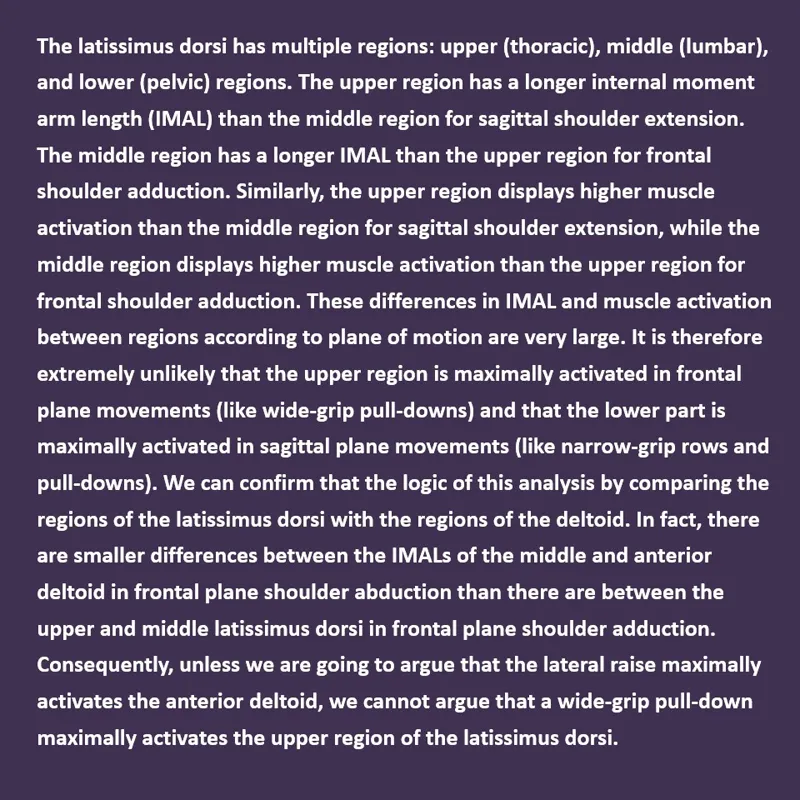
The latissimus dorsi has multiple regions: upper (thoracic), middle (lumbar), and lower (pelvic) regions. The upper region has a longer internal moment arm length (IMAL) than the middle region for sagittal shoulder extension. The middle region has a longer IMAL than the upper region for frontal shoulder adduction. Similarly, the upper region displays higher muscle activation than the middle region for sagittal shoulder extension, while the middle region displays higher muscle activation than the upper region for frontal shoulder adduction. These differences in IMAL and muscle activation between regions according to plane of motion are very large. It is therefore extremely unlikely that the upper region is maximally activated in frontal plane movements (like wide-grip pull-downs) and that the lower part is maximally activated in sagittal plane movements (like narrow-grip rows and pull-downs). We can confirm that the logic of this analysis by comparing the regions of the latissimus dorsi with the regions of the deltoid. In fact, there are smaller differences between the IMALs of the middle and anterior deltoid in frontal plane shoulder abduction than there are between the upper and middle latissimus dorsi in frontal plane shoulder adduction. Consequently, unless we are going to argue that the lateral raise maximally activates the anterior deltoid, we cannot argue that a wide-grip pull-down maximally activates the upper region of the latissimus dorsi.