

Radio War Nerd #331 — The Italian Wars, Part I: Introduction (with Annibale)
Guest: Annibale
Recorded: May 24, 2022
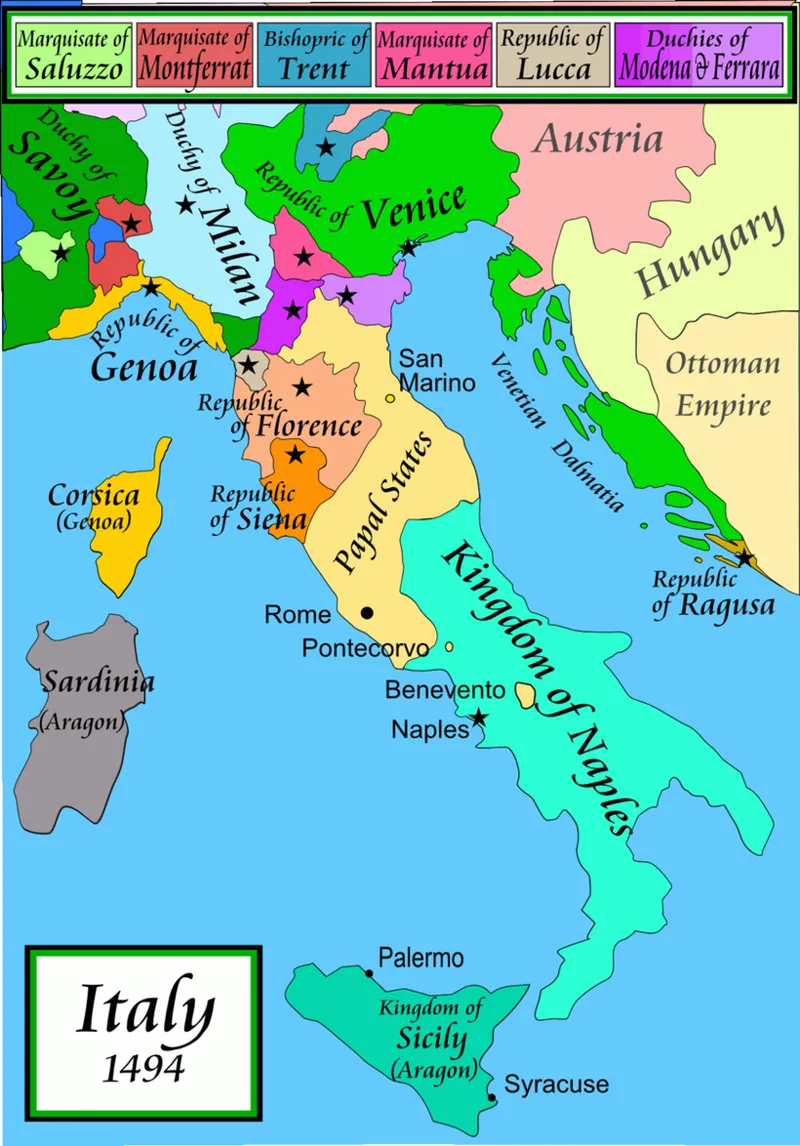
Fave RWN guest Annibale returns for a new series on the Italian Wars (1494-1559), which radically transformed warfare, technologies and European geopolitics. In this introductory episode, Annibale sets the background to French king Charles VIII's invasion of the Kingdom of Naples in 1494, kicking off 65 years of Italian Wars.
*Map of Italy, 1494
Book referenced:
-The Italian Wars, 1494-1559, by Christine Shaw & Michael Mallett
Follow Annibale on Twitter.
Listen to Annibale's RWN series: The Hundred Years War (#175, #176, #177, #180, #182, #183); Italy's Years Of Lead (#134, #135,#136, #139); Italian Resistance in WW2 (#131); Italy on the Eastern Front in WWII (#226, #227, #228, #231, #236); Venetian Empire (#207, #208, #209, #214).
Buy John Dolan's book "The War Nerd Iliad" and his audiobook "Pleasant Hell".
Interlude music by Brendon Anderegg. Check out his group Mountains here.
Total time: 1:41:15







Comments (33)
What’s the political memoir that Annibale references??
The Memoirs Of Philip De Comines
There was a prestige TV series called 'the Borgias' from a couple years back that explores these events from a Papal point of view. Interested to get a sense of what they got right and wrong.
Great listen, as always.
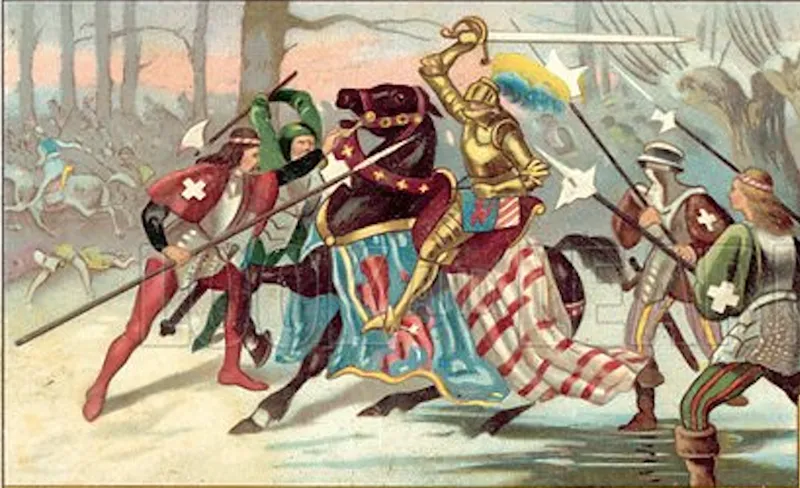
I mean, Swiss mercenaries must have been pretty fucking bad if the peace of Westphalia bans them.
Could you discuss why, in all that turmoil, Protestantism never made any inroads in Italy?
The simple answer may be that conditions weren't those rights for a Protestant takeover, as the upper mercantile and manufacturing classes at some point decided (possibily because of the wars) that they preferred social peace to some sort of "ideology of wealth": The lact of real early Italian colonialism helped too. But for me the main reason was the council of Trento. Simply, a pact was stipulated between Italian social groups to something like "We trade acceptance of Catholicism (and thus a more restrictive take on individual success, wealth = God's favor etc) in exchange for no sectarian wars and a much more colorful / less grim social culture. See it as a trade between outspoken wordly success and peace. The fact that the Catholic Church was able to promote his line as "no sectarian warfare in Italy! NO SECTARIAN WARFARE IN ITALY!) was an enormous plus when the 30 Years War came and everyone became "meh" about fighting for your right to interpret the Bible.
As an American abroad I can confirm that people do react better when they believe you are from California. And when I, a wretched Floridian, tell people I am from Florida and they mistakenly believe or hear that that is California I let the charade continue.
"let the charade continue" is good life advice in general
Thank you so much Annibale! I was starting to get worried something had happened to you. I just wanted to mention that there is a new way in the Anglophone world that people know of the Pazzi and their conspiracy. The video game Assassins Creed 2 has them featured as an early antagonist to your character. You came from a major Tuscan banking family who get executed after being framed by the Pazzi and you have to take revenge upon them. The game sets itself in late 15th century Italy with Florence and Venice being the two main settings, with also the towns of Monetriggoni, San Gimignano, and Flori. After you defeat the Pazzi, Rodrigo Borgia becomes your main antagonist. There is also a sequel that features Rome and your antogonist is now Cesare Borgia. Oh, one last piece of the lore is that your father who comes from a line of Assassin's (and you are one as well) and tries to save his friend Galeazzo Maria Sforza from being murdered. The whole arc of Ezio Auditore da Firenze (your characters name) is the best part about the whole series. They did do Venice dirty though by showing the city administration to be slightly incompetent at rooting out conspiracies and secret societies which is the exact opposite of reality. Either way I love that you are back and hope you can do more episodes in the future (I am dying for not just something on Garibaldi but the entire Risorgimento and the following years politically up to about Adwa). Thanks
Tried to check Assasin Creed, but it's way too fantasy to enjoy it if you know a bit about Renaissance Italy. The whole Venice segment is a bit of a joke. The greatest pop version of that era remains Robin Wood's "Dago" series of comic books.
This is like Christmas morning. Grazie Annibale!
You're welcome!
I would love you guys to do an episode about the welsh revolt of 1400-1415. I studied history and did my dissertation on Medieval Wales, an earlier period than this, but if you guys thought it would be a cool episode I would love to talk to you! Trust me it has everything. And your audience would definitely be less aware of it than say the Scottish Wars of Independence or Early Irish revolts
I was just looking at reviews of books about glyndwr and one mentioned that Fidel Castro referred to him as the 'world's first guerrilla leader'. That tickled me a bit
Thanks for this Episode Annibale! Do you have book suggestions for a deeper dive?
The best "affordable" overview of the wars in English that's not totally shallow and tries to understand some of the finer details is the one we've mentioned in the show. The are others more in depth but are either expensive or dated. But if you can read a translation of De Commynes and Guicciardini, it's still a tremendous narrative of the early wars and its causes. Or if you're interested in the hardware, the Massimo Predonzani series translated and edited by Helion Publishing is very good . https://www.amazon.it/Italian-Wars-1494-1559-Society-Modern/dp/0582057582
when the first aside starts after 2 minutes in [vince_mcmahon_freaking_out.jpg]
I've said it's complicated!
Agreed
In response to Travis Eller, I think I discovered the word “racist” has different connotations in French and Italian than in English, where it is extremely pejorative, and brings up connotations of segregation, scientific racism and the like. I think in the Latin languages its meaning is more like the English “prejudiced.” Just my two cents. As far as the present series I am delighted with this choice of topic and can’t wait to hear more. My background in more in literature and I have always wanted to know more about the history of this exceedingly complex period. I hope Annibale will discuss the sack of Rome.
Italy can be extremely racist, and the Fascist governement became at some point explicitly racist with the 1938 laws. Plus the Salò Republic openly collaborated to the Shoah, period. But "scientific racism" never really catched on in italy, and in general "racism" was never common societal glue here. There are many different reasons, none of them related to Italian being "better people" or any other nonsense. It's a mixture of the Catholic clergy's opposition (particularly in the North) to any "scientific" definition of races, plus the influence of an extremely fragmented and localized culture. And last but not least, the fact that "scientific racism" had this cultural stigma of being "a German thing", and so synonymous of barbarity because of the Reunificationr rethoric
Just listened to the Venice series and I’m ready for more…. Thanks guys!
I love his episodes because like a entertaining dense book you need to read (listen) multiple times to get the details.
Hell yeah, those countless hours in EU4 are paying off
A note regarding Annibale: He makes the claim in the episodes on Italy's participation on the Eastern Front that Italy, in contrast to Germany, did not endorse the racial ideology which is undergirded the holocaust. This is utterly ridiculous. The Italian Fascists were just as racist toward 'dark' Southern Italians as the Germans were towards the Jews. Gramsci makes this point in his "On The Southern Question" and Giuseppe Fiori demonstrates how this type of racialization was used to suppress wage levels amongst Sardinian miners in his biography of Gramsci. The main difference between Germany and Italy was that Italian nationalist-fascists were more culturally cosmopolitan compared to the culturally provincial Germans; both of which were the ideological veil used to cover their otherwise indistinguishable nationalist-liberal movements. The Germans thought 'if only the Jews were gone we could develop more quickly' and the Italians thought 'if only those barbarous peasants had a work ethic we could develop more quickly'. For all his voluminous empirical knowledge Annibale is through and through a liberal-bourgeois who is as theoretically impoverished as Hayek; he just playfully subverts liberal-bourgeois ideology to feign criticality. His theoretical understanding of Venice demonstrates this as well, taking capitalism to simply be the expansion of commerce rather than a socially organized mode of production distinguishable from the socially organized modes of production which preceded it. Ellen Meiksins Wood is leagues ahead of him in understanding that. See the reader of her work compiled by Historical Materialism. Just ask him what he thinks of Bennedetto Croce; he'll characterize him as the Italian inheritor and supersession of Marx following Labriola. In reality, It goes Marx -> Labriola -> Gramsci with Croce playing the role of liberal apologist who work emphatically to distance Italy from its fascist past.
Assuming your comment is serious: 1) I greatly dislike Croce and whatever Croce stands for, and the idea I or anyone else can consider him the inheritor of Marx or Labriola is pure comedy. Croce did a ton of damage to Italian culture and no, not my type of philosopher 2) There never was and never is today any "Italian Fascists racists towards "dark" southern Italians". In fact it's exactly the opposite. There was / is definitely a Southern Italy question and there was /is a generalized and often virulent anti-southern racism in many areas of the North. This was much more acute in the past, but it has somehow toned down in the last couple of decades, without however disappearing. But Fascism played totally the opposite card, saying that "all Italians are Italians" and opposing (often violently) nationalism to regionalism. This made the fascist politics very popular in many areas of the South, in particular Campania and Sicily, while in others (like Puglia) were class instances prevalied over "etnicity" they were less succesful. Gramsci never said that Fascism was promoting inter-Italian racism, he said that for all their posture, Mussolini not only had not solved the Southern Question, but in many case, using class repression, had exacerbated it. The whole Sardinian thing is a different issue, because Sardinia is not considered part of the South and has always lived through different political and social issues. As for Venice and Hayek, I wouldn't put them in the same sentence (and I hate Hayek, btw). Thanks for commenting
Great episode. I think we're gonna need family trees and flow charts. Lots of people with one name.
Yeeeeeees
*The Alan Parsons Project’s “Sirius” starts playing*
The return of the king
Lets goooooooo
oh man I saw Annibale in the patreon notif and thought, whew, this is gonna be a complicated one, but I wasn't anywhere remotely ready, mentally and emotionally, to see this map