

Radio War Nerd #264 — The 1970 Borghese Coup, Part One. With Annibale
Guest: Annibale
Recorded: January 21, 2021
We talk to popular RWN guest Annibale about the murky 1970 Borghese Coup, in the early part of Italy's Years Of Lead. In part one, we look at Junio Borghese's background: the famous Borghese family, his wartime heroics & plans to bomb New York harbor, and his relationship to Fascism, Nazis, James Jesus Angleton and NATO.
Images:
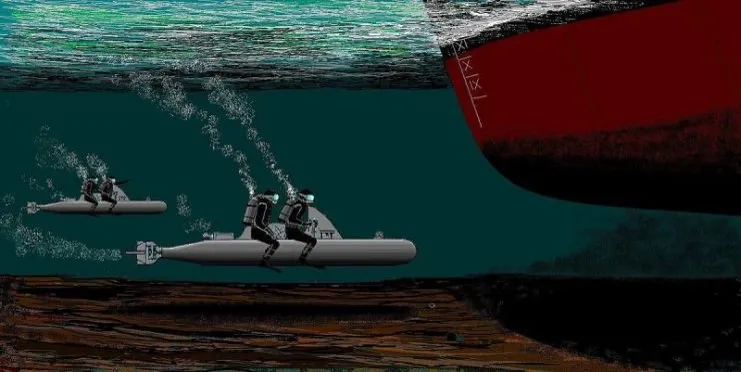
*Drawing of Borghese's manned torpedoes used to bomb British battleships
Follow Annibale on Twitter. Listen to Annibale's popular RWN series: Italy's Years Of Lead(#134, #135,#136, #139); Italian Resistance in WW2 (#131); Italy on the Eastern Front in WWII (#226, #227, #228, #231, #236); Venetian Empire (#207, #208, #209, #214); The Hundred Years War (#175, #176, #177, #180, #182, #183).
Total time: 1:53:26






Comments (22)
Annibale if I may ask one more question, do you know the names of the neo-fascists who supported the Palestinians?
Annibale, I read "The Black Prince and The Sea Devils", and in the book there are two topics which I have tried to research but there is very little information on. 1. It appears that Borghese was involved in the Trieste Crisis of 1953-54. Aside from an off-hand mention of a "bloody uprising" carried out by Borghese and Decima veterans, the authors do not go into further detail on this (there is a very short book/ magazine written on Trieste called "The Trieste Crisis 1953" by Bojan Dimitrijevic from Helion Publishing, if interested). 2. More interestingly, the book mentions that Decima veterans were recruited by the British intelligence services after WW2 to place explosive devices on ships carrying Jewish refugees to Palestine. This is mentioned in a book called “The Secret History of MI6” by Kieth Jeffrey, although he makes no mention of the Decima vets (the mission was known as Operation Embarrass w/in MI6). Are there any resources for these two subjects, in either English or Italian?
Annibale, got a message saying you replied, but your comment didn't show lol. Must be Patreon
What does cat's paw mean?
Very much enjoyed the conversation about the US political scene
pleas retweet/remirror wherever my last post
Supreme Courts Hearing Access High Court of Justiciary Help out a great guy: Case: Petition and Complaint – the Lord Advocate v Craig Murray Date: Wednesday, 27 January 2021 Time: 10.30am Dial (United Kingdom toll): +44-20-7660-8149 Access code: 174 658 1827
Minor nitpick here: the Daily Mail isn't a Murdoch paper - it's still controlled by a Viscount Rothermere (the great-grandson of the pro-Nazi first Viscount). Rupert Murdoch's main British papers are the Times and the Sun.
Thanks for the correction. It sure reads like a Murdoch paper!
Annibale, what was the lesson you referred to earlier in this thread that the ruling class learned from the First World War?
I really liked that film (The Great Beauty), though I took it at face value as a film about a group of friends trying to help eachother survive in modern times. I had to watch it four times as I kept getting absorbed in the scenery and lost the plot entirely. Another of Sorrentinos (the director) films (Il divo) was actually set in the Years of Lead. What did you think of that, Anibale? It is (or was) on Amazon Prime. I liked it better the second time around. An alternative to the term fascist is authoritarian which I think captures the times better as it allows for the idea that our fears drive us. This leads us to accept what we least hate as our political driver and leads to our current miserable state as no-one wants to build anything for the future, just stop people we don't like building what they want. This was briefly discussed at: https://www.youtube.com/watch?v=QYriSO1jT9k Where you can see an old-school Republican arguing for strong unions (at the end)! Great show guys. Much appreciated.
I think your analysis of "Great Beauty" is spot on. There's a scene where Gep, the main character, appears to humiliate Stefania, an insufferably selfish woman who insists on her radical credentials despite being just like any other upper-class privileged people (actually the actress is playing herself, a nice twist). But in fact, he's not scolding her - he's just very calmly and even affectionately trying to wake her up from what he sees as a delusion. It's a very mild and even caring reality check, not a public humiliation. In fact, Gep's characteristic is his refusal to judge people. He knows well about his own shortcomings, so he has no problem accepting those of the others. The movie has no real plot, except the one about Ramona, the stripper (who is the other likable character along with Dadina, the dwarf magazine editor. I'm not a big fan of "Il Divo" - it's a nice film but Andreotti was different.
Borghese family pretty important in 17th c. As Pope Paul V, Camillo Borghese's name is on the facade of St. Peters, completed in his pontificate. He protected Galileo, canonized Carlo Borromeo, etc., etc. Nephew Scipione was the patron of Bernini. I think the family may have originally have been Tuscan (from Siena?).
Yes, they were Tuscanians
@1:40 ish, small correction, the new strain isn't more virulent, it's more transmissible. Transmissible is how quickly it spreads, virulent is how bad it gets when you catch it.
There are some indication the new variants can have a higher fatality ratio (deaths among the infected) but it's a contradictory evidence at best. What worries scientists is that higher transmission rates may mean higher mortality (absolute number of deaths with the population per unit of time). This is because if more people gets it, more vulnerable subjects may get infected.
Hey Mark, could you guys do an episode about the book From Time Immemorial, by Joan Peters? TrueAnon just did some interview eps with Norm Finkelstein, and that book came up. I would be keen to know the details and context of that book (I suspect it's significance at the time is forgotten), but I don't want to actually have to read that pile of crap.
I was shocked that Barabara Tuchman wrote a blurb praising the book, her books are some of my favorites.
I’m sort of a pedant about this, and it was really only briefly mentioned in the middle of the excellent taxonomy-of-fascism discussion, but I will stand up for the idea that Bernie is a socialist in a meaningful sense (if a Fabian one.) While what he proposes is for the most part social democratic reform, he still has a basically Marxist understanding of how politics works, where power comes from, and how reforms are won. If you put him in a more reasonable country, I suspect he would react by upping his demands.
Yeah :(
On fascism: Annibale hit the nail on the head by calling fascism extreme liberalism. And because there is generally a lot of obfuscation with respect to the word "fascism", the marxist approach in my opinion is the more consistent - and I think Annibale trying to draw strict lines on whether Borghese was or not is rather unhelpful. And that is: fascism is in the end a ruling class scheme, ideologically imposed upon increasingly downwardly mobile middle classes. People have to realize that the ruling classes have always been fascist in a sense. Borghese simply didn't think he can win against the Anglos and thus his apparent "liberalism" (that is a capitulation to foreign capital). Trying to define fascism purely in terms of ideology and not paying attention to the ruling class component is rather distracting. Paxton said (quoting from memory) that fascism is the repression of the left amidst popular enthusiasm. So yes, there is a movement in fascism, but it is a movement in the service of sectors of the elite, cultivated by the elite and turned against the interests of the majority. Will Annibale disagree if, for example, we called Mrs. Madeleine "killing 500k children was worth it" Albright a fascist? Do you think they would have any problem with a "totalitarian" state if their interests and property were under risk?
I want to be specific on the labels because calling "fascism" everything to the right of a moderate center, or "fascism," every form of politics we think is evil and oppressive. It is plain wrong and guarantees (as it did during WWII) that anything that calls itself "anti-fascism" gets a pass no matter how reactionary and regressive and plainly bad it is. Albright was not "fascist," and the cynical way she tried to justify the consequences of Iraqi sanctions as "worth it" was not specific to "fascism." In my opinion, it was specific of the way unchecked liberalism works - the interests of a small cosmopolitan clique/class are prevailing above any moral consideration. And the same clique may be focused on a specific nation like the US, but don't really IDENTIFY with it, another instance where nationalists are deluded. If you call everything you don't like "fascism," the term itself loses any meaning. Fascism, conservatism, liberalism, and anti-communism are not interchangeable terms. During the Years of Lead, some of the architects of the worst moments in the strategy of tension were definitely hostile to fascism. Still, they were also more scared by the end of the Yalta status quo and communism/socialism erosion of the liberal norms, so they had no trouble using "fascist" to fight what they considered a bigger threat to their interests.