



Radio War Nerd EP #246 — Arab Conquests, Part I: Pre-Islamic Arabia to Muhammad
Guest: Aamer, podcaster & writer
Recorded: September 13, 2020
We're joined by fellow history pedant Aamer to tell the story of one of the great military empires in history—the Arab Conquests in the 7th and 8th centuries, stretching from modern-day Portugal to Kyrgyzstan. In part 1 of our series with Aamer, we go back to pre-Islamic Arabia to better understand the world that the prophet Mohammad was born into, and end with the death of Mohammad in 632 AD.
Maps:
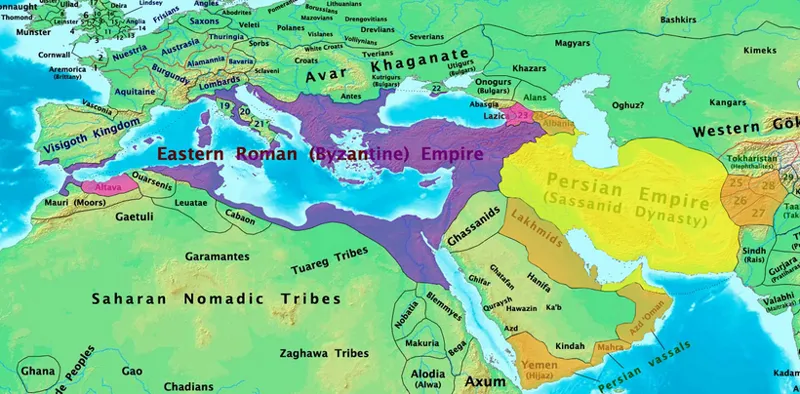
*Major empires, circa-600
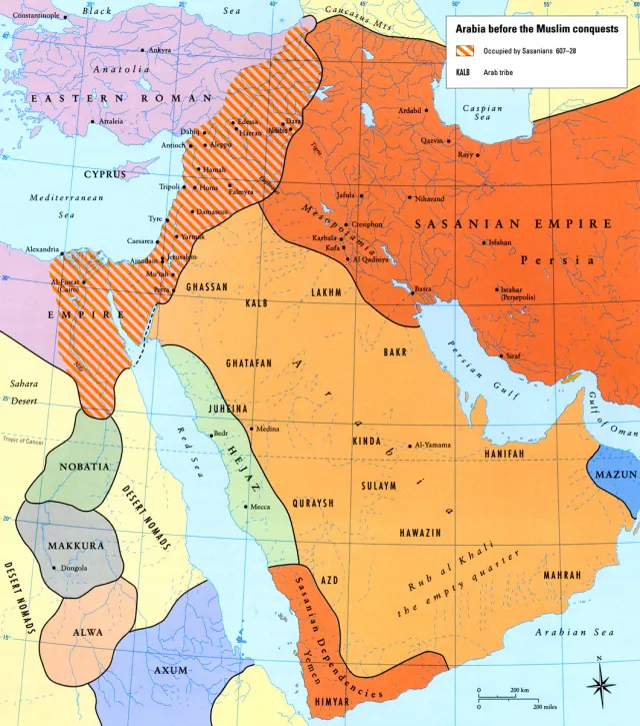
*Arabia before Mohammad's Islamic conquests
*Topographical map
*Battle of the Trench, 626
*Battle of Uhud, 624
Check out Aamer's true crime podcast Das Criminal here. Sign up for Aamer's new substack here.
Total time: 2:37:14
Comments (27)
Listening to this for 3rd time ! Thanks for putting these into collections
Lp
This has got to be a contender for top 10 or even greatest episode ever. I have never read or heard such a complete and clear overview of this story, including a thorough introduction to the society, the political economics, the bigger context of the surrounding empires, the cultural factors, the sturdy camels, and the key people involved, each introduced at exactly the right point. Have you reposted this because it's so great? It is. Also, in this episode the two of you are disciplined in asking the right questions, making the right interventions, and setting up his excellent outline. What a resource of memory and ability to sort it into stories Aamer has. Thank you.
Kudos to the guest for making this so easy to follow!
Fantastic episode all, really enjoyed the content and Aamer is a great guest.
Great exposition!
I'm a new subscriber and this is the first episode I'm listening to. Already completely blown away. So thankful to be hearing you talking about the memorization and oral repetition of very long, complex, hereditary poems. On a certain pedant aside, the procedures that these "poets" use are mnemotechnics, and are widespread in Amerindian indigenous societies as well. In fact the parallels are spot on, the Marubo (a pano-speaking indigenous group on the Brazilian-Peruvian border)have the "saîti" songs, which are enormous metrical, rhyming patterns that repeat ancestry all the way back to the "people before people". Really makes you think that someone like Benveniste, when he wrote the "vocabulary of indoeuropean institutions" (which is a great book to read along with this specific episode), was really tuned in to the global distribution of certain fixed structures. Of course Lévi-Strauss does this about 30 years later, but I'd like to imagine what knowing of these parallels might have done for early structuralism. Anyway so sorry for this winding "comment", this is just to say I love the episode and couldn't be happier with the subscription!
So the uniting of the Arab tribes and the birth of Islam is based around really amazing poetry?
Aamer is a very concise communicator and already one the all time best guests.
Thanks so much!
The important C20th Spanish orientalist Asín Palacios argues in his work 'La escatología musulmana en la Divina Comedia' that the great Sufi mystic Ibn Arabi was one of the main influences on Dante. The book also has an extended discussion of the significance of the Israʾ in this respect.
This website is really slow. Does anyone know if there's some kind of a way to auto-download the mp3 when new eps come out and bypass this terrible interface?
Robert Graves was of the view that Morrocan Arabic was the purest because Morroco had never been occupied by the Turks. Also, does high Arabic differ from lower(?) arabic in the same way that High German differs from Low German? That is, depending on physical geography. Or is the distinction more like Latin where you have vulger and (I suppose) posh Latin which is a class distinction?
I disagree with Robert Graves because Morocco’s Arabic may have not been sullied by the Turk, but it has thoroughly been mixed with pre-Arab Berber languages as well as French due to the colonization. In fact, I would argue the purest Arabic today resides in the Najd plateau, in areas of the desert that were never conquered by the Turks for the simple reason that they had nothing to offer but sand and a nice way to shade the map Ottoman Red. The Ottoman interest in Arabia stopped with the Hejaz and taking Mecca to claim Islamic legitimacy and that’s about it (Yemen is a whole other story, mainly strategic due to the ports). The difference between high and low Arabic is more like Latin than German in that it differs based on class, though today High Arabic is relegated to the fusha (pronounced fus-ha) of newscasts, period piece soap operas, and official government documentation. Speaking High Arabic will elicit more than a few stares and a neon sign indicating you’re an Arabic language student from Europe or something.
Good conversation. But this all appears to be based on the "traditional" history first written down by pious Muslims almost two centuries after Muhammad is supposed to have lived. Tom Holland's book "In the Shadow of the Sword" is a good, highly readable narration of what 40 + years of critical historical scholarship has done to these traditions -- which are discussed in this episode as undisputed fact. In fact, very little is known of Muhammad.
Tom Holland is a pop-historian who can't read Arabic and is a member of the 'defend the West from Islam' brigade, who are as a rule more concerned with spurious point-scoring than with critical readings of sources. Comparable to recommending e.g. Niall Ferguson's deeply partisan history of the British empire.
Really great episode. Arabic is such a cool language. Hearing Aamer pronouncing the names and places is such a treat. Excited for the next part!
The Táin also has a section, right before the climactic battle, with a huge long list of chieftains, and you hear about how each of them had 3,000 men blah blah blah. It goes on for ages and just destroys your will to live. Anyway, I have two theories, not mutually exclusive, about the purpose of these passages. One of them is so that no matter where in Ulster or Greece or wherever these stories are told, you can get to the bit where you namecheck the local hero and give the audience the chance to cheer at the mention of their hometown. This is a very real phenomenon in pro-wrestling, where good guys will frequently begin their speeches by saying how great it is to be in (name of city). The other theory is that there were actually stories about all of these characters, and if you were an aficionado, then you would know those stories and recognise all of the characters in these lists in the same way that comic book fans can name every X-man. We just don't know those stories because we only know the stories that people thought were worth writing down, so we don't recognise most of these characters and naturally they just seem completely pointless.
That's a really good analysis, with excellent analogies. These were popular entertainments, like Marvel or pro wrestling.
Really great episode guys, I only knew this vaguely and without context. As an academic historian, the islamic world is still uncharted. It's either orientalist research by 19th century british explorers, or postcolonial tracts complaining about eurocentrism. Nothing in-between. At least that's the way it was for me.
This episode was exceptional. I feel like I just heard some summarizing the Koran, not offering any kind of serious analysis of any aspect of Islam. A handful of other books and authors are mentioned in passing, but it doesn't look like the information here came from anywhere but this one religious text. The worst was the comment that there's a "debate" on whether or not Mohammed literally teleported to Jerusalem and Heaven. Seriously?
Good episode. For some reason my eyes glaze over as soon as I try to read up on any history that could also double as theology. This episode managed to sneak some information past this mental block. Incorrect opinions on black metal notwithstanding.
I'd condemn myself to burn in Hell for this, but that would only make Varg angrier at the injustice of it all. Don't mean to distract from this great episode, but for you black--ahem, I mean *death* metal pedants, here is my old review of Lords of Chaos: http://exiledonline.com/black-metal-nation-how-norway-spawned-the-worlds-most-violent-rightwing-metalheads/
This really makes me want to see someone walk John and/or Mark through playing crusader kings 3, now that the default map includes the middle east and north Africa
I've had the exact same thought myself but if we lose them down the rabbit hole of Paradox strategy games we may never get another podcast
This is already an all time series and I'm not even done w the episode.
Helllllllll yeah 🔥🔥🔥