
Radio War Nerd EP #619 — Operation Barbarossa, Bonus Episode: The Holocaust & Human Toll + World of Wars: Iran & Ukraine, feat. Annibale
Guest: Annibale
Recorded: July 6, 2026
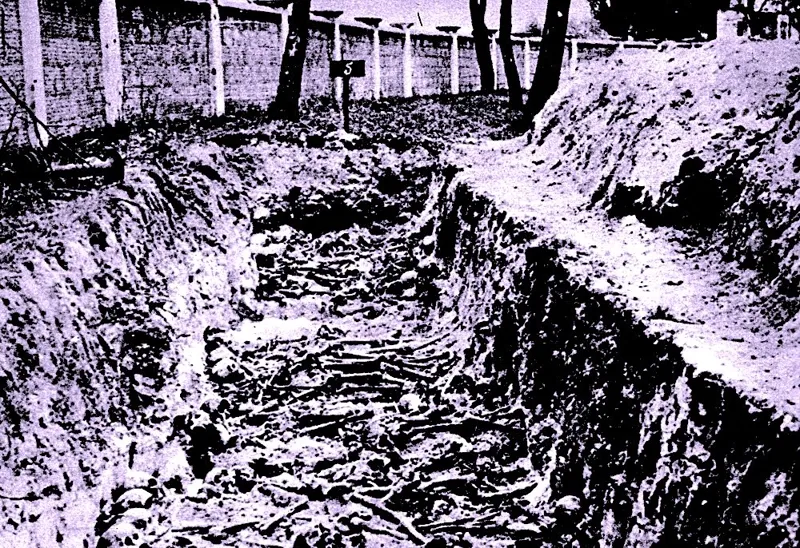
(thumbnail: mass grave of Soviet POWs)
Annibale joins us for his promised bonus episode on Operation Barbarossa, the largest and deadliest invasion in human history, which just quietly passed its 85th anniversary. In this episode, Annibale goes over the unfathomable casualty toll on Soviet soldiers and civilians, and explains how the Holocaust is inextricably part of Barbarossa. But first, we discuss current wars in the Persian Gulf and Ukraine and get the European/Italian view.
First - World of Wars: Iran, Ukraine & Europe
At 49:45 - Music interlude by Brendon Anderegg
At 51:45 - Operation Barbarossa
Annibale's Bibliography
1. The Human Cost
Lopukhovsky, Lev, and Boris Kavalerchik, The Price of Victory: The Red Army's Casualties in the Great Patriotic War (Barnsley: Pen & Sword, 2017). The most sustained archival re-examination of Soviet losses, arguing that the official General Staff figures for 1941 substantially undercount the dead and missing.
Kay, Alex J., and Elke Scherstjanoi, "The Extermination of Red Army Soldiers in German Captivity," Journal of Slavic Military Studies (2024). The most recent scholarly synthesis on the mass death of Soviet prisoners of war.
Bidlack, Richard, and Nikita Lomagin, The Leningrad Blockade, 1941–1944: A New Documentary History from the Soviet Archives (New Haven: Yale University Press, 2012). The siege through formerly classified party and NKVD records.
Cerovic, Masha, Les enfants de Staline: la guerre des partisans soviétiques, 1941–1944 (Paris: Seuil, 2018). The partisan war and its civilian cost in the occupied territories.
2. Barbarossa and the Holocaust
Kay, Alex J., Empire of Destruction: A History of Nazi Mass Killing (New Haven: Yale University Press, 2021). The best single-volume synthesis integrating all the German killing programs, with the war against the USSR at its center.
Bartov, Omer, Hitler's Army: Soldiers, Nazis, and War in the Third Reich (New York: Oxford University Press, 1991). The classic study of how ideology penetrated the ordinary fighting troops on the Eastern Front, and the starting point of the scholarship on Wehrmacht complicity.
Beorn, Waitman Wade, Marching into Darkness: The Wehrmacht and the Holocaust in Belarus (Cambridge, MA: Harvard University Press, 2014). Army complicity in the murder of the Jews, reconstructed at the level of individual units.
Ingrao, Christian, Croire et détruire: les intellectuels dans la machine de guerre SS (Paris: Fayard, 2010). The Einsatzgruppen leadership cohort. English translation: Believe and Destroy: Intellectuals in the SS War Machine (Cambridge: Polity, 2013).
3. Consequences for the Rest of the War
Stahel, David, Retreat from Moscow: A New History of Germany's Winter Campaign, 1941–1942 (New York: Farrar, Straus and Giroux, 2019). The concluding volume of Stahel's series arguing that Germany's theory of victory expired in 1941.
Glantz, David M., and Jonathan House, When Titans Clashed: How the Red Army Stopped Hitler (Lawrence: University Press of Kansas, revised edition 2015). The bilateral strategic framework used throughout the series.
Hill, Alexander, The Red Army and the Second World War (Cambridge: Cambridge University Press, 2017). The Soviet war effort from rearmament to victory, strong on how the army of 1941 became the army of 1945.
Tooze, Adam, The Wages of Destruction: The Making and Breaking of the Nazi Economy (London: Allen Lane, 2006). The economic logic of the campaign and of the December 1941 declaration of war on the United States.
4. The Soviet Union after 1941
Edele, Mark, Stalinism at War: The Soviet Union in World War II (London: Bloomsbury Academic, 2021). A compact recent synthesis of the Soviet war experience and its aftermath.
Brunstedt, Jonathan, The Soviet Myth of World War II: Patriotic Memory and the Russian Question in the USSR (Cambridge: Cambridge University Press, 2021). How the victory myth was built, and whom it included and excluded.
Exeler, Franziska, Ghosts of War: Nazi Occupation and Its Aftermath in Soviet Belarus (Ithaca: Cornell University Press, 2022). What the occupation left behind, and how state and society reckoned with it after 1944.
Bernstein, Seth, Return to the Motherland: Displaced Soviets in WWII and the Cold War (Ithaca: Cornell University Press, 2023). The fate of repatriated POWs and forced laborers, from filtration onward.
--
Total time: 2:00:00
Direct link to this episode's mp3 here
*
Buy & review John Dolan's new book, They Should Have Been Hanged: War Nerd Essays on the U.S. Civil War
Subscribe to Radio War Nerd at patreon.com/radiowarnerd
Sound production by Telescope Audio
Comments (46)
Annibale Stalingrad when???
Great episode! would love a future series on Stalingrad. Unfortunately, the only book I’ve read on Stalingrad is Beevor’s; any recommendations on others?
For a relatively concise and modern treatment I would say Michael K. Jones "Stalingrad: How the Red Army triumphed on Hitler". For the full story with all the detail check David Glantz books (really technical and detailed)
Annibale, international treasure, thank you for your service! 🫡
What diseases were killing 1200 Soviet soldiers per day? Typhus? Dysentery? I’m curious to know more about that in particular.
It's a number including all deaths for non combat causes, including accidents, disease (mostly typhus, dysentery or extreme cold) and suicide or execution. There's not breakdown for each of these causes as far as I know, but studies are ongoing in particular for 1941. Keep in mind that unlike these numbers went down to almost 1/10th of the 1941 ratio in the following years, while the number of people getting sick but recovering remained steady during the war. This means that more people died for non combat related causes in 1941 than in the rest of the war, but level of hospitalization or discharge for non combat related causes remained more or less the same
Great series and marvelous coda.
I'm surprised none of you guys talked about the middle aged and up men who buy expensive Harleys and cruise around wealthy suburbs on the weekends. I once saw a group of eight or so where all but one had white hair or was completely bald. Maybe it's a Connecticut thing...
Here in ROC these are the guys who own all the convertible sport cars. Every single one of them owned by a thinning-white-haired Boomer guy, imagining themselves James Dean or Dustin Hoffman's character in The Graduate.
Great as always. Can we please get Annibale to do a warhammer 40k episode at some point, the people yearn for it
A 16 parts series on the Horus Heresy with an in-depth analysis of the Titandeath on Beta Garmon would do? ;)
Exceptional. Made me look through notes from a 4 credit college class on the Holocaust 30+ years ago. Barbarossa & Wehrmacht barely mentioned except for the 'Holocaust of bullets', for a few minutes in one 90m class. It was considered vaguely disreputable to mention the course of the war at all. Military history altogether was considered disreputable, best left to right wing cranks. I had to re-learn everything from the goddamn Peloponnesian War on my own (and unlearn an awful lot) because my smart, good, liberal IR profs were so ideologically blinkered (Not in the slightest to imply profs at Bard were remotely "left wing", it was The End Of History back then, after all). How the fuck do you teach Napoleon and Bismarck without the military campaigns? They managed to and now I feel cheated for having paid for it. For the Nth time I am so glad for RWN and the community that grew around it. War is horror but it's still all too relevant. Such a joy to encounter a group of people intellectually serious about it, who by and large have some idea of what they are talking about who AREN'T right wing freaks. I remember back when it launched, hoping against hope that it would be sustainable. I smashed that button when we were Company sized, we're a decent sized Corps now and I am glad for it. Made some friends along the way- which is not at all the point of the story! lol but much enjoyed, at least on my end Best regards to all, especially Annibale. "I only consider you scum compared to Krusty!" And thank you for listening to my whole life story.
❤️ Annibale!
Croatia still has Antifascist Struggle Day on June 22 commemorating Barbarossa (they somehow missed that one in the post-Yugoslav anti-communist memory-holing). It sometimes falls on the same date as Corpus Christi, so you can hear the octogenarian brass band playing Katyusha on what used to be Titov Trg competing with 4 sets of church bells in surround sound.
Wages of Destruction was so good, I've always thought that Adam Tooze would be a perfect guest for this show
Do more Russian civil war and interwar (war with Poland, etc.). Since Annibale seems to know what he’s talking about w/r/t to Russia and since the last time you guys discussed the Russian civil war was for about 45-60 minutes in one episode around eight years ago, maybe it’s time for a deeper dive.
Barbarossa XI: And another thing!
“Having a big motorbike, all the girls would look at you, and so on, and so forth..” wow Annibale, you kind of skipped over that real quickly. What’s that all about?
There’s a brand new book “why Barbarossa failed” that argues a key reason why the Germans failed goes back to a fundamental flaw in Clausewitz theory of focusing on counter value objectives (Leningrad, Moscow, the oilfields) rather than focusing on counter force objectives (focusing on destroying the Soviet army) the German panzer divisions literally would bypass all organized Soviet defenses and rush far ahead of the infantry and then would have to stop once they hit actual resistance and this was happening all throughout the first year until they got tossed back from Moscow. This allowed the Soviets to hold up the Germans way more than they should have and reconstitute much earlier than they would have. Very interesting you all should have him on.
That’s basically what Annibale said
Notably, the US strikes on Iran last year happened on the 84th anniversary of Barbarossa. First as tragedy, then as farce.
Thank you for another great conversation with Annibale. He mentioned Gerlach as a better source than Tooze on the biopolitical question (forgive me) in the eastern front, but it's not featured in the bibliography. Having read the wages of destruction I wonder what the dottore thinks of this work and what its shortcomings are in comparison with Gerlach.
It’s a good thing the Nazis didn’t win the Cold War like the confederacy won reconstruction. They could’ve gone into the former Soviet Union states in the 90s and depopulated the place in a genocidal project in the name of bringing capitalism while stripping the place for copper wires (and titanium and oil and gas).
Tooze does a really good job illustrating the Nazis’ agrarian roots in Chapter 6: “Saving the Peasants.” Basically a lot of the momentum behind the Nazi movement was from the German peasantry (which was still quite large) that was being squeezed by modernity into smaller plots of land and eventually wage work in the cities. The obvious solution to this was land reform, but clearly the Nazis weren’t big on that. So colonization of the East was chosen partly for this reason, as well as German planners realizing that Germany could never be agriculturally self sufficient with their current territory.
https://www.wikiart.org/en/georg-scholz/industrial-farmers-1920 Good painting describing the Nazis’ political constituency
“I think things will start up again, most likely they’ll wait until after the midterms” *things start up 3 hours later
The RWN curse strikes again
A great episode. Also, look forward to hearing the episode on Stalingrad. As far as Holocaust remembrance culture goes in the U.S., I believe Holocaust education was first introduced into the public school curriculum in the mid to late-1980s. The U.S. Holocaust Museum opened in 1993. However, Congress formally authorized the construction in 1980.
Thank you great episode
Great episode. Funny how the first segment ends with Annibale supporting Mark's bleak view of the Misha the Bear spectacle with that horrifyingly neutral observation about one of war's timeless prerogatives—people working on overdrive to dehumanize other people because it makes killing them easier—and it's the most upsetting thing you've heard all week for about 1 second when suddenly you're transported into a state of cosmic acceptance by that gorgeous musical interlude. Thanks Telescope Audio. Is this one connected to its own release or did you just GRACE the hell out of the War Nerd audience?
Echoing both the 1) dehumanization (sadly) and 2) telescope audio points above. Great episode. And absolutely always loved the telescope audio interludes.
Love the inclusion of an extensive bibliography. Gives me more material to listen to at work!
Recorded lectures by several of the authors mentioned in Annibale’s bibliography are available on YouTube if listeners are interested. I have listened to some of them and they are excellent.
I
Hey Guys can you have Peter from Events in Ukraine back? Things are really heating up in the war. And no offense to that other dude but Peter has a way better handle on the status of the drone war than him.
Your wish has been granted
Not July 6?
I’d love to hear you guys talk about the whole thing about Patriot missiles actually being only like 2% effective against missiles. MIT engineering prof Ted Postol writes and talks about it a lot. Crazy
I gotta say, the more I learn about this Eetler guy, the less I like him. He seems like a real jerk.
Take it easy guy-- the good book says "judge not lest ye be judged"
Wait why is John leaving Apulia for NZ again
I honestly gave up trying to understand his movements a long time ago. Perhaps being a Weary Traveller is simply his destiny.
Annibale - Our evergreen voice of reason. Always appreciate his perspective. Also, echoing a point Annibale mentioned re-italy. I'm in Spain and the memory of the Franco years are still alive and well. The idea that people here can be hoodwinked into falling for another war... Idk but I think they will have to push hard to make that happen. There are right wing podcasts that are trying, but its unclear that they'll be successful. The memories are still too real. Also, pro-palestine sentiment is everywhere. Barcelona, Madrid, Santiago. Also based on random conversations with Spaniards, they cannot fathom how Americans aren't in the streets to protest the Epstein files. Slightly different causes from Italy (less focus on the pope), but equally unwilling participants. (On a recent bus trip, a girl from Galicia said the Spanish see Italians as their cool cousins, and Portugal is their brother). So the cool cousins probably have a different POV. Plus the whole FIFA fiasco...
What makes you think Americans aren't protesting? It's just that our government doesn't listen to us, and we have no way to make them. As an American, it's always odd for me to hear people speak positively of other countries. Even the small anecdote you shared seems strange to me. A lot of Americans hate every other country on Earth. The media pilloried Obama once when he made some innocuous comment that suggested he didn't think America was The Greatest Country on Earth™️. I know other countries have nationalists and xenophobes - those people I can understand just fine. The whole "some of us recognize that other people exist" is alien to me. I remember during the pandemic, Annibale mentioned once that Italians were wishing the best for Americans. I cannot emphasize enough that... well, some large percentage of Americans (certainly everyone I've ever met, but I can't be sure how many people think this way) wouldn't *necessarily* go out of their way to murder an Italian in cold blood for no reason at all, but if every single person in Italy died of COVID, *at best* they wouldn't feel a thing. (A few people I talked to, when I said that other countries did a better job responding to COVID because they had fewer deaths per capita, immediately dismissed it as "they're lying." Which made me wonder *how* and *why* someone would lie about that, even if it was true, but I digress...) I know quite a few people who would be happy about it, for some reason or another. Not that Americans hate and despise Italians specifically, but they truly and deeply believe that Americans (and not even all Americans) are the only real human beings with interiority and subjectivity and thoughts and feelings who have ever lived. The simmering resentment, contempt, and occasional outright murderousness that goes along with that is hardly unique to the Republicans, though they're the most open and explicit about it. Anyway, just a thought I had from reading your post. If anyone else wants to push back, feel free. I think I'm right, but I'm prepared to be proven wrong. It's certainly not *all* Americans who feel this way, or even most (we've had some huge pro-Palestinian protests, after all). But I think it's a lot of us.
I think in Ridley Scott's Black Rain (1987?), a yakuza on a motorbike takes off Andy Garcia's head off with a katana. In Akira(1988?) the Neo Tokyo bikers hit each other with pipes. But in both, they drag them on the asphalt to sharpen them, maybe?
Are Dolan and Ames finally becoming anime fans? I hope? You know, Japan has a whole subculture dedicated to war nerdery (they call them military otaku). The video game auteur Hideo Kojima is probably the most famous one. One of his games, Peace Walker, is all about dramatizing the practical and moral dilemmas of MAD. The U.S. government is concerned that a human operator might refrain from launching a second strike because they wouldn't want the death of the world on their conscience, so they create an AI that (theoretically) can be relied on for deterrence purposes. And then they put it in a giant robot because why not. And then the disgraced former head of the CIA, who is doing a coup in a Latin American country, steals it to try and cause a nuclear exchange with the Soviets in order to get his job back. Also the AI is based on the mind of the protagonist's late mentor, who had to give herself a c-section on the beaches of Normandy with a combat knife during the D-Day landings and was the *actual* first person into space, but they covered it up because the rocket screwed up and almost killed her on re-entry, and they were embarrassed.