
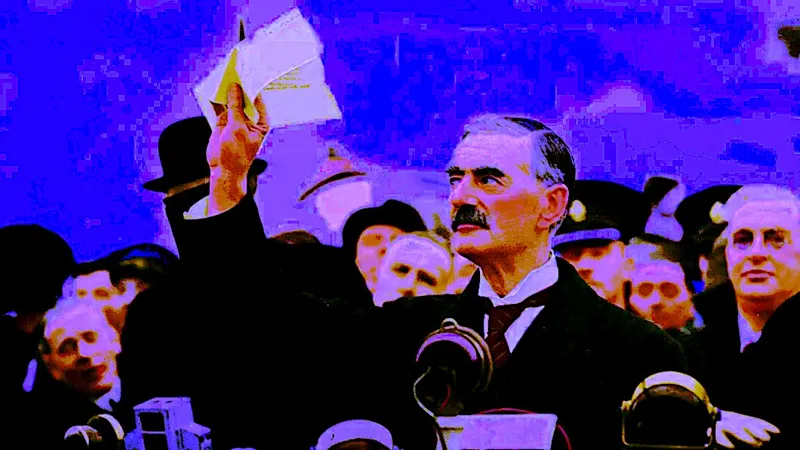
Radio War Nerd EP #578 — Deconstructing "Munich 1938" Pt. 2: 1933-39, feat. Annibale
Guest: Annibale
Recorded: January 30, 2026
Part 2 of Annibale's series recovering the actual history of the much-abused "Munich 1938" myth. In this episode, Annibale explains how the western powers were Munich-1938'ing year after year, crisis after crisis, so that by the time the actual Munich conference came around, the outcome was long a done deal.
Further listening:
RWN EP #576 - Deconstructing "Munich 1938" Pt. 1: 1919-1933
Annibale's Bibliography:
Steiner, Zara. The Triumph of the Dark: European International History 1933–1939. Oxford: Oxford University Press, 2011.
(Comprehensive structural history of the 1930s showing how repeated crises taught European governments that enforcement was politically impossible/ inconvenient)Watt, Donald Cameron. How War Came: The Immediate Origins of the Second World War. New York: Pantheon Books, 1989.
(Early work showing that Britain / France restraint and delay reflected conscious political choices, not ignorance of German intentions or miscalculation alone.)Graham, Helen. The Spanish Republic at War, 1936–1939. Cambridge: Cambridge University Press, 2002.
(Spanish Civil War as an international crisis that normalized large-scale violence without escalation, reinforcing expectations of non-enforcement.)Carley, Michael Jabara. 1939: The Alliance That Never Was and the Coming of World War II. Chicago: Ivan R. Dee, 1999.
(Study of failed Anglo-French-Soviet negotiations showing how ideological distrust of the USSR decisively narrowed alliance options.)Mazower, Mark. Dark Continent: Europe’s Twentieth Century. London: Penguin Books, 1998.
(Explains why interwar elites often viewed fascism as order-preserving while treating Bolshevism as destabilizing)
Total time: 1:36:22
Direct link to this episode's mp3 here
*
Buy & review John Dolan's new book, They Should Have Been Hanged: War Nerd Essays on the U.S. Civil War
Subscribe to Radio War Nerd at patreon.com/radiowarnerd
Sound production by Telescope Audio
Comments (22)
Annibale's accounting of the Spanish Civil War would make a great series on its own. Curious if you have ever heard the take that the May Day crisis between POUM and the Spanish Communist Party was actually the result of Trotsky's meddling in exile?
Trotsky played a political and rhetorical role in condemning the Soviet actions in Spain. Still, the reality is that while POUM was considered "Trotsky-friendly", Trotsky and Andreu Nin weren't getting along at all. The most credible reading of the May Day crisis was that POUM was naive, easily manipulable, even by the VERY limited operations done by Western intelligence, and mostly wrong about a cold, rational strategy to keep the republic alive. But they weren't a fifth column and the NKVD-led repression was almost entirely based on fabrication and paranoia. Again, this doesn't mean Orwell was right in its reading of the crisis.
What is the episode about the origins of neo-liberalism?
Ep 205 Listen now also :)
I’m reading Zara Stiner’s book Triumph of the Darkness so this episode hits!
Great episode guys. Thank you Annibale, I'm really enjoying the series (as usual). Mark you mentioned you were reading about Indonesia and Dutch colonialism in the interbellum. I'd be curious to know what you are reading. In the Netherlands we were off course taught next to nothing in school or pop culture about colonialism
Aside: great to be around people who love Space Balls :D
John the only guy who has dental surgery like most highways have construction
Annibale, what is your opinion of “The Deluge” by Adam Tooze? Also great ep, thanks guys.
You’re going to ask Annibale’s opinion on a tooze book and not mention wages of destruction
Krainer went into detail about how big the Czech military was and how the Nazis used it, and a little more into the plotting by purported allies, but less about Stalin. Enjoying both of these
Huge counter-factual, but, do you think the whole thing would have gone different if France and Britain weren't globe spanning empires at the time? Also was the League of Nations whole deal a kind of 'hoisted by their own petard' thing?
Not exactly. Britain was mainly preoccupied with "defending imperial interests," but other factors like budget issues and post-WWI "war fatigue" were also significant. France, less global than Britain, was genuinely frightened by the idea of another war with Germany. The League of Nations was a late 19th-century concept with some 20th-century polish: it was very Britain- and France-centred, lacked enforcement powers, was unpopular with most public opinion outside those countries, and had a grotesque "all decisions must be unanimous" rule, making effective action against aggression difficult. I believe Wilson sincerely proposed it, but, like much of his work, it showed a poor grasp of European politics. Wilson thought, in a very "liberal Anglo-Saxon Protestant" way, that war was triggered by secret diplomacy and power struggles, that peace could be maintained by diplomatic institutions, that international law could restrain states, and that democracy led to peace. However, he completely misunderstood WWI’s trauma and its lasting impact, misreading US isolationism and Europe colonial legacies.
19 and 27 are my Roulette numbers.
If you like Catherine O’Hara and Eugene Levy you guys gotta watch Schitt’s Creek.
Second this. A lot of liberals meme about it and say it’s the best thing ever which can push some away to not watch it but it’s genuinely good and heartwarming. O’Hara puts on a comedic masterclass. Made me laugh so hard my stomach hurt. Just an incredibly funny person. I grew up watching her from home alone to beetlejuice to best in show to schitt’s creek. Was genuinely gutted reading she passed.
Wonder what Annibale makes of the Robert Harris novel Munich, which posits that Chamberlain secretly understood the Munich Agreement wouldn’t hold, but accepted his ruined reputation as the price to buy Britain time to prepare for war. It’s a pretty silly thriller, but it was the first time in pop culture I’d seen Neville not totally vilified.
The message I hope will be clear after listening to the episode is that Chamberlain was a fool (or at least someone who made a mistaken assessment of his own diplomatic capacity), but not a fool in the sense he's been portrayed in the post-Churchill era. This means he was not a "coward" and did not "believe in Hitler". This is clear from the evidence we have - in private, Chamberlain often repeated that he did not trust Hitler. Also, his perception that England in 1938 was not in a position to deter Germany was correct. However, implying that Munich was a clever short-term sacrifice to buy England time is just silly (and most of Harris is silly, IMHO). Because Chamberlain (like most European leaders at the time) greatly downplayed the danger Hitler was posing to Europe and - crucially - misread the Soviet position. Until 1940 he was convinced that while deterring Hitler was impossible, "containing him" and preserving British interests was possible. In other words, Chamberlain asked himself this question: How do we avoid a catastrophic war we are not ready to fight? The question was right, but he gave himself the wrong answer. On the other hand, Churchill's position in 1938 was that Germany's power was growing and British interests were best served by finding a way to stop this growth. Again, right question, but unfortunately Churchill too gave himself the wrong answer.
Uh ohhh Orwellheads will get mad at Annibale for besmirching the beautiful baby Republicans.
I'm concerned this might reinforce my growing reputation as a tankie or a closet Stalinist. I am definitely neither. My goal is to be honest about understanding history. The current consensus is that, although Orwell provided a detailed, ground-level perspective on Barcelona during the May days, his interpretation of the events was (purposefully?) inaccurate. It is now clear that Stalin wasn't particularly interested in a "Soviet" Spain and would have preferred supporting a strong republican government that was, first, sympathetic to the USSR, and second, acceptable to Britain, France, and the US. Moreover, despite the obvious admiration for the International Brigades, without Soviet organisational support, they might not have lasted as long as they did.
annibale has taught me more than any history professor at dartmouth college has in my 9 years of attempting to get a bachelor’s degree
Loudoun4Palestine