

Radio War Nerd EP #576 — Deconstructing "Munich 1938" Pt. 1: 1919-1933, feat. Annibale
Guest: Annibale
Recorded: January 23, 2026
Once again, it's "Munich 1938" in warmongering punditville, as it has been since the end of World War II, especially since the end of the Cold War. But it turns out the actual Munich 1938 history has little to do with the mythologized fake history version used by successive western media-political elites to shape public opinion for whatever war they're selling. Annibale joins us for a new series on the real Munich 1938 story. First, the background: 1919-1933.
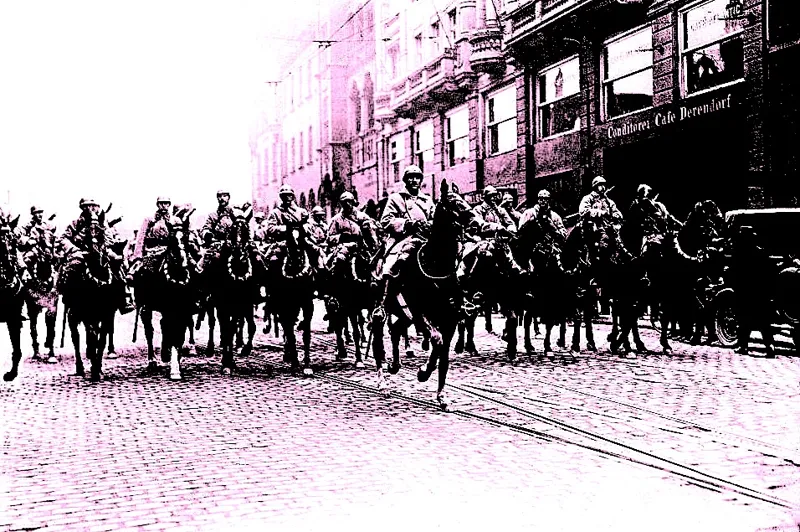
*Map of Occupied German Rhineland
Total time: 1:19:37
Direct link to this episode's mp3 here
*
Buy & review John Dolan's new book, They Should Have Been Hanged: War Nerd Essays on the U.S. Civil War
Subscribe to Radio War Nerd at patreon.com/radiowarnerd
Sound production by Telescope Audio
Comments (27)
The influence of Woodrow Wilson's batshit devotion to "racial science" was a huge, fascinating, awful influence on the post-WW1 division of Europe: he'd managed to convince himself, somehow, that shared "ethnolinguistic origin" (c. 1919, which is to say "no goddamn idea what we're talking about") was the guarantor of social cohesion, and thus of peace, so every major ethnolinguistic group should have its own nation. It should be amazing that he never considered what it would mean to have a continent of rigorously segregated ethnic groups that exclusively bordered other rigorously segregated ethnic groups – according to HIS definitions of "rigorous," "segregated," and "ethnic group," not theirs – but to be honest, as an American, I find myself not-that-amazed.
Wilson absorbed 20th-century racial thinking — almost everyone in elite politics did — and he was personally racist in the American context (segregation of federal offices, etc.), but beware that the Versailles map was not Wilson’s design. France, Britain, local nationalist leaders, and strategic considerations shaped borders far more than ethnography. Czechoslovakia, Yugoslavia, and Poland were built for strategic purposes, not ethnic purity. They were multiethnic by design. “Rigorously segregated ethnic groups” was not the actual outcome. Eastern Europe after 1919 was full of minorities. Poland had Germans, Ukrainians, and Jews; Czechoslovakia had Sudeten Germans; Romania had Hungarians; Yugoslavia was a patchwork of ethnicities. The conference created minority problems, not ethnic homogeneity.
This isn’t pertinent to the current ep but would love to hear about Greek resistance during ww2 into the civil war through the junta. Huge fan keep it up gentlemen
As an addendum to anibales excellent presentation i would recommend Berlin Alexzanderplatz by Werner Fassbinder . It is an intimate look at the lives of a man pushed by all the forces spoken of in the episode. Eventually into the nazis. Its a really interesting perspective. I wonder if @Annibale has seen it.
The Alfred Döblin novel that movie is based on (pretty loosely, since it's Fassbinder) is very worthwhile, if you can find a good English version of it, which isn't easy. There's a newish one, like 2010s, that's supposed to be much better than its predecessors. The most common English version, by Eugène Jolas, is famously terrible – it's been 15 years since I read a word of it, and I still have a harrowingly sharp memory of encountering the line "Holy show, Leona, your tits make me insane!"
Great episode - looking forward to the next one. On the closeness between Mussolini and Britain, Italian academic Clara Mattei wrote a great book 'The Capital Order' on the influence of Italian economic management under Mussolini on the British government and Treasury.
Really insightful thank you
Annibale: Mythbuster
What happened to the eastern front series😭
We’ll come back to it, plenty more before we complete the Battle of Moscow
To be clear all nations are artificial political constructions, especially all of the countries of Central Europe
I would love Annibale do a "bibliographic essay" type episode where he discusses the historiography more of what he's researched and read. Such a wealth of knowledge thanks again
I have sometimes wondered what Annibale thinks of Giorgio Agamben. Agamben's first two Homo Sacer books have had a pretty big influence on me and how I understand the Nazis and/or fascism. The whole Carl Scmitt "state of exception" thing.
Same here . His writing on the pandemic were also quite interesting. Im deeply moved by his work
As ever, most enlightening. I read a book called "Lords of Finance" by Liaquat Ahamed. My two take-aways from it that coincide with the discussion here are: a) How slow things were then. If the governor of the Bank of England (Norman Montagu) wanted to confer with his American counterpart (Benjamin Strong) he would have to take a ship. They had cables but that would be like modern equivalents communicating by Tik-Tok. b) After WW1, international trade became very difficult due to the shortage of gold which was mostly sitting in America. Thus it was hard for countries to re-build their econmomies because it was hard to trade. During one crisis the French asked the Americans for help in this department and this was refused. Later, during the Depression, the Americans asked for help and the French refused as they had managed to stabilise their situation and were doing ok. I suppose that the shortage of gold acted like a kind of austerity protected by the moralising fig-leaf financial discipline. Also, regarding reparations, in a book by Alistair Horne about the French Commune in 1871, he pointed out that the what the French did to the Germans vis a vis reparations was what the Germans had done to them after the Franco-Prussian war. Those reparations were designed to cripple the French but the Germans miscalculated and the French paid the reparations off in the 1890's. I'm guessing here that they did it by milking their empire for all they could get. As an aside, I sometimes wonder if the current French economic problems might be due in part to their recent reversals in sub-saharan Africa.
Gold shortage wasn’t THE impediment to as much as it was AN impediment. Interest rate policies, the failure to devalue currencies to catch up with the massive amounts of paper money issued to pay for war supplies; sources of raw materials were harder to come by with the destruction wrought in Europe and Russia descending into chaos. Additionally, the war debts and reparations constrained most governments’ ability to spend money and a whole round of tariffs arose as governments tried to protect their economies
I recently watched The Ice Storm & liked it, it does definitely focus on 70s ennui, but in a bit of a Raymond Carved type of way which I appreciated
Annibale, mom said it’s my turn to talk about ww2 on the podcast
She also said if you didn’t stop, you won’t get any dessert tonight
Are mark and John on UpScrolled yet?
Another fantastic episode with the great Annibale! Do you have any books to recommend to better understand European politics during the interwar period?
Big “merci !” to Le Tigre. Way to go, Clemenceau.
Kuhnock
Flashing back to an old forum post that said Neoconservatives cite Munich so much they sound like they live in The Sims videogame "Munich! Munich Munich Munich. Munich Munich!" "Yalta" *Slap*
Looking forward to comparing this to Alex Krainer’s 3 parter on Munich 1938.
It (Krainer’s series) doesn’t have Hadolf Eetler
Hell yeah !