










THIS WEEK IN VIOLENCE: Strange Bedfellows
Hello, it’s me, Gregk, the guy who does the show. For those of you who might not be aware, this is This Week in Violence, a little bonus feature myself and Thomas put out for Patreon subscribers each week in written and audio form.
During the week, the two of us send each other news reports about events going on around the world, and then we select one, discuss our thoughts and perspectives on the subject matter, and assemble those thoughts into a newsletter, prefaced with a brief excerpt from the article in question along with a link for you to read in full.
This week we’re returning to a topic we’ve touched on in a previous newsletter but which we wanted to go a bit deeper on. I think there are some ways you’ll be able to listen to this and use it to continue thinking through some of the issues we touched on at the end of our interview with Jonathan Katz this week regarding the fallout of western intervention in fragile regions and unstable states, and the issues with trying to stabilise those states with further interventions and military means alone.
Widening the lens a bit more, we also think it’s a story which really gets to the heart of a lot of the questions and inquiries animating the show, about the interactions of power, political-economy and violence; the texture of this new political era myself and Thomas suspect we’re entering into, where normative beliefs in the liberal world order, international law and global governance are falling away, replaced by pure, economism and self-preservation; and what that might portend for those of us lucky enough to not have been caught in the crossfire — yet.
If nothing else, like I said, this is a topic we’ve both been very interested in, and we really want to explore it further in the future with one or more guests, and so this newsletter was an opportunity for us both to learn a bit more about the background, and then share that with you, so when that episode comes you’ll be able to listen back and get some grounding.
And if you’re not already a subscriber, this is a taste of the kind of stuff we do behind the paywall. So if you’d like to hear myself or Thomas discussing Russkaya Obshchina, the Russian paramilitary gangs; or commenting on the recent Loyalist riots in Belfast; or Israel and the United States’ attempts to set up a new Operation Condor for the digital media age in South America; or if you’d just like to hear how I really feel about the pig, dog, and wretched slob, Sir Keir Starmer, then please consider becoming a Patreon supporter at bloodwork.show.
And since I’ve got your attention and it’s been a while since I asked, if you haven’t already left us a rating or review on your preferred podcast platform, please consider doing so. It’s a huge help to us getting the show out there, which helps us to lock down really cool guests, which means we can then make a better show for you. And thank you to everyone who has already done so and left such kind and encouraging comments, we’re both incredibly appreciative.
Okay. Onto the newsletter.
2026, Week 27
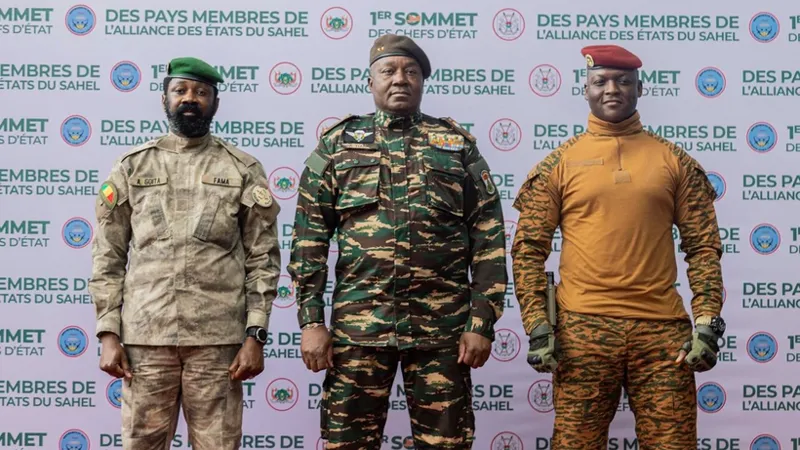
For this week’s newsletter, we’re returning to the Sahel in West Africa to take a closer look at the violence unfolding in Mali in which a mosaic of factions from national militaries and private mercenaries to jihadists, Tuareg separatists, and pastoral peasants have been engulfed in a civil war with no apparent centre.
This time around, we thought it was worth digging deeper into the history of the conflict in the Sahel, and particularly the role outside actors have played in resolving (or exacerbating) the fighting — so this is a slightly longer newsletter than usual, but hopefully one which you’ll enjoy reading or listening to.
In order to sketch out more of the historical context surrounding Russia’s Private Military Company the Wagner Group, we’ve cribbed a little from John Lechner’s 2025 book Death is Our Business: Russian Mercenaries and the New Era of Private Warfare; particularly chapters 4 and 5, which tell the story of Wagner’s opportunistic entry onto the African continent in the late 2010s.
Thanks again for listening and supporting the show, and we hope you enjoy.
Mali: Grave Abuses Amid Renewed Fighting
Army, Allied Militias, Islamist Armed Groups Commit Violations with Impunity
Report by Human Rights Watch – Jun 28, 2026
(Nairobi) – Islamist armed groups and Malian armed forces and their allies have committed serious abuses against civilians since fighting escalated in Mali in April 2026, Human Rights Watch said today.
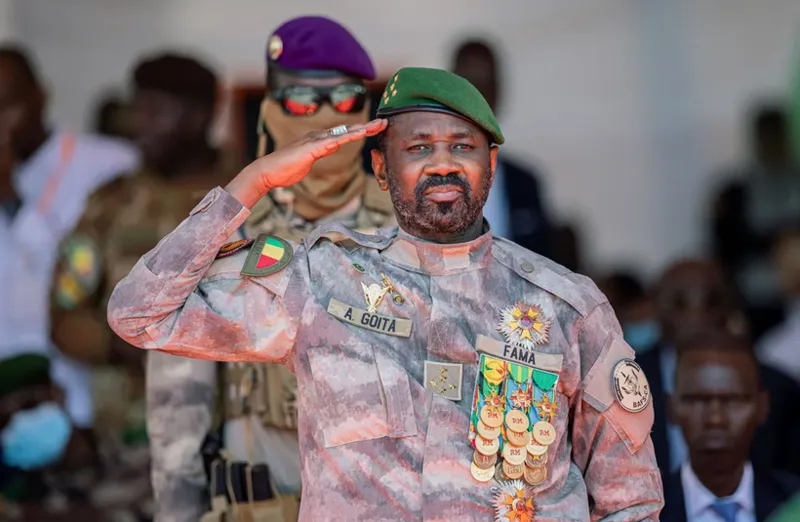
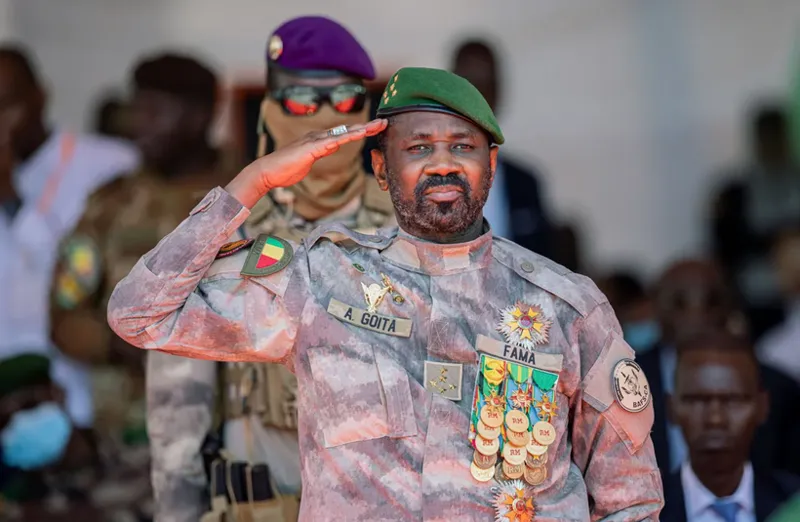
On April 25, the Al-Qaeda-linked Group for the Support of Islam and Muslims (Jama’at Nusrat al-Islam wal-Muslimin, or JNIM) carried out coordinated attacks across Mali. JNIM joined forces with Tuareg fighters of the Azawad Liberation Front (Front de libération de l’Azawad, or FLA), who are seeking to overthrow the military junta led by Gen. Assimi Goïta and backed by Russian fighters from Africa Corps (formerly the Wagner Group). All parties have unlawfully attacked civilians and some parties destroyed and looted their homes and shops. On April 28, JNIM announced a “total siege” of the capital, Bamako, threatened to kill civilians obstructing its operations, and attacked civilian vehicles. Malian armed forces responded with apparent reprisals against Fulani communities and two apparent airstrikes killing civilians.
“As fighting flares up again, the warring parties in Mali are once again carrying out grave abuses against civilians, repeating former patterns of harming civilians,” said Ilaria Allegrozzi, senior Sahel researcher at Human Rights Watch. “All parties are obligated to respect international humanitarian law, take all feasible steps to avoid civilian harm, and facilitate access to humanitarian aid.”
[...]
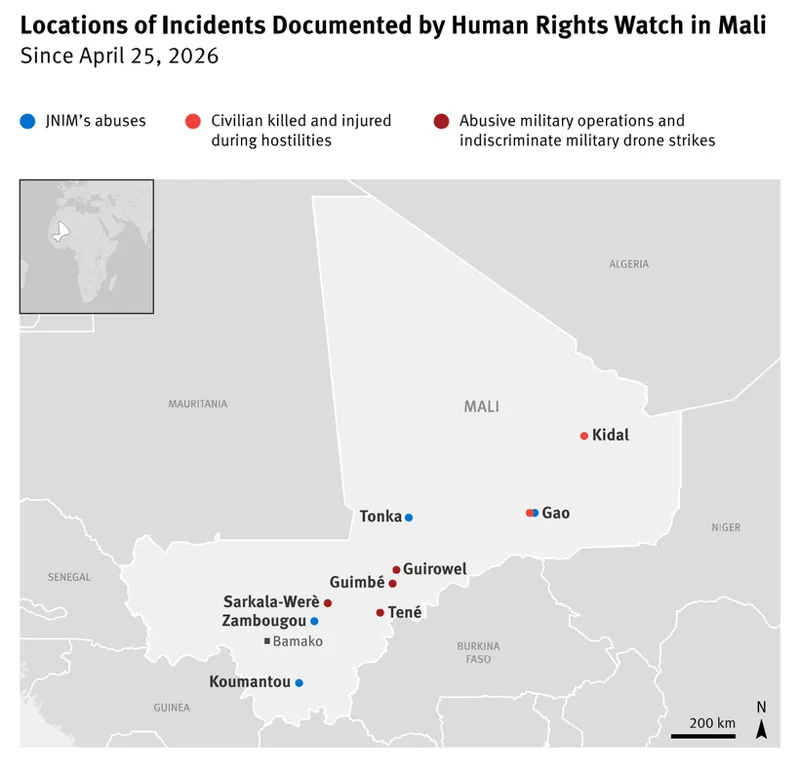
On April 25, clashes between JNIM and allied FLA fighters against Malian and Africa Corps forces in the northern cities of Gao and Kidal killed 13 civilians and wounded at least 25. Between May 6 and 21, JNIM fighters burned more than 40 civilian vehicles bound for Bamako, accusing passengers of violating the siege of the capital, and publicly executed a man in the northern town of Tonka. Between May 14 and 17, the military also conducted abusive counterinsurgency operations against Fulani communities in central Mali, killing 38 civilians, including 23 children. Mali’s military carried out two apparent drone strikes in the central villages of Guimbé on April 25, which killed 12 children and teenagers, and Tené on May 17, which killed 10 men and women.
[...]
On the night of May 17, an explosive munition, apparently dropped from a drone believed to have been operated by the military, killed at least 10 civilians in Tené village, as residents gathered for a traditional wedding. The groom, who had gone with others to collect his bride and the wedding food, was among those killed. “I heard a noise coming from the sky and then an explosion and then there were screams everywhere,” said a 45-year-old man. “We rushed there and found that the damages were enormous, with dead and injured people.”
Human Rights Watch has previously documented how Malian military forces have conducted drone attacks that caused civilian casualties.
On May 9, 10 days after JNIM announced the start of the siege of Bamako, JNIM fighters burned at least 40 civilian vehicles in the village of Zambougou, about 60 kilometers from the capital. A 43-year-old bus passenger said: “A jihadist said: ‘Didn’t we warn you that Bamako is under siege? Get out!’ Then they set the buses on fire.” There were no military forces in the vicinity and none of the vehicles carried weapons or military equipment.
Since September 2025, JNIM has cut off fuel supplies into Mali, blocking and attacking tanker truck convoys from neighboring countries and killing truck drivers, triggering severe shortages that have halted transport, disrupted education and electricity, and paralyzed daily life in Bamako and elsewhere. While the laws of war do not prohibit sieges, warring parties must take all feasible precautions to avoid harming civilians and comply with the principles of distinction and proportionality. Siege tactics that prevent civilians getting access to items essential for their survival are prohibited.
In a June 15 reply to Human Rights Watch, JNIM said civilians “violating some of the rules of order enforced by JNIM in its areas of controls or on the siege … are deterred proportionately to their violation as per the Sharia [Islamic law] rulings regarding offenders – leniently in some cases and strictly in others.”
Making sense of the different forces at play in the Sahel, and the alliances they have formed during years of fighting in the region, can be a dizzying task. As a result, outside observers have occasionally resorted to sturdy, pre-packaged narratives to explain the conflict. More often than not, such narratives say more about the ideologies of the individuals making use of them than the groups fighting on the ground.
As we covered briefly in our previous newsletter on developments in the Sahel, fighting in the region has been localised in three countries in the region’s west which underwent a series of coups d’état in quick succession.
In 2021, Mali underwent a so-called ‘coup-within-a-coup’ when, following the ouster of President Ibrahim Boubacar Keïta the previous August, the same military generals who led that coup then arrested the country’s interim civilian leadership, with Colonel Assimi Goïta then assuming the presidency.
Months later, in Burkina Faso, a similar sequence of events unfolded when that country’s President, Roch Marc Christian Kaboré, was arrested by members of a military junta calling itself the Patriotic Movement for Safeguard and Restoration (MPSR).
The coup had been spurred, in part, by frustrations with the handling of an insurgency by Jama'at Nusrat al-Islam wal-Muslimin (JNIM) which had begun almost concurrent with Kaboré’s election in late 2015, and which by the 2020s now controlled vast swathes of territory in the country and had been perpetrating horrific massacres.
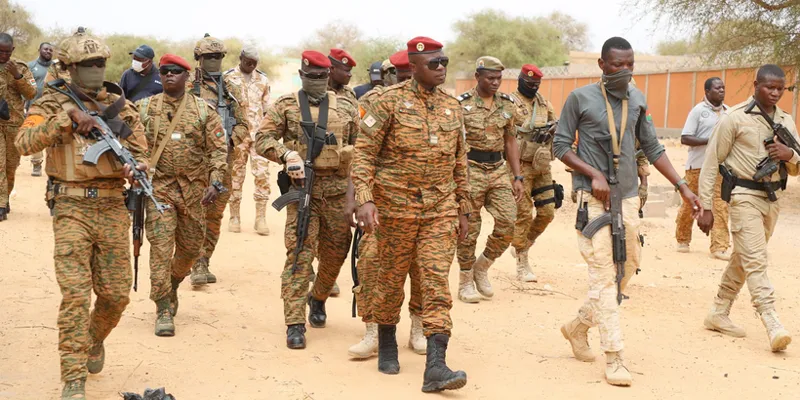
The MPSR was initially led by Lieutenant-Colonel Paul-Henri Sandaogo Damiba, but he was then ousted only eight months later by his subordinate Captain Ibrahim Traoré, allegedly due to Damiba’s own failure to confront the insurgency.
Since then, Traoré has occasionally styled himself as a modern instantiation of the famed Burkinabé revolutionary Thomas Sankara. Himself a Captain in the country’s military who ascended to power in a 1983 coup, Sankara reoriented the former French colony onto a programme of Marxist, Pan-Africanist self-sufficiency until he was himself assassinated and overthrown in 1987 by his former comrade Blaise Compaoré.
However noble Traoré’s purported aspirations to continue Sankara’s legacy, his programme has not been without its flaws in practice. Despite admirable efforts to bolster the country’s self-sufficiency through construction of gold refineries and food processing factories, other actions — such as suspension of democratic processes, the outlawing of homosexuality, and outright hostility to critical journalists — have placed a question mark over his government’s revolutionary aspirations.
Putting all of that aside, the country’s ongoing conflict with JNIM and other insurgent and opposition forces mean Traoré’s government has necessarily been one on a permanent war footing. These struggles have only been exacerbated by the country’s suspension from the African Union and Economic Community of West African States (ECOWAS), and its subsequent withdrawal altogether from the latter. Now further hampered in its battle against non-state actors, this has created incentives to seek assistance from elsewhere, which will be a theme of this newsletter.
Following these two coups, France, which had played a heavy (and not always benevolent) hand in securitisation efforts in those former colonies refocused on neighbouring Niger as the centre of its anti-jihadist operations in the region. As part of these efforts, the United States had also maintained an 1,100 strong military presence in the country.
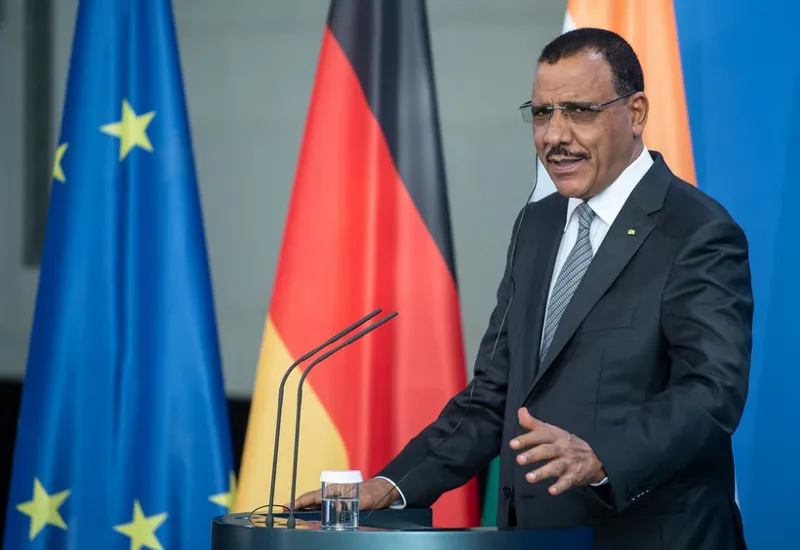
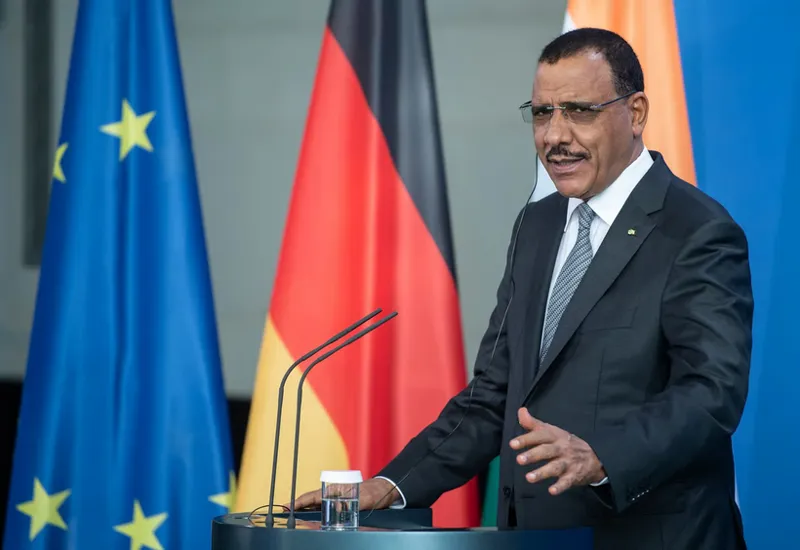
Nigerien president Mohamad Bazoum was now perceived as the last remaining holdout of pro-Western sentiment in a region that was rapidly turning against the West. Unfortunately, in July of 2023, Bazoum was then overthrown by a military junta. After several days of uncertainty, he was supplanted by Abdourahamane Tchiani, former Chief of the Nigerien Presidential Guard. As with numerous armed forces in the region and further afield on the African continent, many members of this Guard had received training from the United States military.
The upshot of this trio of coups is that all three countries were suspended from the African Union and ECOWAS, leaving them somewhat isolated, diplomatically, economically and militarily. In response, the three have since formed their own Alliance des États du Sahel (AES) or Alliance of Sahel States, a mutual defence pact with aspirations of forging closer internal diplomatic and economic ties, possibly leading to a common market or monetary union or perhaps even the forging of a combined federal state.
Irrespective of one’s read on all this, what cannot be denied is that with the exiting of French and US forces from their territories, rightly or wrongly, each of these countries is commencing on this project with a marked security deficit, one which they are unable to fill on their own, individually or collectively, because a deficit shared among three countries with deficits is, well, a deficit tripled.
Returning to Mali, perhaps now we can begin to unpack some of the strange alliances which have been forged in this morass, beginning with the partnership between Mali’s armed forces (FAMa) and Russia’s Africa Corps, more famously known, until recently, as the Private Military Company (PMC), Wagner Group.
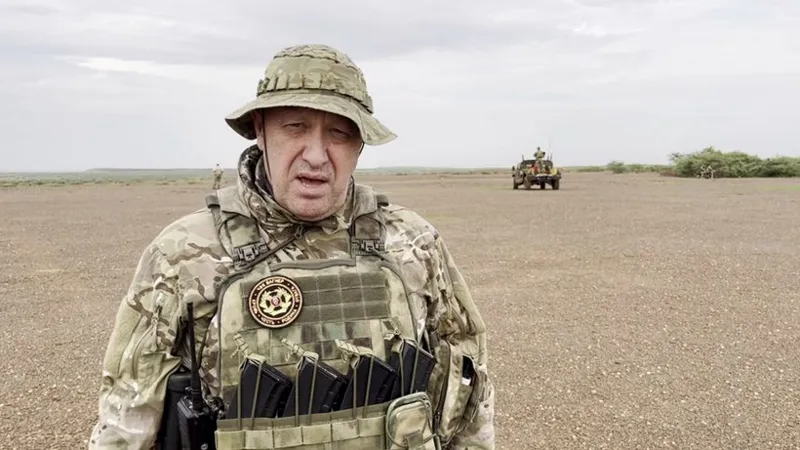
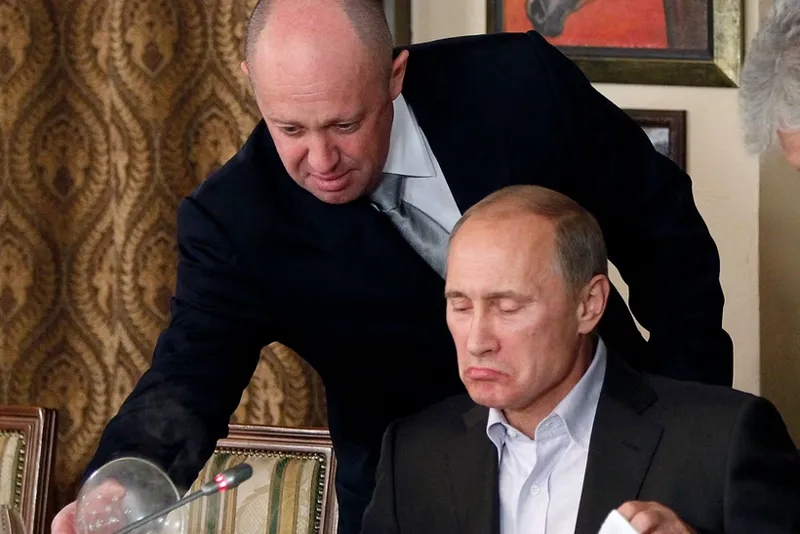
Much ink has been spilled attempting to summarise the late Yevgeny Prigozhin’s PMC and its relation to the Russian state. According to some, the group is a strictly mercenary outfit in the classical sense, renting its guns for hire out to the highest bidder with little care for politics or ideology. Others depict the group as little more than a shell company, a front group for the Russian state and military which it uses to obfuscate its hand in various regional conflicts and keep the true costs (and losses) of its military expenditures out of sight.
The truth is probably somewhere between those two poles. In his youth, Prigozhin was a petty criminal who endured stints in prison in the late Soviet era for theft and fraud. He was allegedly the leader of a burglary ring, for example. That type of stuff.
As the Soviet Union collapsed and transitioned to a free-market economy, he applied the skills he learned in the world of crime to capitalism and excelled where other of his countrymen struggled. Go figure.
Over the next two decades, Prigozhin continued to charm and hustle his way up the ladder in Russia’s emerging system where political and economic power braided and intermingled with less subtlety or panache than we’re accustomed to in the west. (It has occasionally been said that it is a misnomer to refer to Russia as an ‘oligarchy’, as this term implies that the country’s wealthy economic elites wield power over the executive, President Vladimir Putin. This is not the case; Russia’s wealthy industrialists and billionaires occupy their lofty stations at the pleasure of Putin, and do well to remember this fact before upsetting any hotdog carts.)
Fast-forward to 2014, and Prigozhin and another individual, Dmitry Utkin, were reportedly being made director and commander of a military operation based in Rostov Oblast, a region in southwestern Russia directly bordering the contested Ukrainian regions of Donetsk and Luhansk, collectively known as the Donbass. A document leaked in 2023, signed by the two men, connected the operation’s establishment to “the difficult situation in Ukraine and the necessity of defending Donbass (the heart of Russia).”
Thus, Wagner Group was born.
What scant documentation can be found surrounding Wagner Group’s founding would indicate that the Russian Military of Defence played some role in its establishment and development. In its early months, Utkin led the company in assisting pro-Russian factions warring with the Ukrainian military in the Donbass, while director Prigozhin secured financing and logistics back home. A year later, in 2015, Wagner operatives began appearing in Syria, providing assistance to Russian forces operating there.
The whole time this was going on, the true nature of the relation between Prigozhin’s group and the Russian Ministry of Defence remained opaque. At times the relation apparently functioned as if an informal collaboration, at others more like an unofficial division of the Russian armed forces. To offer some point of comparison, American mercenary outfit Blackwater was heavily involved in numerous US military operations throughout the 2000s onwards, but its founder Erik Prince has often had a terse, if not outright standoffish relationship with his government. By contrast, both Prigozhin and his outfit were simultaneously guns for hire and proud fighters for the Russian state.
Prestige, however, doesn’t pay the bills. Certainly not for a PMC. And so this dynamic created dual priorities on the other end. Working with Assad’s military and aligned forces in Syria wasn’t always a profitable venture, and it also left Prigozhin squarely under the thumb of government directives.
In the late 2010s, Russia began to branch out onto the African continent, inking economic and trade deals with Muhammad Hamdan Dagalo Musa, better known as Hemedti, now leader of Sudan’s Rapid Support Forces (RSF), in exchange for military training and support. One beneficiary of these deals was M-Invest, a recently founded company with close ties to Prigozhin, which had now gained a foothold in Sudan’s expansive mineral extraction industry, in particular gold.
At this point, Prigozhin pivoted, in a sense, back to his hustling ways, looking for other potential security operations which could then be leveraged for lucrative mining contracts. In the Central African Republic, Wagner entered a country which had endured years-long wars between the national military, a Muslim armed group called Séléka, a coalition of predominantly Christian but also animist armed groups known as anti-Balaka, as well as ethnic Peul (or Fulani) factions. Both French and UN-led peacekeeping missions had tried to contain this swirl of violence, and failed.
Though religion and ethnicity factored heavily into the fighting, a large part of the war’s backdrop was a raw political and economic power struggle over the country’s vast gold and diamond mines, as well as other mineral interests.
And so, by first allying with the government of CAR President Faustin-Archange Touadéra, and then arranging a 2019 peace agreement between the government and these various factions — with collaboration of forces in neighbouring Sudan as well as the UAE — Wagner gained freedom of movement between the various groups’ territories, as well as access to explore mining sites.
In CAR, somewhat miraculously, Prigozhin and Wagner had achieved something scores of others had failed at: a peace deal. And they had done it by approaching the conflict with a cold-hearted, economistic calculus, uniting the groups in their shared desire for money and power. Stability was restored, but at the cost of prospects for the country’s broader population, who now had to live in a country that had effectively been strategically divided up among warlords.
Nor would that stability be guaranteed. In 2020, tensions over the forthcoming presidential election in CAR provoked a split. A new cross-factional armed group, the Coalition of Patriots for Change (CPC), announced widespread military operations across the country, which Wagner, along with UN peacekeepers and Rwandan troops, were then brought in to counter.
Reports soon followed of Russian soldiers massacring civilians and looting their possessions alongside pro-government militias known as ‘Black Russians’. Authority was ultimately restored to the Central African government according to a tactic the Russian military had previously deployed in Afghanistan and Chechnya: Maximum force, by whatever means necessary. Only now it was being performed by private enterprise, as a service.
Wagner Group’s endeavours in the Central African Republic then provided something of a blueprint for future projects across the continent. Drawing closer to the UAE, Wagner provided support to both the RSF in Sudan as that country fractured into civil war, as well as to UAE-backed factions in war-torn Libya. On the African continent, the activities of Wagner and other Russian military forces were becoming infamous, receiving increasing coverage in international news media.
It would be a mistake, however, to attribute this rise to Russia alone. Following the end of the Cold War, military assistance in Africa had come from two places: peacekeeping missions coordinated by the United Nations, or security partnerships with western nations.
These had often not fared well. UN peacekeeping missions were often poorly managed and ineffective, as well as rife with abuse and exploitation of civilians, including widespread reports of rapes. Western securitising missions, often coordinated with the UN, were sometimes headed up by former colonial powers such as France, provoking well-founded suspicions around what the objectives of these missions really were and for whom they were being performed.
As western states were discouraged from intervening unilaterally on the continent, the UN became the sole arbitrator in disputes. Perhaps understandably, the organisation refused to recognise as legitimate armed groups which were purely driven by economic interests or extortion. And so, in order to avoid getting shut out of negotiations, many of these groups wrote manifestos, and declared political opposition to this or that government, or allegiance with this or that cause. If you’ll only recognise our violence if it is political, then so be it, we will declare our violence political.
With the UN perceived as tilted in favour of their former colonial masters, many in the developing world sought an alternative to the only game in town. With its permanent seat on the UN Security Council and sufficient military heft to throw its own weight around independently, Russia became an appealing prospect — as the CAR story would later demonstrate.
But this was an alternative on different terms. In order for Russia to commit to such operations, they had to be beneficial to Russia, and they had to make some sort of narrative sense.
Around the same time Russia had been prospecting work in the CAR, Prigozhin had also been probing opportunities in Madagascar, as well as in Mozambique. In the latter country, in 2017, the ruling democratic socialist Mozambique Liberation Front (FRELIMO) was working on a tentative peace deal with the Mozambique National Resistance (RENAMO), a right-wing anticommunist faction founded with the assistance of Rhodesian intelligence shortly following FRELIMO’s victory against Portugal in their battle for independence.
Mozambican President Filipe Nyusi reached out to Wagner for support with a growing insurgency in the country’s north, but also to hopefully coup-proof his government in preparation for elections in 2019. Southern Africa has no shortage of PMCs, and so plenty put in bids, including Erik Prince’s new outfit Frontier Services Group, but they were all outmatched by Wagner, which could tout its easy access to the expansive arsenal of the Russian military.
After just a few months on the ground, however, Wagner backed out. Confusion on the ground had led to a number of deaths, and there were reports that the Russian MoD didn’t approve of Prigozhin’s freelance operation. Strained relations between Mozambique and Russia aside, the alliance didn’t really make sense. There was no narrative on which to hang the intervention.
But what if there were another area of the continent, with a better story to tell? A region formerly controlled not by Portugal, now greatly diminished, but a still relevant European power? A region beset by those twin western boogiemen of Islamic terrorism and immigration? One where local governments and populations alike had become disillusioned with interventions by the UN and western powers? One where an entrepreneurial security outfit — private enterprise in theory, but overtly Russian in popular perception — could really make its mark?
Since the collapse of Libya in 2011 following NATO’s disastrous intervention, that country had become a breeding ground for armed groups, mercenaries, jihadists, security forces, or whoever else. With its long coastline facing onto the Mediterranean, there were plenty of places from which weapons, humans, money, and whatever else could come and go, and as for its land borders — with Tunisia, Algeria, Egypt, Chad, Niger and Sudan — more than enough hazards, or opportunities, for the violence to spread.
Which is precisely what happened. And as jihadist violence spilled out across the surrounding region, numerous interventions by France and peacekeeping missions led by both the UN and EU had failed to stop the violence. In the Sahel, if anything, they may have made things worse. Attempts to neatly capture the conflict within an anti-jihadist framework obfuscated, or even exacerbated, tensions of other natures.
And so as Mali, Burkina Faso and then Niger underwent a series of military coups in the early 2020s, and began ejecting French and US military forces, Russia spotted an opportunity. By leveraging narratives of a ‘great power’ struggle between Russia and the West — one which the West had been enthusiastically inflating for several years — and insinuating itself into a locus point of jihad and mass migration, Russia, through Wagner Group, could flex its credentials as a counterweight to (and so discredit) the western security umbrella.
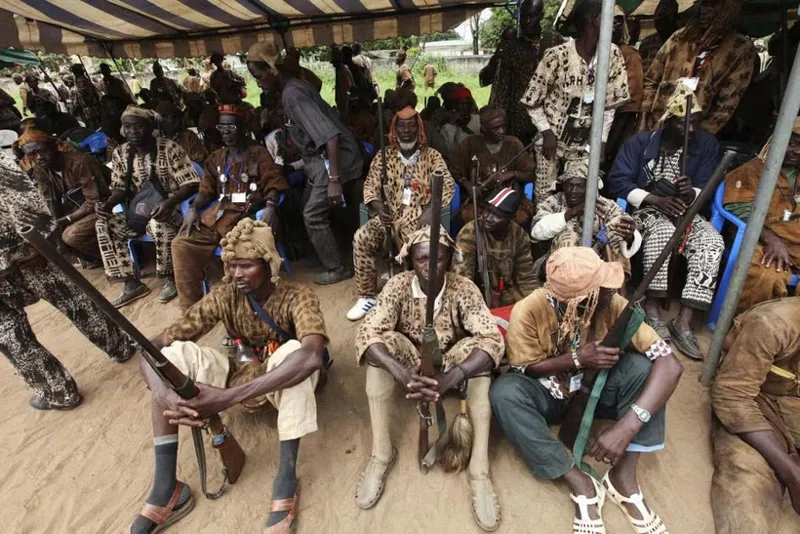
In Mali, in the years preceding President Keïta’s ouster, various jihadist groups had begun to coalesce into Jama’at al-Nusrat al-Islam wal-Muslimin (JMIN). In response, traditional hunting communities of ethnic Dogon and Bambara peoples, known as dozo, formed self-defence groups, which then committed excessive violence against Peul or Fulani groups with whom they were competing over resources.
Seeking to form coalitions against JNIM, France then teamed up with the National Movement for the Liberation of Azawad (NMLA), an armed group which draws from the Tuareg, a predominantly Muslim nomadic group which has historically occupied parts of Mali, Burkina Faso and Niger, as well as Algeria and Libya. Note that the NMLA is a nationalist movement with aspirations of a separate Azawad state. In a context in which Mali was combatting an insurgency which threatened its territorial integrity, France’s elevation of the separatist NMLA only angered the Malian government further.
And so in early 2022, as France’s time in Mali ran out, Wagner moved in, partnering with Mali’s military, FAMa, on an operation they hoped to model on their brutal campaign against the CPC in the Central African Republic two years earlier. The contract had been valued around $10 million a month for Wagner, although the financing structure was hazy, to put it lightly. No matter. Associates of M-Invest soon followed to assess the country’s mining portfolio.
Wagner commenced their operation in close collaboration with FAMa, but as they delved deeper into the country, into regions, cultures and multiethnic milieus they did not fully understand, the violence spiraled.
Soon after the French withdrawal, villages surrounding the capital of Bamako suffered economic downturns — because like them or not, those French soldiers had money — and JNIM-aligned factions moved in, souring sentiments against the government and its new peacekeepers. Wagner responded by applying their ‘no mercy’ strategy, committing ruthless massacres which often swept up Peul or Fulani groups in their wake.
Half-hearted support granted to the Dogon and Bambara dozos — who were often fighting with homemade or poorly maintained weapons which they had to sell their cattle, their livelihoods, to purchase — meant they would receive only a few days’ support at a time before being abandoned again, increasing the targets on their backs. Tentative peace between the dozos and the Peul foundered, as the Peul became unsure if they could safely visit Dogon and Bambara villages to trade. As a consequence, they turned to JNIM for safety. In an operation ostensibly intended to stabilise Mali and combat jihadism, Wagner Group’s indiscriminate killings were turning the Peul into jihadists of convenience.
As for the alliance between JNIM and the Azawad Liberation Front (FLA) mentioned in the Human Rights Watch report up top, the FLA is a coalition of different Azawad separatist and Tuareg self-defence groups in the region, including the NMLA.
You can probably imagine how the vision of a separate, sovereign and nominally secular Azawad state might ultimately clash against JNIM’s vision of establishing a state authority that transcends national borders and disadvantages individuals or groups who do not accord with its conservative Salafist interpretation of Islamic law.
But misery makes strange bedfellows. If you brutalise different groups indiscriminately as muslims, they will fight back on the basis of their shared brutalisation as muslims, with the belief, or hope, that other issues can be resolved later.
Meanwhile, onlookers further afield have struggled to make accurate assessments of Wagner’s performance in Mali, in part because they misapprehend the group’s objectives. Viewing these operations through the lens of a stabilisation or peacekeeping mission, they look at a conflict in which sides have exchanged territory with little meaningful change, and they perceive a failure.
But this was an operation carried out at the behest of Mali’s military leader, Assimi Goïta, whose personal objectives are of a different nature, primarily: prevent another coup, and control the Tuareg separatists in the North. So long as Russia keeps sending mercenaries and behaving with sufficient brutality, they’ll likely serve their purpose.
In the time that has passed since those three coups, a lot has happened in the Sahel, and in Russia. This has produced knock-on effects for the Wagner Group, some necessary, some arguably quite unnecessary.
As stated up top, Yvgeny Prigozhin was always an individual with one foot in the Russian state, and one on the outside; part team-player, part upstart hustler. His pursuit of personal fame, fortune and glory could never be neatly disentangled from his desire for prestige within the Russian political system.
Unfortunately, due to the nature of the business he was in, these twin desires were sometimes at odds with one another. Strictly speaking, there are no star players in a state’s official military structure, everybody performs their function as assigned. In the entrepreneurial world of PMCs, your commitment isn’t to any state’s ideology or national project, it’s to make money. You can probably imagine the problems that began to arise when Prigozhin then found his men being dragged back to Europe to fight a Russian war for which there often didn’t seem to be much of a plan.
It has been alleged that one reason Prigozhin branched Wagner’s operations out from support efforts in Ukraine and Syria in the 2010s, and into new pastures was due to longstanding ‘personality clashes’ with Sergei Shoigu, Russia’s Minister of Defence from 2014 to 2024.
As the individual heading up Russia’s military efforts in Ukraine, Shoigu surely shares a fair bit of the blame for his military’s disastrous efforts in that war’s outset. As an entrepreneurial warlord who had long been a self-publicist through video rants posted on social media, and whose mercs had played a major role in the brutal, bloody Battle of Bakhmut in 2023, Prigozhin had plenty to say about Shoigu, and made his feelings known.
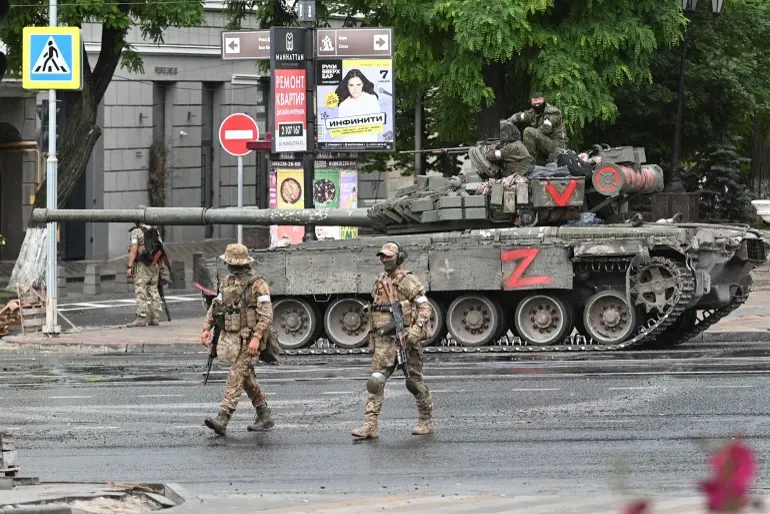
In June of 2023, as you hopefully remember, Prigozhin finally let his outsized ego get the better of him, and mutinied. Turning away from the frontline, he marched an armored column of Russian tanks back toward Moscow, shooting down a couple of Russian helicopters on the way, and killing as many as three dozen Russian soldiers.
His outburst was ultimately quelled before he could reach the Russian capital, but the ride was unlikely to continue much longer. On August 23, exactly two months after the rebellion, Prigozhin boarded a private jet from Moscow to St. Petersburg along with several other key members of the Wagner Group, including Dmitry Utkin. Roughly twenty minutes after takeoff, transmission from the plane ceased, and the plane crashed into a field near Kuzhenkino, roughly 100 km north from its departure point. There were no survivors.
Shortly after the untimely death of Wagner Group’s leadership, the Russian Ministry of Defence founded a new paramilitary group to oversee its strategic interests in Africa. The new group, Africa Corps, effectively subsumed Wagner Group, placing it firmly under MoD control, along with a number of other formerly external paramilitary groups.
In cosmetic terms, it marked an end to the inside-outside dynamic of Russia’s PMC operations in Africa. In real terms, it probably didn’t mean much of anything at all. Mercenary forces with easy access to large state arsenals would continue to be hired out to willing buyers, conducting brutal violence work in conflict zones in which they have no immediate interest — just economic gain, and maybe the chance to rub the west’s nose in a humiliating change of fortunes as part of that struggle between so-called ‘great powers’.
As regards Mali and the broader Sahel today, however, a few points are perhaps worth dwelling on. As we’ve seen in numerous conflict zones across the world today — in El Fasher in Sudan, in Gaza, and now in the Malian capital of Bamako — the tactic of brutal, siege warfare is making a horrifying return on the world stage; the deliberate imposition of starvation conditions upon entire cities, combatants and non-combatants alike, so as to terrorise and starve whole populations into submission.
In Mali, this tactic has reportedly been conducted at the hands of JNIM against the Malian military. FAMa, meanwhile, is ironically acting out a farcical repeat of the USA’s own expansion of drone warfare tactics during the Obama era, bombing weddings and other civilian gatherings under the aegis of combatting terrorism.
No one would wish the brutal governance of JNIM on anyone, and their use of criminal warfighting tactics against civilians is contemptible. But when the alternative is a coalition of Malian forces and Russian mercenaries terrorising communities until they are too scared to leave or enter their villages, unable to trade, exchange or live together for fear of reprisals from within or without, one has to wonder whether there is, functionally, any difference.
Second to consider is the way in which the mosaic of factions and forces fighting and allying in Mali has produced something akin to a dual insurgency; a battle in which two sides, one non-state, the other backed by two states, engage in asymmetrical warfare against each other. No marked strategy for the conflict’s resolution, just an endless push-and-pull, for zones of control, or just against one’s own demise, whether of an ethnic group, a way of life, a theological purpose, or simply to stave off being replaced by the next disgruntled general.
And lastly, without downplaying the earnest efforts of NGOs and international onlookers and the citizens of these countries, to draw attention to the plights of those living and dying in this region, it is strange to note the way in which much of the western world has simply turned away from the violence in the Sahel, whether in the western region of Mali, Burkina Faso and Niger, or further east in Sudan — not to mention nearby Somalia and Ethiopia.
It is not that long ago, in grand historical terms, that border wars in parts of the African continent were primary concerns of the international community, framed as they were as the final battlegrounds in a great ideological struggle between the First and Second Worlds, fought on and through the terrains and peoples of the Third.
Now, with that ideological struggle fought and settled, it is as though there is little incentive for others to meaningfully intervene once an attempt at the old methods of military intervention and counterinsurgency has failed. Try, fail, pull out, move on. Once that’s done, all that’s left is the pursuit of cold, cynical interests for those motivated to try and extract some personal gain out of the bloodbath. A truly mercenary warzone, conducted according to the only ideology that functions anymore: economy.
As for everyone else, without an ideology of more substance, and with the last vestiges of post-Cold War liberalism gradually falling away, like debris crumbling from a cliff face, it sometimes feels as though nothing is happening at all.
Comments (1)
yall should like fuckin put me on the podcast or something, I have no relevant formal training despite being one of the seemingly scant few people cursed with the pain of an eidetic memory, also I can predict what yall say about 20 mins in advance most of the time and often do that without trying to…