


THIS WEEK IN VIOLENCE: A Quiet Place
2026, Week 13
It is difficult, at times, not to feel your horror at witnessing violence unfolding in one part of the world become compounded by the guilt of knowing you are neglecting other violences unfolding elsewhere.
This is particularly acute in the present moment, where focus on the US and Israel’s illegal war of aggression against Iran distracts from other horrors in Cuba, Venezuela – a neglect which then plays into the Trump administration’s murderous hands.
This week, we are returning to the civil war in Sudan between the Sudanese Armed Forces and the Rapid Support Forces, spurred by new in-depth reporting of the RSF’s devastating siege and assault on El Fasher in October of last year.
Sudan’s civil war might be many hundreds of miles from Iran, and rooted in far different political and historical circumstances, but elements of reporting regarding RSF’s operations during this war, and the American and British responses, demonstrate that the horrors in Sudan and Gaza aren’t as separate as you might think.
Heroism, horror and the ‘pits of hell’: inside the last days of El Fasher
The Guardian – March 25, 2026
Reported by Mark Townsend
In the pistachio green Toyota Land Cruiser rattling over the desert plain, Aboud Khater pressed his foot to the floor. Behind, the sun rose above El Fasher. Smoke belched from the stricken city. Khater was driving the last vehicle of the final evacuation convoy from El Fasher.
It was 5:45am on 27 October 2025. He couldn’t have waited any longer. The historic capital of Sudan’s sprawling region of Darfur would capitulate in the next two hours. Thousands of civilians – children, women and men – were slaughtered. The city’s streets had seen the fastest and largest killing spree this century.
El Fasher’s fall marked the vicious finale of an 18-month starvation siege by the paramilitary Rapid Support Forces (RSF), the most brutal chapter of its ruinous war against Sudan’s government forces.
A depleted army garrison had defended the city alongside the joint forces, local self-protection groups who had come together to shield residents against genocide.
[...]
To frame El Fasher within the timeworn narrative of collective international failure avoids the darker truth.
Decisions were taken that ensured help never came. Both the US and UK suppressed or sidelined warnings that would have helped avoid the slaughter.
Central to the UK’s approach was the Joint Analysis of Conflict and Stability (Jacs), conceived to assess whether genocide was likely and, if so, intervene suitably.
The UK’s own intelligence, sources confirm, said the RSF wanted to “eliminate” the city’s non-Arab population.
Yet no attempt was made to update Jacs throughout the 18-month siege. The most recent Jacs assessment for Sudan is dated 2019: four years before the current war began.
It typified an attitude, said experts, that cost lives. “The UK’s approach was a death sentence to the people of El Fasher. Their lives were not seen as important as others,” said a parliamentarian.
In order to make sense of the carnage unfolding in Sudan, it is necessary to place the conflict in its broader historical and geopolitical context. This is a dizzying task, given how that context is one which spans both time and space.
The conflict’s origins arguably trace all the way back to 1989, when Sudan’s democratically elected government of Prime Minister Sadiq al-Mahdi and President Ahmed al-Mirghani were ousted in a military coup architected by the mercurial Islamist politician Hassan al-Turabi and led by General Omar al-Bashir. al-Bashir would go on to rule as the country’s Head of State for thirty years, during which period the country became a hospitable zone for Islamic fundamentalist militias.
In 1991, for example, a former mujahideen from the Soviet-Afghan War named Osama bin Laden clashed with his government in Saudi Arabia over their decision to allow US troops to station in the country during the First Gulf War the previous year. He relocated to Sudan, having allegedly been personally invited by Hassan al-Turabi. Between 1991 and 1996, bin Laden used Sudan as a base of operations for his early activities with al-Qaeda, operating from a house in an upscale neighborhood in the capital of Khartoum.
al-Bashir’s government naturally favoured the country’s Arab or Arabised population, to the detriment of Black and non-Muslim Sudanese. In 2003, tensions came to a head when several armed groups in Sudan’s western region of Darfur rose up against al-Bashir, leading to a war that would rage for the next seventeen years, ending in a stalemate.
During this conflict, al-Bashir sought to strengthen his hand by exploiting local ethnic and resource conflicts. A nomadic group of Sudanese Arab herders known as the Janjaweed often clashed with sedentary indigenous groups in the region over access to land and water. With al-Bashir’s legitimation and backing, the Janjaweed operated as the Sudanese government’s primary counterinsurgency force against the rebel groups. By 2008, five years into the conflict, it was estimated that as many as 300,000 members of the Fur, Masalit and Zaghawa ethnic groups had been killed by the Janjaweed, with many hundreds of thousands more displaced, many fleeing into neighbouring Chad.
In 2004, United States Secretary of State Colin Powell classified the Janjaweed’s actions in Darfur as genocide. In October 2025, only a few weeks before the massacres in El Fasher unfolded, the International Criminal Court found a Janjaweed militia leader named Ali Kushayb guilty of war crimes and crimes against humanity for his actions in Darfur. Two months later, he was sentenced to twenty years in prison. An ICC case against al-Bashir is still ongoing.
In 2011, a wave of protests swept across North Africa and the Middle East. Beginning in Tunisia, then spreading to Egypt, Yemen, Bahrain, Libya and Syria, protestors demonstrated en masse against injustices committed by their repressive governments, seeking liberalisation and democratisation of their political systems. The movements became known, collectively, as the Arab Spring, and were celebrated as heralding a new epoch of political transformation in the Arab world.
Ultimately, each ended with either the ruling power reasserting control and consolidating power, or the country unravelling into civil war, as happened in Yemen, Syria and Libya. The movement’s one ‘success story’ was the original locus point, Tunisia, where that country’s military dictatorship had been ousted and replaced with a democratically-elected constituent assembly.
In 2019, Kais Saied was elected as the country’s second post-revolution President. Two years later, he was brutally cracking down on protests against police brutality, and initiated a so-called self-coup in which he dissolved the government’s assembly and judiciary and consolidated power within his own office.
Though the Arab Spring as an event is naturally identified with the year 2011 specifically, as the Tunisian story demonstrates, its narrative spans a much larger time period. Subsequent protest movements in countries like Burkina Faso in 2014, Iraq in 2018 and Iran in 2022 are sometimes characterised as secondary waves within the same political tendency.
So, too, are the sustained protest movements which began in Sudan in December of 2018 and, months later, led to the toppling of Omar al-Bashir after ruling the country for three decades. Two key players in al-Bashir’s coup had been Abdel Fattah al-Burhan, Commander-in-Chief of the Sudanese Armed Forces (SAF), who became the country’s de facto ruler under various titles from 2019 onward, and General Mohamed Hamdan Dagalo, better known as Hemedti, who served as his deputy until 2023.
Hemedti began his military career in the Janjaweed militias in the early 2000s. It is believed he was one of the chief perpetrators of war crimes by the Janjaweed during the Darfur Conflict. In 2013, Omar al-Bashir made moves to semi-regularise the Janjweed militias, absorbing them into a new paramilitary group under Hemedti’s command, the Rapid Support Forces (RSF).
Though al-Burhan of the SAF and Hemedti of the RSF began as allies, by 2023 relations between the two had broken down, leading to the outbreak of the current civil war. Whether the Darfur War actually ended in 2020, or whether what happened was more like a brief respite as different factions reconstituted themselves and prepared for the next wave of fighting, is a worthy question.
Hemedti made his name and his bones as a warlord, and thrived in Omar al-Bashir’s Sudan, where the military dictator consolidated power in the country’s urban centres and privatised large swathes of the state while stoking racial tensions and making use of auxiliary violence workers to maintain a manageable chaos in the country’s multi-ethnic peripheries.
Through his warmaking, Hemedti acquired a number of lucrative assets including real estate and steel production facilities, as well as numerous gold mines, including the country’s largest. Aside from the profits from these holdings, the RSF also made money renting its services to other nations. One early patron of the Hemedti was the United Arab Emirates, who hired the RSF as mercenaries to assist Saudi Arabia’s war on Yemen.
Hemedti and the RSF’s connections to the UAE go deeper. In 2019, leaked documents revealed that the RSF moves its funding through two front companies controlled by Hemedti’s brothers: GSK, a security tech company based in Sudan, and Tradive General Trading LLC, based in the UAE. Tradive apparently functions to funnel money toward the RSF, while GSK is used for procurement.
Other leaked documents showed the RSF received roughly $40 million for so-called ‘technical support’. Roughly $30 million of this was then used to purchase over 900 Toyota Hilux and Land Cruiser trucks from various Emirati auto dealers to be converted into machine gun-mounted ‘technicals’.
Naturally, onlookers have put the two and two from such circumstances together and deduced that the UAE is likely backing the RSF both financially and militarily. Why this is is not entirely clear. One simple explanation might be that the Emiratis have stakes in the mines and other holdings in the territories the RSF controls and so is simply backing the de facto power in those areas to protect its own interests.
Hamedti has then exploited this lucrative marriage of convenience to advance his own power ambitions in Sudan, turning the RSF into a ravenous war machine which pursues his political-factional objective with a genocidal fury. Despite its Janjaweed origins, the RSF is something of an ideological hodge-podge with three core pillars: Anti-Black racism, Arab supremacism and Hamedti supremacy. This triad has granted the RSF a broad scope for violence, allowing virtually anyone to be identified as an enemy to be massacred, particularly those living in non-RSF controlled territories.
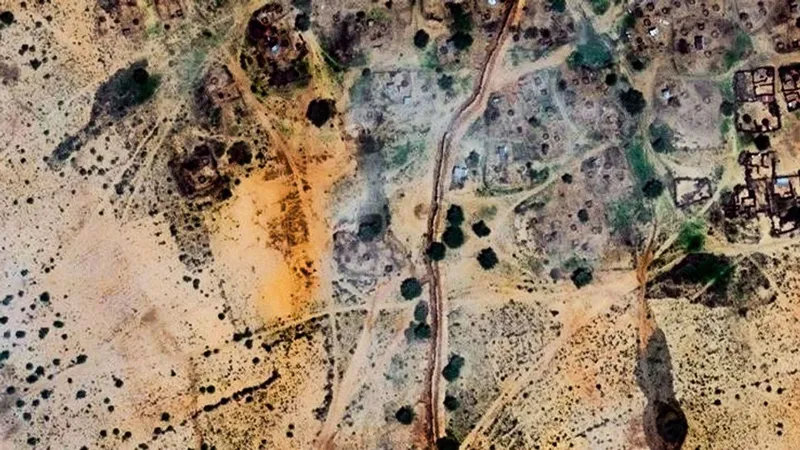
Mark Townsend’s account of the RSF’s massacre in El Fasher is harrowing, but should be read and engaged with. Over the course of eighteen months, RSF forces constructed a perimeter of berms and trenches around El Fasher in its entirety, shutting it off from outside supplies and trapping enemy SAF forces and civilians inside, and enacting a brutal starvation siege.
Then, in October, they stormed the city, using guns, bombs, drones and whatever other weaponry at hand to slaughter fleeing civilians in droves. The trenched perimeter then became a trap to capture those trying to flee, who were then shot and left in these trenches.
More shocking, however, are Townsend’s revelations that international inaction regarding the RSF was apparently the result of a deliberate, conscientious effort on the part of the US and British governments.
According to Townsend, the British government demurred on performing a strategic Joint Analysis of Conflict and Stability at any point after 2021, and repeatedly ignored warnings that the RSF harboured genocidal ambitions toward El Fasher’s non-Arab citizens and intended to ‘liquidate’ them. Not only that, in August 2023, the British government quietly revised its assessment of the 2003 Darfur War to downplay allegations of genocide and war crimes.
Similar events took place in Washington, where the US government suppressed intelligence assessments which would have compelled the Americans to intervene in an active and ongoing genocide.
In both cases, the reason for these governments’ enforced silence on Sudan was the same: A wish to avoid raising issues which would have required them to confront the RSF’s primary backer, the United Arab Emirates.
Aside from being one of the US’s primary military partners in the Middle East, the UAE is also a key player in the Abraham Accords, a series of agreements hoping to normalise relations between the Arab states and Israel, consolidate American-Israeli hegemony in the reason, and foreclose pushes for Palestinian statehood by circumventing the question entirely.
If Townsend’s reporting is accurate, then both the United States government under both Donald Trump and Joe Biden, as well as the British government under the Conservatives and Labour, deliberately stood by and allowed the RSF to carry out clearly signposted war crimes and genocidal acts in Sudan to ensure that Israel would not be obstructed from conducting its own war crimes and genocidal acts in Gaza, which both governments also actively supported, aided and abetted.
What this amounts to, ultimately, is a system of deliberate, strategic, coordinated lawlessness on a goliath scale, constructed and operated by the US, UK, Israel, UAE and likely others, in the cynical pursuit of regional power objectives. In the case of Keir Starmer and the Labour government, the evidence suggests that the British government stood idly by, allowing one of the most notoriously murderous paramilitaries of our era to carry out massacres in broad daylight, very likely using equipment and parts manufactured in the UK and sold to the UAE, because it didn’t want to ‘rock the boat’.
On a more positive note, over the past few weeks, reports have trickled out of Sudan that the Sudanese Armed Forces have enjoyed a few successes trying to retake territory from the RSF and push them out of key cities.
After the US and Israel commenced their legal war of aggression against Iran, the Iranians responded with retaliatory strikes targeting key US and Israeli strategic assets in the region. As one of the US’ most loyal and bellicose allies in the region, these strikes have hit the UAE exceptionally hard.
It has been speculated that one reason the RSF’s fortunes are beginning to turn is that Iran’s retaliation strikes have imposed acute and unexpected military pressures upon the Emiratis, who are now having to prioritise their own immediate security concerns at the expense of their murderous clients in Sudan. If this is true, then Iran will have done more to stop the RSF’s genocidal rampage in a few weeks than both the US and UK had done for years.
As for the future of Sudan, whether the SAF or RSF emerge as the victors of the civil war. Though the RSF have become infamous for their brutality in war, there is little to suggest that either side would be too different in government. More importantly, it is unlikely that either will give the people of Sudan the democratic society to which they aspire. More likely the country will revert to a default military dictatorship for several decades more as low-level civil wars continue to bubble up in the peripheries.
What would a solution for Sudan look like? It would probably require an intervention by UN peacekeepers to bring the killing to a halt, followed by a long, supervised negotiation process to create an acceptable political settlement for all concerned, a lengthy period of economic assistance and humanitarian aid to help the country to rebuild, and criminal prosecutions for those accused of coordinating and perpetrating war sides on all sides.
In short, it would require precisely the kind of collaborative process of international diplomacy and peacekeeping which the US, Israel, UK and many others have spent the past few years systematically discrediting and feeding into the woodchipper so as to continue enabling Israel’s twin territorial and genocidal ambitions in Palestine and beyond.
And so rather than international leadership, we instead get this; the most powerful countries in the developed world standing idly by as a genocide unfolds – in the British case, indirectly profiting from it – to ensure another genocide can unfold comfortably, their silence secured through a combination of dead-eyed economism, profit-seeking, and fear of the consequences of having a conscience.
On a tangential note: On March 23rd, 2026, Singapore’s Minister for Foreign Affairs Dr Vivian Balakrishnan was interviewed by Mark Bendeich of Reuters. Their conversation covered a number of pressing issues in geopolitics and foreign affairs. At one point, Bendeich asked Balakrishnan if the United States was no longer a reliable, steady partner.
In closing, here is Balakrishnan’s response:
The US is now a revisionist power. For 80 years, the US was the underwriter for a system of globalisation based on UN Charter principles, multilateralism, territorial integrity, sovereign equality. It actually heralded an unprecedented and unique period of global prosperity and peace. Of course there were exceptions. And of course, the Cold War was still in effect for at least half of the last 80 years. But generally, for those of us who were non-communists, who ran open economies, who provided first world infrastructure, together with a hardworking disciplined people, we had unprecedented opportunities. The story of Singapore, with a per capita GDP of 500 US dollars in 1965. Now, [it is] somewhere between 80,000 to 90,000 US dollars. It would not have happened if it had not been for this unprecedented period, basically Pax Americana and then turbocharged by the reform and opening of China for decades. It has been unprecedented. It has been great for many of us. In fact, I will say, for all of us, if you look back 80 years. But now, whether you like it or not, objectively, this period has ended. There is no point trying to assign blame or pejorative adjectives. That is not helpful. Basically, the underwriter of this world order has now become a revisionist power, and some people would even say a disruptor. But the larger point is that the erosion of norms, processes, and institutions that underpinned a remarkable period of peace and prosperity; that foundation has gone. What you are seeing now, whether you watch the war in Ukraine, in the Middle East or elsewhere, including in Asia, to me these are symptoms of the underlying tectonic rupture. Big powers and even lesser powers have a more narrow definition of national interest. [They] are willing to weaponise all levers in their hands. You look at the weaponisation of currency, weaponisation of technology, weaponisation of critical minerals, weaponisation of trade interdependency, which were supposed to keep us at peace with one another- now it becomes yet another portal for exploitation. You end up with a world in which strategic trust has dropped. Everyone has to assume the worst.
Comments (1)
Really appreciate this deep dive on Sudan, a conflict like Yemen's long and bloody civil war, that typically does not have the spotlight shined on it. Also that you tie it in to the Gulf states that have picked a side as their plaything, and the western powers who have abdicated any desire to see de-escalation.