










The Top 5 Things You Need to Do Before Starting Invention and Tech II Production in EVE Online
Stop guessing, protect your ISK, and build a production chain that can actually scale.
I make most of my ISK through invention and Tech II production. I currently run 15 accounts, so it is fair to say I have gone a bit mad with it—but that scale came later. What hooked me was the process: copying, inventing, sourcing, manufacturing, hauling and finally watching the finished products sell. Tech II industry is one of the most satisfying ways to make ISK in EVE Online, but it is also one of the easiest places to burn through a wallet while convincing yourself that you are “investing”. Get one link in the chain wrong and the whole operation can quietly lose money.
The good news is that you do not need 15 accounts to make this work. A single account can still make solid ISK if you set up all three characters properly and use their science and manufacturing slots intelligently. Whether you are starting with three characters or building an industrial empire, these are the five things I think you need to get right.
1. Choose the Product Before You Build the Factory
The biggest mistake is starting with the question, “What can I build?” The better question is, “What can I sell?” A positive margin means nothing if the item moves twice a month, and a busy market means nothing if fees, taxes and price competition erase the profit.
Before committing, check daily trading volume, recent price movement, the gap between buy and sell orders, and the realistic number of units you can move. Start with a small batch. Your first objective is not maximum profit; it is proving that the entire loop works. If ten units sell reliably, scale to twenty. If they sit in a hangar, learn the lesson before producing another hundred.
2. Train the Skills That Improve the Whole Chain
Invention uses science job slots, while production uses manufacturing job slots. This is why I always tell people to think in characters, not just accounts. On a single Omega account, all three characters can be developed into useful industrial pilots, giving you far more copying, invention and manufacturing capacity than you might expect. Laboratory Operation and Advanced Laboratory Operation expand your science capacity; Mass Production and Advanced Mass Production do the same for manufacturing. Industry and Advanced Industry help jobs complete faster.
Each invention job also requires the relevant encryption method and two science skills shown on the blueprint. Higher levels improve your chance of success, but I would not wait for every skill to reach Level V before starting. Get your first character working, learn the process, and then train the other two characters into clear roles. One might handle copying and invention, another might focus on components, and the third can add final manufacturing capacity. I only added more accounts once I knew the workflow worked and I genuinely needed more slots.
3. Calculate the Real Cost—not the Convenient Cost
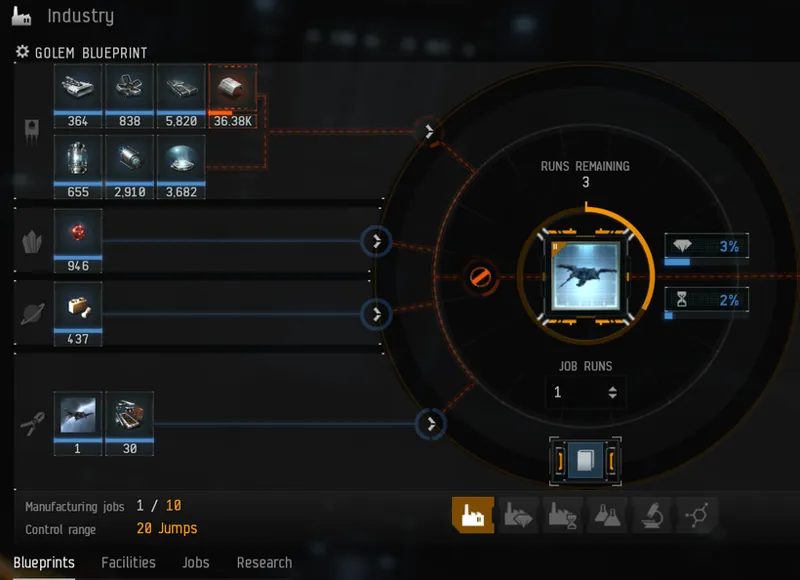
Your minerals are not free because you mined them. Your datacores are not free because you earned them. Every input has an opportunity cost: what it could have been sold for instead. A proper calculation should include the Tech I blueprint copy, datacores, decryptor if used, failed invention attempts, Tech II components, raw materials, job installation costs, hauling, broker fees and sales tax.
Real profit = sale proceeds − every cost required to invent, build, move and sell the item.
Remember that invention is probabilistic (I totally heard this word at work today so wanted to use it hahah) Datacores and the Tech I blueprint-copy run are consumed whether the job succeeds or fails, so failed attempts must be spread across the successful Tech II blueprint copies you expect to receive. And because New Eden does not stand still, treat every spreadsheet result as a snapshot—not a promise.
4. Build Around Facilities and Logistics
A cheaper job is not automatically a better job. Facility bonuses and system cost indices matter, but so do hauling time, fuel, market access and the risk of putting valuable materials into a player-owned structure. Saving a fraction on manufacturing is pointless if your inputs require repeated high-risk trips or your finished stock is stranded far from buyers.
Map the route before you start: where the originals are copied, where invention happens, where components are built, where final assembly occurs and where the products will be sold. Consolidate trips, keep a buffer of common materials and avoid locking your entire wallet into one structure or one cargo. Your production chain should save you time, not turn you into its full-time courier.
5. Run a Pipeline, Not a One-Off Gamble
For me, Tech II production became properly powerful when I stopped treating each job as a one-off and started running a pipeline. While one batch is manufacturing, the next set of Tech I blueprint copies is running and another invention batch is ready to deliver. With 15 accounts that can become a slightly ridiculous number of moving parts, but the principle is exactly the same with one account and three well-prepared characters: keep each stage feeding the next without creating more work than you can manage.
Decryptors are tools, not automatic upgrades. They can change success chance, runs, material efficiency and time efficiency, so compare their added cost with the outcome you actually need. Record expected versus actual invention results, unit cost, sale price, time to sell and remaining stock. Scale the products that repeatedly work; pause the ones that only look good on paper.
Your First Tech II Production Run
1. Pick one familiar module, ammunition type, drone or rig with steady demand.
2. Check the required blueprint, skills, datacores, materials and facilities.
3. Calculate the full expected cost, including failures and selling fees.
4. Invent and manufacture a small test batch.
5. Review the result, then scale only if the stock sells at the margin you planned.
Final Thoughts
I have taken invention further than most people ever need to. Fifteen accounts give me a huge number of slots, but they also create more logistics, more materials to track and more opportunities to make an expensive mistake. Do not look at that scale and assume it is the entry requirement. Start with one account, set up all three characters properly, prove that your products sell and build from there. There is no single “best” Tech II item forever; the real advantage comes from measuring the whole chain, testing before scaling and adapting faster than everyone copying the same shopping list.
WE HAVE FREE SPREADSHEETS FOR YOU! This one is a market opportunity spotting tool The EVE ONLINE Trade Computer V1.2 | SquadB Gaming on Patreon
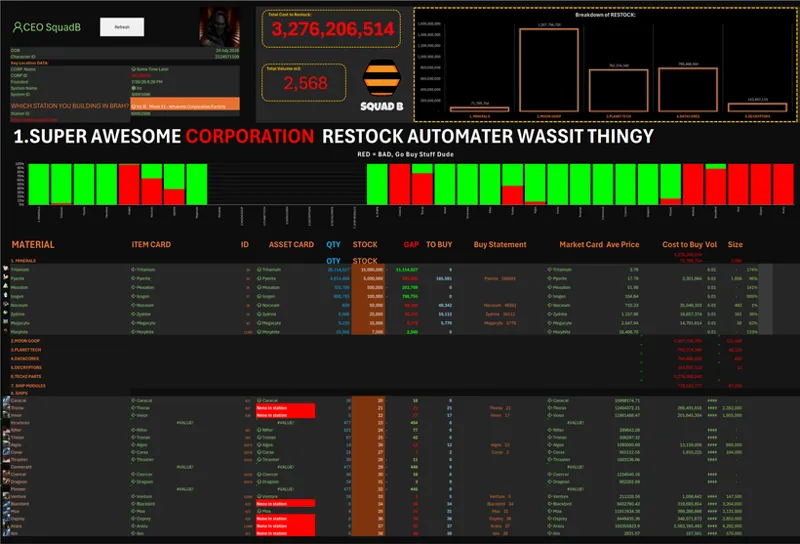
and this one is a restocking tool go watch the videos linked to these posts: The EVE Online Excel Sheet Pushes to version 1.6 with many quality of life improvements wooo! | SquadB Gaming on Patreon
If you want more practical EVE Online industry guides, experiments and spreadsheet-powered chaos, subscribe at www.youtube.com/ceopyrex. For the tools, deeper dives and the community helping us build smarter, come and join the Hive at https://www.patreon.com/cw/jointhehive.