


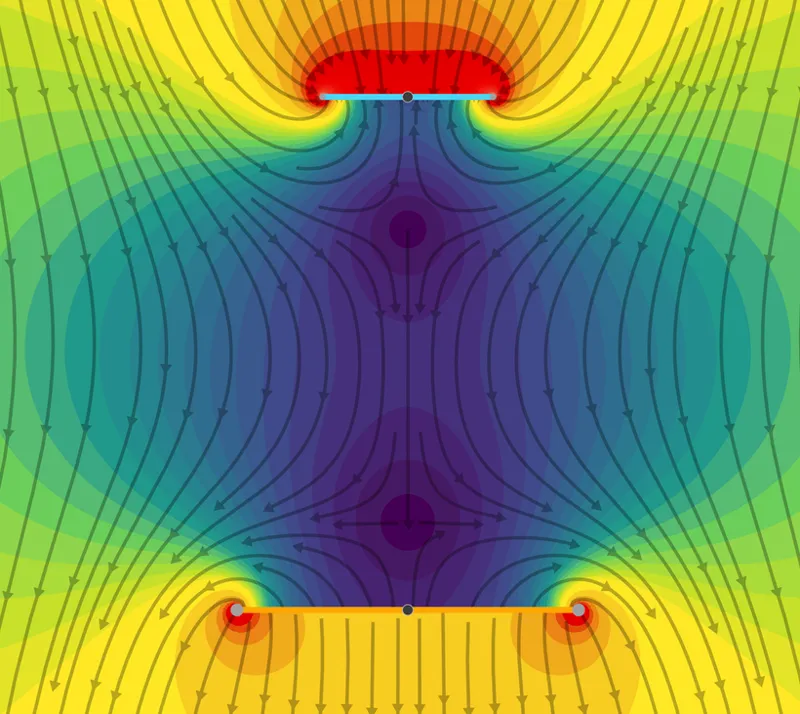

















New Portal Lab version: gravity in the pocket dimension, scaling portals and unexpected discovery of a self-force
I finished all the complex coding related to the next video, and I have a pretty big update to the previous post.
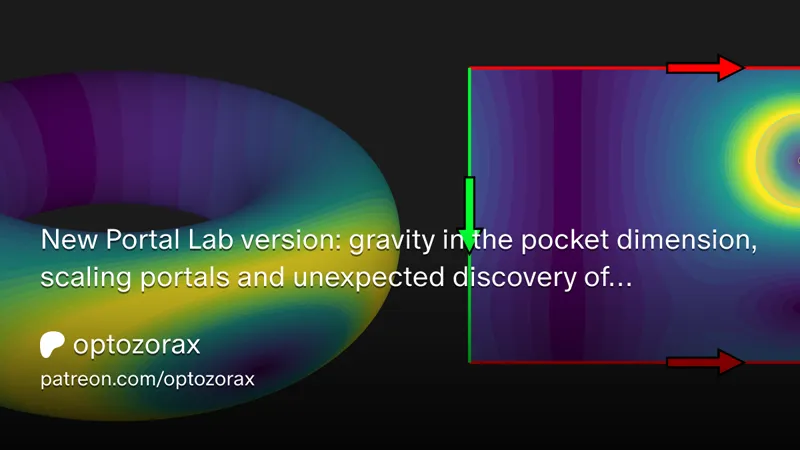
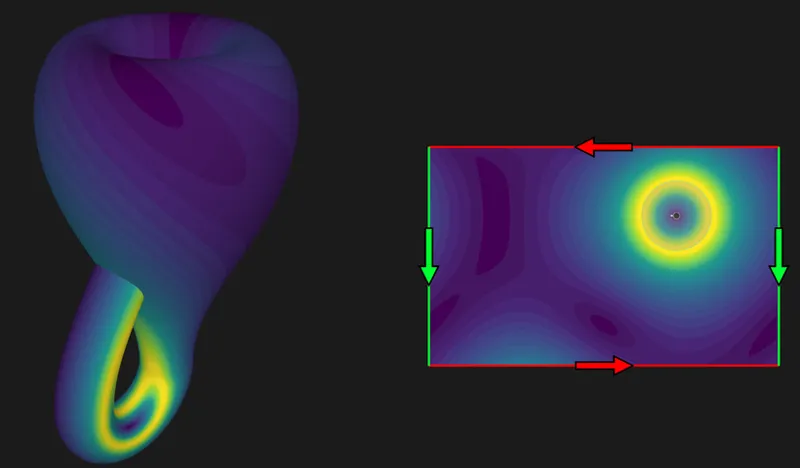
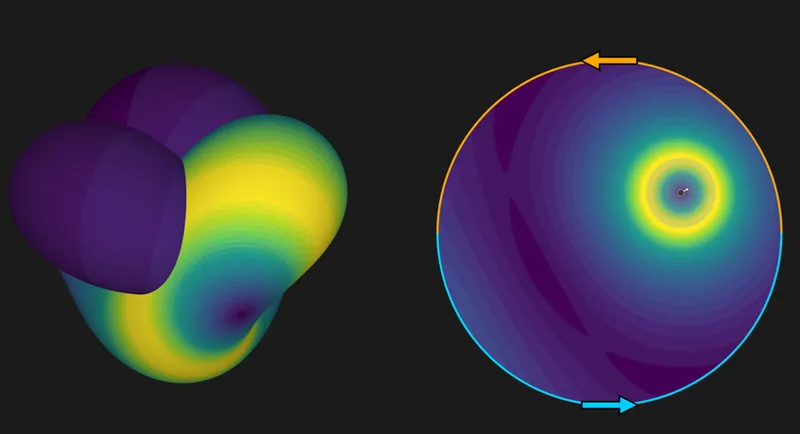
First, there are now 3D visualizations next to popular closed surfaces:
You can rotate both the 2D camera and the 3D camera by pressing different mouse buttons (right button for 3D, left button for 2D).
----------------------------------------------------
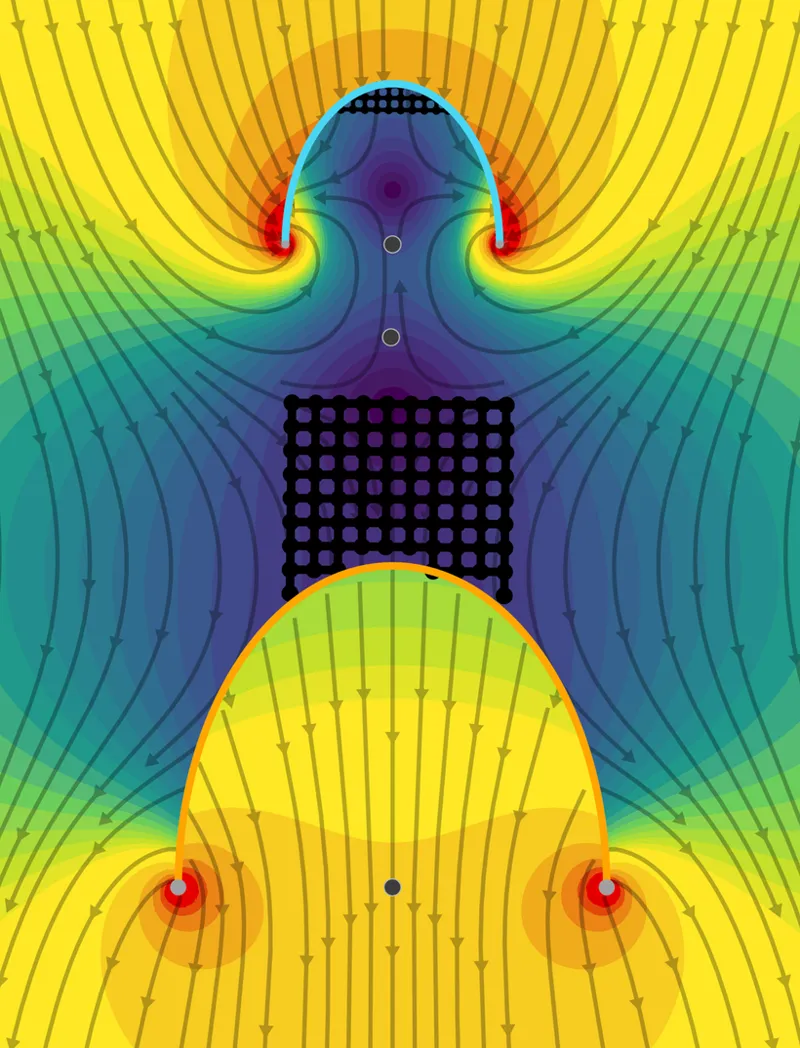
Scaling portals
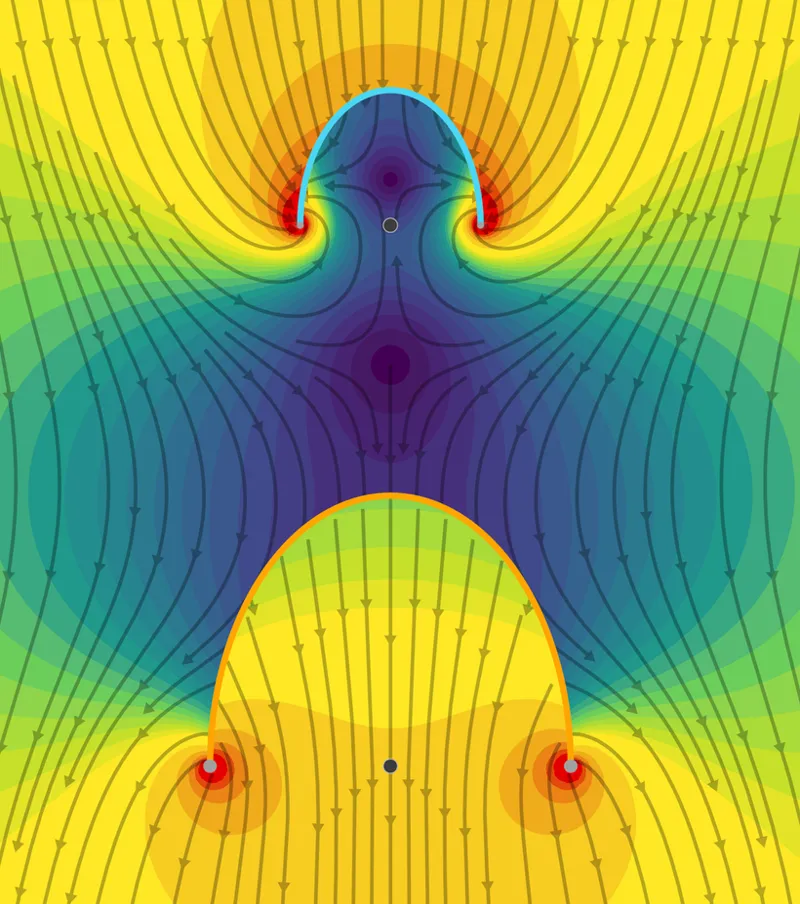
It turns out that scaling portals work with FEM by default, and they obey surface irrelevance, which is very nice:
The only thing I have to support now is the softbody. Turns out, to make it work, I just have to scale softbody springs and particle speeds according to portals, and then make particles weigh S^2 times more than before, where S is the scaling factor between portals. Now, if you put a softbody near the upper portal entrance, it will fly out of the big portal at the same height as with the semicircular portal.
Which means that this obeys surface irrelevance, and therefore can be assumed to be correct for now (but more research is needed).
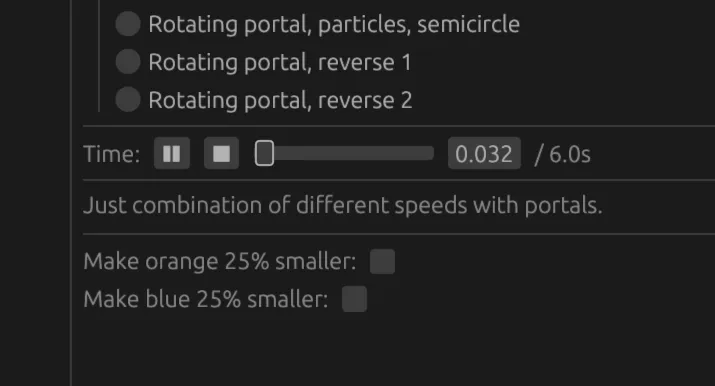
I also added these checkboxes to the "Moving physics" scene, so that you can see how basic physics works with scaling portals.
----------------------------------------------------
Pocket dimension
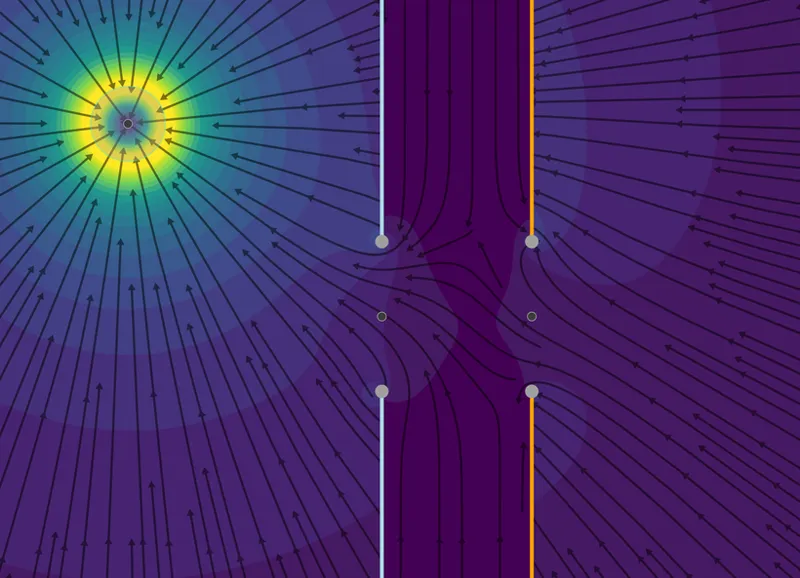
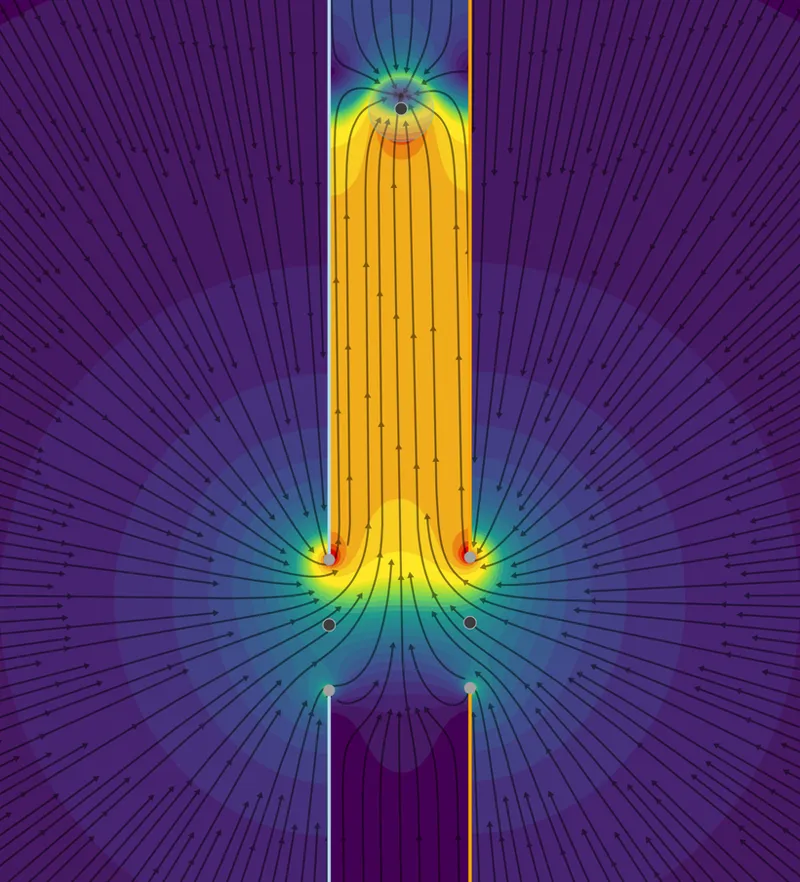
Next, the pocket dimension, using negative portals:
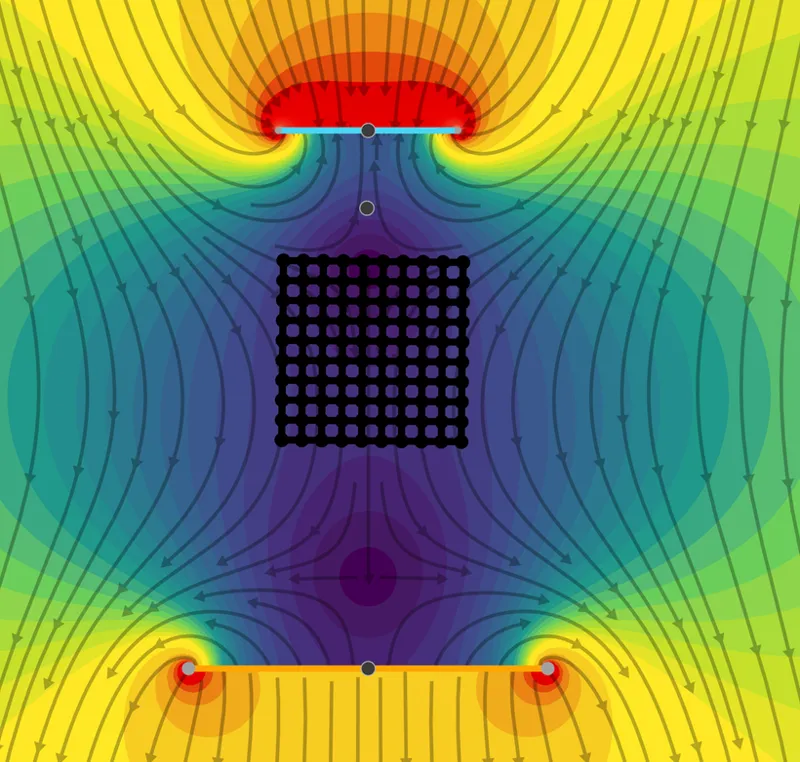
Since the pocket dimension in 2D is closed on itself like a cylinder, the gravity there behaves almost like in 1D, meaning it doesn't decrease with distance:
So, no matter how far away you are from the entrance, your mass will exert the same gravitational force as if it was near the entrance. This feels like a Newtonian black hole that can swallow an infinite amount of mass into a small area and exert more and more gravitational force.
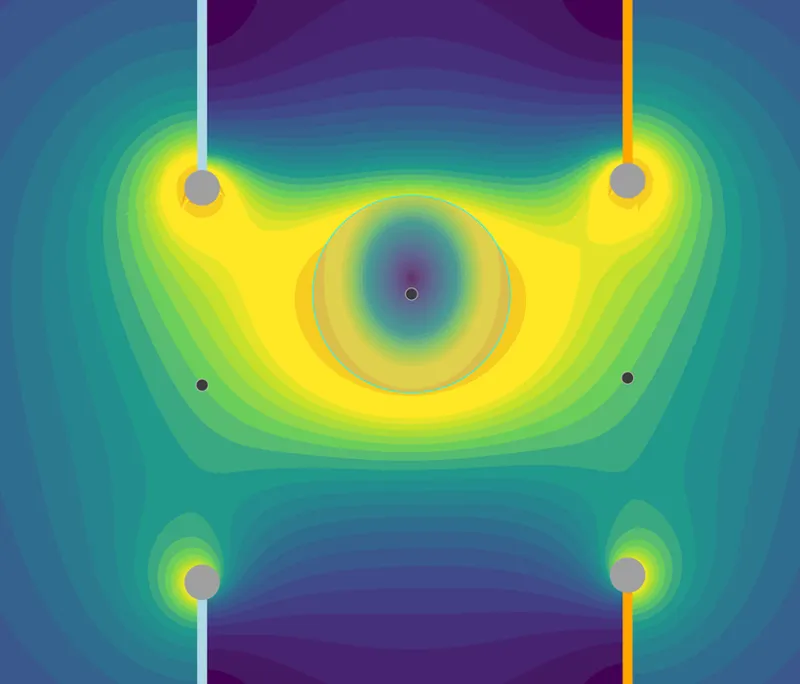
But that's not the only interesting thing related to the pocket dimension. When I played with it, I found a really interesting visual artifact. Look:
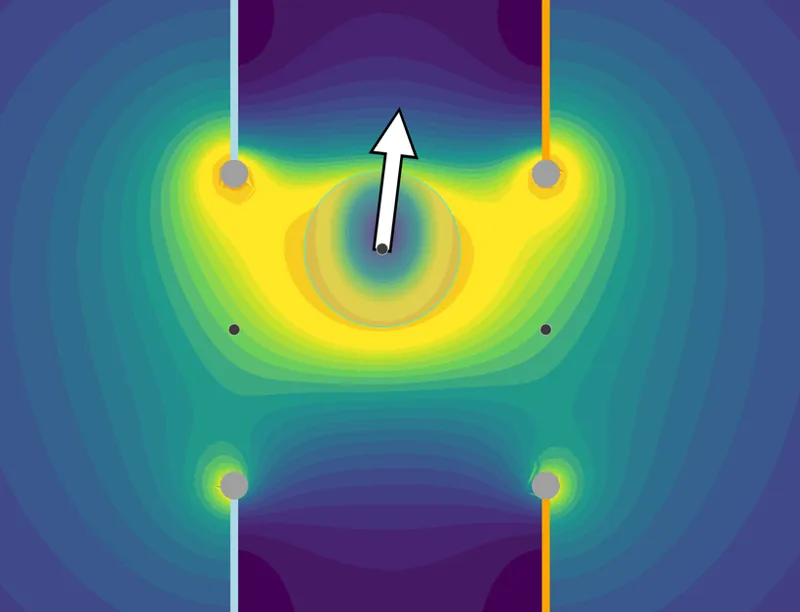
Do you see that the black point of stable equilibrium is located not at the center of the planet? This looks like in the "Two planets" scene, where two masses are attracted to each other and also have their equilibrium point offset:
The big planet has a slight offset of this point (because it's massive, it will not be moved as much by the small planet), but the small planet even lost this point.
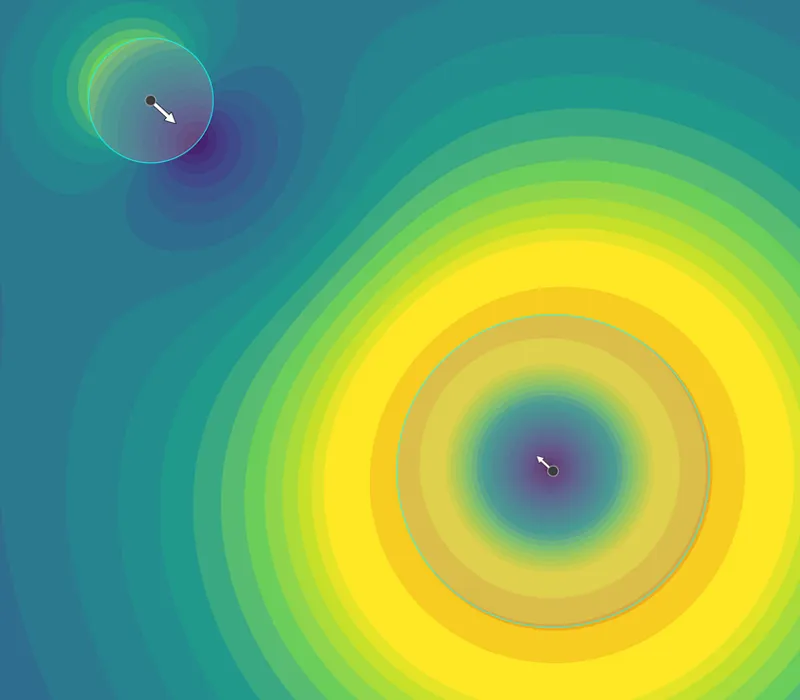
I decided to calculate the acceleration using an integral along the planet surface, and I represented it with the white arrow. This is how it looks for two planets:
So, one planet in the pocket dimension is attracted to something... But what attracts it? There is nothing else, except this planet! It turns out that this planet attracts itself through portals. Portals break some symmetries, and a circular mass is no longer in equilibrium. And I believe this acceleration will persist even if we shrink this mass down to a particle without radius.
And I made the softbody exert mass into the FEM so that I can visualize how such a planet would behave there:
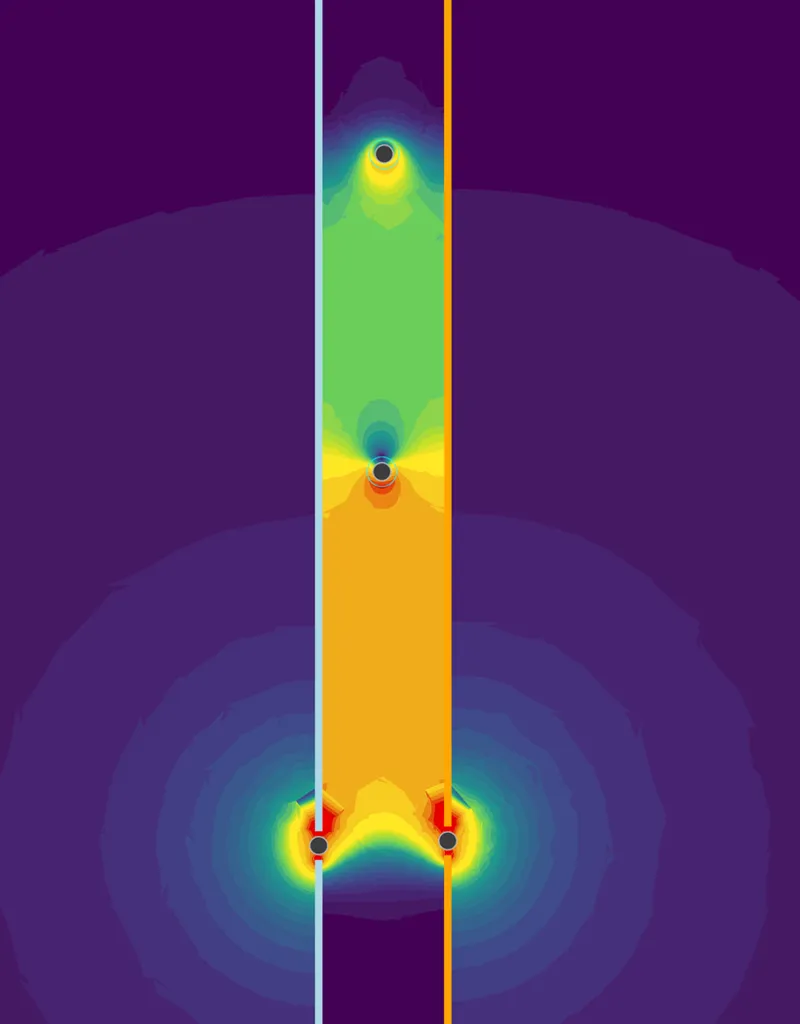
It takes too much time to calculate such thing, because I have to recalculate FEM at every frame, which is slow, so I decided to visualize this self-force field differently: I move small probe mass at every point in space, calculate FEM, calculate integral along that mass boundary, and then get self-force vector. Then I visualize that vector with one arrow and one pixel:
And the final image looks like this:
It takes even more time, but now I have a complete picture of how this self-force behaves, without doing 1000 simulations with the moving softbody.
It's interesting that this portal makes mass push itself away from the portal, but near the portal entrance it makes mass push itself into the pocket dimension. And inside the pocket dimension, mass gives itself a constant infinite acceleration into the abyss. Now the antiportal looks even more like a Newtonian black hole.
And no matter how much matter you have, the pocket dimension will consume all of it, and will exert all its gravitational force:
Although, there might be a problem with the boundary conditions, because I have Dirichlet boundary conditions set to 0 at the far-away boundary. And maybe this makes the pocket dimension behave in such a strange way. I don't know.
I also decided to visualize how self-force looks for other scenes, and here are the results.
Regular portals: (it looks like singularity points at the edges just produce repelling self-force)
Klein bottle: (interestingly, torus space does not produce self-force at all)
Monoportal: (it looks like the cone point at the center of the monoportal produces an attracting self-force. So, cone points with >360 degrees produce repelling force, and cone points with <360 degrees produce attracting force 🤔?)
Triple portal:
So, that's everything I prepared for the next video! I'm starting to write the script. I promised the advertiser that I will make this video by the end of February, so I have no choice but to make it by that date 💀.
Although, I think scaling portals will not make it into the next video, because there is already too much isolated content. Pocket dimension is somehow related to the torus and Klein bottle, but scaling portals aren't. Maybe I will make a separate video about scaling portals.
Also, I was unable to make the softbody work for the torus and Klein bottle scenes. This task is too hard to finish without breaking other scenes.
As always, everything I showed here can be seen in the Portal Lab! I added much more that didn't make it into this post (like planet controls for the scenes "Up and down", "Monoportal", "Triple portal").
If the app doesn't work, try running it with --multisampling 0.
Comments (5)
You think I could get the source code? I just want to see how this works in code
No way, it’s finally working on android, yay ! (Before that, I could only use the PC version because everything crashed when loading gravity simulations) thank you! By the way, how can I place my scene in program. I understand that I haven't done much compared to the others, but suddenly it's possible to place a scene with portal lenses, portals from math functions and planets with portals in the category the "community scene". They have user-friendly interface and screen points. I would be very grateful if it is possible. Upd: I had seen update with a planet in the old scenes.
Please send such scenes to me in telegram, I also changed scene format recently
Is it correct to use such a ball sweep? I think it's better to use loxodroma (although I know how hard it will be to program it)
I don't understand both what a "ball sweep" is and what is "loxodoma" and how it's may be possibly related to anything in this post. Can you elaborate?