




ISAF 2009-2013 - ACO Building - AEW and Tactical C2 (4/x)
On the same principle as for the AAR areas, let's take the time to discuss the practical incidence of the Tactical C2 structure on the ACO. We'll discuss two main topics before coming up with an ACO example: the question of AWACS, followed by the airspace division for Tacical C2 responsibilities.
In order to be able to establish their patterns, let's start the issue of Airborne Warning and Control System (AWACS) aircraft with a description of their performances and orbit parameters.
I. E-3 Sentry
I.1 - Basing
First of all, we can note that during most of the conflict in Afghanistan, E-3 were not based directly in Afghanistan. It's only from January 2011 to September 2014 that NATO AWACS squadron was deployed at Mazar-e-Sharif, in Northern Afghanistan.
But it's not because there was no AWACS based on the theater, that there was no AWACS in the sky: during all other periods, these aircraft were send on demand from the Gulf countries (Qatar or UAE). As for the tankers, the aircraft supported both OIF and OEF alternatively.
I.2 - Patterns
In order to establish realistic holding patterns on the theater, we can have a closer look at E-3 flight manual. This manual states that 3 different orbit patterns can be created in the aircraft's FMS (Flight Management System):
circular;
racetrack;
figure 8.
The "racetrack" pattern is very similar to the tanker's pattern. It's defined in the system by a "Fix", or the reference waypoint for the hot leg, the turn radius (minimum 5 Nm) and the leg's length (no less than 2 x radius + 3 Nm).
The "figure 8" pattern is very similar to the "racetrack" pattern, and it's defined by the very same parameters. The main difference lies in the fact that legs are crossing each other, and as a consequence the turns are alternatively right and left.
The "circle" pattern is also defined by a single point (the circle's center can also be used), and the turn radius.
We can note that each pattern has its own advantages: for example, the circle pattern is very compressed, and can be used whenever available airspace is limited. That's the case in the Batlic countries, where AWACS are nowadays very frequently deployed. The angle of bank is also constant, letting the radar work in very stable conditions.
The racetrack pattern is very useful when the aircraft's Electronic Support Means (ESM) are used for ELINT (Electronic Intelligence) purposes: the longer the leg, the more precise the triangulation of radar emissions. If the relief is factor, the racetrack pattern can also reduce blind zones. The figure 8 pattern has mostly the same advantages, with the additional advantage of limiting wind effects (by always turning into the wind for example). The aspect for radar detection is also more varied, improving the triangulation.
I.3 - Flight Parameters
The flight manual also gives us a good idea of the optimal flight parameters. The performance chart tells us that around 30,000', the best endurance speed is around 230 kt CAS, or Mach 0.6. We can see that both the aircraft's weight and the bank angle have an impact on that speed: the heavier the aircraft, or the higher the AoB, the higher the optimal speed. The manual also states that
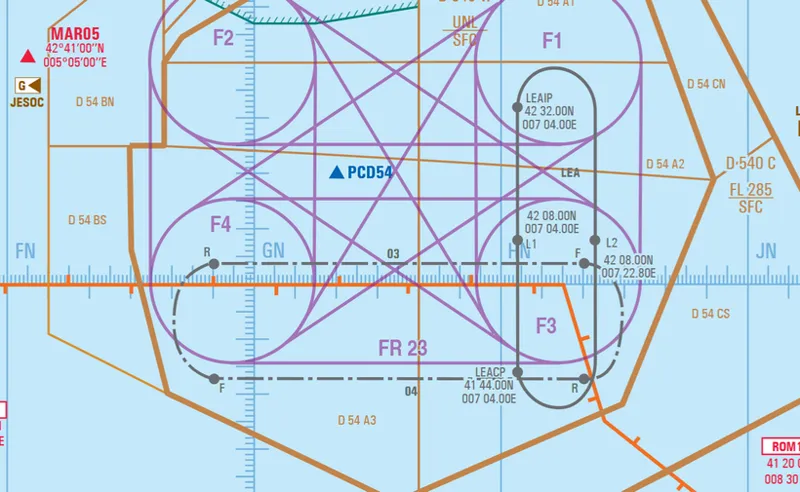
The example above, or military charts, show us that 15 Nm is a standard turn radius. In order to determine the angle of bank, we have to convert the CAS to TAS, then use the mathematical formula or use an online calculator. A 230 kt CAS at 30,000 ft gives us a 360 kt TAD and therefore a 6° AoB turn for a 15 Nm turn radius.
The military chart above also gives us the length of the legs: 60 Nm in this case. Obviously, it will have to be adapted to the available airspace on the theater.
With all these data, we are now able to build the patterns of our choice!
I. E-2 Hawkeye
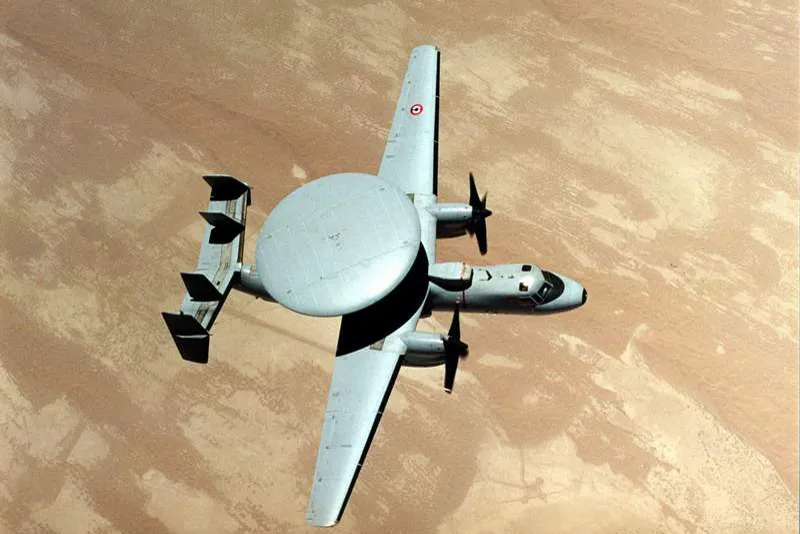
The E-2 was the second type of AEW aircraft regularly deployed over Afghanistan. Basically, whenever an aircraft carrier was supporting the operations from the Indian Ocean, an Hawkeye was potentially deployed in Southern Afghanistan.
To my knowledge, they never deployed on the ground in Afghanistan, contrarily to the EA-6B Prowler, another Navy aircraft that were based several times at Bagram.
II.1 - Flight Parameters
The E-2 is physically able to fly exactly the same type of patterns as the E-3. The "figure 8" pattern is recommended:
But this aircraft has the particularity of being able to operate its radar only when it's perfectly level: banked turns make the radar's signal quality lower, and for this reason the Hawkeye has a specific turn mode when orbiting: the flat turn mode.
We can note that maximum 0.6° per second is equivalent to less than 10° AoB for a usual non-flat turn. It's very similar to the E-3's AoB. The turn radius is around 7 Nm at the optimal speed.
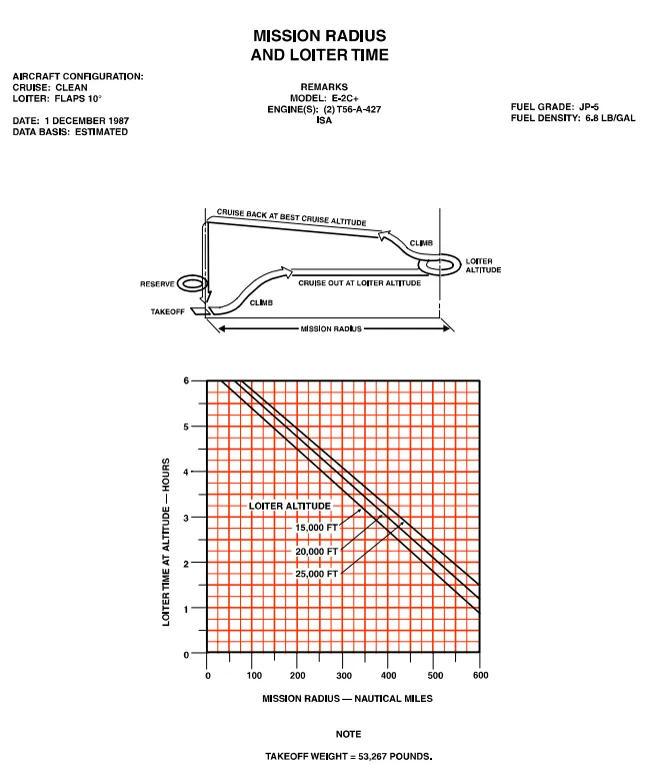
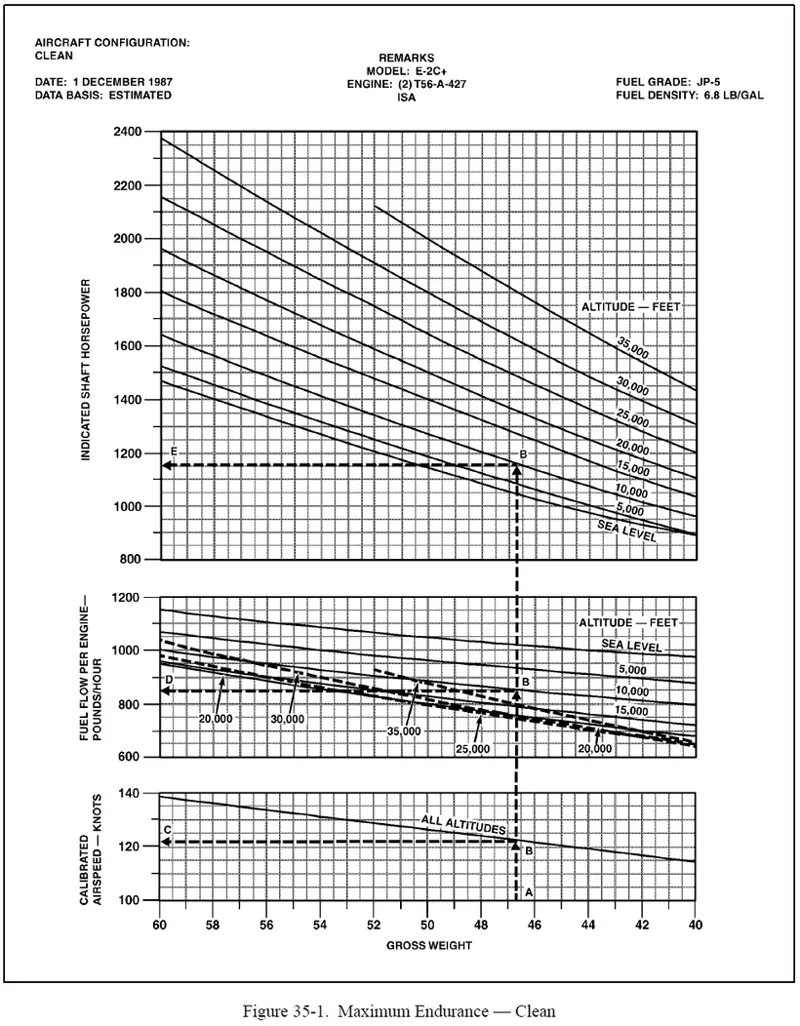
Regarding speed and altitude, the NATOPS manual gives us all the necessary details for the E-2C (the more modern version is currently the E2-D Advanced Hawkeye).
From these two charts, we can determine that a speed of around 120 kt IAS, and an altitude from 20,000 to 25,000 ft is optimal. By comparison, the maximum range speed is around 180 kt (for your transit from the Indian Ocean to Afghanistan).
Conclusion
The elements above will let you create realistic patterns at the optimal altitudes for the two type of AEW aircraft that were regularly used during OEF. If you want more details on their performances, you can look in the attached flight manuals.
In a next post, we'll look at their ground based counterparts: the CRC (Control and Reporting Centers), and their areas of responsibility, called BMA (Battle Management Areas).
USAF E-3 Sentry (AWACS) Mission Over Afghanistan (HD) (YouTube)