
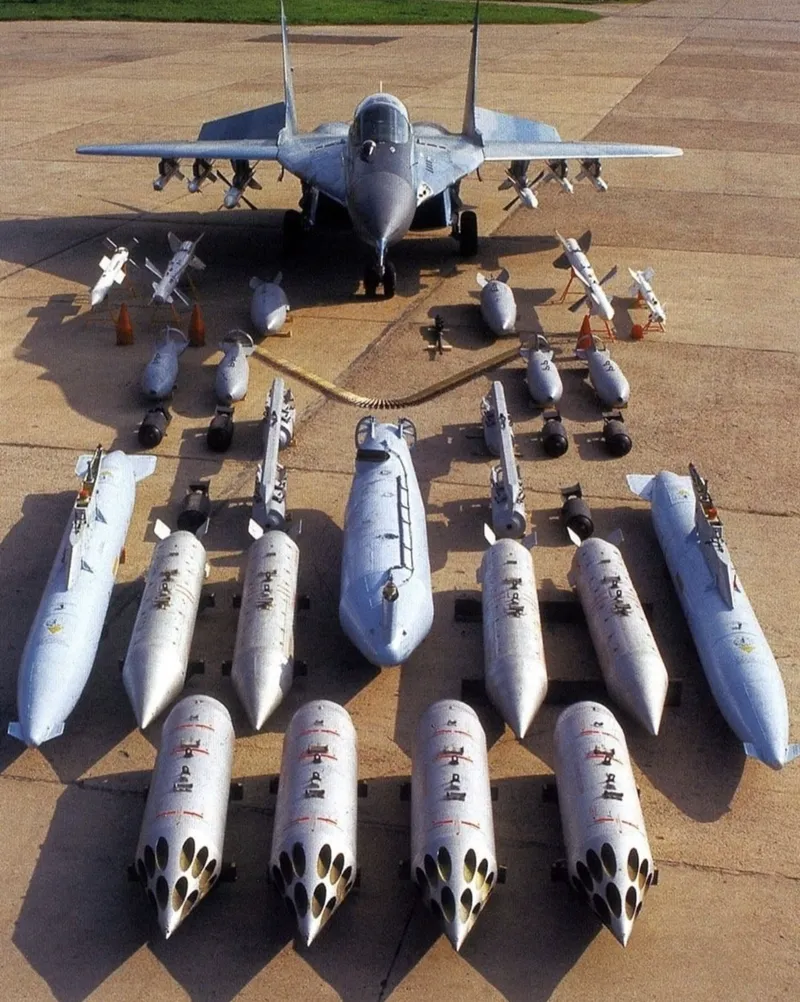





DCS MiG-29: Introduction to Soviet/Russian Air-to-Ground Bombs and Fuzes (1/2)
With the MiG-29 now modeled in full fidelity in DCS World, we finally have access to a level of realism that exposes the full complexity of Soviet and Russian unguided munitions. The recent addition of selectable bomb-fuze options places the Fulcrum on the same level as its Western counterparts, where weapons such as the Mk-8X series and their associated fuzes require informed choices before take-off. That is why I felt it was the right moment to present a family of bombs that many of us probably do not yet know as intimately as their Western equivalents.
This series of posts continues in the same spirit as the ones that were published on Western fuzes a year ago (already!). That earlier work aimed to present the particularities the M-904/905, FMU-139/143/152 and DSU-33 among others. As a refresher, you might also want to give a look at the generalities of bomb fuzes: their roles, the various types, and the main parameters that need to be taken into account to select the most appropriate fuze. The objective here is identical: to give you operational clarity and allow you to employ the MiG-29’s weapons with the same confidence and professionalism that real-world crews apply.
Russian bombs deserve this attention because they were designed under different aerodynamic principles, different industrial constraints and different tactical assumptions than their Western counterparts.
Where American engineers refined sleek, low-drag bomb bodies optimised for medium- and high-altitude release, Soviet designers had a different philosophy. Their first general-purpose bombs kept a robust cylindrical body and large rigid stabilizing fins, a shape that may appear crude at first glance but that were engineered for aggressive delivery profiles. The FAB-250 and FAB-500 families were explicitly tested for separation and stable fall at very high speeds, including release conditions corresponding to Mach 1.5 for the FAB-500 M-62, something no Western Mk-80-series bomb was ever designed to withstand.
The overall design is therefore not primitive, but purposeful: a modular and immensely durable weapon adapted to high-speed, low-altitude, and steep-dive attack profiles typical of Soviet strike doctrine. Understanding this design philosophy is the first step in learning how to correctly use Soviet bombs in DCS.
A similar vocabulary shift occurs with the fuzes. While we are accustomed to a small and relatively standardized set of settings (e.g. instant, delay, proximity) managed by a handful of fuze families, Russian nomenclature looks more intimidating because it is more granular: AVU, AVT, AV-139, VDV, BNV, BRV and several others... Yet once decoded, the logic is straightforward and entirely coherent with the operational habits of Soviet aviation.
The core of this first post is simply to establish the language: how bombs and fuzes are classified by Russian engineers, what their names actually mean, and how that vocabulary already tells us a lot about their purpose and their intended employment.
I. Primary Sources
Here is a short introduction of the sources that will be used to write this post and the following articles.
I.1 - L. A. Vlasov, “Design of Aerial Weapons” (Конструкции авиационных средств поражения), 2004
This is the most technically detailed Russian book on the construction of unguided bombs and aerial munitions that I could find. It explains the geometry, internal structure, stabilizer types, fuze wells, explosive fillers, and the aerodynamic behavior of FAB, OFAB, BETAB, ZAB and other specialized bombs. Vlasov also discusses the modernization programs (M-46, M-54, M-62), the shift toward thermal-resistant casings, and the specific flight regimes for which these bombs were tested.
I.2 - “GNPP Bazalt: Catalog of Aircraft Munitions” (ГНПП “Базальт”: Каталог авиационных боеприпасов), 2000
There are two version of the official manufacturer reference for most Soviet/Russian free-fall bombs, including FAB-250/500, BETAB-500/500ShP, OFAB series, and RBK cluster munitions. It gives authoritative data on mass, dimensions, explosive fillers, penetration capability, release envelopes, drag characteristics, and explicitly lists which fuzes are compatible with each bomb type.
I.3 - “Lecture Notes on Aviation Munitions” (Лекции по курсу “Авиационные боеприпасы”)
This learning document provides practical instruction for ordnance technicians and aviation cadets. It illustrates the key external and internal features of bombs and includes ballistic diagrams for specific munitions. Of particular relevance is the documented release of the FAB-500 M-62 at Mach 1.5 from high altitude, which demonstrates the structural and aerodynamic robustness of the M-62 series. These lecture notes also detail typical flight phases, safe separation characteristics, and the distribution of aerodynamic loads across the bomb body and stabilizer.
I.4. A. L. Grinkevich, “Fuzes of Aerial Munitions” (Взрыватели авиационных боеприпасов)
This is the central technical reference on Soviet fuze design. It systematically describes the AVU, AVT, AV-139, MDV, BNV, BRV, AT-E and other families used on FAB, OFAB, BETAB and RBK bombs. The author explains arming mechanisms, safety devices, pyrotechnic trains, selectors for impact or delay, and the way long-arming intervals are implemented in electro-pyrotechnic models.
I.5. OP-2009 (Ordnance Publication) " Soviet/Russian Aircraft Bombs and Fuzes", US DoD, 1954
This old (1954!) US intelligence document provides cross-validated descriptions of Soviet fuzes and their employment logic. It is particularly useful for confirming arming and delay ranges for older fuze models, the general design of mechanical and electro-pyrotechnic systems, and the coding of fuze families (AV-, AT-, AD-, MDV-). Although less detailed than the Russian sources, OP-2009 is valuable because it corroborates many technical characteristics found in the Russian sources stated above.
II. Terminology of Soviet/Russian Bombs
II.1 -Soviet Classification of Free-Fall Aerial Munitions
The Soviet Air Force groups all unguided, gravity-dropped weapons under the large umbrella term BSP (БСП - Бомбардировочные Средства Поражения), literally Bombardment Means of Destruction (i.e. weapons). This term does not describe a single weapon type, but the entire family of free-fall aerial munitions. This category is itself a sub-category of the larger ASP family (АСП - Авиационные средства поражения: Aviation Means of Destruction, or Aviation Weapons).
The diagram organizes this family into four official categories, each represented by a hexagon around the central БСП symbol. These four categories AB, RBK, RBS and BKF (АБ, РБК, РБС, БКФ) are the only classes recognized in the Soviet technical manuals.
II.1. RBK: Single Use Cluster Bomb (РБК - Разовая Бомбовая Кассета)
RBK identifies all Soviet cluster bombs whose casing opens in flight to release submunitions (small bombs, mines, incendiary elements). An RBK is structurally a thin-walled bomb body designed to disperse payload elements once. RBK-250 and RBK-500 families belong here.
Additional numbers indicate the actual weight in kilograms and any further letters signify special applications or types of submunitions used.
Note: they are classified as "bombs", not "dispensers".
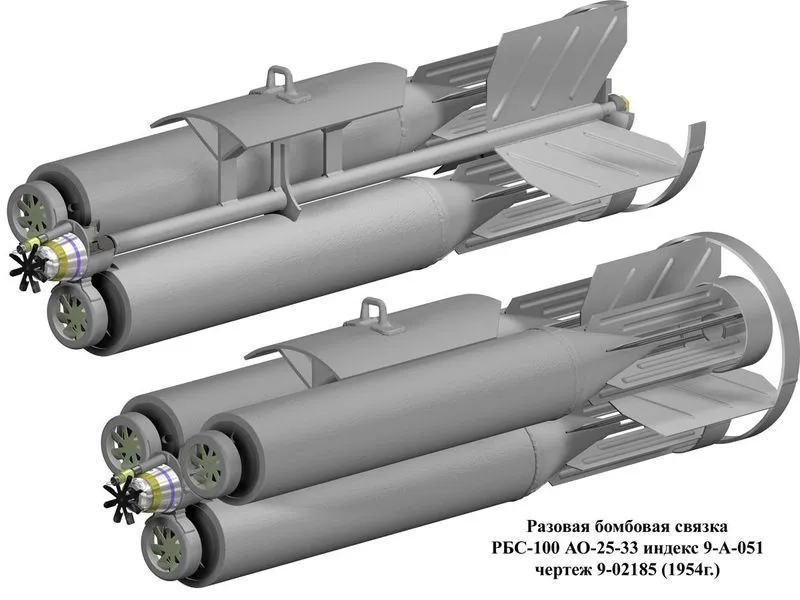
II.2 - RBS: Single-Use Bomb Rack (РБС - Разовая Бомбовая Связка)
RBS refers to devices that combine several full-size aircraft bombs into one single suspension. They are essentially mechanical racks carrying multiple 25–100 kg bombs dropped simultaneously.
RBS such as the RBS-100 were created to allow Soviet aircraft with few pylons to deliver multiple small bombs simultaneously, producing a cluster-like area effect cheaply, quickly, and with excellent compatibility across early jet fighters. These are not submunition containers and not directly relevant to the MiG-29’s standard loadouts, but they remain part of the classification scheme.
II.3 - BKF: Container Blocks for Frontline Aviation (БКФ - Блоки Контейнерные для Фронтовой авиации)
BKF are expendable cassette blocks specifically designed to fit inside the KMGU-2 (КМГУ-2) universal dispenser. Each BKF is a self-contained munition loaded with small-caliber bombs, fragmentation elements, mines, or anti-tank submunitions. During an attack, only the BKF blocks are released. The KMGU-2 container remains attached to the aircraft, does not leave the pylon, and is designed for multiple reuses, being reloaded on the ground with new blocks for subsequent sorties.
Note: Western aircraft have no direct equivalent, but the closest functional comparison is the British JP233 runway-denial pod, while US cluster bombs (CBU series) resemble RBK rather than BKF.
II.4 AB: Aviation Bombs (АБ - Авиационные бомбы)
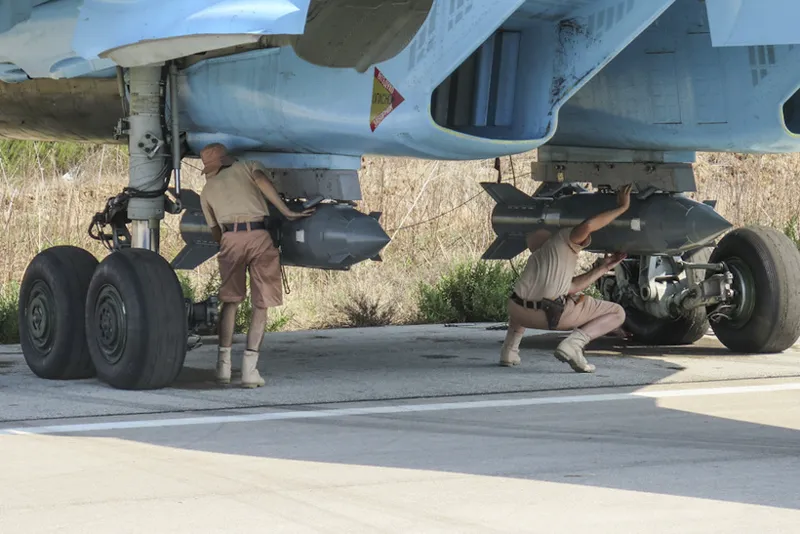
This category forms the backbone of all free-fall aerial munitions. An AB is a complete munition, structurally unified and capable of being employed independently.
The Soviet system defines aviation bombs not by size or weight alone, but by purpose, effect, and mission type. According to the official taxonomy, aviation bombs are divided into four functional groups: general-purpose, non-lethal, auxiliary, and special-purpose bombs. Each branch is defined by the type of effect delivered or by the operational role fulfilled on the battlefield.
II.4.1 - General Purpose
The first and broadest branch is that of general-purpose bombs (основного назначения). These include the munitions used to destroy fortifications, runways, vehicles, industrial infrastructure, personnel, and most tactical targets.
Here we find the most familiar Soviet bomb families: the FAB (ФАБ - фугасные or high-explosive (HE)), the OFAB (ОФАБ -осколочно-фугасные or fragmentation-HE), and the OAB (ОАБ - осколочные or fragmentation).
This branch also contains incendiary bombs ZAB, ZB (ЗАБ, ЗБ), combined-effect bombs FZABn OFZAB (ФЗАБ, ОФЗАБ), thermobaric bombs ODAB (ОДАБ), and all penetration munitions, including BRAB (БРАБ - бронебойные or armor-piercing) and BETAB (БЕТАБ - бетонобойные or concrete-penetrating). The BETAB-500 and BETAB-500ShP carried by the MiG-29 in DCS belong to this group.
II.4.2 - Non-lethal
Next, the diagram identifies non-lethal bombs (нелетального назначения). These bombs act not primarily through blast and fragmentation but through functional effects such as neutralisation, disruption, or disabling. They include graphite or electromagnetic bombs among others.
II.4.3 - Auxiliary
A third branch contains auxiliary bombs (вспомогательного назначения) designed not to destroy a target but to assist the execution of air operations. These bombs illuminate, mark, or signal: they guide attacking aircraft onto an axis or indicate a reference point on land or at sea. This branch includes SAB (САБ - светящие авиабомбы or illumination bombs); DOSAB, NOSAB and TsOSAB (ДОСАБ, НОСАБ, ЦОСАБ or daytime, nighttime, and colored); and OMAB (ОМАБ - ориентирно-морские or marine orientation).
II.4.4 - Special-Purpose
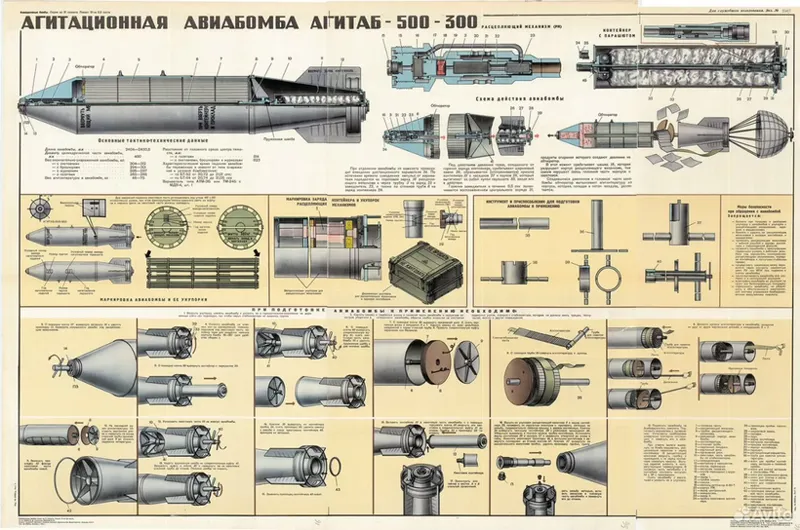
The final branch gathers special-purpose bombs (специального назначения), which perform very specialized missions. Among them are FOTAB (ФОТАБ - фотоосветительные or photoflash), DAB (ДАБ - дымовые or smoke), IAB (ИАБ - имитационные or fake), P and U (П - практические or training, У - учебные or education) and AGITAB (АГИТАБ - агитационные or agitation (!) for leaflet-delivery bombs).
II.4.5 - Guided Bombs
The original Soviet classification of free-fall aerial munitions was established in an era when guided bombs did not yet exist in the VVS arsenal. The architecture detailed above was developed around unguided munitions: weapons whose trajectories were purely ballistic and whose accuracy depended entirely on the releasing aircraft. For this reason, the earliest versions of the classification contained no dedicated place for guided or “corrected” bombs.
By the late 1970s and early 1980s, however, the emergence of electro-optical, television-guided, and semi-active laser guidance kits created a new class of weapons: KAB (КАБ - корректируемые авиационные бомбы), literally corrected aviation bombs. These weapons retained the aerodynamic form and explosive body of traditional AB but introduced a guidance system whether laser, TV, inertial, or satellite-assisted that allowed the munition to correct its own trajectory during flight.
Here an important distinction arises between Soviet/Russian practice and Western design philosophy: for decades, Western air forces relied primarily on guidance kits attached to standard “dumb” bomb bodies. In that model, the bomb body and its guidance kit are separate components.
The Soviet approach was different: rather than adapting existing FAB or OFAB bodies with removable kits, Soviet design bureaus developed fully-built guided bombs from the outset, each a complete weapon: KAB-500L (laser), KAB-500Kr (TV) and later KAB-500S with satellite-corrected inertial guidance. The guidance system, control fins, body, and warhead were integrated into a single purpose-built design. This meant that KABs were not “kits” but dedicated precision munitions, separate from the traditional aviation bomb families.
This divergence persisted until very recently. It is only with the 2022 war in Ukraine that Russian aviation began adopting a Western-style approach: the development and mass employment of UMPK (УМПК - универсальный модуль планирования и коррекции, or universal gliding and correction module). The UMPK functions as a modular gliding + guidance kit, attached to standard FAB-250, FAB-500, or FAB-1500 bomb bodies. With UMPK, Russia finally adopted the concept of converting large existing stocks of unguided bombs into guided glide weapons, mirroring the logic that drove Western JDAM production more than twenty years earlier.
II.5 - Conclusion
The classification of Soviet free-fall munitions may appear dense at first glance, but its internal logic is remarkably consistent. Once the four principal categories of the BSP family (АБ, РБК, РБС, and БКФ) are understood, every bomb and submunition in the VVS inventory finds its natural place. General-purpose aviation bombs form the backbone of the system; cluster cassettes, bundles, and cassette blocks extend their effects across wider areas; and the various auxiliary and special-purpose bombs complete the picture. Knowing how a FAB, an OFAB, a BETAB, an RBK, or a KMGU-2 fits into this hierarchy will define how each weapon is built, prepared, fuzed, and ultimately employed.
The next step is therefore to turn to the fuzes themselves. Just as Soviet bombs follow a distinct classification, Soviet fuzes follow a distinct philosophy, one that differs from the American M904/M905, FMU-139, or FMU-152 families now familiar to DCS pilots. Their naming conventions are different, their mechanical logic is different, and their operational assumptions are different. In the next part, I will therefore try to decode the Russian fuze nomenclature.
Comments (2)
Oh sir, thank you so much for all the hard work you’ve done to gather the material and share it with us. It’s such a pleasure to get all this information together in one place. Waiting forward to read the next part. p.s. if you would need any help with translation or explanation of any docs in russian or ukrainian - please feel free to contact me
С удовольствием!