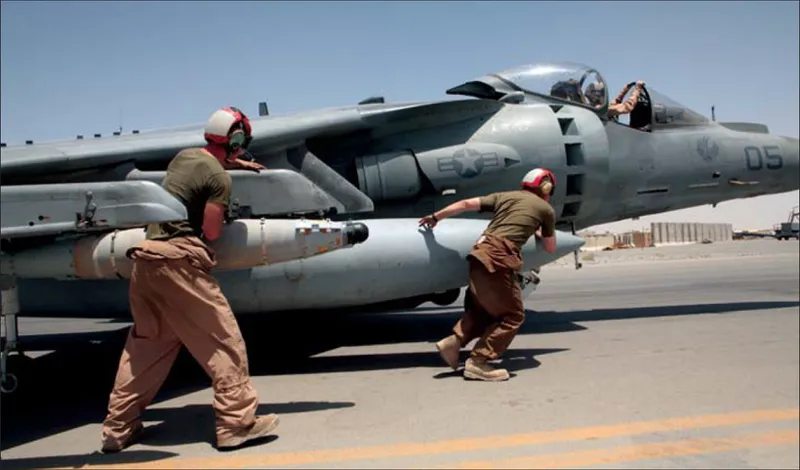
Book Review: AV-8B Harrier II Units of Operation Enduring Freedom
This is a follow-up of my previous reviews of Osprey’s F-14 Units of Operation Enduring Freedom and A-10 Units of Operation Enduring Freedom (2002-2007 and 2008-2014) volumes. As you've seen it, these books really stand out for their amazing details and firsthand accounts, offering us, virtual pilots in the DCS community, a valuable insights into real-world air combat operations.
AV-8B Harrier II Units of Operation Enduring Freedom, by Lon Nordeen, provides a comprehensive operational history of the AV-8B Harrier II in the Afghan theatre, covering its deployments from 2001 through the end of the campaign. As usual, you’ll find detailed mission breakdowns, loadout specifics, accounts of CAS missions and weapons employment examples. The content will speaks directly to those who not only fly these jets virtually but are willing to get a better understanding of the systems, tactics, and human factors involved.
Following the usual structure seen in the previous Osprey Combat Aircraft volumes, we have here a chronological review of the deployments of the AV-8B Harrier II throughout the Afghan campaign.
The content is broken down into six chapters and a set of appendices, each offering a look at specific periods and aspects of Harrier operations in OEF.
Chapter 1: USMC and AV-8B Air Support
This first chapter is fairly original, because it provides a doctrinal explanation of how the AV-8B fits within the US Marine Corps' combined arms approach. As a light, highly mobile force, the USMC depends on tactical aviation, and jets like the Harrier II, to compensate for limited organic artillery. The AV-8B was developed specifically for this role, offering close-in fire support from amphibious ships or forward bases where conventional aircraft couldn’t operate.
A comparison between the AV-8B and the F/A-18 Hornet is done, noting the Harrier’s STOVL advantage but also its limitations: slower speed, lower payload, and a significantly higher accident rate. Despite this, its ability to launch from ships or short strips made it indispensable for expeditionary ops.
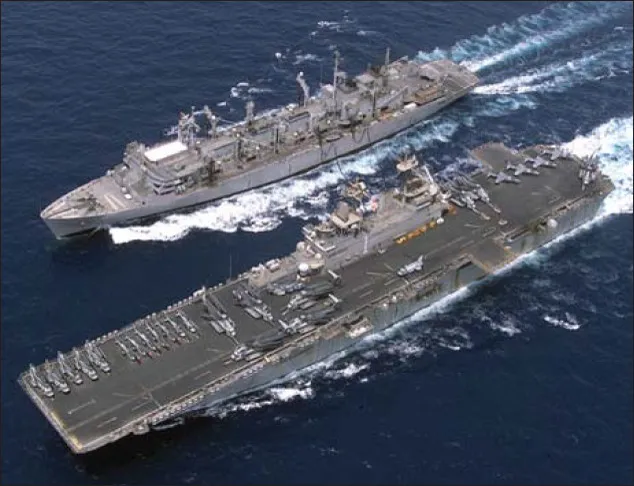
"USNS Supply (AEO-6) delivers nearly 65,000 lbs of fuel to USS Wasp (LHD-1) during an underway replenishment off the coast of Pakistan on 17 July 2002. Wasp deployed with the 22nd MEU-SOC/HMM-261 embarked, the latter unit including six AV-8Bs from VMA-542 ‘Det A’ within its ranks."
We get an explanation of how AV-8B squadrons integrate into the Marine Expeditionary Unit (MEU) and Marine Air-Ground Task Force (MAGTF) structure. A typical Harrier detachment includes six jets, nine pilots, and around 90 support personnel, deploying as part of a composite air combat element aboard ships like LHA or LHD-class amphibious assault vessels.
A detailed history of upgrades is included—from the Night Attack variant’s FLIR and HUD improvements to the radar-equipped Harrier II+, and eventually the integration of the Litening II pod and JDAMs. These transformed the Harrier from a clear-weather bomber at the beginning of OEF, into a 24/7 precision strike platform.
"The full set of equipment that comprises the L3 Remote Operational Video Enhanced Receiver (ROVER III), as used by US Marine Corps AV-8Bs, F/A-18s and UASs."
This chapter was necessary for understanding the Harrier’s operational peculiarities. And for DCS players who don't fly the Harrier, it will porbably clarifies why it was designed the way it was.
Chapter 2: OEF 2001-02
This chapter details the Harrier II’s first combat missions in Operation Enduring Freedom. It begins with the deployment of the 15th MEU aboard USS Peleliu and the 26th MEU aboard USS Bataan, each carrying six Harriers and associated support elements. Due to Afghanistan’s landlocked geography and heavy political resistance to U.S. basing in the region, sea-based Harrier operations became critical in the early phase of the war.
Initially, the AV-8Bs faced reluctance from the CAOC to task them with strike missions due to their lack of precision targeting pods. Harrier pilots had to "lobby" to get tasked, eventually flying long-range sorties with Mk 82 bombs and external tanks, refueling multiple times per mission, often with RAF or French tankers.
"A VMA-311 ‘Det B’ AV-8B Harrier II+ armed with GBU-12 LGBs takes on fuel from French C-135FR over southern Afghanistan on 9 December 2001. Aerial refuelling has been critical to the effective employment of Coalition air power throughout OEF, and this was particularly the case during the early stages of the campaign."
The first Harrier combat sortie occurred on 3 November 2001, striking a terrorist training camp deep inside Afghanistan. From that point on, VMA-311 and VMA-223 began flying sustained CAS mission in any conditions. As usual in Osprey books, we have several firsthand pilot accounts detailing procedures like bomb tosses from above 15,000 ft due to ROE restrictions, reliance on ground-based laser designation, and the logistical challenge of sustaining two four-ship missions per day with only six aircraft... We also learn that the AV-8B had to refuel three times per sortie (once over the ocean, once in Pakistan, and again when returning) just to reach and return from Afghanistan itself.
Chapter 3: OEF 2002-03
The third chapter details the the transition from sea-based to land-based operations, notably with VMA-513 deploying to Bagram Airfield in October 2002, the first shore-based Harrier detachment in the theatre.
At this time, the use of precision-guided munitions and the Litening II targeting pod becomes standard practice. VMA-542's deployment aboard USS Wasp in early 2002 marked the AV-8B’s combat debut with the Litening II. It is recognized that this integration allowed for important tactical improvements, like real-time target identification, buddy-lasing tactics, and far greater mission flexibility compared to the earlier campaigns in 2001.
"Litening II pods were still in short supply when VMA-513 deployed to Bagram in October 2002, and typically only the lead jet in a two aircraft section would be equipped with one when flying a patrol. In this photograph, taken from a KC-10 on 29 January 2003, the lead aircraft has a single 1000-lb GBU-16 to counteract the 440-lb weight of the Litening II pod. The trailing jet is armed with a 500-lb GBU-12 and a LAU-10D/A rocket pod."
Among other anecdotes, we have an account from Capt Michael Perez of VMA-542, one of the first Marine Harrier pilots to fly combat sorties using the Litening II pod. With minimal documentation and no formal training materials, his squadron developed tactics on the fly. The squadron was literally writing the book on Litening II operations while flying live combat missions. They overcame limited software support (the system identified the pod as a Laser Maverick), no documentation, and narrow weapons compatibility—all under combat conditions.
Chapter 4: OEF 2004-06
This longer time period was the time when AV-8B Harrier II operations reached full operational maturity in Afghanistan. This phase saw the AV-8B mainly operating from fixed land bases, most notably Bagram and Kandahar Airfields. While Bagram remained a key hub for VMA-513’s long deployment, Kandahar became increasingly important from a logistical and strategic standpoint. Located closer to ongoing combat operations in southern Afghanistan, Kandahar allowed for shorter transit times, hence greater sortie rates and more responsive CAS ("Harriers based at Kandahar could reach some southern target areas in as little as 10–15 minutes, compared to over an hour from sea-based platforms—greatly improving CAS responsiveness").
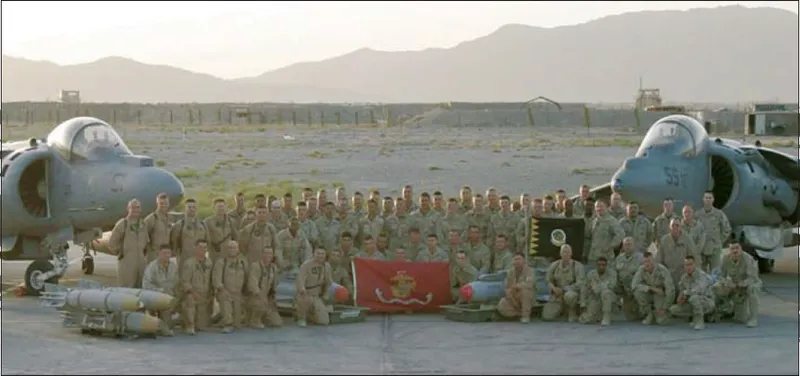
"VMA-542 ‘Det A’s’ pilots and maintainers pose for an end-of deployment photograph at Kandahar in late July 2004. The detachment performed more than 400 strike and ISR sorties totalling 1339 combat hours during its time in-country."
We have several example of Harriers' mixed ordnance loads—GBU-12s or GBU-38s paired with 25 mm gun pods or rocket pods, with a standard loadout that now always included the Litening II pod.
In on of the interesting combat mission accounts, we learn how Maj Michael Franzak of VMA-513, who flew a mission in support of SEAL Team “Malice” operating near the Pakistan border, executed two strafing runs with the 25 mm cannon, followed by a precision drop of a GBU-16.
Chapter 5: OEF 2007-10
That next chapter takes place in a phase when U.S. and coalition forces began shifting their focus toward a full-spectrum counterinsurgency campaign. During this period, the Harrier’s role expanded beyond traditional CAS, like persistent overwatch, ISR (Intelligence, Surveillance, Reconnaissance), or convoy escort.
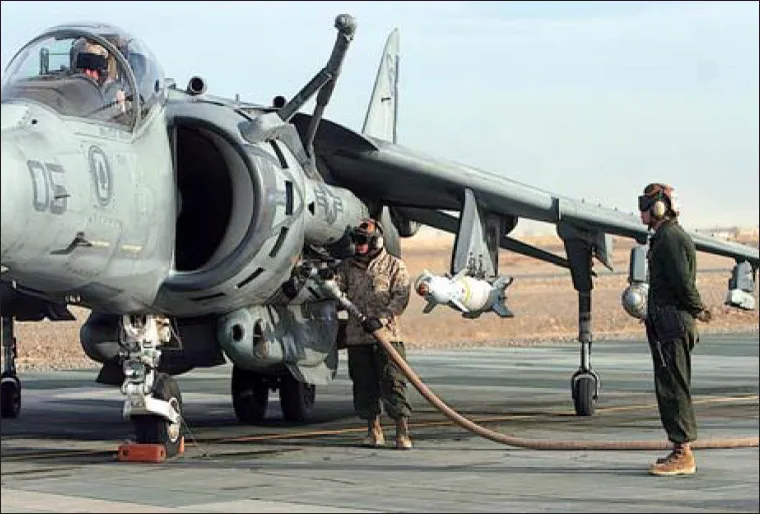
"A refuelling crew from MWSS-372 replenish the tanks in a VMA-231 jet at Camp Dwyer"
With more forward operating bases established across southern Afghanistan, Kandahar Airfield became the main hub for land-based AV-8B squadrons. From here, Marine Harrier detachments provided rapid response and long-duration coverage, often flying 5–6 hour missions with mixed ordnance. Most jets were at this time radar-equipped Harrier II+ versions, carrying Litening II pods, GBU-12s, GBU-38 JDAMs, and the 25 mm gun as a standard CAS loadout.
We start to see the increasing reliance on real-time video downlink via ROVER to JTACs, allowing Harrier pilots and ground forces to work way more efficiently together. Pilots describe using Litening II not just for laser designation, but most of the time as a surveillance tool, tracking enemy movement, monitoring building entrances, or covering friendly troop movements during assaults.
Chapter 6: The Surge
The last chapter focuses on the Harrier’s role during the U.S. troop surge in Afghanistan (2009–2011), that led to the most demanding operational tempo Marine aviation had experienced in the war.
Deployed primarily from Kandahar Airfield, squadrons such as VMA-231 and VMA-223 supported the surge with round-the-clock CAS, overwatch, and armed reconnaissance, generally flying two sorties per day and per aircraft. With US Marine troops spread across Helmand and Kandahar provinces, Harriers were relied upon for persistent overhead cover, providing real-time battlefield awareness to ground commanders.
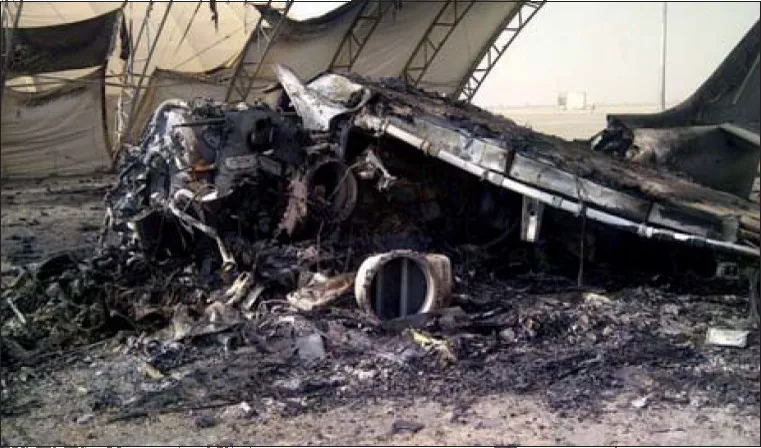
One of the most significant events covered in this chapter 6 is the attack on Camp Bastion on 14 September 2012, which resulted in the worst single-day loss of U.S. Marine Corps airpower since the Vietnam War. On that night, a group of 15 Taliban insurgents, disguised in U.S. Army uniforms, breached the perimeter of Camp Bastion. Armed with small arms, RPGs, and explosive vests, they launched an assault against the aircraft parking area used by VMA-211, which was deployed at the time with Harrier II+ jets in support of ongoing operations. The attack was devastating, since in just a few minutes, six AV-8B Harrier IIs were completely destroyed, and two more were severely damaged.
The charred remains of AV-8B BuNo 165568 the morning after the attack that destroyed six Harrier IIs and badly damaged two others on Camp Bastion’s Lima Ramp.
We can note that the introduction of the GBU-54 Laser JDAMs for engaging moving targets was a major improvement over earlier fixed-coordinate JDAM use. The Digital Improved Triple Ejector Rack (DITER) also began appearing, allowing pilots to carry more precision munitions per sortie.
"VMA-513 became the first land-based US Marine Corps AV-8B squadron to employ a laser-guided GBU-54 JDAM in combat in July 2011. This 500-lb guided bomb gave Harrier II pilots the ability to target fixed positions (like an insurgent stronghold) with GPS technology, as well as undertake precision strikes on moving targets by using the bomb as a laser-guided weapon. This aircraft, photographed at Kandahar on 22 July 2011, has a GBU-54 beneath its right wing on the stores pylon usually reserved for the Litening II pod. The latter, again in a first for a US Marine Corps Harrier II unit, is centrally mounted under the fuselage of the aircraft."
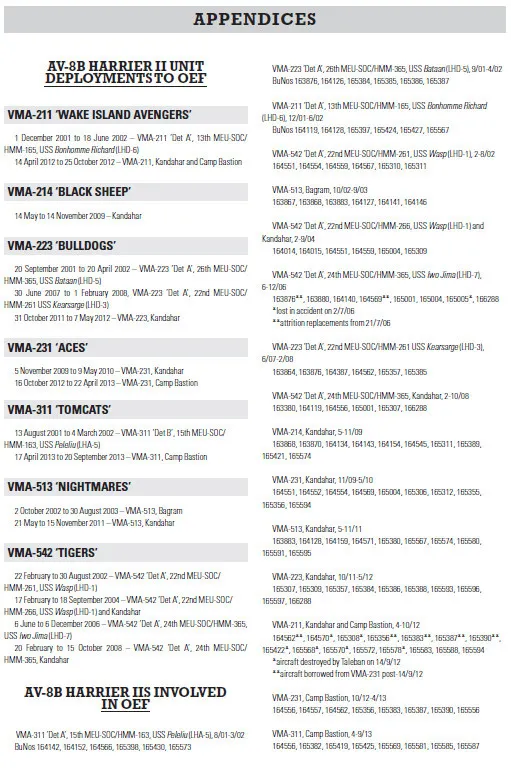
Appendices
As usual in the Osprey series, the appendices gives us additional data on unit deployments, as well as beautiful color plates who can be useful for livery makers.