Combat Search and Rescue: Relationship with Medical Support and 2010 Basing Example (8/8)
NATO medical support doctrine, CSAR and CASEVAC HLO basing in 2010.
As it has been discussed in the previous publications, CSAR and CASEVAC helicopters in Afghanistan were very important for NATO’s medical system. Helicopters like the UH-60G Pave Hawk or CH-47 Chinook worked together with different levels of hospitals to save lives after clashes with the insurgents or IED attacks. The locations of these helicopters were close to medical facilities, which made it easier to transport injured people quickly.
NATO Medical System
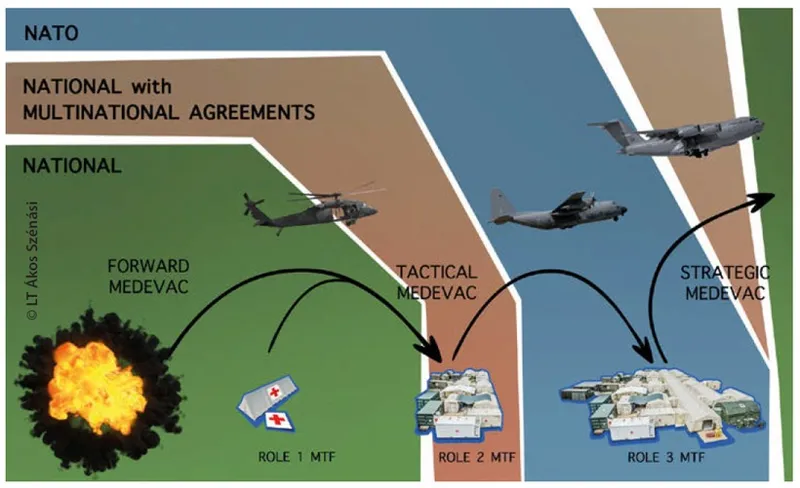
In NATO’s system, medical care is divided into three levels: Role 1, Role 2, and Role 3 hospitals. Each level provides more advanced care than the one before. This system helps to take care of soldiers from the moment they are hurt until they get full treatment. The system follows rules of speed, continuity, and care, as describer in NATO’s AJP-4.10 doctrine about Medical Support. These rules were very important in Afghanistan.
Casualties treatment system used in Afghanistan, for ISAF personnel, Afghan National Security Forces and Afghan nationals.
Role 3 hospitals are the most advanced. They are like big civilian hospitals and were located at large bases like Bagram Airfield and Kandahar Airfield. These hospitals had surgeons, intensive care, and equipment for complicated surgeries. CASEVAC helicopters often brought the most seriously injured people directly to Role 3 hospitals. This was important because delays could mean the difference between life and death.
Bastion wall painting commemorating a deployment at Kandahar's Role 3 hospital.
Role 2 hospitals were located at large Forward Operating Bases (FOBs), such as Camp Bastion in Helmand Province (this hospital will later be upgraded to Role 3). These hospitals provided surgery and trauma care to stabilize patients. They were often run by the lead nation in the region, as a reminder of each commander's responsibility upon the lives of their wounded soldiers. Once patients were stable, they could be moved to a Role 3 hospital if needed. Helicopters like the CH-47 Chinook carried many casualties at once and were used for missions that required long flights or high-altitude operations.
View of the Dutch Role 2 hospital in Tarin Kowt.
Role 1 facilities were small medical units close to the battlefield. These units provided first aid and helped stabilize patients before they were moved to Role 2 or Role 3 hospitals. If Role 1 hospitals were the norm at the early stages of the conflict, many of them were later transformed into Role 2.
View of theoretical responsibilities in terms of medical evacuations: each nation has to bring its soldiers by its own means to a Role 1.
Note: NATO used the 10-1-2 rule, which means life-saving care should happen in 10 minutes, resuscitation in 1 hour, and full treatment in 2 hours. Given the distances and the difficulty of the terrain, helicopters were the only way to actually follow this rule by flying quickly to hospitals, even when distances were long or the terrain was hard.
STRATEVAC: Strategic Evacuation
Strategic evacuation is the last step of the evacuation process, when Role 3 hospitals are not in a position to offer adequate treatment, either because of the severity of the injuries, or because of the number of casualties. In that case, there was a need to transport those patients from in-theater hospitals to advanced medical facilities outside the combat zone for further treatment. After stabilization at Role 3 hospitals, patients could be flown to facilities like Landstuhl Regional Medical Center (LRMC) in Germany, or to hospitals in their home countries.
These evacuations relied on fixed-wing aircraft like the C-17 Globemaster III, which were configured for aeromedical missions. Staffed by teams called Critical Care Air Transport Teams (CCATTs) in the US, these flights served as flying intensive care units, ensuring patients received life-saving care during transit. The timeline for evacuation was typically within 24 to 72 hours of stabilization, depending on the severity of injuries and logistical factors.
CCATT in a C-17 during a STRATEVAC form Afghanistan.
Other countries, like France, developed original medical evacuation means. During the Afghan conflict, the C-135FR tanker was transformed into a medical unit for such missions, using what was called a MORPHEE kit, used for the first time in 2006. The use of this aircraft was chosen for its guaranteed availability, since several of these tankers had to be ready 24/7 in order to support the French nuclear air component. Since the introduction of the A330 MRTT as a replacement of the C-135FR, the concept is still alive since the MRTT can also be transformed as a medical evacuation unit.
Details of the MORPHEE kit used on C-135FR for STRATEVAC.
Basing Example as of 2010
Understanding the relationship between military hospitals and the medical evacuation system helps us better analyze the layout of CASEVAC and CSAR helicopters in Afghanistan.
In 2010, dedicated HH-60G Pave Hawk CSAR assets were based only at Kandahar Airfield and Bagram Airfield (operational radius in dark purple on the map). These locations served as the primary hubs for CSAR missions. In the event of a rescue operation, these helicopters might have to relocate closer to the area of operation before launching the actual mission to reduce response time and maximize their on-station playtime.
CSAR HH-60G in the Kabul area in 2011.
In addition to these specialized CSAR units, numerous CASEVAC helicopters were deployed across the theater, providing broader coverage for initial responses. However, these CASEVAC helicopters lacked the advanced training, equipment, and capabilities required for dedicated CSAR operations. In the event of an ejection, they could still be used for recovery attempts, employing the more flexible Combat Recovery procedures rather than the more specialized CSAR protocols.
One notable gap in helicopter coverage was in the central region of the country, where the high-altitude terrain made operations difficult (yellow) or even impossible (red) for helicopters.
CSAR and CASEVAC helicopters basing in Afghanistan in 2010, in relation with the various Role 1/2/3 hospitals.
Note: The combat radii shown on the map are approximate. They consider the higher altitudes and temperatures typical of Afghanistan and assume operations without air-to-air refueling. The calculations also include 30 minutes of playtime on station.
The .cf file used to create this map is attached for further analysis.