
Building your Patreon community FAQs
Every community looks a little different, and so does the path to building one.
You've worked through defining what community management means for you, setting community expectations, moderating with confidence, and knowing your own limits.
Here are some of the questions we hear most from creators as they put these ideas into practice. If something comes up that isn't here, let us know — we'll keep adding to this as more creators go through the collection.
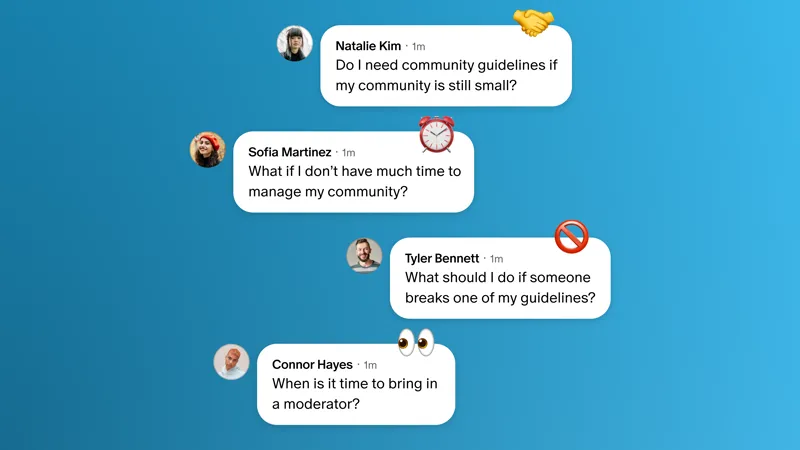
Do I need to set community expectations or rules if my community is still small?
Patreon's Community Guidelines already give every community a shared foundation, so creating your own community expectations is a choice you can make based on what your community needs.
Even in a small community, your own expectations can be helpful when you want to add clarity that's specific to your space. Maybe you want members to label spoilers, ask before offering feedback, or keep self-promotion to certain conversations.
As those situations come up, you can decide whether an expectation would make things clearer for everyone. And when you do need to moderate, both Patreon's Community Guidelines and any community expectations you've set give you something clear to point back to.
What should I do if someone breaks one of my community expectations?
Start with the situation in front of you.
Many moments can be resolved with a calm response and a reminder about your community expectations or Patreon’s Community Guidelines. That can happen right where the conversation is already taking place. A simple public reminder gives the person a chance to adjust while also reinforcing the expectation for everyone else who sees it.
If the behavior continues or the situation calls for a stronger response, that's when moderation tools can help you take the next step.
What if I don't have much time to manage my community?
Community management looks different for every creator.
Some creators enjoy checking in every day. Others stop by when they can and create opportunities for members to connect with each other between visits. Many communities land somewhere in the middle.
Find a level of involvement that fits the time and energy you have available. That might mean checking in less often, simplifying your approach, or bringing in a trusted moderator to share some of the responsibility.
The right approach is one that gives you room to keep participating in your community in a way that works for you.
When is it time to bring on a moderator?
There's no single milestone that tells you it's time.
You might start thinking about moderation help as more people join your community, conversations happen more frequently, or keeping up with moderation starts taking more time and energy than you'd like. You may also simply want another trusted person helping look after the space you've built.
Many creators begin with someone who's already an active, trusted member of the community before deciding whether they need additional moderation support.
What if people aren't engaging with my posts?
A quiet response doesn't necessarily mean your community isn't interested. Some members may read along, learn from other people's responses, or enjoy feeling connected without commenting themselves.
Keep experimenting with what makes it easiest for people to join in. If an open-ended question isn't getting much response, try lowering the lift with a poll or emoji check-in. You can also experiment with different topics, timing, or how often you post.
Give yourself time to notice patterns. What gets your members talking, what gets a quick reaction, and what they prefer to simply follow along with can all help you learn how your community likes to participate.
What if I'm feeling overwhelmed?
Building community asks something of you, too.
Feeling drained from time to time is worth paying attention to. Sometimes the best next step is simplifying your approach, adjusting how often you show up, or asking someone you trust to help.
You may also find yourself supporting members through situations that are bigger than what any creator should be expected to carry alone. When that happens, connecting someone with professional resources is often the most supportive thing you can do. Patreon's Mental health and wellness resource hub is a great place to start.
Looking after your own capacity is one of the ways you look after your community.