
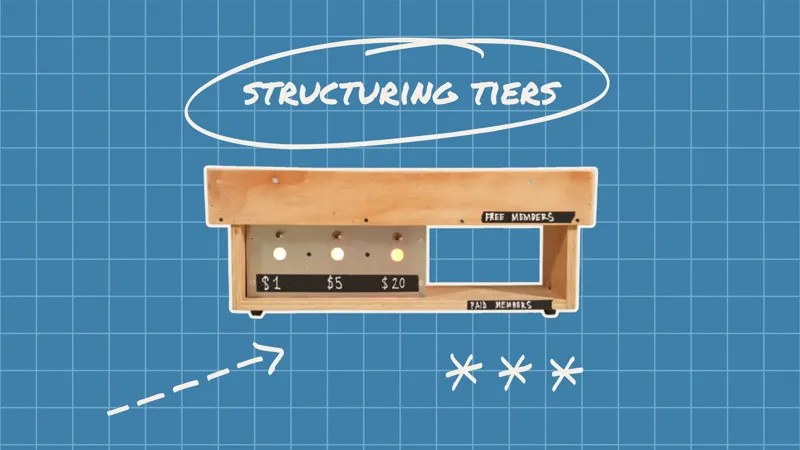
Designing your tiers
You’ve got the idea. You’ve built your Patreon space. Now let’s add some structure.
This post’s all about getting a feel for what your tiers could be. We’ll explore ideas here, then bring them to life in the next post.
⚡Pro Tip: Want help organizing your ideas as you go through the post? Check out the Tier Design Worksheet. It’s a simple way to map out your tiers and make sure the structure feels clear, distinct, and sustainable.
Note: The worksheet links will prompt you to make your own copy so you can fill it in (this requires a Google account). You can also download PDF versions at the bottom of this post.
So let’s talk tiers!
Tiers are the different membership levels people can choose when they join your Patreon. Each one offers its own set of benefits that invite your fans to be part of what you’re building.
Think of them like layers of the experience you’re creating.
Someone might first come across your work on social media, Patreon’s home feed, or by simply following along with what you create.
Then they might want a little more access.
Then maybe they want to go deeper.
Tiers help make that journey clear.
And the trick to designing them well is keeping three things in mind: Tiers should be clear, distinct, and sustainable.
Clear: start with 1-3 tiers
When you start designing tiers, the temptation is to go big.
Lots of options! Big offerings! Flashy perks!
Totally understandable.
But when someone is deciding whether to join your Patreon, you want that decision to feel easy.
Think of it like the menu at In-N-Out vs. The Cheesecake Factory.
In-N-Out is famously known for its super simple menu: three types of burgers, fries, and drinks. A few clear choices. You glance at it and immediately know what you’re getting.
The Cheesecake Factory menu reads more like a novel. So many options! And that can feel overwhelming.
Channel that In-N-Out mentality and begin with just one to three tiers.
If you’re thinking, “I just want to start with one tier for now” - perfect! That’s a great place to begin. You can always think ahead about what a higher tier might look like later and keep that idea in your back pocket.
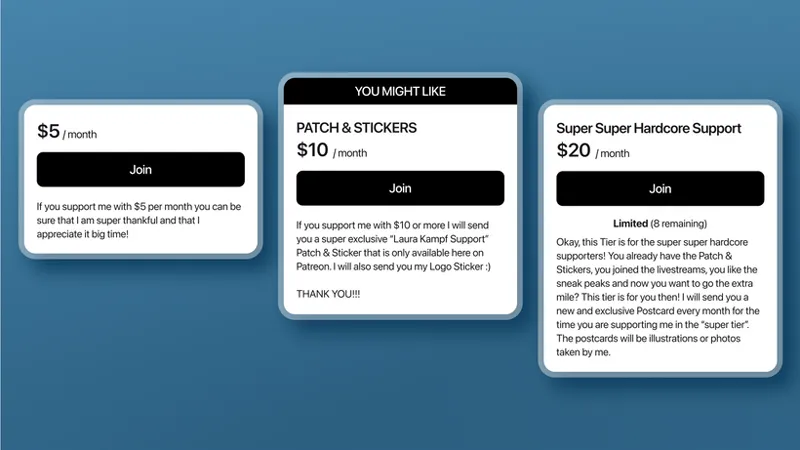
If you want more, two or three tiers give people options without overwhelming them. If you decide to offer three tiers, it can help to think of the middle one as your "main" tier — the one you expect most members to choose — with your first tier as an easy way to get started and your top tier for the fans who want to go deeper.
And if you’re really not sure what to offer yet, there’s another option too.
You can experiment with one-time purchases. They’re individual pieces of work or products that people can buy once instead of subscribing monthly. It’s a simple way to test what sells best with your audience — and what you are comfortable delivering — before building out a full tier structure.
Building or adding more tiers can always come later. Clear choices make it easier for people to say yes.
Distinct: design in levels
When you have multiple tiers, think about how they build on each other. A strong tier structure feels like levels.
Instead of stacking more and more media, think about how the member’s experience deepens.
Maybe the first tier gives early access to your work. A higher tier might include bonus media or a monthly livestream. Another might unlock something unique like exclusive merch, creative input, or a closer interaction with you.
Not this: Media → More media → The most media
This: Paid posts access → Paid posts access + behind-the-scenes clips → Paid posts access + behind-the-scenes clips + monthly livestream
Each level adds something meaningful. When someone reads the description, they should be able to picture what they’re getting.
Sustainable: build around what you already create
Here’s where a lot of creators accidentally make things harder than they need to. They design tiers that require a bunch of new work.
Instead, start with what you already create. Ask yourself:
What do I already make that people enjoy?
🎙️ Podcast example: If you already have a podcast, this should 100% be a tier offering. Just offer an ad-free version or early access for your members.
🎨 Visual art example: Maybe you showcase your next project to Patreon members as an early preview.
What parts of my process could I share?
🎙️ Podcast example: Podcast outtakes and other behind-the-scenes materials are a popular tier offering.
🎨 Visual art example: A time-lapse recording of you sketching, updating, and coloring in your most recent work shows your process and doesn’t add much additional work.
What would I actually enjoy delivering every month?
🎙️ Podcast example: Would you love and have time to write a personalized hand-written letter to every member? Probably not! But a quick shout-out at the end of your podcast could be a quicker, personalized tier benefit.
Your tiers should feel exciting… but also sustainable. Think: what are you already making or doing that you could offer? For instance: sharing outtakes from your podcast doesn’t take a lot of additional effort. Creating a separate podcast just for your Patreon members does.
Visual artist creator Katy Lipscomb shared wise advice:
“Launching your page can feel like pure possibility. You’re overflowing with ideas, your fans are cheering you on, and maybe for the first time, it feels like there might be a real path to steady creative income. That momentum is powerful, but it can also lead you to overpromise and inadvertently create a structure you can’t keep up with….
Before you promise anything, run a simple stress test: could you still deliver on your advertised benefits if you got sick for a week (or two)? Or if life got chaotic? Or if another income stream spikes and your attention has to shift? If the honest answer is “not really,” your intended structure needs to get simpler.
From there, let one question guide everything: what’s the highest-value thing your fans want that you can deliver reliably with the least ongoing time, cost, and complexity? Build your tiers around those “value-per-minute” benefits first: formats you can repeat, batch, and schedule so Patreon doesn’t become a constant emergency. The counterintuitive truth is that the healthiest pages start small: fewer promises, delivered consistently, and with room to breathe. Remember: Consistency builds trust; overpromising builds stress.”
Because excitement brings people in, but consistency keeps them there.
Free as a strategic entry point
As you design clear, distinct, sustainable tiers, remember that your free membership strategy is a great entry point.
What’s free membership? Check out the How free memberships can help grow your community Help Center article for a quick overview.
Think of free membership like the front door of your Patreon. It gives people a chance to explore your community, see what you offer, and get comfortable before deciding to go deeper.
And how do people find that front door? One way is through your public posts that appear on Patreon’s home feed, where new fans can come across your work and discover you.
Want to see how discovery in the home feed works? Check out the Get to know your home feed Patreon for Creators post.
So while you’re designing paid tiers, also think about the free experience.
What can someone see for free?
What can they explore?
What might make them interested in joining as a free and paid member?
So really, your free membership strategy can be a valuable level that leads to your tiers.
Try this: explore before you build
If you’re feeling stuck or want some inspiration, one of the best things you can do is look around. Explore creators in your niche on Patreon and notice things like:
How many tiers they offer or what posts, digital products, or collections they offer for sale
What kinds of benefits they include in their tiers
How they describe each level
Creators like podcasters Midnight Burger or Two Gay Matts, video creator Brian David Gilbert, and visual artist Ginny Di each approach tiers a little differently, but they all keep the structure clear, distinct, and sustainable.
You can also ask your audience what they’d love to see! Use social media to find out.
🧭 Your next steps
Explore creators in your niche on Patreon for inspiration
Decide how many tiers you will start with and draft the descriptions
Use the Tier Design Worksheet to map your ideas
Now that you’ve got your tiers in mind, it’s time to turn those ideas into actual tiers inside Patreon.
Next up: Building your tiers.
📌 How helpful was this material? Click to let us know: 👍 | 👎
Comments (7)
Hi
Is there a way to have people join on the free like becoming a free member on this platform to see the posts, or can anyone just pop on through and see it all on the free? I see the # of visitors is more than the signed members up under the free.
Hey there, anyone who lands on your page can see Public posts without joining, since that's just the fan stage of browsing. Joining as a free member is a separate step (just name and email, no password) and that's what unlocks "Free members only" and "All members" posts in their inbox and app, plus notifications and comment access if enabled. So the gap between visitors and free signups tracks: a lot of people read what's public and never take that extra step. More on free membership: https://support.patreon.com/hc/en-us/articles/16433886029325-How-free-memberships-can-help-grow-your-community More on the public view vs. member view: https://support.patreon.com/hc/en-us/articles/360033339832-The-public-view-of-your-Patreon You can also preview your page as a fan, free member, or paid member using the view dropdown in Creator Studio.
Thanks for this
I keep everything as simple as possible: https://patreon.com/join/andreigornish Minimalist, nothing extra.
I can't figure out what to do, I am lodt
Pięknie