
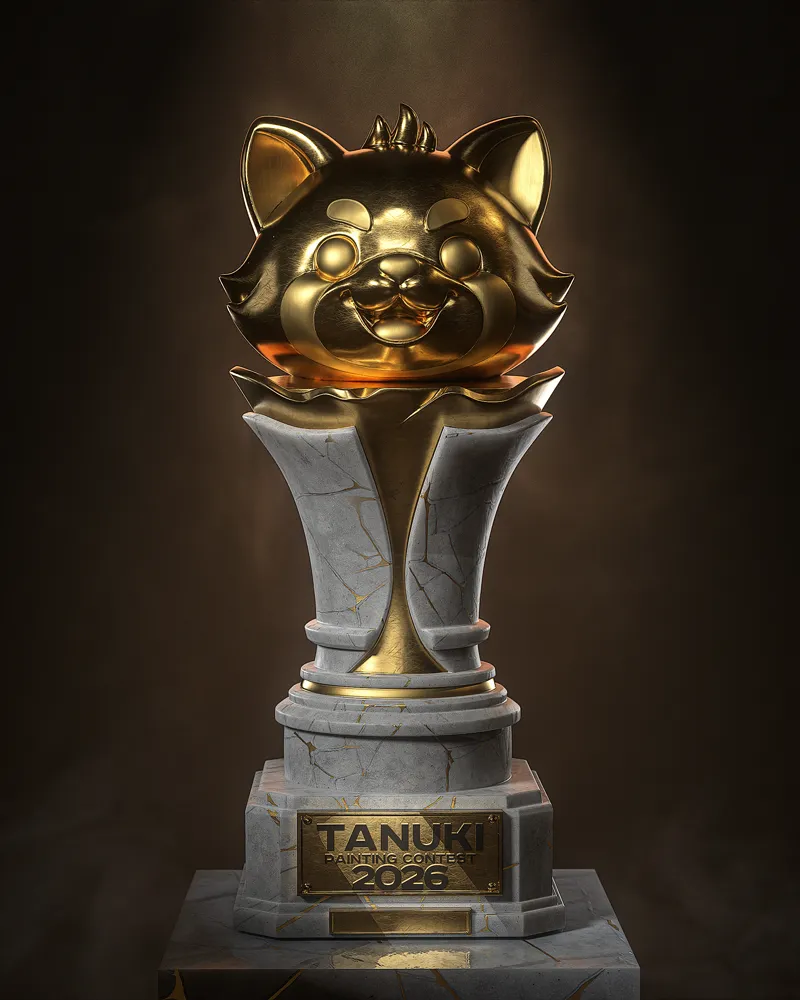
The Tanuki Painting Contest returns in May 2027, bigger and better!
After an edition featuring almost 300 entries submitted by artists from around the world, we are already preparing the next chapter of this journey.
TPC 2027 will take place in May 2027, bringing improvements shaped by everything we learned from the first two editions and by the feedback shared by our community.
Organizing an event of this scale requires an immense amount of effort: hundreds of hours are dedicated to developing the platform, organizing submissions, coordinating the judges, evaluating the entries, managing the prizes, and communicating with all participants.
We are very pleased with how the contest has evolved, and we want to keep improving the system. For this reason, we would like to clarify a few points about the current process and share what we are considering for 2027.
Current Valuation Stages:
1st Stage — Preselection by the Tanuki Team Judge
An excessive number of entries and scores can compromise the accuracy of the evaluation. The judges do not have unlimited time, and when the number of entries exceeds a realistic limit, it becomes more difficult to evaluate each piece with the necessary care, attention, and consistency.
That is why the contest includes a preselection stage. It allows the judging panel to dedicate more time to a manageable number of finalists, preserving the quality of the evaluation.
The Tanuki Team, which officially participates on the judging panel as one of the judges, is made up of more than seven artists, including sculptors and painters, many of whom are responsible for creating the original models used in the contest. This experience gives the team technical knowledge of the pieces original designs, as well as the qualified artistic perspective needed to conduct the preselection stage collectively.
2nd Stage — In-Depth Evaluation by the Judging Panel
After the careful selection carried out during the first preselection stage, the selected entries advance to an in-depth evaluation by the judging panel.
Judging is blind: the participants’ identities are not shown to the judges during the evaluation.
The order in which the entries are displayed is also randomized, preventing an entry’s position on the list from favoring or disadvantaging its evaluation.
Each judge evaluates the finalists independently, following the same criteria and their respective weights:
Visual Impact — 40% of the final score
Technique — 30% of the final score
Finishing — 20% of the final score
Fidelity — 10% of the final score
The evaluations from all judges are then combined to determine each entry’s final score and ranking.
Why are only the Top 10 scores made public?
We chose to make only the Top 10 scores public because every participant who reaches this stage receives a reward and an official placement in the contest.
For the remaining participants, publishing a score without the full context of their individual evaluation could lead to comparisons, frustration, or resentment over not reaching the Top 10, rather than providing truly constructive feedback.
A score represents only how that particular entry performed according to the contest’s specific criteria. It does not define the artist’s ability, talent, or value.
For 2027, we are considering:
Increasing the number of finalists;
Increasing the number of judges;
Making each stage of the evaluation process easier to understand.
By doing so, we aim to further increase transparency, accuracy, and impartiality throughout every stage of the event’s evaluation process.
However, we want to hear from the community before deciding on the format for 2027:
Would you like the scores of all finalists, including those who did not reach the Top 10, to be shared as well?
Public scores for all finalists;
A private score sent to each finalist;
Keep only the Top 10 scores public.
Please comment on this post and tell us which format you consider the fairest and most transparent. Every opinion will be read and considered by the team as we organize TPC 2027.
Why do we publish only the final average score rather than each judge’s individual score?
We publish the combined average from all judges because it represents the official result of the evaluation process.
Individual scores remain confidential to protect the members of the judging panel. This allows each judge to evaluate the entries freely, honestly, and independently, without concern about pressure, confrontation, or personal interpretations of their decisions.
This protection also reduces potential outside influence and allows the evaluation to be conducted with as little bias, pressure, or personal influence as possible.
Each judge brings their own technical and artistic perspective. Differences between their scores are therefore natural and expected. The final average combines these different perspectives and provides a more balanced result, without attributing the final decision to any single member of the judging panel.
Why not create different categories for different painting styles?
At this time, creating additional categories is not yet feasible given the event’s current size and structure.
Dividing the contest into categories would also mean splitting the audience, reorganizing the entire evaluation process, and distributing the prize pool among different groups. To do this fairly, we would need to proportionally expand our resources, team, judging panel, and total prize value.
This possibility has not been ruled out for the future, but it needs to develop alongside the growth of TPC so that it does not weaken the competition or reduce the recognition given to the winners.
Why are only the finalists evaluated by the judging panel?
The number of finalists must reflect the team’s capacity and, most importantly, the availability of the judging panel.
It would be unrealistic to expect every judge to conduct an individual, in-depth evaluation of more than 300 entries. Considering the contest’s four criteria, this would require more than 1,200 individual scores from each judge, in addition to the time needed to carefully examine every painted piece.
Even evaluating 100 entries would require each judge to analyze and record 400 individual scores. Such a high volume can lead to fatigue and compromise the consistency of the evaluations. As a result, a judge would not be able to assess every entry with the same precision, attention, and depth they could give to a smaller, carefully selected group.
The preselection stage exists precisely to preserve the quality of the evaluation. It gives the judges enough time to examine the details, carefully compare the entries, and correctly apply all of the criteria.
The more entries that advance, the more time is required to conduct accurate evaluations, process the scores, organize the results, and manage the entire event structure. This growth also requires greater investment in the team, judges, platform, and prize pool.
As we improve our platform and expand the contest’s structure, we can gradually increase the number of entries evaluated by the judging panel. For 2027, we are planning adjustments that will allow us to include even more artists among the finalists without compromising the accuracy or quality of the process.
Our goal is to ensure that more and more participants feel included and properly considered. We will continue improving the system based on the experience we have gained and the feedback shared by the community.
Is photography part of the score?
The artistic quality of the photography is not an evaluation criterion. However, the photographs are how the judges are able to view and assess the painting.
The entry must be presented clearly enough to show the finish, colors, transitions, contrast, and details. A dark or blurry photograph, or one that hides important parts of the piece, may limit the judges’ ability to evaluate it.
Professional equipment is not required. The most important thing is to submit clear images that accurately represent the painting’s real appearance.
Do colored lights affect the evaluation?
The use of colored lights does not result in an automatic penalty.
They may only affect the evaluation when they excessively alter the colors or make the painting difficult to see. If the lighting prevents the judges from accurately identifying the tones, contrasts, and details, it naturally limits the precision of their evaluation.
Artistic photographs may be included, but we recommend also presenting the piece under clear, neutral lighting.
What can you expect from TPC 2027?
The next edition will be built on everything we have learned so far and, most importantly, together with you, the artists and members of our community.
The improvements we are considering include:
More finalists;
A larger and more diverse judging panel;
Clear explanations of every preselection stage in advance;
Clearer guidelines regarding photography and lighting;
More detailed rules regarding modifications and additional elements;
Greater evaluation capacity through continued platform improvements;
Greater clarity regarding how scores are calculated;
A broader contest scope.
Community feedback is extremely important to the evolution of TPC. Many of the changes we are already planning for 2027 came directly from the points you raised after the 2026 edition. Your contributions are not simply being heard, they are already influencing and transforming the way we are building the next edition.
TPC is only in its second edition and has already reached an extraordinary scale. We are pleased with the progress we have made, and we want to continue evolving responsibly while preserving the accuracy of the evaluations and the event’s long-term viability.
We want to build an even better contest together with the community. Our channel therefore remains open for feedback, suggestions, and constructive criticism. You can share your thoughts directly in the comments on this post. Every contribution will be read, reviewed, and considered by the team as we develop the next edition.
See you in May 2027 for a Tanuki Painting Contest built together with you, bigger and better!
Comments (16)
From my own experience i need more feedbacks than a ranking. Ranking is good for the top ones 😅 When you start, you can't count on your friend to tell you what to improve as they say you did a great job 🤣
Yeah we totally understand that Adutelluma! Thanks for the feedback!
I think the key to all of this is transparency. It can be frustrating even for someone who just participated for fun: paying for Patreon, working for two months, buying materials and paints, and losing sleep while waiting for some feedback. I think it’s fair to have had a pre-selection phase (even though not many of us paid attention to it), but they could also have extended the evaluation period. Perhaps the first selection stage should have maintained the same criteria and provided some direct, private feedback. According to some users, certain entries were essentially not reviewed at all, and the lack of feedback makes those comments carry much more weight (whether or not they’re true). Also, consider giving the judges more time. I know that judging 300 participants is exhausting, but in the contests and tournaments I’ve participated in, two scores are given: one based on first impressions and another based on comparison (the latter to avoid “wasting” the 10/10 on a submission that was comparatively inferior), and the process takes weeks or even months. And regarding that last point, I always try to show my students what the evaluation criteria are and provide them with visual examples: What is a 10/10? What is a 5/10? What is a 0/10? I think what you’re doing is wonderful—your models, your team, and everything—but we can all learn from these experiences, and, as I said at the beginning, the key is transparency.
We understand your points, Tharkim. Thank you for taking the time to give this feedback. We certainly learned a lot to improve next time.
For next year I would love to get some feedback to now where are my opportunity to work on them . I know that’s a lot of work for every judge but if only one give me some advice to do better that Will be Always be something that I Will be greatfull with . Get my score Will be also a good :)
Thank you for your feedback Forge of D.
-Category system Hey everyone, I’m sharing some suggestions for a new awards and judging system, based on nearly a decade of experience with tattoo conventions. First, the contest should be divided into categories; for instance, when submitting an entry, you would choose the specific painting style—such as realism, cell shading, or comics—thereby matching each style to the appropriate judge's area of expertise. -Rewards system Now, considering the category system, each judge could individually evaluate every entry in their category—scoring specific aspects and making head-to-head comparisons—to create a top-10 list. Once this selection is made, the judge decides the category winner; only the top entry from each category advances to compete for the overall event title. In other words, the winner of each category receives a $500 prize and then competes for the overall event title, which carries a $1,000 prize. This way, you maintain the current total prize pool while awarding higher amounts to three different artists. -Why is the scoring system flawed? The individual scoring and evaluation system is flawed because there are no 1v1 head-to-head matchups to compare how much better one paint job is than another. When you evaluate and assign scores without direct comparison, you create a scoring "ceiling." For example: the first piece a judge evaluates features incredible skin painting and gets a 5.0 score. However, ten figures later, there is one that is even better—but the judge has already established a maximum score. How can a piece that is clearly superior receive a 5.0 while another, "inferior" one receives the same score? How can I be certain the judge evaluated the figure by making a comparison, ensuring that only the absolute best one received a 5.0? A note on this: the more judges there are, the greater the risk of the scoring system being flawed. A low score from a single judge—based purely on personal taste—can completely ruin the average; this actually happened to my figure in the last contest. The judges gave it a 5.0 in one category, but one judge gave it a 4.0, which dragged down my average significantly and caused me to drop two or three places in the rankings. The final assessment to determine who is truly the best at the event must be conducted using a head-to-head system; only in this way can you evaluate every aspect of each painting, assign scores, and deliberate among the judges. -Mixed midia (fabric, hair, leds) Regarding evaluation criteria based on modifications—such as LEDs, hair, or fabric—it has been stated that these elements are not taken into account during judging; however, let us consider the following point: If you remove an element that was meant to be painted during a PAINTING COMPETITION, the judges cannot mentally subtract that element to evaluate the piece's visual impact. For a painting competition, mixed-media modifications should be prohibited; this is the only way to prevent misunderstandings among competitors.
But this never can be just painting competition, this is a making competition. As such I would somehow change naming convention. Why? Well... First of all, you have to print your object. Then you need to clean it up, fix gaps etc etc. And only then you can start painting. What is the goal? In my opinion the goal is to make best looking "product". If that means that you will use artificial snow, grass, resin for water effect, hair implants, sure lets do it. It can still be restricted from lighting effect for example, but if you mastered all these skills during years of trying and failing, why not to show it off?
I think with 300 entries it might be time to start thinking of splitting standard and masters (I know you said splitting for styles is not doable). You can keep the current prize pool and split it between these. At the moment, with a prize pool the size that you have, you get the risk of professional tourists. What I mean is professional painters who only subscribe to do the competition, win and then unsubscribe again untill next year. Since it's a community event I don't think that's what you're looking for. By splitting it this way more people in the community get rewarded. I don't think it risks professionals just entering standard either, judges should be able to tell the difference fairly easily. As for feedback / scores. I think you should release scores of the top 25%, while this is quite a high amount of entries, I think it's fair given the amount of time people spend painting. You could take an extra 2 weeks judging. I also think a dedicated discord channel where people can ask for community feedback might help (people just have to accept both positive and negative feedback if they want to know where to improve).
Unfortunately I have seen professionals enter in beginner and intermediate categories in all manner of types of comps whether there is a prizes or not. However, what would the cut off be? Certain techniques not being allowed? How long you have been in the hobby? Some people learn very quickly and some have subscriptions where those techniques are taught, some have experience painting outside of figures. Would you bar them from a category because of those reasons? That hardly seems fair.
As a newer artist who really wanted to enter, I'm honestly glad that I didn't. I don't mean this as a knock on you all Tanuki team because what you do is amazing! I'm saying from my perspective I would've put tons of hours into a piece with really no true understanding of what judges are looking for. I know a lot of people are wanting their scores but I agree with you all that giving a score and no context wouldn't be the way to go. A critique would be the best but I also understand the shear logistics of something like that is also unrealistic. I feel like having categories, even though you've said it's not really feasible right now, is the best bet to ensuring transparency, consistency, and more of an apples-to-apples objective scoring system. Placing categories or artistic styles would ensure people are all attempting to do the same thing fundamentally. If I don't know how to do a certain style or don't like that style then I don't enter that category and I don't feel like I wasted my time. If I do enter, and I'll be clear that I don't have the skillset developed to seriously compete so I wouldn't place anyway, but I would at least know I was being judged and outdone by those doing the same type of style or category. I really want to enter paint competitions to push myself but let's face it, competition means we all want to win or place. Having no real understanding of how to compete or what is being looked for feels like being rudderless in the sea. There's just endless open water with no ability to understand a direction to travel. Hope that made some sense anyway lol and truly, you all do amazing work! I know it's lots of thankless hours prepping something like this so for that thank you!
8kg of resin, 41 days of work. I never knew this would turn out to be the worst, most meaningless time of my life, with absolutely nothing gained and nothing left to show for it. In the end, all that remains are countless STL files obtained under the condition of maintaining a subscription for contests. Overwhelmed by a profound sense of emptiness, I have halted all preparations for the Nom Nom Studio contest as well. This is because I worry that other online contests would likely be no different. I simply resent and hate myself for deciding to do this.
It would be nice to see your score (for each critia), because as it stands now, unless you're a top tier painter you won't get any feedback at all. I know I have zero chance to place, but it would be cool if the initial Tanuki Team gave out ratings, so I could at least see if I'm improving each year. I've just got into 3D printing recently so couldn't enter this one, but it would be fun for next year. But if that would be too much work I get it, and I understand if the contest is only intended for professionals, it's still fun to see the amazing pieces.
Thank you for the feedback, Steven! We understand your point. TPC will be better each time!
Preparing myself now. Starting with the biggest print I’ve done. Kaido! Dude is huge!
That's a good one! Thanks xGhost!