
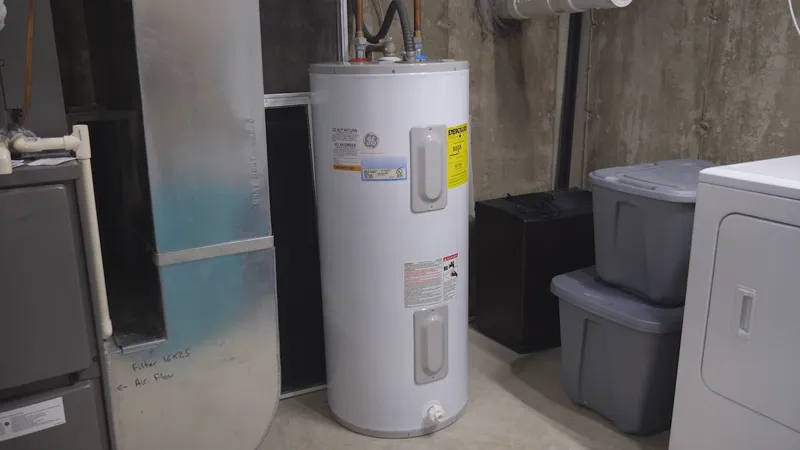

It's a heat pump water heater.
Hello!
It's been a minute. But I have a new video for you today!
YT link:
https://youtu.be/0tWToC4b6Jo
This was supposed to be one of two videos for July and as you can see... things fell apart. The mix of frustration and the overall vibes of everything right now lead to a pretty bad case of burnout and I stepped away for a while. I know y'all are always OK which I very much appreciate, but a few folks were getting worried.
And speaking of stepping away for a while, filming this went right up to the wire before I left to visit family and take a for real break. I may need to sit on this for a spell because I won't be able to record the Connextras follow-up until Tuesday evening at the very earliest. I doubt I can get the next engine management video done before the end of August so this will likely be the only main channel video for the month - and there's no real reason to release it publicly on YouTube until the follow-up is done.
For now, I hope you enjoy this!
Comments (68)
Hey Alec, So, you mentioned no 120 volt resistive water heaters. And turns out, I kinda have one. Technically, I have a normal 240 volt resistive one, but during a fit of desperation in a nearly 2 week power outage I was in two winters ago with only a 120 volt generator, I looked up the specs on the components in the water heater, turns out they're really dumb, and can run in 120 volt mode. I figured the resistor wouldn't mind (it would just run at 1/4 power) so I did some checking, prayed to the appropriate gods, and swapped out one side of the 240 line with neutral, and hey, it worked! It's normally a 4500w heater, so I figured it was running at ~1200 watts, (which was great cause my generator is only rated to 3000w). And from what I can tell it didn't damage the components at all. I swapped it back to 240 volt mode once my power came back and haven't had any trouble since.
When you talked about the switched outlet in the heater, instantly my head made the association with master-slave extension cords. Usually marketed to start the shop-vac when you switch on some power tool. Also available as bigger extension cords for your home theater setup, but I think in this case just the 1+1 style extension for garage use would be ideal. Ones for TV use also many times has a potentiometer to select the power level when it wakes up rest of the devices. I'm using those to switch on my old-school stereo amplifier when TV is turned on, but it ignores the standby use. Yes it was a bit difficult to find the position for the potentiometer so the relay stays on when picture is dark and backlight is off but it won't turn on by itself when TV is not in deepest sleep. Also, there are power sensitive relays to use with home theater video projectors. When projector is switched on the relay switches and that is meant to control the motorized screen. I would argue also those has the sensitivity dial as projectors also need some power for standby electronics.
You have a carbon monoxide meter nearby right? All those extra vents just make me nervous that it might mess with the pressure on the furnace during its cycles, despite all the ventilation.
I love your videos, technology connection. I’m a big fan.
Hey, I used to own that water heater! Not that exact one, because the installer ran a 240-volt hardwire to power it, but close enough. It had the side benefit of sounding a little like a spaceship.
So, I've had a heat-pump water heater for about 10 years and in general I really like it! It 's a hybrid model that replaced an electric water heater so it was, as you said, a no-brainer when that old one started to fail. With my model the electric assist only comes on if you push a button, and with only my wife and me living here it's extremely rare that we need to do that, and only in the winter. My #1 complaint by far is that I work in my basement (where I have my office space set up, because my house is very small) and in the winter it SUCKS down here. It gets down to about 55°F. I've thought about running a space heater, but in MA where I live we have stupid high electric rates and I just end up suffering with the low temperatures. This video got me thinking, though - what if I built a shroud around the output side and just piped the cold air outdoors through the old dryer vent, which is obsolete since I got a heat-pump dryer? I might try that! The cold basement problem is exacerbated by the fact that it runs much longer in the winter because of the one-two punch of colder ambient air plus much colder incoming water (it's about 35°F in the winter as opposed to about 70°F in the summer). In the summer, of course, the heat pump's output just helps cool the basement, which is nice. Claims that it helps with dehumidification aren't really true, though - it doesn't run long enough for that and I still need to run a dehumidifier, unfortunately (we store a lot of stuff down here and mold is not good). My model also does a trick where it heats the relatively-small tank water quite hot (160°F+ I think) and mixes it with cold water to bring that temperature down to about 120°F, which is a perfectly cromulent temperature for domestic hot water as far as I'm concerned. So in theory I could get "more" hot water capacity by letting it heat the tank even hotter, to a point. The anode rod in this one is an "impressed current" anode rod, which is a tiny rod with a small electrical current flowing through it. Bad things happened when there was a leak and the connection to the anode rod failed - the water heater detected this condition and shut down, but my friendly neighborhood HVAC company fixed it fairly quickly.
I assume you've seen the Tech Ingredients video about his DIY geothermal heat pump system? https://www.youtube.com/watch?v=s-41UF02vrU
I just replaced my gas water heater in the spring. The gas and electricity is cheap where I live so the cost of the heat pump being 3 times what I paid for a conventional gas would make it a non-starter. My old water heater lasted 18 years before the tank started leaking. The longevity of the heat pump one is an unknown. I still like the video though. Just because something doesn't work for me won't stop me from learning something new.
Glad you are taking some breaks! Burnout really sucks, I hope you can step away as much as you need to keep this fun for you in the long run.
They do make 120v water heaters, but they're for RVs and are (almost?) always going to always going to also have propane burners as well so there can be hot water when the RV is not plugged in and is this running on the batteries/12v system. These are necessarily small, 10-12 gallons at most, so they are depleted quickly. I bring this up because you can run both the 120v element and the propane burner at the same time to recover more quickly when the RV is plugged in.
Would you consider doing a similar show for on-demand gas and electric water heaters? I have an old house built in 1914 in Hampton Roads VA so my gas on-demand water heater hangs on the outside of the house. Is the efficiency of this type setup similar, better or worse than your heat pump?
One thing I want to bring up with heat pump water heaters vs ordinary storage hot water systems with a heating element. I am an electrician in the maintenance industry, specifically with holiday homes, like air bnbs and luxury Exlusive holiday homes, that sort of thing. I have seen a surprising amount of heat pump water heaters failing, even as early in as 3 years, and it’s unusual to see them last 10 years. When a conventional storage water heater fails in a way it won’t heat the waters there’s a total of 2 components that can be at fault, the element and the thermostat. In Australia these are universal parts to all storage hot water heaters and are carried at all electrical supply places so we can usually fix an ordinary water heater in about an hour or so (we carry elements and thermostats in our vans). There has been a supprisingly large number of occasions where paying guests are staying in these luxury mansions and the heat pump water heater has failed, and since we aren’t lisenced to work on refrigerant systems, (and in most cases these water heaters aren’t designed to be repaired), there’s nothing we can do. Which becomes a big headache on say a Saturday night at 7pm. Not saying these are a terrible thing, and I wouldn’t consider not installing one on my own house but they really don’t make sense for holiday homes, air bnbs, hotels and the like, from a reliability, simplistic and maintenance point of view. Again not dissing them, just think this is something worth mentioning.
Also I want to add, I am Australian so all of that is in the context of, Australia
There must be some big difference with hot water situation between US and Europe, because i cannot really grasp that massive 250l size. My place has 50l and my parents only got bigger one (i think it's 100l) recently to use it as a battery for new solar system.
Thanks for this video, I've just gotten a new house with a garage and I briefly considered installing an AC unit for it as I suspect it will get very hot in summer. However it would be a fair bit of money to install and I'm not sure how much time I will actually spend in the garage. But I've also been considering replacing the existing resistive electric hot water heater with a heat pump system which is in the garage and was wondering if I could get away with just dumping a bunch of hot water down the drain (heat from a separate AC would've been wasted anyway, but I might pay an extra $0.75 for the water I waste) on particularly hot days in summer when I wanted the garage to be a bit cooler. Your results are very useful, and I think it might actually provide some noticeable cooling my garage. There will be a PV inverter and battery installed next to it though which complicates it a bit, that will probably give off 500+ W of waste heat during times of peak usage. But as it's 240 V AC here I can get a system that consumes 1.5 kW on a standard plug so I think I can make it work, but I'll run some numbers to extrapolate your data and see if I can get more confident about it.
For 120V water heaters: since it's just a resistance, you can plug any electrical water on a single phase, it will work as well with half the heating power.
"Through the power of paying attention..." 😆
We only use our Rheem heat pump water hearter in Heat Pump Only mode. The "Energy Saver" mode, which is the default, sometimes uses electric resistance heating, which uses more energy! We just do not use enough hot water to need resistance heating. Plus we set the water heater to a higher temperature, then use a mixing valve which combines the extra hot water with cold to the setpoint we want. which makes our heat pump water heater act like it has a larger tank. Home Assistant integration lets us also ensure we mostly run when the electric rates are lowest, or when our solar generationis high. You can get most of that just using the Rheem schedule fature to raise and lower the goal temperature to encourage use during low electric rates.
We put in a Rherm heat pump water heater 7 years ago. Being in southern Florida, the extra cooling is great. And the scheduling in it lets use do a money saving trick: we set it to a higher heat when electric rates are low, then use a mixing valve to output the lower temp we want for the hot water ( it mixes in cold water to do this). Kind of a heat battery, so it simulates a larger tank. Try it. Also Rherm has easy ways to connect ducts, though one is on the side instead of top. Also it cost half of what you paid.
Here in recognition of Maelstrom … and also In appreciation of the magical hands-free automatic door reveal on the water heater in the closet!
Here in Germany we have air-to-water heat pumps for room heating through conventional water filled radiators. And those can also produce hot water for a tank. Those are usually spit heat pumps, and they have the downside of not being able to cool your home.
much love, Alec!
I guess our water gets heated from the waste heat from our nearby data center, like the apartment heating... But as usual (at least here in Switzerland), real estate owners and property managers are not keen on informing their tenants how stuff works... (I would be really interested to have a look in the maschine rooms of my building and get some explanation about how all of this high-tech stuff works, or, unfortunately many times, doesn't work...) With the remark on "Northern Europe" (I guess you can include Central Europe, at least Switzerland, as well) I think you completely nailed it: installing good airconditioners is discouraged or even forbidden, as "they use a lot of power"... What happens in practice: everybody is using inefficient monoblock air conditioners here now as it would be almost unlivable here. The so-called "Minergie" building guidelines that were actually meant to decrease energy usage even make it worse: to prevent heat-loss in winter, the building gathers heat quite efficienty and doesn't get rid of it.
Soon a video about a "drain water energy recovery" installation ? I'm seriously thinking about installing one to minimize the amount of heat I'm flushing in the drain.
As someone who installed a 240 volt HP water heater at the end of 2025 in Virginia to take advantage of the 30% tax credit, I rather did enjoy this. I had many of your same concerns but all were also debunked during the first winter. I specifically installed the Rheem one you showed because with an ESP32 I can integrate it locally with Home Assistant to track energy usage and control the temperature. I am hoping you can address during your connextras video whether or not it is a good idea to run as a normal water heater (set and forget. Let it run periodically when using) or dynamically adjust with the app scheduling (turn up the water temperature before use and turn down at night). Does the energy for HP start up make a difference? Does constant cycling of the HP cause increased wear?
This was enjoyably informative. Sadly, the most important thing I learned is that with only 5'8" of headroom in my basement, I can't install one until they make them in a short, squat format.
Thank you as always, Alec. Don't let your Midwestern worth ethic eat you up. Take care of yourself and enjoy your downtime.
Seems like there is a need for an all in one heater / AC / fridge solution. Something that intelligently pumps heat around between places that need heating or cooling, dumping cold outside when it is not required for the fridge or house and heat in the water tank whenever available.
I have the same thought whenever I see another appliance with a dedicated heat pump. I already have plumbing for hot and cold water, why not hot and cold refrigerant lines? Would the added efficiency make up for the loss in the lines?
Take care, Alec. You go first.
I have a 10 year old electric water heater in the utility room behind the garage. It will eventually fail, and I'm dreading the replacement process. Due to the low room height, going with a heat pump variant of the same capacity won't work. I've thought about going with a heat pump version with lower capacity, cranking up the water temperature, and then connecting a thermostatic mixing valve to bring the temperature down to a reasonable level, thus achieving the same overall throughput with a smaller tank. It works in theory, but I haven't seen any installation like this online.
we did just that. Makes a small water heater tank act like a larger tank. Worked perfectly for us. Search for :mixing valve: on Amazon for you local supplier.
I enjoy the extra nerdy tinkering breakdown in the last segments.
Great video. We just built a new home and definitely went with a heat pump for the house which is amazing. For hot water we went with a gas on-demand heating system which has been amazing and very cheap to run. In my area natural gas is considerably cheaper than electricity so our builder and hardware folk advised us that natural gas was a better choice - at least for now.
We usually use split units in Sweden. Not sure if i have ever seen the single units like this one. Would perhaps be a nice alternative for me actually if I can get a hold of one. Thanks for the video!
"I'll never say no to a heat pump" ❤️ This is the way!
After seeing that pinball machine it makes me want to see another one of those. Also there was no popup for the extra video. Can you post a link for that?
I have a 80 gal Rheem hybrid version, which replaced a 45 gallon first gen GE one. The GE one had some weird tank coating that slowly peeled off and it eventually rusted out after 13 years. Both were hybrid so they could fall back on the resistive. I actually use my small server room to provide heat to its space, and then it cools my server room. My advise: just make sure you size it right!
Meh, I just took a full 2-week no-fucks-given camping trip to the middle of nowhere and it was very much needed. You deserve a break!
Look after yourself! We'll be here. I'm in a 12 unit (6 × 2 bed, 6 x 1 bed) block in Sydney, Australia. We had a gas central hot water system. Two years ago we replaced it with two system Reclaim C02 heat pumps (COP of up to 6), and two 400 litre storage tanks. The heat pump water outlet temperature is fixed at 63 Celcius. We cost to replace the old gas system would have been $AU33,000. The heat pumps cost a total (installed) of $AU17k, and $AU11,300 including govt rebate. Running costs are a quarter to a third of the old gas system cost.
As someone who regularly runs out his 50 gallon water heater, I felt a little called out there. But everything in life is a balance, and long showers give me more enjoyment than they cost me in money so I'm happy to pay.
I'm having trouble accepting that hot water floats above cold water. Wild.
Since you've got an AO Smith water heater, you might be interested in this - you can actually integrate those into Home Assistant very easily! Back in the day, Lowe's backed a smart-home system called Iris, and made dongles that connect to the CTA-2045 port found on recent electric water heaters, including yours (the port is under the plastic panel immediately below the control panel). Once Iris went *poof*, those dongles can be found very cheaply on eBay, for about $25 shipped - search for the part number, "612026". The dongles don't do any sort of TLS certificate verification, so with a bit of DNS-redirection wizardry in your router, and a spare Raspberry Pi, you can use the open-source Energy Smart Bridge project ( https://github.com/starsoccer/energysmartbridge ) to control the water heater via MQTT. I use that same setup to control my hybrid heat-pump water heater! I use it to preheat the tank to a higher temperature during the cheapest overnight rate periods, and shut off heating completely during peak hours. It also provides the temperatures at the top and bottom of the tank, as well as a readout for the tank's leak sensor, so you can tie it into any other alerting systems you might have. If you want to give it a go, feel free to reach out to me with any questions!
I wish (and hope in the future) more device manufacturers would (will) offer local APIs to avoid the DNS wizardry/hackery, but in the meantime, people like you who take the time to point these things out in online comments are doing us all a service, so thank you!
At 25:08 to 26:49, your audio goes quite quiet. Probably worth boosting it for the YT release . Also at 27:17 you have Litrers in the text overlay
Thanks for that, I'll see if I can mess with that on YouTube or if I need a re-render. I'm almost certain I know what caused that (a clip went missing and I had to replace it manually) and I forgot to add an audio boost when I fixed it
We just fitted a GE 50 gallon one, its been amazing, even on turtle mode with heatpump only its just as good as a regular one
I found this a bit confusing: @8:44 hybrid water heaters exist, but this isn't one of them and it only has the heat pump. @40:17 this model totally is a hybrid and has resistive elements too. I gather in hindsight the earlier reference probably meant 240V resistive specifically, but that wasn't really clear and still seems inconsistent even listening to it again.
Most of these 120V models are not hybrids, which is why I talked about it as if it's not. And in any case, the hybrid nature of the AO Smith model is just a technical distinction: resistive mode is better understood as a backup or alternative to the heat pump and not a supplement since it's even slower
I hope your time at Open Sauce and hanging out with the good folks there was able to help you recharge your batteries and re-calibrate your vibes a bit. It was fun seeing you in ElectroBoom's video.
Re: cold water sandwich @37:00, was something else running at the time? Does your home have a hot water recirculator? This phenomenon is not unheard of in multifamily scenarios, but can also occur if something is using hot water for a bit, then stops.
Nope, never happened with the old water heater and nothing else in the house was in use. The last time it happened I checked to see if it had just come on but nope, it was sitting idle
I didn't know heat pump water heaters were a thing, cool! I will never not be amazed by how these are installed INSIDE homes in the US. Here in Argentina these are either installed outside, or in the kitchen if it's an old house (which is also why tankless water heaters are much more common).
In California they're typically in the garage. In apartments they're usually in a dedicated closet on the balcony or patio, where they're effectively outside.
So glad you're taking time for breaks when you need them but also so excited for this new video! Thank you!
Besides the space constraints, split systems generally have higher efficiency and can be better suited for multifamily because you gang them together more easily.
This looks like a preview for another video idea... the Final Boss level of heat pumps: The Hydronic Heat Pump HVAC + DWH System! It uses the same split heat pump system that you'd use for HVAC, but instead of running refrigerant lines between your indoor and outdoor units, it runs water lines between the two domains. Because it uses water, it gives you some extra benefits: 1. You can connect your domestic hot water tank to it and use the heat pump to heat your hot water 2. You can add in more than just a single central air handler, you can do independently controlled zones, and even under-floor heating, and in-ceiling radiant cooling 3. Only a single breaker is needed for the entirety of your system 4. You don't need a refrigerant license to install since all the refrigerant is entirely self-contained in the outdoor unit 5. (helpful only in colder climates) You don't have to deal with the cold air that the DWH heat pump produces, since the heat is pumped between indoor and outdoor sides
I just replaced my old nat gas wh, and i was looking hard at one of these. In my area nat gas is still so inexpensive, plus multiple companies said theres none installed around here, thus no one to repair them. Since these are much more intelligent, there are more ways it breaks. I was gonna put it in a lower level with a fridge and a freezer (heat sources) and get the free cold air along with the hot water. Just wasnt in the cards for me.
Take it easy for a while! Thanks for the new upload!
Do you have any plans to make a video about heat pump clothes dryers? That's one more air conditioner for your collection.
Eventually, yes!
I was going to replace my aging electric water heater with a 240 V hybrid heat pump WH but moved to an apartment for the time being. Financially and physically, it did not make sense to stay at my original home. There was a lot of repairs and renovations needed and the property was beyond my ability to upkeep. Being in the South, any added cooling and dehumidification is appreciated, even if it is insignificant.
Yay! I was getting a bit concerned, not in a "where's my content?!" way but "hope every things ok" way
Few things make me happier than a new TC video.
We’ve had heat pump water heaters in Australia for well over a decade. They are (very) expensive to buy compared to the traditional electric resistance water heaters. Gas is being phased out largely in homes for cooking and water and home heating. And if you have rooftop solar and batteries, heat pump water heaters make even more sense. I love them.
I love my heat pump water heater. I have had one for over 14 years. We are on our second one now though.
Well, the one in the picture isn't 😁
Nice