
[COLUMN] Coyote vs. Acme Is a Reflection on a Lost America | by Darren Mooney
Note: This piece contains spoilers for Coyote vs. Acme, which is in theatres this weekend. It’s great. It’s delightful. I have a few minor qualms with the animation, but the film is a delightfully broad rapid-fire comedy that really speaks to what makes the Coyote such an endearing and appealing character. It’s well worth checking out. So feel free to bookmark and come back, if you want to go in completely blind.
Part of the beauty of the classic Warner Bros. Looney Tunes is the way in which those iconic cartoon characters manage to speak to something that is both universal and undeniably of its own time.
Wile E. Coyote and the Road Runner are familiar archetypes. The Coyote chases the Road Runner across the deserts of the American Southwest, but he will never catch him. The Coyote has set himself an impossible and insurmountable task. The Road Runner will always be too fast, too smart or just too lucky. The Coyote will always find a way to snatch defeat from the jaws of victory. However, there is value in the chase.
There is something fundamentally human in the story of the Coyote, in the impulse to chase things that we can never catch, to want things that – on some level – we know that we can never have. After all, success is easy. There is very little effort required for nobility in success. There is, however, a great deal of effort required to maintain dignity in failure. To pick one’s self up after every disappointment and humiliation, and to commit to trying again – knowing that failure is just as likely.
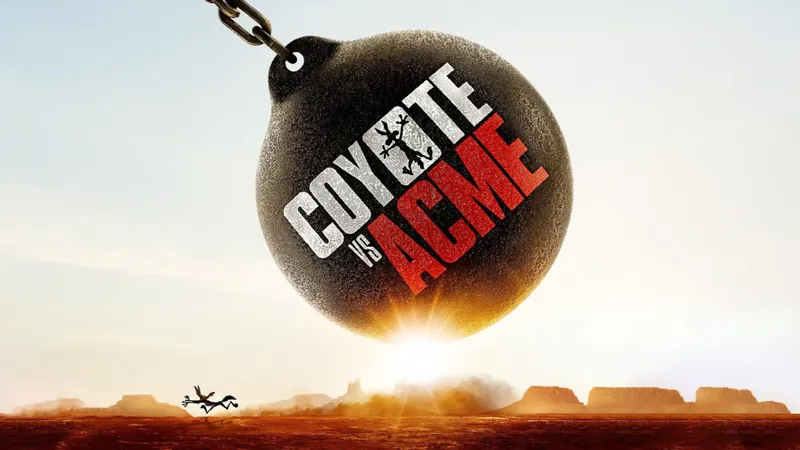
Coyote vs. Acme understands this. The movie is largely built around a conspiracy known as “Project Sisyphus”, a reference to the classic Greek legend of the man cursed to roll a boulder up a hill day after day, only for it to tumble down the other side so that he might have to start from scratch again. The film’s poster draws from the logo for “Project Sisyphus” within the film and from the myth outside it, the Coyote pushing a giant round bomb up a hill, undoubtedly to yet another failure.
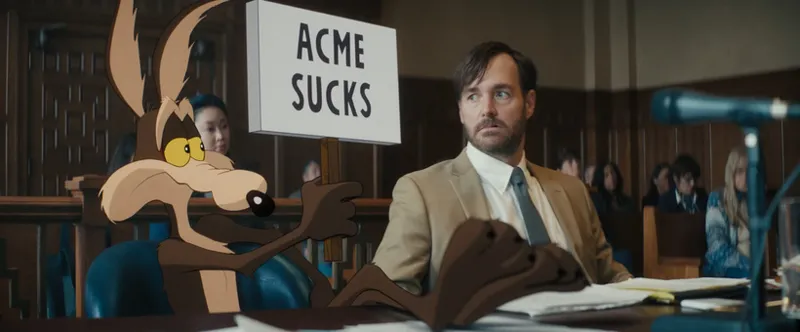
“One must imagine Sisyphus happy,” observed French philosopher Albert Camus, at the end of his treatise The Myth of Sisyphus. The idea is that it is the task itself that provides meaning to an individual, not the accomplishment of it. Coyote vs. Acme understands this as well. One of the film’s most moving shots comes as the Coyote is being driven around Albuquerque by his lawyer Kevin Avery (Will Forte). The Coyote has rolled down the window, his head bobbing in the breeze.
It is a shot that, strangely enough, mirrors one of the iconic shots from Christopher Nolan’s The Dark Knight, after the Joker (Heath Ledger) has escaped police custody. Driving through Gotham in a stolen police car, the Joker lifts his head out the window, letting his hair blow in the breeze. “I’m like a dog chasing cars,” the Joker boasts to Harvey Dent (Aaron Eckhart) just a scene or two later. “I don’t know what I’d do if I caught one.” The Coyote is chasing his own car. It even goes “beep beep.”
This is undoubtedly a large part of the appeal of the Road Runner and Coyote cartoons. Beneath the absurdity and the silliness, the underlying logic speaks to something truly universal. Everybody who has ever watched the Coyote try and fail, but keep trying, can feel some measure of empathy for the creature. This is why these characters endure, why they are timeless. However, there is something else underneath that. After all, while they are timeless, the Looney Tunes are also of their time.
The Looney Tunes were a product of mid-20th century America. Coyote vs. Acme is very much aware of this as well. After all, the film’s opening set piece is built around the animated version of Peter Lorre, a staple of the cartoons based on one of the most distinctive actors of that era whose work in films like Casablanca or M or The Maltese Falcon is completely unknown to a large portion of the audience. Avery works for the law firm Avery, Jones & Maltese.
In particular, the Road Runner and the Coyote exist specifically in the context of the wave of industrialization that followed the Second World War. Premiering with The Fast and the Furry-ous in 1949, and with the first real wave of their cartoons running until War and Pieces in 1964, the adventures unfold against the backdrop of a highly stylized version of the highways and byways that cut across the American Southwest.
Though these roads cutting through this landscape are taken for granted today, they were still novel at the time that the shorts premiered. America was a young nation, and its infrastructure developed rather slowly. In 1892, General Roy Stone, a Civil War veteran who would become the first head of the Office of Road Inquiry, opined, “We have the worst roads in the civilized world; their condition is a crushing tax on the whole people.”
When the Office of Road Inquiry delivered its official findings on the state of the nation’s roads over a decade later, it observed that though there were 2,151,570 miles of rural public roads in the United States, “[o]nly 153,662 miles of public roads had any kind of surfacing.” In 1919, the United States military charted a convoy from one side of the country to the other, the first transcontinental motor convoy. The trip took 62 days, with one officer observing that the roads “belong to the Stone Age.”
Future President of the United States, Dwight D. Eisenhower, was part of this convoy. He kept a journal of the trip. In particular, he noted that the roads were particularly bad out west. “From Orr's Ranch, Utah, to Carson City, Nevada, the road is one succession of dust, ruts, pits, and holes,” he wrote. “This stretch was not improved in any way, and consisted only of a track across the desert. At many points on the road, water is twenty miles distant, and parts of the road are ninety miles from the nearest railroad.”
Although they are wild animals, the Coyote and the Road Runner do not really traverse the wilderness. Although there are exceptions, they largely navigate the system of manmade roads cutting through the American Southwest. As Chuck Jones decreed, “The Road Runner must stay on the road — otherwise, logically, he would not be called a Road Runner.” However, the roads the Road Runner and Coyote navigate only came into existence around the time of the Second World War.
In 1944, President Franklin D. Roosevelt signed a Federal Aid Highway Act, decrying “[t]here shall be designated within the continental United States a National System of Interstate Highways … to connect by routes, as direct as practicable, the principal metropolitan areas, cities, and industrial centers, to serve the national defense, and to connect at suitable border points with routes of continental importance in the Dominion of Canada and the Republic of Mexico.”
In fact, this development of the road network within the United States continued in parallel with the early Road Runner and Coyote cartoons. During the 1950s, President Eisenhower pioneered the development of the interstate highway system, which connected the country through a series of tarmac arteries. It was arguably the “country’s largest-ever public works project as well as an agent of almost immeasurable cultural, economic, and physical change.”
“This new highway program will affect our entire economic and social structure,” wrote Robert Moses in Harper's Magazine in December 1956. “The appearance of the new arteries and their adjacent areas will leave a permanent imprint on our communities and people. They will constitute the framework within which we must live.” The roads were not just roads. They were a circulatory system for an emerging nation, a foundation upon which true economic prosperity could be built.
Eisenhower understood this. “Our unity as a nation is sustained by free communication of thought and by easy transportation of people and goods,” he stated in a message to Congress in February 1955. The roads were simply a way of manifesting the country’s raw potential in the wake of the Second World War, of connecting the nation to itself in a way that would facilitate greater innovation and development.
The American West and Southwest saw a huge redevelopment in the middle of the 20th century thanks to industrialization. The Hoover Dam opened in 1936, and became a foundation for the work that the Bureau of Reclamation would do over the subsequent decades to develop the region. During the 1950s, military and industrial development – along with easier access through the desert by road – turned Las Vegas into an economic hub.
This was a microcosm of what was happening in the country as a whole. The United States was in the midst of an economic miracle. By 1945, America was assembling more than half of the produced goods in the world, while the nation’s exports made up more than one-third of the total global exports, and it held roughly two-thirds of the available gold reserves. It was an era of incredible prosperity, and with prosperity came modernity.
This was, naturally, given the size of the country, tied to the roads. New car sales quadrupled between 1945 and 1955, and by the end of the 1950s, three-quarters of American households owned at least one car. In 1965, a year after the last Chuck Jones short, the country’s automobile industry reached its peak, producing 11.1 million new cars, trucks and buses and accounting for one out of every six American jobs. It was the dawn of the American Century. Anything was possible.
And this all bubbles through those classic Road Runner and Coyote shorts. One of the most striking aspects of these cartoons is that they take place in the middle of nowhere, with no human beings around. There are no towns, no settlements, no farms, no hitch hikers. However, there are constant signs of industrialization and progress, like roads and railways. These roads and railways don’t seem to lead anywhere – at least nowhere of concern to the Coyote. While he never encounters any actual individual person, he is always reminded of modernity – constantly crushed by trucks and trains traversing this once-untouched space.
Indeed, even before the arrival of Amazon, one of the defining features of the Road Runner cartoons is the sense that the Coyote can receive overnight delivery from the Acme Corporation, even in the middle of the desert without an address. America is so connected, that while the Coyote never interacts with a human being, he can shop for and order from a gigantic conglomerate. This is the postwar era. In the age of televisions and refrigerators, even Coyotes must embrace modernity.
One of the central recurring jokes in those cartoons is the sense that this push towards modernity, this embrace of technology and industry, has served to disconnect the Coyote from nature. The Coyote does not speak in these shorts – he does when he interacts with Bugs Bunny – but he walks upright. There is a sense that the Coyote has been anthropomorphized, certainly more than the happy-go-lucky Road Runner. The Coyote has been burdened with consciousness, with awareness.
This was the beauty of the original Road Runner and Coyote cartoons. While they spoke to something universal in the human condition, they were also very much a product of their time. They reflected something of the Eisenhower and Kennedy eras, the sense that the nation was undergoing a process of industrialization and that even its most remote locations and the animals within them were beholden to these larger innovations and inventions.
Coyote vs. Acme understands this, without leaning too heavily upon it. While the film is just as much about the Sisyphusian anxieties of the Coyote, it is also about how far America has moved since the Eisenhower era. While it includes the animated Peter Lorre, its frame of reference includes the Albuquerque of Breaking Bad and Better Call Saul and casts P.J. Byrne from Wolf of Wall Street as another wormy wig-wearing lawyer, alongside fellow Wolf of Wall Street alum Kenneth Choi.
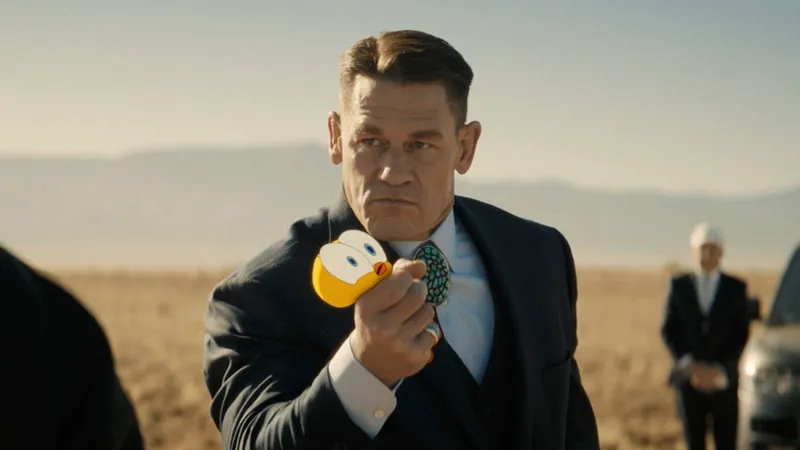
In keeping with the sense that Coyote vs. Acme is about the sun setting on that Eisenhower era America, the film is haunted by the ghost of Richard Nixon, Eisenhower’s vice-president who lost the election against John F. Kennedy in 1960, but would win in 1968. The Coyote’s first action scene involves fighters dispatched from “Fort Nix.” At the climax, Acme lawyer Buddy Crane (John Cena) invokes Nixon’s “silent majority” as validation of his company’s amoral policies.
Nixon was a lawyer before transitioning to politics, and indeed returned to corporate law between his presidential bids. As Avery and the Coyote dig into the activities of the Acme Corporation, Coyote vs. Acme draws from that most foundational of American conspiracies, the Watergate Scandal, with Bugs Bunny cast as Deep Throat. There is a sense that the romantic world of those original Road Runner and Coyote shorts has disappeared, replaced with something more cynical.
The Acme Corporation is in some ways the end result of the process of industrialization and modernization that began in the wake of the Second World War. All those sleek desert roads were inevitably leading towards Acme. It is a gigantic conglomerate that manufactures everything from consumer goods to military-grade weapons. It is the embodiment of the forces that Eisenhower himself had identified as the “military-industrial complex” by the end of his presidency.
Acme is a monster of late-stage capitalism. It manufactures faulty products and – rather than recalling them – simply offers low-level payouts to those affected. It is a cartoon version of the logic that underpinned the infamous Ford Pinto memo, which circulated within the company in 1968, arguing that it was more cost effective to ship a faulty and potentially lethal product than to recall it, because the recall would cost more than the settlements from resulting lawsuits.
Of course, this is inevitably part of the metatext of Coyote vs. Acme. The film was famously developed by Warner Bros., only for the pretty much completed film to be shelved by the company in order to claim a tax write-off. The film was never supposed to see the light of day. It was only the late intervention of Ketchup Entertainment that ensured its release. It is a fairly damning indictment of modern capitalism that Warner Bros. could get paid by the taxpayer to destroy their own art.
The opening of Coyote vs. Acme includes a joke that Warner Bros. is “a wholly owned subsidiary of the Acme Corporation.” There is a sense in which the film is in some ways about Warner Bros. relationship to the Looney Tunes, a core part of the company’s cultural history. After all, the big reveal is that Acme has knowingly developed faulty products to be tested on cartoons, knowing that they can use information gathered in the process to bolster their other more diverse holdings.
As in Who Framed Roger Rabbit?, an obvious influence on Coyote vs. Acme, there is a none-too-subtle racial subtext in this idea of cartoons as inherently “lesser” beings. There is a long and depressing history of experimentation upon disadvantaged groups. However, Acme’s use of these toons to promote their other holdings feels like a commentary on the cynicism of projects like Space Jam: A New Legacy, which uses the Looney Tunes to sell the company’s intellectual property.
However, as with the best of these Looney Tunes concepts, Coyote vs. Acme feels at once specific and universal. The film is in some ways a documentary of its own production, the story of a large faceless conglomerate trying to bury the Coyote and other toons. However, it is more broadly an exploration of what became of the world that created the Coyote and the Road Runner. It is a reflection on how those vast and complex interconnected systems that trap the Coyote have only grown stronger.
Coyote vs. Acme argues that all a person can ask is for the freedom and the opportunity to chase their dreams, even those that they know they will never catch. In this broken world, Coyote vs. Acme fights for the right to imagine the Coyote happy.
Comments (8)
Well, didn’t see this particular history lesson coming but it’s made me think a little differently about the old cartoons. Thanks!
I love this essay - we have so little media literacy nowadays, we need more analysis like this.
Coming back for this; maybe we should all embrace the capital A “Absurdity” of modern living, and perhaps even smile like Sisyphus as Camus may have imagined him.
2026 has made me feel more and more like Wile E Coyote
Maybe that 50s sentiment is why my dad is so against trains. He was born in 55
The movie isn’t necessarily a masterpiece, yet its message of never giving up is one I think kids need to see and learn. A lot of adults too.
The way I see it, the movie works on 3 levels: 1. Most importantly, the movie works on its own terms. It's a well done comedy that knows how to use the Looney Tunes, there's solid technical execution on a modest budget and the central story of Coyote and Avery bonding as kindred spirits holds it together. 2. It does for legal thrillers what Roger Rabbit did for noir-style detective mysteries. It clearly has a lot on its mind about the dangers of monopolies, enshittification/disruption culture and the systems of power that allow companies to get away with it, even admitting it publicly. The movie treats this as a joke/commentary but reaches a point where it stops being funny and becomes serious. 3. The meta surrounding the movie as a story about corrupt, evil corporate guys abusing of the Looney Tunes for personal benefit and taking the fight to them both in and out of the film. If WB had just allowed the movie to release as normal, it would've been a blip in the radar for a bit and then gone the way of a lot of straight-to-streaming releases. People still would've connected the dots about Acme and WB and would've made for good discussion. The behind-the-scenes history of this movie has propelled it from something of a curiosity (even if it's one of the better uses of Looney Tunes in a long time) to something of a landmark in movie history and the current hellscape that is the state of WB. Just a huge faceplant for the company to try and make this go away (and profit from it) and make the movie bigger in the public eye because of it.
Enjoyed your take and commentary on the development of the Interstate system. I was born in the mid-60s and have always taken it for granted; it wasn't until my father told me how he and his father drove from Texas to Michigan on two-lane U.S. (non-interstate system) roads in a car without AC in the middle of summer that it really sunk in how far we've come in less than 100 years. Except for "work" which, unlike interstate travel, still feels Sisyphean.