
July 9, 2026 - Daily News Digest
On this Day: in 2004, The Senate Report on Iraqi WMD Intelligence is released by the United States Senate Select Committee on Intelligence, casting doubt on the rationale for the Iraq War.
QOTD: “To me, I think it’s over,” Trump said of the ceasefire at the North Atlantic Treaty Organization summit in Ankara, Turkey. “I don’t want to deal with them…They’re liars, they’re cheats, they’re sick people.”
US/WORLD/TRADE - Senator Wyden Says Trump Tariffs Are ‘Ill-Designed’ to Combat Forced Labor Globally
https://www.bloomberg.com/news/newsletters/2026-07-09/trump-s-latest-tariffs-ill-designed-to-combat-forced-labor-wyden-says
Just weeks before a set of stopgap tariffs expire, the Trump administration is close to finalizing a new set of duties it says are intended to stamp out goods made with forced labor from the global economy
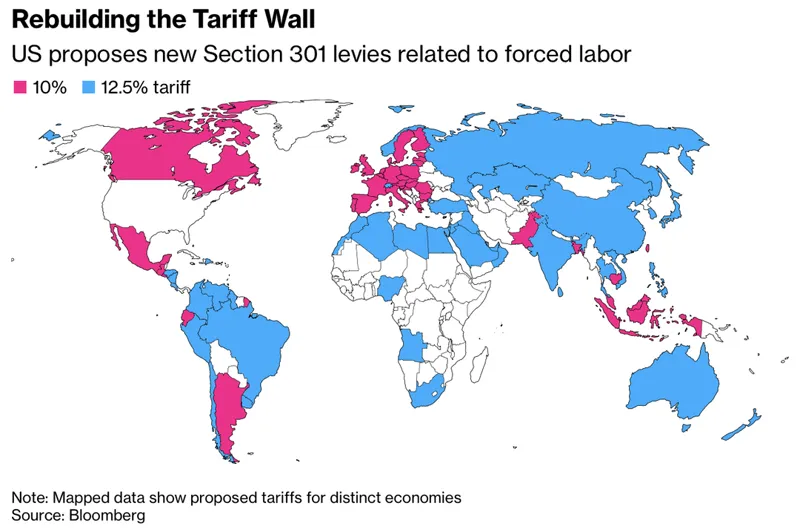
This week, a USTR panel has been hearing testimony from dozens of foreign government officials, business owners and industry groups about the administration’s plan to impose 10% or 12.5% duties on imported goods from 60 trading partners under Section 301 of the Trade Act of 1974.
The proposal is based on a report that found the targeted countries were either ineffective at enforcing bans on goods made with forced labor from entering their economies, or that they had no rules in place to prevent it.
But in a letter to US Trade Representative Jamieson Greer, Senator Ron Wyden of Oregon called the proposal “ill-designed to accomplish a legitimate objective,” and said the forced labor action “is merely an effort to reconstruct President Trump’s global tariff regime after it was invalidated by the Supreme Court.”
US/IRAN/MIL - Iran war live: Tehran retaliates in Kuwait and Bahrain after second day of US strikes
https://www.reuters.com/world/iran-war-live-tehran-retaliates-kuwait-bahrain-after-second-day-us-strikes-2026-07-09/
US military launched fresh strikes on Iran it said were aimed at keeping the Strait of Hormuz open to shipping traffic
The second wave of overnight strikes this week came after US President Donald Trump said an interim agreement to try to end the war was 'over'
Trump said the strikes were 'in retribution' for Tuesday's assault by Iran on three cargo ships transiting the strait
Hours later, Iran said it had attacked US military sites in Bahrain and Kuwait in response to the new US strikes on infrastructure
Iran will bury its slain Supreme Leader Ayatollah Ali Khamenei on Thursday at the country's holiest shrine in Mashhad
MORE: Inside Trump’s Oval Office Decision to Ditch the Iran Ceasefire
https://www.wsj.com/world/middle-east/inside-trumps-oval-office-decision-to-ditch-the-iran-ceasefire-b70a8b8b
President Trump was preparing to leave the White House for Turkey on Monday evening when his top national-security aides walked into the Oval Office with reports of new Iranian attacks.
Secretary of State Marco Rubio and Defense Secretary Pete Hegseth told him that Iran had fired antiship cruise missiles and one-way attack drones at vessels seeking to cross the Strait of Hormuz through a southern route, according to people familiar with the discussion. Three ships had been struck within hours of each other, including a liquefied-natural-gas tanker, they told the president.
Angered by the strikes, Trump pressed them on whether they believed Iran was serious about reaching a final deal. In the end, after discussing it with his senior aides, the president decided they weren’t.
The surprise attacks triggered a fierce response from Trump that stripped away some of the accord’s remaining incentives, leaving little of the peace framework he had signed at the Versailles palace in France two weeks ago to much applause. The president revoked Iran’s oil-selling license, ordered several rounds of strikes on Iranian targets in and around the strait on Tuesday and Wednesday, and threatened to hit civilian infrastructure in the country, including desalination plants that supply drinking water.
An Iranian diplomat said Wednesday that the U.S. had violated the peace deal by setting up a shipping lane that wasn’t coordinated with Tehran, contending that it justified the Islamic Republic’s decision to fire at traffic.
US/NATO - Takeaways: Trump leaves NATO summit declaring ‘a lot of love’ with allies after a rocky start
https://apnews.com/article/nato-summit-takeaways-trump-ukraine-iran-albania-4821e7c6f2ab0b8a729d0e798bfe6359
NATO’s summit in Turkey on Wednesday had threatened to go off the rails even before U.S. President Donald Trump and his counterparts sat down to work. But the leaders renewed their vow to defend each other should any of them come under attack.
It came despite a fresh storm of old Trump criticism toward U.S. allies that seemed to put his commitment in doubt. In the end, Trump told reporters, “There was a lot of love in that room. A lot of unity.”
“We’ve had a tremendous time and I think a great success,” Trump said later at a news conference.
In a declaration, the leaders said their pledge to Article 5 of NATO’s treaty is “ironclad.” They said that “an attack on one is an attack on all.”
NATO Secretary-General Mark Rutte said U.S. allies “warmly welcomed President Trump’s leadership.” It jarred after Trump had insisted his America should take control of Greenland, a semiautonomous part of ally Denmark.
“The message from this summit is simple. NATO delivers,” Rutte said.
Here are some takeaways from the summit:
Iran strikes and a possible NATO role
Let them have Patriots, and perhaps F-35s
Good news for Ukraine; a softer Trump tone and a big loan
More cash and defense deals, and a stronger Europe
Mystery surrounds NATO’s next summit
[More details at link; should be free to read with subscription. -mnno]
IRAN/US/SHIPPING - Hormuz Shipping Grinds to Near Halt After US, Iran Strikes
https://www.bloomberg.com/news/articles/2026-07-09/hormuz-traffic-grinds-to-a-near-halt-as-ceasefire-under-threat
Traffic through the Strait of Hormuz came to a near standstill on Thursday after the US struck Iran for a second straight day, as a fragile truce between the two sides looked increasingly shaky.
Observable movements in the world’s most vital energy conduit largely occurred along an Iran-approved route nearer to the waterway’s north, while the US-supported Omani corridor was quiet, ship-tracking data show. Among larger vessels, only a US-sanctioned supertanker heading out of the Persian Gulf was seen in the strait, alongside an Iranian-flagged container ship.
Some vessels crossed on Wednesday with their transponders turned off. An India-flagged supertanker that had aborted an earlier attempt to transit Hormuz reappeared in the Gulf of Oman on Thursday, indicating it had made the crossing in the dark. A United Arab Emirates-linked bulk carrier did the same, resurfacing off Fujairah on Thursday, according to vessel-tracking data compiled by Bloomberg.
As the war has gone on, it’s become increasingly evident that some oil tankers have been sailing through Hormuz with their transponders off to lower the risk of attack by Iranian forces. With three attacks on big oil and gas tankers this week, it’s very possible that the practice has resumed. Information about those dark transits takes several days to emerge.
CHINA/TAIWAN/WEATHER - China, Taiwan brace for Typhoon Bavi, possibly the most powerful storm in years
https://www.reuters.com/business/environment/typhoon-bavi-churns-towards-taiwan-china-braces-landfall-2026-07-09/
Fishermen sheltered in harbours, residents queued for sandbags and farmers raced to bring in crops on Thursday as China and Taiwan braced for Typhoon Bavi, possibly the most destructive tropical storm in years.
As Bavi churned southeast of Taiwan, rescue workers in southern China continued to search for victims and survivors of Typhoon Maysak, which killed at least 39 people earlier this week.
"Don't be fooled by the nice and calm weather now. A storm like this could be the most terrifying," said Chen Ming-hui, captain of a 3-metric-ton fishing vessel, recalling how previous typhoons had sunk boats and inundated the town.
Authorities in Taiwan warned that Bavi could bring up to one metre (3.3 feet) of rain to mountains north of Taipei and placed about 29,000 soldiers on standby, according to the defence ministry. The storm could become Taiwan's most powerful typhoon since Kong-rey in 2024, which killed three people.
Bavi, with winds approaching 200 kph (124 mph), spans about 1,000 km (621 miles) at its widest point, roughly the width of France, and is forecast to skirt northern Taiwan before making landfall in China's eastern Fujian province on Saturday evening, according to China's National Meteorological Centre.
UK/POL/ABSOLUTE FARCE ALL AROUND - UK Farage's election gamble could see him face one challenger... Count Binface
https://www.reuters.com/world/uk/uk-farages-election-gamble-could-see-him-face-one-challenger-count-binface-2026-07-08/
A gamble by Nigel Farage, leader of Britain's populist Reform UK, to trigger an election for his own parliamentary seat could mean the only opponent he will face during campaigning is a man with a trash can on his head, better known as Count Binface.
Farage, 62, under investigation in parliament over millions of pounds of gifts from wealthy backers, has said he wants voters in his Clacton electoral district, in southeast England, to judge his actions, not what he characterises as a liberal "establishment" bent on discrediting him.
Many voters in the beach town, which is famous for its Victorian pleasure pier, said that, while they were confused about the reason for a new election, they still supported Farage whatever gifts he had received.
"Why are they going on about it?" said retiree Rosina Herriott, 78, adding all politicians receive gifts. "It's because of him. They're scared of him, that's what it is."
VOTERS DEFEND FARAGE
Farage, whose party has led opinion polls for more than a year, quit as a lawmaker on Tuesday to trigger what is known as a by-election.
He said the parliamentary standards committee investigating him was being used as a "political tool" by those who feared the electoral threat he posed. He has denied any wrongdoing.
RUSSIA/ENERGY - Russia bans diesel exports after Ukrainian attacks, straining tense global market
https://www.cnn.com/2026/07/09/business/russia-diesel-ban-ukrainian-strikes-intl
Russia has fully banned exports of diesel after Ukrainian drone strikes on its refineries triggered widespread fuel shortages and as the global energy market braces for more disruption in the Strait of Hormuz.
Russian Deputy Prime Minister Alexander Novak announced the ban in a televised meeting alongside President Vladimir Putin, saying the decision was intended to “increase supplies to the domestic market.”
Russia had already imposed a partial ban that prevents non-producers, like fuel traders, from selling diesel abroad. Wednesday’s ban extends that restriction to producers, encompassing the entirety of the market, Natalia Losada, senior oil products analyst at Energy Aspects, explained to CNN.
Earlier in the week, Novak claimed that the Russian market was “fully supplied” with both diesel and gasoline, despite scenes of long lines of cars and trucks outside the country’s stations – putting the reality of its more than four-year war with Ukraine into sharp focus.
MIDDLE EAST/WORLD/FERTILIZER - The Iran War threatened a food crisis. The next Gulf conflict could do the same.
https://www.reuters.com/graphics/IRAN-WAR/FERTILIZER/zjvqgwgakvx/
In the late 1800s, scientists worried that shortages of fertilizer for crops could cause global famine. But between 1909 and 1913, two German scientists developed the Haber-Bosch Process. This lifts nitrogen gas from the air, splits it with pressure and heat from natural gas, and creates ammonia. This powerful fertilizer became critical for wheat, corn and rice varieties. When these crops absorbed that synthetic fertilizer, yields soared.
There will always be enough nitrogen, so fertilizer of this sort is plentiful as long as natural gas is available.
The Green Revolution of the 1960s and 1970s combined seed breeding, pesticides, mechanization and fertilizer. It is credited with saving over one billion people from starvation, many in the Indian subcontinent and Mexico.
For the first time in modern history, the world wasn’t running out of farmland or the ability to feed itself.
[I always enjoy these Reuters info-graphic/interactive research pieces. If you have the time and access, it comes highly recommended. -mnno]
UKRAINE/MIL/US/TECH - Ukraine’s Six-Part Strategy to Survive the Global Run on Patriot Missiles
https://www.wsj.com/world/ukraines-six-part-strategy-to-survive-the-global-run-on-patriot-missiles-463cb8c2?mod=world_lead_pos1
Ukraine is running out of U.S.-made Patriot interceptor missiles, leaving its cities nearly defenseless against Russia’s escalating barrages of ballistic missiles.
What can Ukraine do about it?
It is pressing Western nations to donate more Patriot missiles faster from their stockpiles, but everyone is running low. The U.S.-Iran war has worsened the global shortage of interceptors. Production of new ones is painfully slow.
Moscow is exploiting the weakness in Kyiv’s air defenses as the Russian army struggles on the front lines. This week, Ukraine wasn’t able to shoot down any of the 28 ballistic missiles that Russia fired at the Kyiv area. The attacks are killing dozens of civilians.
“This is Russia’s last major advantage,” Ukrainian President Volodymyr Zelensky told allies at the North Atlantic Treaty Organization summit in Ankara on Tuesday. “We are capable of doing everything else ourselves. But when it comes to air defense, we need our partners’ determination.”
President Trump said Wednesday said he would support giving Ukraine licenses to build Patriot interceptors on its own territory, something Kyiv has been asking for. However, turning U.S. political approval into the production of actual missiles could take years, leaving Ukrainian cities dangerously exposed.
GERMANY/US/MIL - Merz: Germany agreed to buy Tomahawk missiles at NATO summit
https://www.dw.com/en/merz-germany-agreed-to-buy-tomahawk-missiles-at-nato-summit/a-77884596
Germany has agreed to purchase US Tomahawk cruise missiles and station them in Germany, Chancellor Friedrich Merz told Germany's parliament, or Bundestag, on Thursday morning.
Merz has just returned from the NATO summit in Ankara, Turkey, also attended by US President Donald Trump and other senior US government officials.
What did Merz tell parliament after the NATO summit?
Merz was speaking in a broader address to the Bundestag touting his government's record.
As well as a string of domestic and economic priorities — like planned income tax and pension reforms working their way through parliament — he listed a final goal as moving toward "a future where our country is not susceptible to blackmail, but rather can confidently meet every threat posed to our free way of life using its own strength."
Merz said the "results" of this week's NATO summit in Turkey "exceeded all of my expectations," saying it had showed that the alliance was "united, strong and self-confident."
"On the sidelines of the NATO summit in Ankara we also agreed with the American government that Tomahawk missiles would be purchased by us and stationed in Germany," Merz said. "With this we are closing an important strategic gap in our defense. And at the same time we will work on developing our own European systems and deploying them in Europe."