


Stop wasting your time at the painting desk.
In all my teachings there’s a clear pattern I’ve seen from my students. A habit that is hard to kick. And though this habit comes from good intentions. I've seen it frustrate painters and ruin the impact of paintjobs too often to count.
Ok, enough suspense. I’m talking about thinning your paints.
I know, I know. Hear me out.
Let’s think about what happens when you thin your paints. You decrease the amount of pigment you apply with the brush. That means worse coverage and therefore a lower saturation in the applied color. Some paints will even become extra chalky because of the medium in the paint separating from the pigment if too much water is added.
Painters struggle with low-opacity overly-thinned paint from start-to-finish and grow frustrated when their miniature looks chalky and the colors look muted.
Because they used thin paints from the beginning, they never built up the strength in color and saturation they're going for on the model.
I love desaturated colors and I’ve used them plenty in my painting - but the key is that these decisions should be in your control and not left up to the chance of your technique.
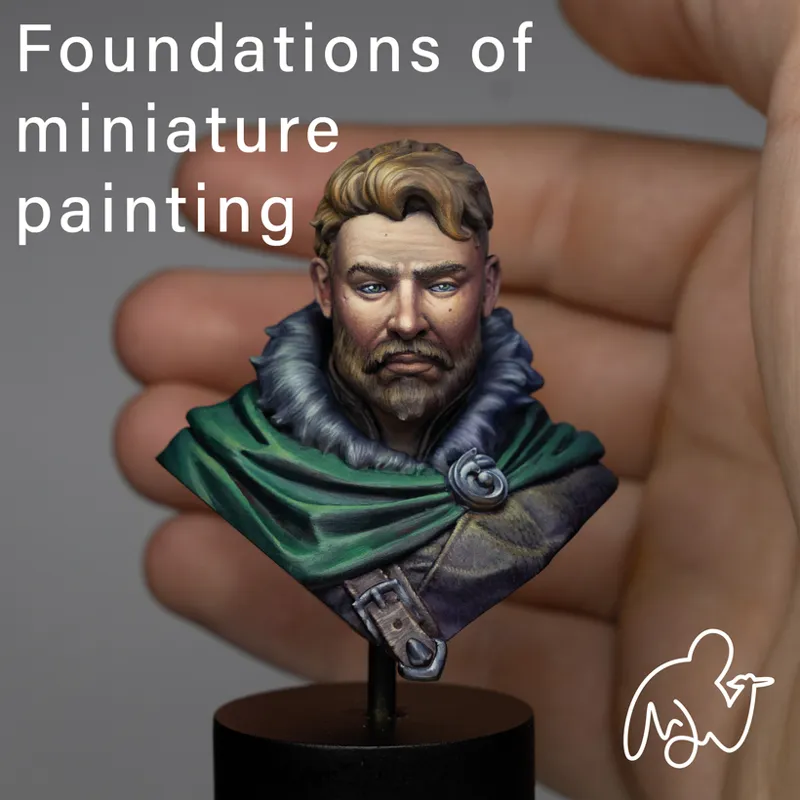
By painting with thicker paint - I build structure and strength in color first. Only then can I thin my paint to refine the gradients and blend the colors together.
It goes from big to small.
Thick to thin.
General to the specific.
Basically I put off thinning my paints for as long as I possibly can.
Scale plays a huge role in this. If I'm painting the rivets on a space marine armor - I’ll need thinner paint from the beginning because of the size of this detail. But if I’m painting a bust, 75 or 54 mm figure - i always try to thin my paints as little as possible.
I want a consistency that is thin enough to leave the brush easily - but thick enough to where I can clearly see the brush strokes on the figure.
The real key isn’t thick versus thin paint. It’s knowing when to use each and why.
That sense of progression is rarely taught explicitly. Most painters piece it together over years of trial and error.
In Foundations of miniature painting, I’ve structured that progression intentionally. Over six weeks, we build from bold structural sketching into controlled refinement with live-streamed group feedback after every week.
We start April 6.
Enrollment closes April 3.
We’re now a little over two weeks out from beginning, and once we start, the group moves forward together.
If you’ve felt stuck in endless smoothing and over-blending without seeing real growth, this might be the right moment to rethink your process.
Comments (2)
Thanks! And btw I would love to join your lessons but I am at a workshop with Roman Lappat in parallel. So do a second edition later this year, pleeease!
I'll keep that in mind, thanks! Have a good class! You're in good hands with Roman ;)