
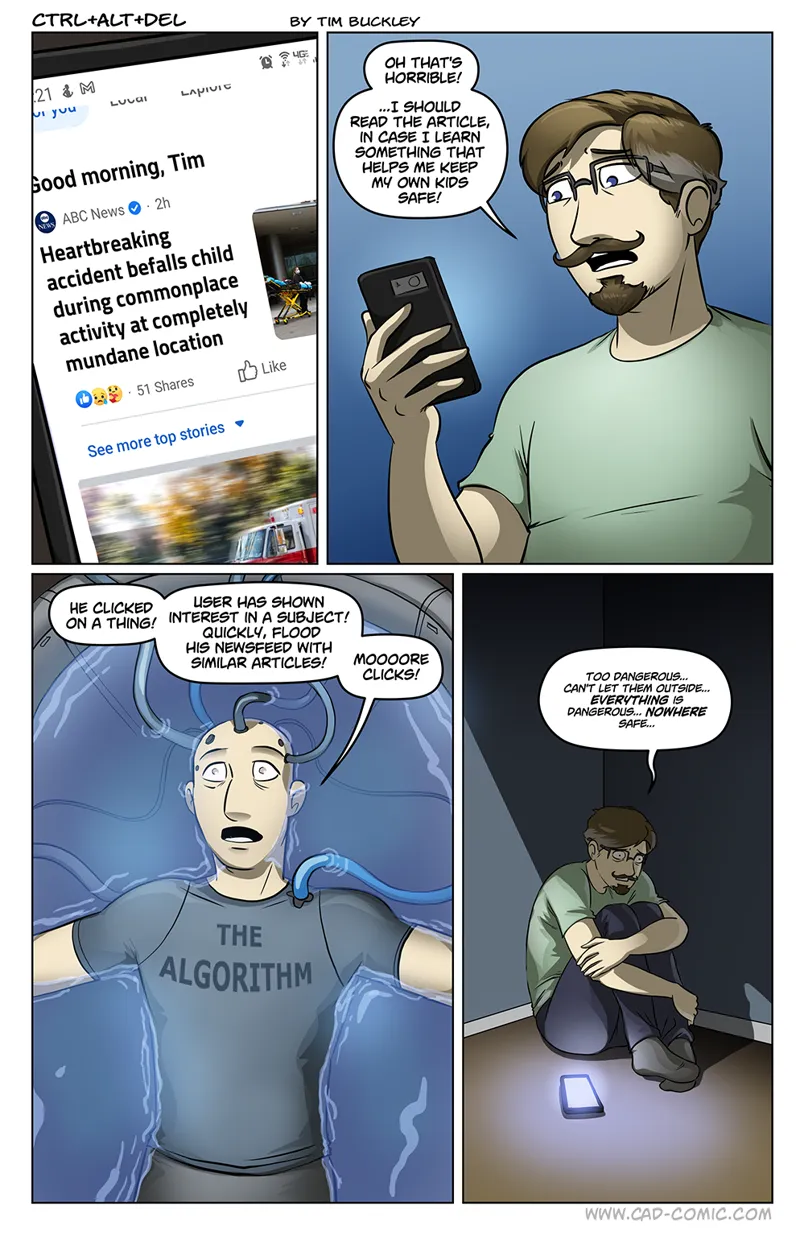
Comic for Monday 7/18 (Early High Res)
It can feel like the world has gotten more dangerous over the last few generations, but more so I think due to technology we're now more aware of/bombarded with every little terrible thing that happens around the globe, which can amplify that sense of chaos and danger.
My wife and I both sometimes find ourselves comparing notes on headlines we've seen. "Did you see the one about the...?" even though hearing/reading about these things makes us heartsick and we hate imagining the reality of it, in a way it feels like vigilance. Accidents happen and you can't walk around in a constant state of fear, but I think on a basic level we imagine that if we can at least be aware of the things that could go wrong, we might be better prepared to protect against them.
Knowing how metric-driven most internet feeds are, I then wonder if we're just skewing our article results worse and worse. Are kids really drowning every time they're near water (nope), or is the algorithm just trying to find every drowning-related article to shove in my face (yup). It can look pretty dire if you aren't taking it all with a grain of salt.
This is just a parenting example, but we know it happens with everything; politics, conspiracy theories, etc. It's not hard to imagine why some people lose their grip when the world looks the way it does through one of these cultivated lenses.
Comments (5)
I force myself to more or less view my child like a cockroach over a fragile vase. I have trained them the best I can and they're more physically resilient then I am. If I think of something that I think they should know I try to teach that something to them and not fret. I'm not going to put my child into a bad situation if I can help. I'm not going to let the unknown turn me into an anxiety mess either.
To put it succinctly, tragedy brings in more views. The crime rates in the US have dropped substantially decade by decade. We've just become more and more aware of each instance thanks to 'news' becoming 'entertainment'; everything has to be dramatic to keep that ad revenue high. If you are interested in having a look at crime rate graphs, here's a graph: https://www.pewresearch.org/fact-tank/2020/11/20/facts-about-crime-in-the-u-s/ft_20-11-12_crimeintheus_2/ and the related article: https://www.pewresearch.org/fact-tank/2020/11/20/facts-about-crime-in-the-u-s/ Feel free to search other sources, but I can say with confidence that the trend is at least very similar to what is represented.
You are my wife? ;-) All parents know that problem to a certain amount. Since the first day I have to say to myself "everything you are doing ist hello her living without you!". From the first day till the last
For better or for worse, the Internet now makes it much easier for us to check whether trends in headlines are reflective of an actual trend. If you're worried about accidental drownings, good news: the per-capita rate of child accidental drownings in the US has steadily decreased over the last 2 decades (source: www.cdc.gov/nchs/data/databriefs/db413-H.pdf). If you're worried about being fatally hit by vehicles as pedestrians, bad news: that rate has steadily INCREASED over the last decade, thanks largely to the proliferation of larger vehicles (e.g. SUVs) (source: https://usa.streetsblog.org/2021/10/20/op-ed-the-troubling-tie-between-big-cars-and-pedestrian-deaths/ contains link to peer-reviewed study that is paywalled) I do think the most effective way to push back against the grip that engagement-driven headlines have on us is not with passive skepticism ("taking it all with a grain of salt") but with active validation: What is the impression that these headlines are giving me? What kind of information/data would help me check whether that impression is correct? How do I get my hands on a reliable copy of that information/data? And perhaps most importantly: Am I ready to change my worldview if the data tells me something I don't want to hear? Active validation is a lot more work up front, but once we've done the work, it gives us a solid foundation to interpret and contextualize headlines, while passive skepticism will continue to just wear us down without actually providing us with any information ("believe nothing you read" is no more useful than "believe everything you read").
I do think having a solid "gut check" on articles, and a solid base-level skepticism of headlines in general, is a good starting point, however. Active validation is really the only way to gain a solid confidence one way or the other, but given how *yellow* modern journalism has reverted to, with the rise of clickbait and agenda-driven reporting, assuming every single headline you read, *even the ones you want to be accurate*, is probably *at least* stretching the truth, if not outright misrepresenting or lying, is probably the most rational approach to news consumptions these days. Does it get you more information on the topic? No, but it at least insulates you a bit against the massive deluge of patently false information caking our news feed. And critically based on that, do NOT rely on the headlines as your source of news. Read the article, check sources, cross-check against other sources if it's important to you, but the headlines are where they pack the most lying and misrepresentation, because the headline IS the ad for the article. It's there to grab your attention and get you to click on it. It's the "FREE X FOR EVERY CUSTOMER*" sign out front (with the "*1 in 10,000 chance to quality, free only with purchase over $10,000 and signing over your first born's soul" in tiny little letters at the end of the article).