
Comic for Wednesday 11/6 (Early High Res)
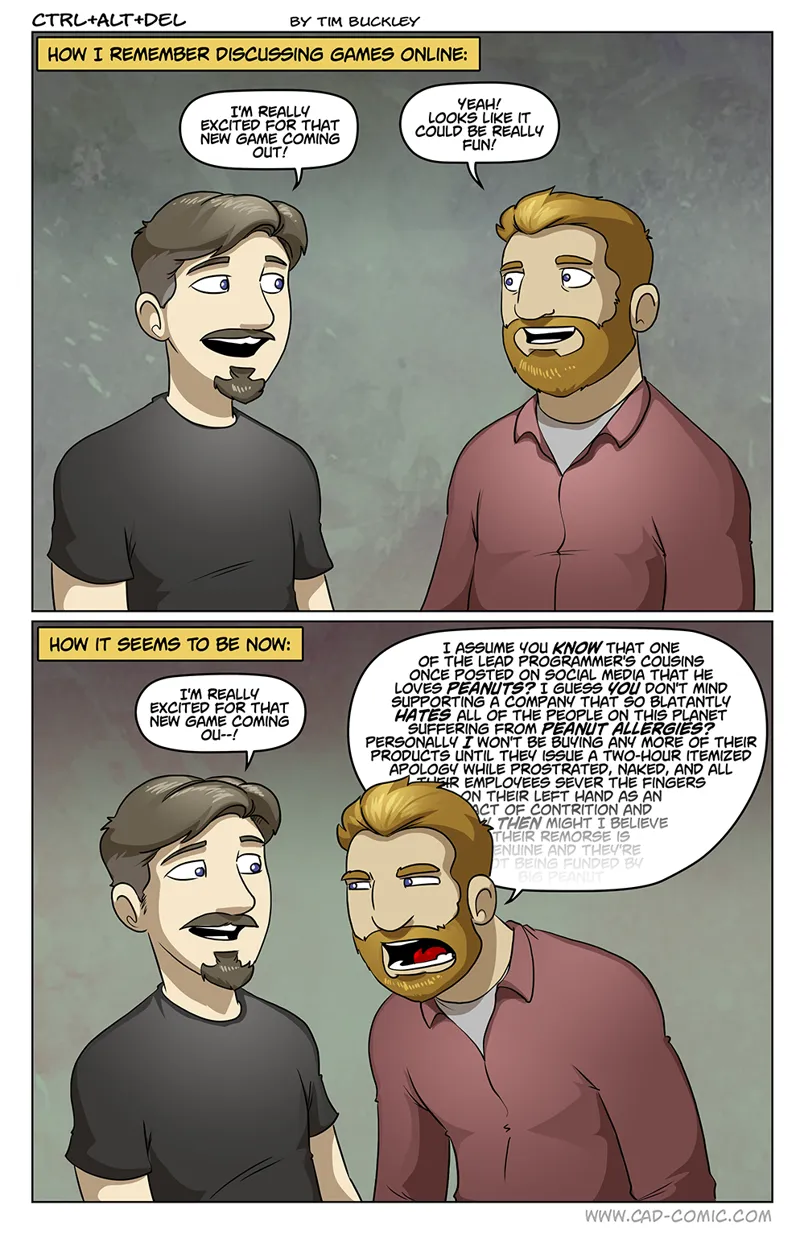
I have this feeling, and I've had it for a while now, that people are finding less and less joy in gaming.
I'm growing weary of this culture of outrage that we're living in, where it seems like the only thing people enjoy anymore is being mad at shit. Recently it feels like every month we're boycotting some new game developer for some new thing they did or said.
I'm not arguing that we, as a community of gamers, shouldn't be speaking up about things; quite the opposite. Being vocal with our opinions is an important tool to communicate where the perceived boundaries of our customer loyalties lie (second only to voting with our wallets). An example I could readily point to would be Battlefront 2, where the discussion over how far EA could push microtransactions finally came to a head, and the outcry/negative PR was so cacophonous that not only EA, but many other developers were forced to step back and reevaluate the financial benefit of pushing that business model.
It has certainly seemed to me that, in the years since, many developers have been very gun shy or cautious in regards to microtransactions and loot boxes. Microtransactions might not be extinct, but I would argue there has been a definitive trend towards developers being explicit that they either don't have microtransaction, or that the microtransactions are strictly cosmetic in nature.
Likewise, I'm not arguing that we should ignore it when a developer does something shitty, such as Blizzard's heavy-handed reaction towards Blitzchung's political statements on their stream. I think most of us would agree that China is hot garbage, an oppressive-regime front. Given their human rights violations and tendency to silence dissension, it's natural to be less than thrilled at the prospect of a US game developer bending over backwards to appease them.
Whether Blizzard has the right to sanction/moderate player comments on their stream isn't really at issue there; it's not a free speech issue because it's a privately-owned venue, and I have little doubt that if a Hearthstone player started chanting "Trump 2020", there'd be a lot of complaints stateside about letting a gaming tournament get political. So I think most gamers understand the concept of Blizzard wanting to keep a gaming stream to, primarily, games.
But, the severity of Blizzard's initial punishment, in the face of an infraction that should have warranted at most a warning or short-term ban from tournament play, makes it impossible not to view the punishment as Blizzard's overall genuflection to China's purse strings.
Through the press and public outrage that followed, I think it's now been made clear to Blizzard (and in the process any other developers wrapped up in Chinese money) that even the appearance of allowing foreign money to dictate policy and procedure is going to be met with pushback. While their phoned-in apology at Blizzcon may not entirely reflect it, it would be naive to assume this will not inform the company decision-making process in the future.
All of this is to say that, speaking up and voicing opinion and, yes, even outrage can all serve a very valid purpose and bring about change. Which brings me to the primary point I wanted to make here, and that is this: Amidst all of the speaking out, and being upset, and righting perceived injustices... don't let it drown out the concept of forgiveness.
I know that sounds super Jesus-y and shit, and I'm not trying to get preachy here, but bear with me a moment. Sometimes in reading comments, discussing these things with people across the internet, etc, I get the impression that some people are so invested, so addicted to the grudges they hold against developers, that they reach a place where absolutely no amount of apology, or reversal, or amends is going to ever be good enough. And I'm not trying to tell you that sometimes reaching that place isn't justified, or that you should be willing to fork over cash to a company that keeps making decisions you don't agree with.
But I do worry that we're reaching a point (as a whole also, not strictly related to the gaming community) where nobody has a tolerance for mistakes anymore and we're not giving each other a chance to grow. Get it right the first time, or you're written off forever (a standard we only hold others to, of course, never ourselves). People make mistakes, and companies, as much as we'd like to envision them as just a board room of old white guys in suits twirling their mustaches, are made of people. Sometimes those people make decisions that are, in fact, simply from a place of "how can we fuck more money out of them" greed. But sometimes the mistakes are more complex than that.
Take No Man's Sky, for example. Sean Murray famously overhyped and overpromised on that game's premise, and as we all know, at launch it was about as fun and fully formed as diarrhea. It sucks that we all bought a game thinking it was one thing, and it wasn't that thing. We had a right to be upset. But I don't believe that the overhyping and overpromising came from any sort of malicious place; Sean was naive, and perhaps just overly excited about the game he envisioned, and his eyes got bigger than his development window.
This belief of mine is backed up by the fact that, despite the incredibly negative PR shitstorm surrounding the game's launch, Hello Games put their heads down, got to work, and continued to try and meet the lofty goals everyone had for the game. They worked for years after the fact to add and expand the game for free, and have turned No Man's Sky around. It is now an honest-to-goodness game, bigger and better than it was at launch.
Yet, a few months ago when I mentioned that NMS had made such an impressive comeback, I saw a lot of comments basically maintaining that Sean Murray should never be allowed to work in games again, before also dying slowly in a fire. In the face of the updates made to the game, "that's not special, he should have finished it before launching in the first place" was a common sentiment. And... I agree, that is a valid argument. However, it's not an argument that leaves any room for someone wanting to fix their mistakes, that wants to learn and be better moving forward.
I'm sure at this point some of you think I'm here with the goal of defending video game developers. To a point, perhaps. I do believe that if you're going to voice dissatisfaction with a company/product, it should be with the goal of giving them a chance to improve and change. Because if it's merely a matter of not liking a company's game(s), the simplest and most effective answer is to not buy them. It doesn't require a single word to be spoken. But if you're posting rants and vocalizing outrage over something a company did wrong while also setting the bar for amends impossibly high, then you don't care if anything changes; you're just invested the act of being outraged over something.
So when I say "consider forgiveness", it's not with developers in mind but gamers and the community we're all a part of. I think we could all stand to be less angry about this stuff, in the grand scheme of things. And if forgiveness doesn't fit the bill, then at the very least the act of letting some stuff go could probably serve to make a lot of us happier. Spending less time clinging to past grievances. Like, yes, perhaps EA has pulled so many shitty little moves over the years that at this point it is justifiably impossible to give them the benefit of the doubt... that doesn't mean you need to carry that frustration around with you all the time. It's not doing you any good, especially if it's souring your outlook on other games.
A couple of weeks ago when I was talking about being excited for the release of The Outer Worlds, some of the immediate discussion revolved around the bugginess of some of Obsidian's earlier games, and how Outer Worlds would probably bomb and there's no point in getting excited for games because they might suck.
"If you don't let yourself get your hopes up, you won't end up being disappointed."
I just find that to be a terribly depressing viewpoint to walk around with, especially for a hobby that is basically a luxury. For me, video games have always been a source of fun and joy, and I do still get excited about game announcements and trailers, the same way I did pouring over the latest issue of EGM or GameSpot when I was a kid. Sure, that means that sometimes I'm let down when a game doesn't deliver, but the world keeps on spinning and there are always new games on the horizon if the last one isn't great. I'd still rather approach games with excitement and anticipation, and maybe it's just wishful thinking, but I'd love to see more of that enthusiasm in the community like we used to, instead of so much constant negativity.
This post won't effect any sweeping changes in attitude. It probably fell on a lot of deaf ears the moment I suggested "don't get so angry", and I don't have so wide a reach I can convince anyone to reconsider the way they carry their frustrations (or enough time and patience to address every single "But what about when THIS developer did THIS?!" variable I'll likely see in the comments).
I wanted to say it, though, because I often make jokes about these "controversies" in gaming, but upon discussing them I guess I don't come across as legitimately angry over them as some people feel I should be. And it's because I just can't walk around outraged all the time. At least not about this stuff. I don't like when a game pushes microtransactions; it does feel greedy to me, and I won't support it with my cash. But I can't get mad about it in the same way I can get mad when I hear a pharmaceutical company is charging $1000 a pill for medicine people need or whatever.
And so I guess TL;DR... try to have some perspective on stuff, in the grand scheme of things. Outrage should be a tool, not the endgame. And try to let some things go. Life's too short.
Comments (12)
If I have an issue with a game developer because they did something that broke the law then I will stop buying their games even if they apologise and I might get vocal about it. The only way I will buy their games again is when the justice says they paid their due. There are some things you cannot appologise your way through.
I didn't know there was any issues in the gaming community this heated. I'm apparently too busy playing video games and enjoying them... I think the larger problem is that people actually listen to and subscribe to these alarmists, spouting crap constantly. Bah, back to my games :)
I think the main reason it came this far that in the past years developers started doing more and more stuff that made players angry and at some point it was too much and the whole pent up outrage broke loose. People are just tired of seeing shit happen over and over and over again.
No, devs have always done stuff like that. What changed over the last decade or so is that information visibility has increased by orders of magnitude thanks to the twin singularities of social media and smartphones. In the 90's, one read a newspaper to get one's news, and one called a friend to stay up to date on social stuff. Information propagation was slow, and was generally fairly limited unless it was national-news-worthy (and what was news-worthy has a higher bar, because newspapers were generally only competing against maybe a half-dozen other publications, at the most). Today, we have a constant stream of information at our fingertips. News publications are competing with literally thousands (tens of thousands? Hundreds of thousands? I'm honestly not sure the scale of the competitive market for news networks these days) of competitors, and users can trivially easily flip between them. We have news aggregators like Google, and alternative news streams from the plethora of social media services. Something that is merely noteworthy can easily gain a national stage, because we're consuming hundreds of times as much information and news per day as people did in decades past. This makes it much much more difficult to hide or suppress faux pas or legitimate transgressions, regardless of the scale, because there will always been a segment *somewhere* that is willing to get outraged about it. Social media also connects and amplifies that segment, allowing a smattering of a couple thousand people country-wide (or perhaps even world-wide) to sound off as a united outcry and have that broadcast across the world. So no, it's not that companies are doing these things more these days. It's that they can no longer hide the fact that they are doing them.
"The Good Place" has a really good commentary on this in the heart of the show. I'll read the rest of the comments in a minute. I like to get my take on all of this. (Also 'enter' to post is annoying) Comments like your seeing often comes from a feeling of powerlessness. Here in the US, demographically speaking, people who play videogames are not seeing policies and officials in government that reflect their values. A feeling of hopelessness starts to permeate every time a vote is cast and one finds out that they are in the voting minority. When ones full generation is regularly verbally trashed and deranged for taking the advice of the generation that is trashing and deranging them, its demoralizing. Then to see an industry that survives off of the work of ones brow start to do the same thing makes one question their life choices and worth. Coupled with the aforementioned items one gets backed into a virtual defensive corner where prioritization shifts from finding joy to avoiding hurt or put another way not getting joy stolen. That's why I agree that forgiveness, not to the point of naivety, is required. No one knows exactly what is going on with anyone. The exact circumstance that led to the decisions made. I would even include oneself in that. I just don't like the UI decisions that were made on MacOS/OSX. They annoy me. I don't primarily use Macs. That doesn't mean I can't recognize what they excel at and acknowledge that their are folks that do find the UI intuitive. Humans have Free Will and Free Will is really just the ability to make mistakes. I hate sandbox games and I feel that Minecraft in the early days was almost to the point of being an insult to developers with what was going on. There is countries worth of people that disagree with me and that's fine. We are free to enjoy the games we want. I am looking forward to Pokemon Sword for one reason and one reason only, the Evolution for Farfetch'd that I've been waiting for for 20+ years is in it. Its an odd thing to want from a game. Its my privilege to be odd and spend my capital how I please. A shame that within our circles of interactions that a futility has set in on our ability to manipulate our larger world.
I miss the times when discussing a game really was about discussing the game... Luckily, I don't care too much about what others say about games -- regardless of the reason they're saying it. Otherwise, I'd miss out on games which are still great. --- By the way, you're absolutely right about giving people a chance to fix mistakes. Unfortunately, for many people once you've made a mistake, you're done. And that's quite unfair...
In that regard being able to actually discuss media to its full extent without having to only skim the surface because of "Spoilers"
Hear hear! Well spoken Tim. This needed to be said :)
#playtoo
It is a case of “Live by the sword, die by the sword.” If companies embrace the mantra of hype and declare the viral marketing to be the holy grail, they also open the door for the shitstorms. Both are two sides of the same medal. They rely on the same mechanisms: black-and-white-thinking, emotions before argument, simplification ad extremis, etc.
> think most of us would agree that China is hot garbage, an oppressive-regime front. And today, Ctrl-Alt-Del was banned in China =P But for serious, it's the entire notion of cancel culture. Our society, or at least a vocal portion of it, have gotten so addicted to the notion of outrage and zero tolerance that *any* mistake from someone's past is enough to put them in the "literally subhuman and unworthy of anything" box forever. It's disgusting, to be frank. Brings back that old saying about slinging rocks in a glass house, because *no one* is mistake-free. We seem to have lost sight of the fact that a person's strength of character is defined (in part) by their ability to *learn from their mistakes*, not avoid ever making one.
I mean, that's literally human growth, right? And I agree that it really seems now that nobody wants growth in anything. As a society, we seem to expect things to appear fully formed and perfect, with a further expectation to maintain that perfection. And whenever something fails to meet that, we immediately discard it. We never even give anything the chance to understand and learn from the mistakes it's made. Whether it's media, or products, or even fellow humans. And that's such a toxic way to live our lives.