


Aprons and Other Things from 1916
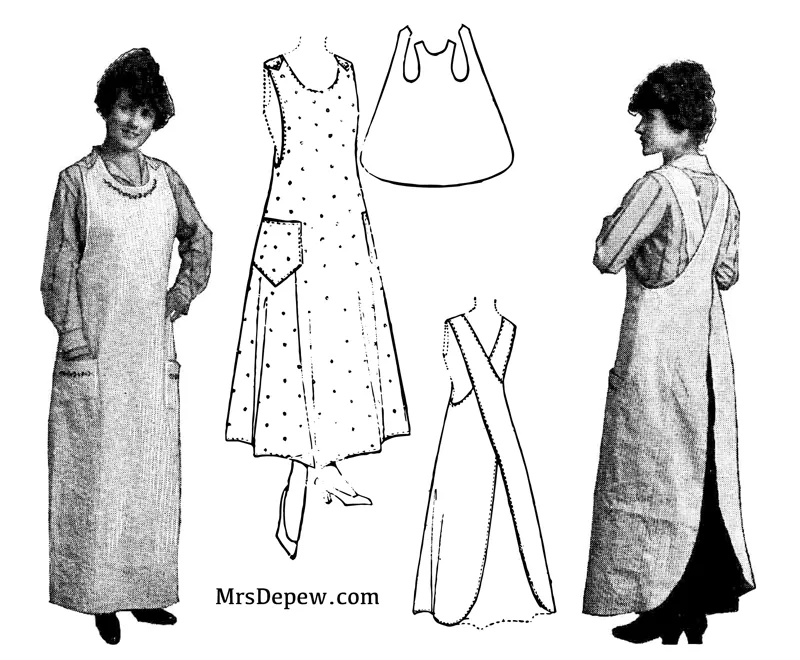
I have been working quite a bit this week on an apron sewing pattern from 1916. Much to my delight, while researching the pattern, I found it featured in an article, Aprons and Other Things, in the April 1916 McCall's Magazine. And what's more, they had photographed an actual woman wearing the apron. Isn't it darling?
I found the article even more charming and useful than the average antique McCall's piece, and I wanted to share with with you all too.
I hope you enjoy reading it as much as I did!
"APRONS AND OTHER THINGS
By JOSEPHINE W. HOW
Staying for a short time in a New England farmhouse, last summer, I was amused, as well as impressed, to see the method by which my landlady performed her daily tasks.
The house itself was adorable, being over 200 years old, and while my landlady loved it with just pride, she disliked the daily routine of housework. However, finding that food and cleanliness necessitated a daily round of work, she decided to make her tools for this labor as attractive as possible, and as a result of her efforts to do this, she now says that it is just as easy to make useful things good-looking as bad-looking, and that being attractive makes them much easier to work with.
Her kitchen is a large low-ceiled room, on the sunny side of the house, with three small-paned windows, and a wonderful old fireplace which takes up nearly one side of the room. Each window has its fresh, white, cheese-cloth curtains, with a six-inch frill of flowered chintz across the top, and gay plants blooming summer and winter on the window sills. The narrow, low mantle also has its frill of chintz below its pewter plates and jugs.
"Her aprons, dish towels, and all other "munitions of war", as she calls them, while of serviceable material, are really decorative. The large aprons for the morning's work are of various materials. One is of blue-and-white striped galatea, and has no sleeves, but buttons on the shoulders, after crossing in the back (Figs. 1 and 2). It is long enough to cover the hem of the gown, and has two ample pockets at either side. A simple embroidered design is worked in satin stitch, with blue embroidery cotton, around the curve at the top of the apron, and across the pockets just below the hem. (This apron is made from McCall pattern no. 6920.)
Another apron of the same design has no embroidery, but has a binding around all the edges, of cotton tape, the color of the stripe. A charming one is made of flowered chintz, with a tan background, pink-and-blue flowers, and leaves. This is bound with blue tape.
A dusting cap matches each apron. The cap is made by sewing a casing for elastic around the edge of a 12-inch disc of the material, and drawing it up to the required size.
A dainty little striped apron, which buttons around the waist, is used for carrying clothes-pins out to the line. It has a double-pocket arrangement over the foundation apron, formed by a row of stitching through the center from top to bottom, which makes two pockets. This stitching is not necessary if only one pocket is preferred. A simple design in applique gives an attractive touch to this apron (Fig. 8). It is made of motifs cut from material of a plain color, with the edges turned in and hemmed down neatly. The colors used for this applique are green for the leaves and stems, and yellow for the flower motifs, to harmonize with the green-and-white stripes of the apron. The edges of the pocket openings, and the outside edges of the apron, are bound with narrow strips of the same green that is used for the applique. The upper edge of the belt is also bound with the green.
Another apron of this pattern is made of inexpensive tan linen, and bound at the edges with blue; and still another is of flowered chintz, bound with green.
A charming apron of dimity (Fig. 7) can be made with one width of the goods forming a front panel, one-half a width on each side, and large pockets put on in a unique way. To make the pockets, one width of the goods, a little more than half the length of the should be folded in half length wise, cut straight across the top, and at the bottom shaped in an even curve from the outside edge to the middle.
This makes a piece about five or six inches deep in the center and rounding clown and out to half the length of the apron at the sides.
Embroidery motifs should be worked on the bottom of the front panel. and on each side of the piece which is to form the pockets. The edges of the pockets, at either side and at the top, should be turned in, as should also the curved edge for the lower part of the pocket piece. This piece should be laid on the front panel of the apron and basted in place, with the tops and sides of the piece and of the apron-panel together, leaving an opening for the pockets at the sides, near the top. The center of the pocket piece and the center of the apron must be held together by a row of stitching running from the waistband center to the point of division of the apron piece - about six inches. The two sides should then be sewn in place to either side of the front panel and the edges of the apron hemmed. A gathered four-inch ruffle, not too full, should finish the bottom of the apron, and the top should have a band, with button and buttonhole at either end.
It may be feather-stitched around the pocket openings, at the top of the ruffle, where the band joins the apron, and over the stitching which holds the pocket piece to the apron in the center, and forms the division of that piece into two pockets. This is a good design for a utility apron of gingham, galatea. or other substantial material. Both the apron and the pocket, may be made as long as desired, and the featherstitching omitted.
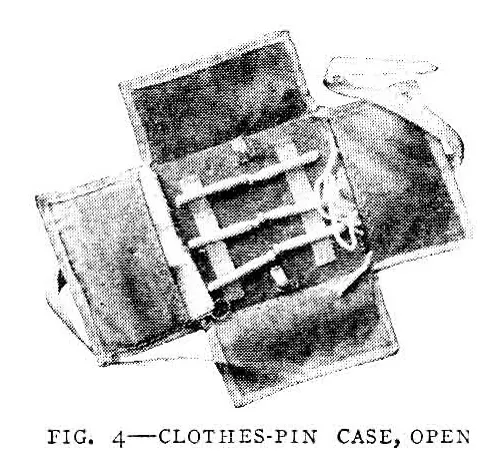
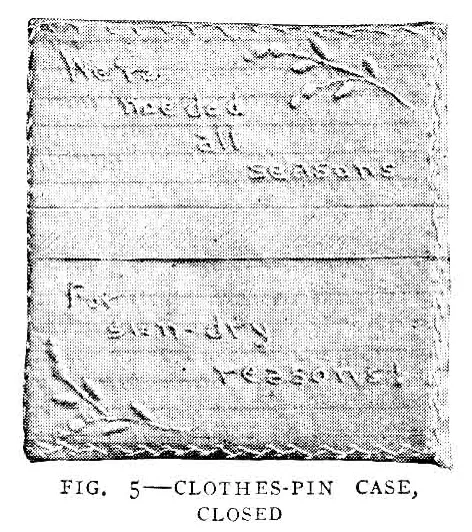
A little clothespin case which my hostess made is a charming idea, and would not only be useful to a house-wife for her own laundering or laces, fine handkerchiefs, and such things, but also to travelers, or those of us who like to launder small objects in our own rooms (Figs. 4 and 5). The clothespins, two glass push-pins for fastening up the clothes-line, and an iron holder are all in place and ready for use.
These may be purchased in toy departments. The case is five and one-half inches square, with pockets on two sides, three and one-half inches deep, and three-inch flaps on the other two sides. The material is cotton taffeta in a shade of tan, but linen or denim may be used. The lining is sateen, the same color as the binding and embroidery.
A motto which reads "We're needed all seasons, for sundry reasons!" is outlined in mercerized cotton, and two flower motifs decorate the corners.
When the loops for the clothes-pins and glass push-pins have been sewn in place on the lining, the lining and outside pieces are basted together over a piece of cardboard five and three-quarter inches square. Sew around this on the machine, or feather-stitch around it. Cut out and feather-stitch the top of the pockets, baste them over the flap on which they belong, and bind all edges with cotton tape the color of the case. Sew tie-strings of the tape on the outside.
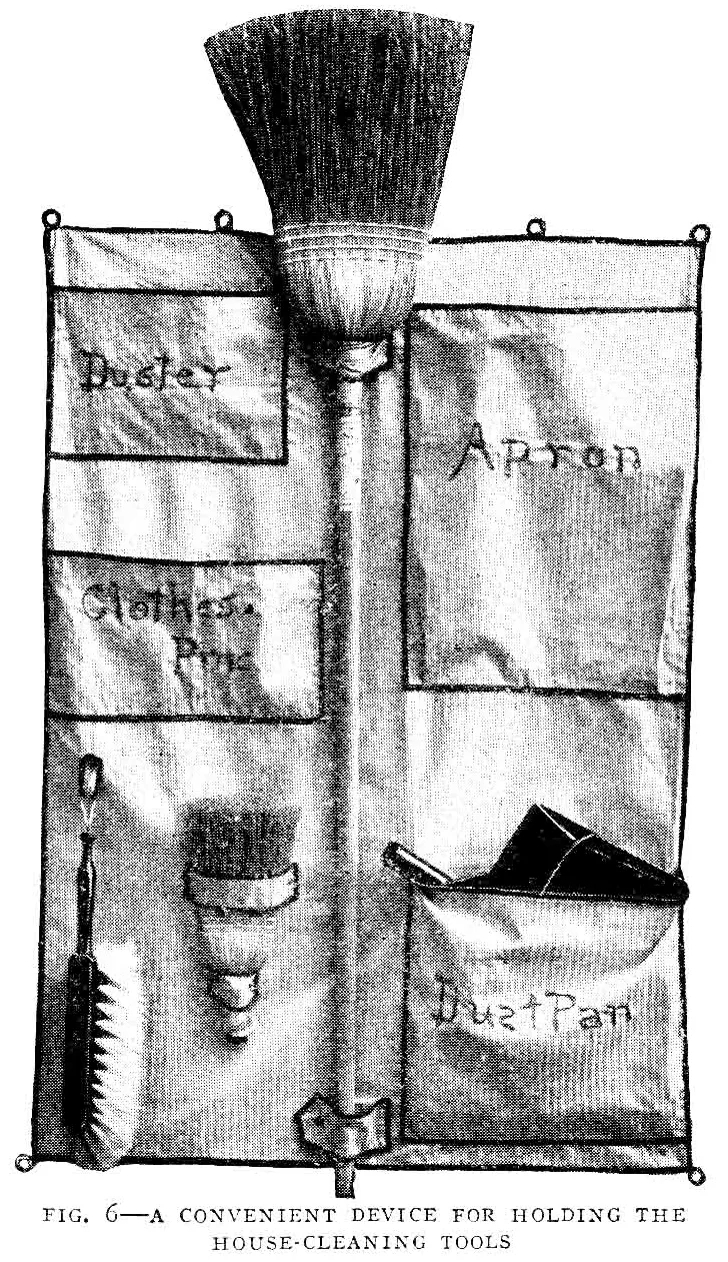
A case for brooms, dustpan, etc., may be hung anywhere these implements are kept- against the wall, in a closet, or on a door (Fig. 6). Tan cotton material, bound with green tape, is effective. A good size is thirty-two inches wide, the width of the material, and one and one-fourth yards long. A pocket for the working apron should go in the upper right-hand corner, three inches below the upper edge, eighteen inches deep and sixteen inches wide, with two small pleats at the lower edge to give it fulness, making it fourteen inches across. Below this pocket, in the lower right-hand corner, should be a pocket for the dust-pan, pleated at the lower edge to fourteen inches, fifteen inches wide at the top, and twelve inches deep. At the upper left-hand corner place a duster-pocket, eight inches deep and eleven and one-half inches wide; and below that, a clothes-pin pocket thirteen and one-half inches wide and seven and one-half inches deep. Two flaps, two inches wide, and long enough to fit over a broom-handle, should be bound with tape and placed at the upper and lower edges of the case, through which to slip one's broom. The flaps fasten down with snappers. A flap one inch wide and four inches long, should be placed below the clothes-pin bag, to slip through the cord of a soft brush; with a flap beside it to fit the whisk-broom.
All these pieces for pockets and flaps should be bound with tape as is the foundation-piece. Brass rings are sewn at intervals along the top and the lower edge, to hold the case in place against the door.
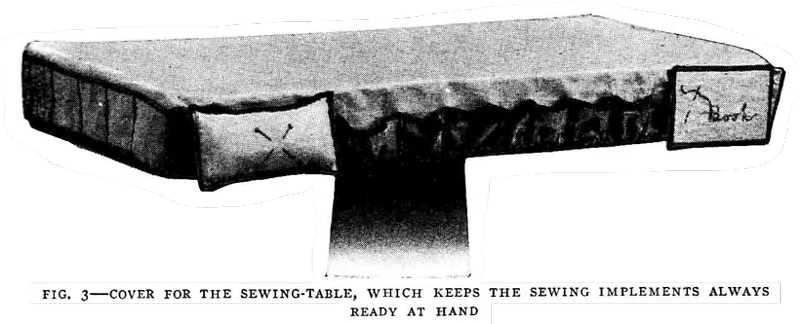
A cover for a sewing-table, with sewing pockets on the side, keeps the implements for sewing always ready at hand ( Fig. 3). Any table of convenient size can be converted into a sewing-table by the use of this cover.
The top should be cut from tan linen of light quality. Four strips should be cut, four inches deep, and the correct length for each side. A pincushion should be attached to one corner, a needle-book to the other corner, of one side, and casings made for spools, by dividing a strip two inches deep into pockets, by feather-stitching.
On another side, three large pockets can be made by feather-stitched divisions, and on the opposite side, a row of smaller pockets, two or three inches wide, for tapes, needles, etc. The pockets, lower edges of four sides, pincushion and needlebook, should be bound with colored tape.
Editor's Note. - Perforated patterns giving designs for stamping for the clothes-pin case and two small aprons can be supplied by the McCall Company for 10 cents each. McCall Pattern No. 6920 for making the long apron, 15 cents; perforated pattern for embroidery design on this apron, 10 cents."