



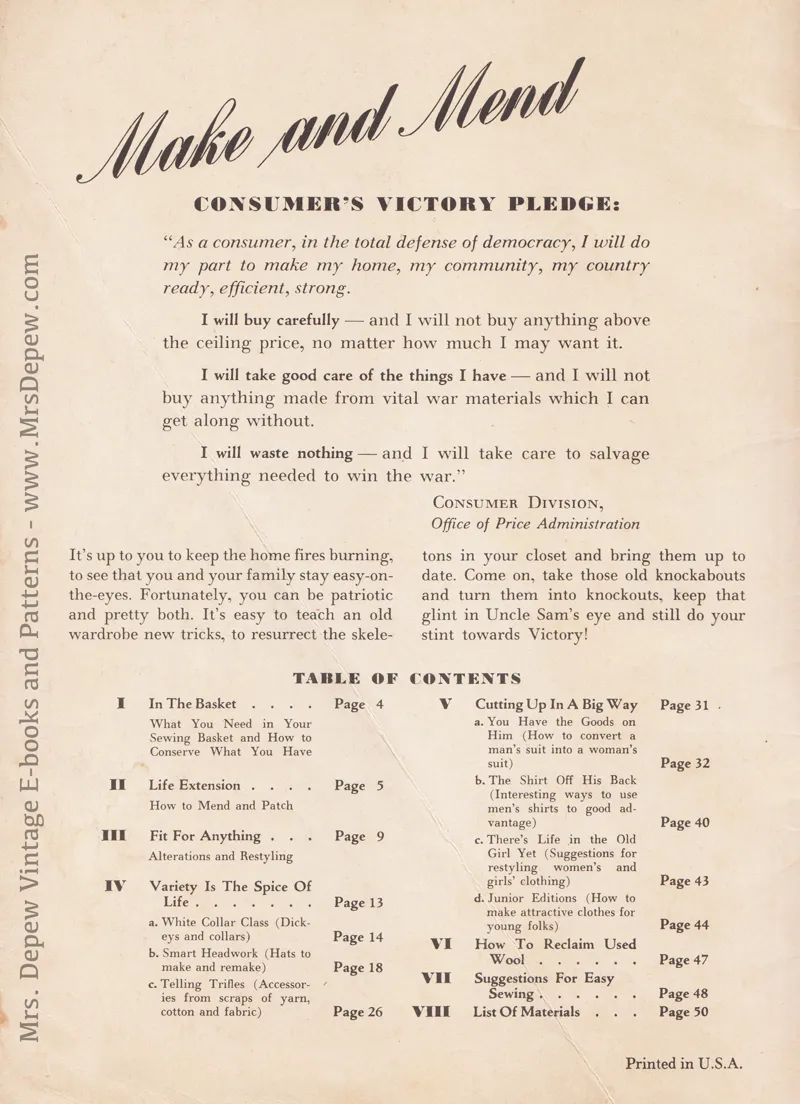
Make and Mend - Sewing with Wartime Fabric Conservation in Mind.
Do you ever wonder why a certain fashion came into being, or what world event or trend might have triggered its popularity?
For example, one might wonder if the 1940s crochet accessories and jewelry trends, short bolero jackets, and slightly mannish two-piece suits came into style because they simply did? Or were they clever uses for limited fabric and notions during wartime conservation?
These two bits of sewing history from 1942-1943 contain hints as to the origin of these trends.
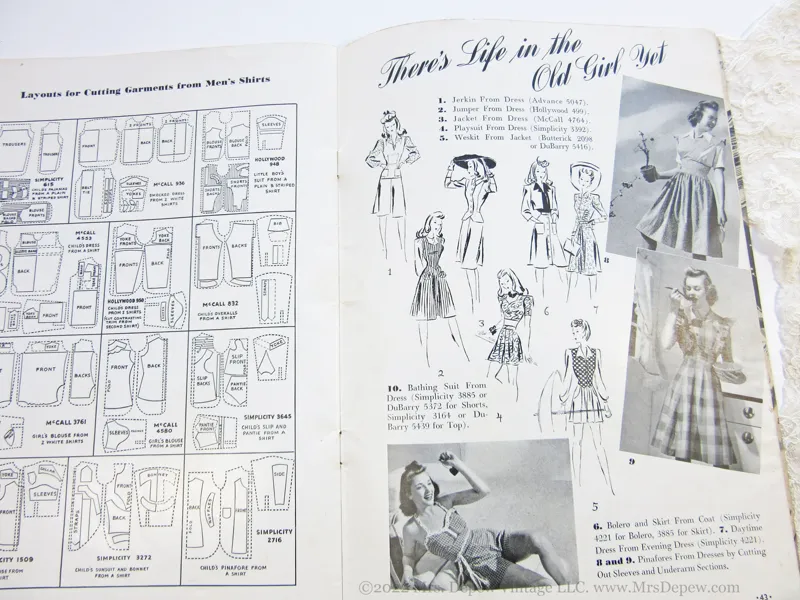
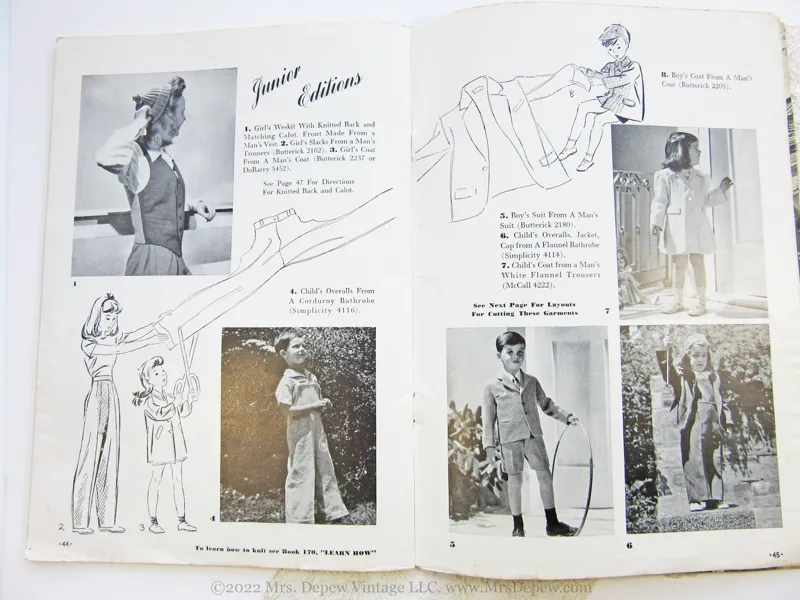
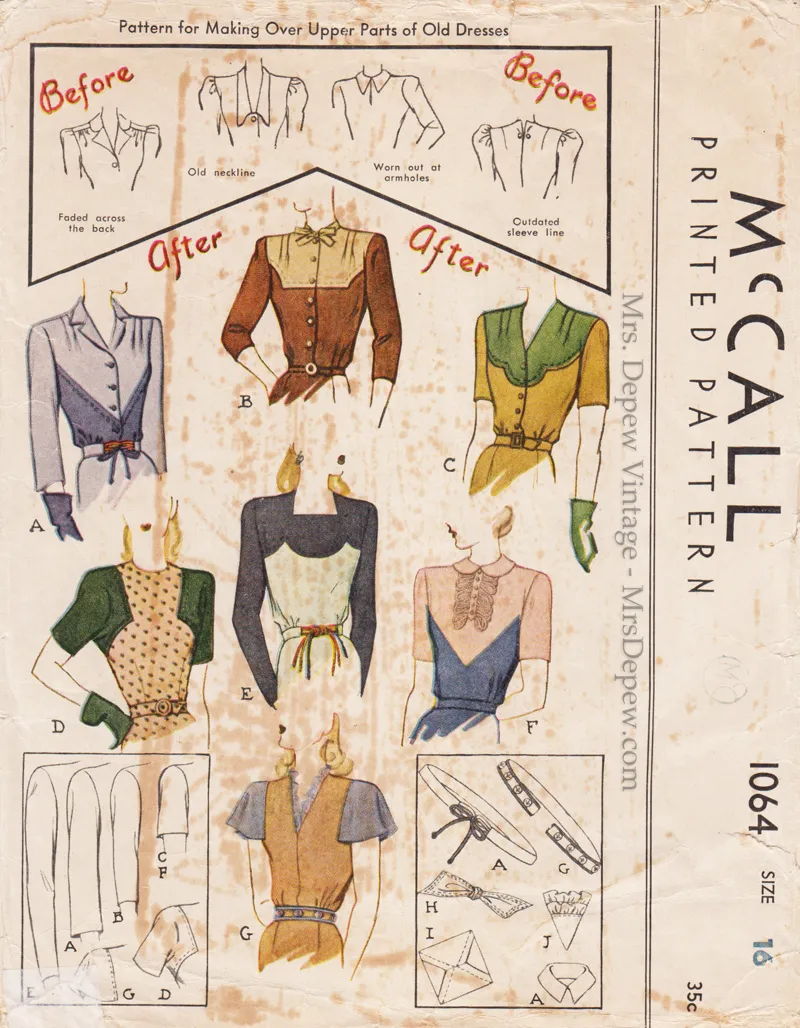
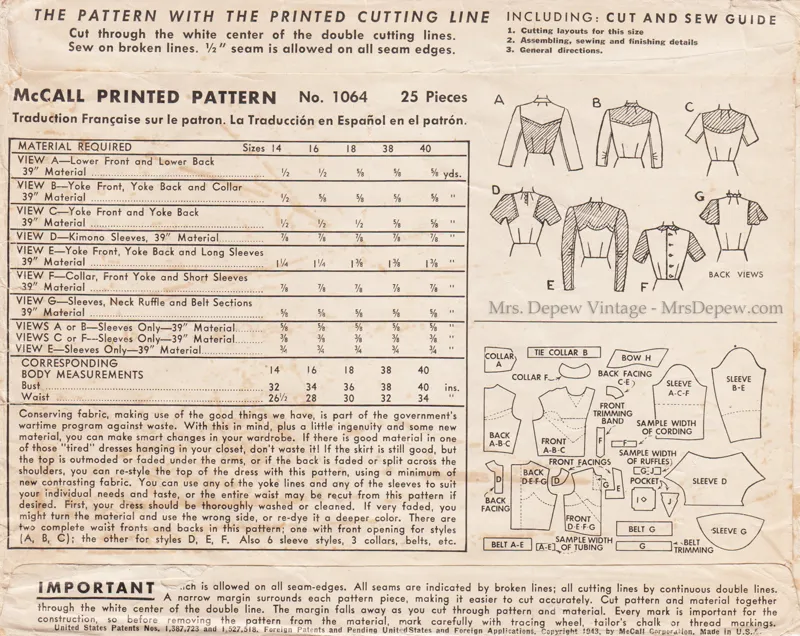
The book Make and Mend for Victory teaches one how to update and preserve existing clothing into entirely new garments with mending, "Cutting Down", and clever alterations. The pattern, McCall 1064, contains pattern pieces for altering and updating dress bodices with yokes, collars, belts, and other contrasting design features.
In the page below, the uncredited author of Make and Mend writes,
"Clothes may make the woman but nowadays there's no doubt that accessories make the clothes. It's no trick at all for a dress to have nine lives. You can give last year's dress a new lease on life, make every costume pay extra dividends with a little needle and thread trickery.
At 9 a.m. a simple crepe dress looks trim and business-like with neat white collar and cuffs. At 9 p.m. the same dress, glamorized with a frothy dickey, a new belt, a gay little hat, may on occasion wear a fresh-as-paint party face."
Many a woman with a well-deserved reputation for chic has only a few basic costumes on which she has learned to ring endless changes. It's good fashion sense and smart dollars and cents to s-t-r-e-t-c-h your wardrobe with a versatile collection of easy-to-make accessories.
A polka-dotted hat and bag, a pair of red gloves and a matching calot or an inch of scarlet flounce peeping out from the bottom of a skirt; a necklace and earrings of bright crocheted stars; a set of buttons salvaged from a bureau drawer or made with a few bits of odd yarn change a dress so your best friend couldn't recognize it."
This has always been sound advice but in an era of fast fashion and low-quality clothing produced at little cost (to the customer, that is) it is easy to forget how previous generations stretched the use and versatility of their clothing which was built to last from the outset.
In 1942 however, conservation was more than just a trend, it was a patriotic requirement as factories and production lines switched from making luxuries to munitions, uniforms, tent canvas, parachutes, and all the other trappings of war.
The "Consumers Victory Pledge" at the beginning of Make Do and Mend for Victory states,
"As a consumer, in the total defense of democracy, I will do my part to make my home, my community, my country ready, efficient, strong.
I will buy carefully - and I will not buy anything above the ceiling price, no matter how much I may want it.
I will take good care of the things I have - and I will not buy anything made from vital war materials which I can get along without.
I will waste nothing - and I will take care to salvage everything needed to win the war."
The booklet continues, "It's up to you to keep the home fires burning, to see that you and your family stay easy-on-the-eyes. Fortunately, you can be patriotic and pretty both. It's easy to teach an old wardrobe new tricks, to resurrect the skeletons in your closet and bring them up to date. Come on, take those old knockabouts and turn them into knockouts, keep that glint in Uncle Sam's eye and still do your stint towards Victory!"
On McCall 1064 released in 1943, the envelope description reads,
"Pattern for Making Over Upper Parts of Old Dresses.
Conserving fabric, making use of the good things we have, is part of the government's wartime program against waste. With this in mind, plus a little ingenuity and some new material, you can make smart changes in your wardrobe. If there is good material in one of those "tired" dresses hanging in your closet, don't waste it! If the skirt is still good, but the top is outmoded or faded under the arms, or if the back is faded or split across the shoulders, you can re-style the top of the dress with this pattern, using a minimum of new contrasting fabric. You can use any of the yoke lines and any of the sleeves to suit your individual needs and taste, and the entire waist may be recut from this pattern if desired. First, your dress should be thoroughly washed or cleaned. If very faded, you might turn the material and use the wrong side, or re-dye it a deeper color. There are two complete waist fronts and backs in this pattern; one with front opening for styles (A, B, C); the other for styles D, E, F. Also 6 sleeve styles, 3 collars, belts, etc. "
Though this pattern was released a year after the publication of the booklet, it is a fantastic illustration of how one used these materials to new and interesting effect.
Make and Mend also names specific patterns on the market at the time of publication that one could use to employ these clever upcycling techniques.
They are listed on our blog at the link below in case, like me, that notion triggers the Pokemon-like "Gotta Catch-em All" mentality so prominent in many pattern collectors and history buffs.
(On our blog, each of these is linked to the Vintage Pattern Wiki when possible).
Find the complete blog post and a list of featured vintage sewing patterns here:
https://mrsdepew.com/f/make-and-mend---sewing-with-wartime-fabric-conservation-in-mind
Comments (3)
I have been trying to keep up with mending for a few years now. I find that if I have matching thread, using the darning stitch on my sewing machine is the easiest way for me to mend.
That's a great idea!
I had picked up a book before that has reprints of several British pamplets on the made and mend. https://smile.amazon.com/gp/product/1843172658/ref=ppx_yo_dt_b_asin_title_o02_s00?ie=UTF8&psc=1