










The Fabric Tattoo: All About Vintage Kaumagraph Patterns
What Exactly is a "Kaumagraph"?
One question I often get in the Vintage Sewing Pattern Nerd Facebook group I help run is, "What is a kaumagraph?"
The short answer? It is a hot iron transfer. The longer answer is better given by Kaumagraph International, the original manufacturer:
"...Simply put, a Kaumagraph is a hot paper transfer that is applied to a textile with heat and pressure. A Kaumagraph is different from many other transfers on the market in that it doesn’t need any special coated paper, adhesive glue or powders to make it adhere to the garment. The secret is in the inks. Our inks melt into the textile which is what allows us to have a very durable finish."
The name "Kaumagraph" was actually a brand name (Kaumagraph Co.) that became a generic term for almost any hot-iron transfer, similar to how we use the brand name Kleenex to refer to tissues.
How did Kaumagraph get started?
It took me quite a bit of research to find exactly when Kaumagraph first came into being.
Kaumagraph Co. was organized as an unincorporated association in New York, NY on September 3, 1903, and continued as such until in or about the month of January, 1905 when it was officially incorporated.
The founders were H. R. Monro (President), who was at the time engaged in the lithographing business; J. O. Hillyer, executor of the Colgate estate; Jos. A. Richards, an advertising agent; H. E. Selchow, who worked for a Trust Company; and J. C. Jack, who worked as both clergyman and promoter. They seem to have built their company on a a number of processes already known and used in England by Wm. Briggs & Co, improving on the chemical formula and machines used in the process to form their own special transfer method.
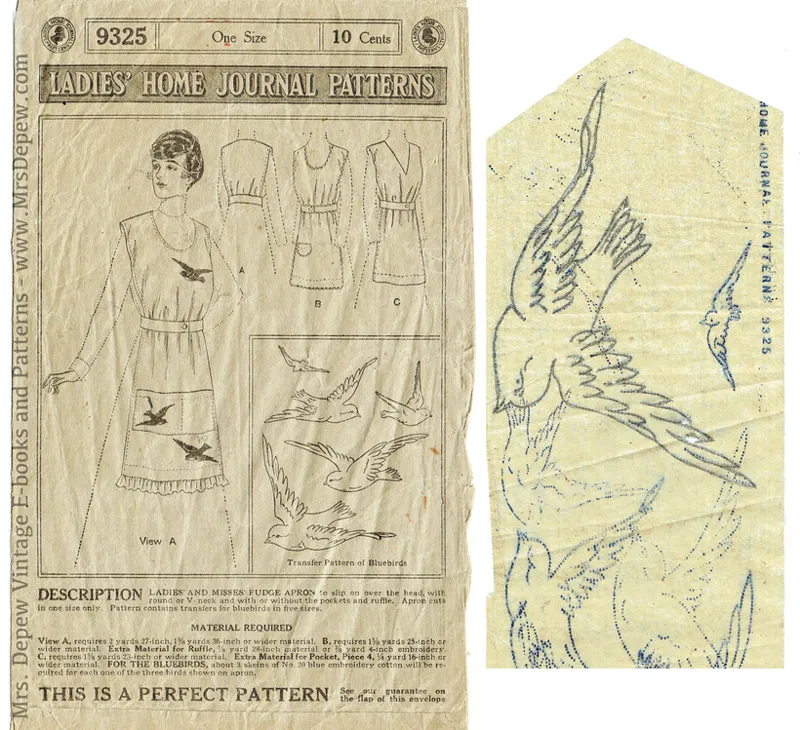
In August of 1905, Kaumagraph began to manufacture hot iron transfers patterns for the Ladies' Home Journal / Home Pattern Company. In November of that same year however, that contract was cancelled and Joseph A Walker took over transfer design printing for the Home Pattern Co.
At the time, the main embroidery transfer method available to consumers was made from a design perforated into paper. Butterick Pattern Company, among others, sold such a transfer (though it was manufactured elsewhere). The embroidery design was transferred when one put a piece of carbon paper underneath the perforated pattern and then rubbed the surface. These sheets when unused often look almost like the raised surface of braille printing.
In 1906, with the demonstration of the Kaumagraph Company's superior method and growing popularity on the home needlework market, Butterick began selling Kaumagraph transfers as well. They did so until around 1910 when they developed their own transfer ink compound and printing process in-house.
Kaumagraph Company also manufactured transfers for Simplicity Pattern Company for an unspecified period, and again for Butterick in later years, again for an unspecified period.
The McCall Kaumagraph Partnership
In the December 1912 McCall's Magazine needlework pages, McCall advertised their embroidery designs sold on stamped linen as they had for several previous years. McCall sold most designs stamped on about 3 yards of lawn, nainsook, or linen fabric.
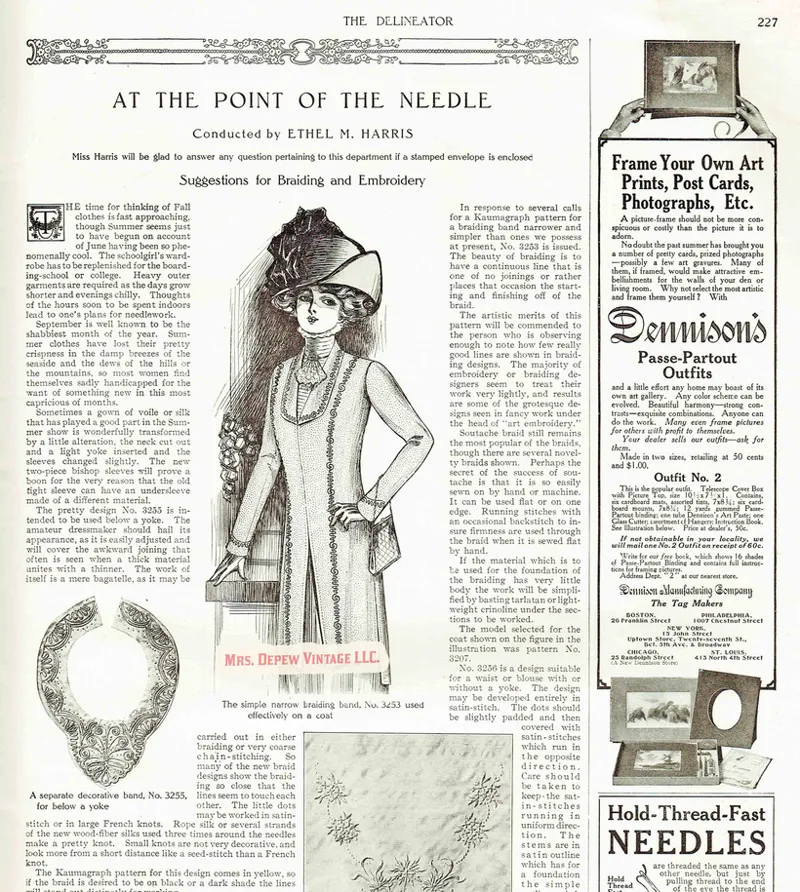
But the next month, in the January 1913 edition of McCall's Magazine, the first McCall Kaumagraph patterns, Nos. 318-500 are featured. They were sold via mail order from the magazine for a price of 10 cents each.
Over the next decade the market for McCall Kaumagraph designs seems to have gradually expanded.
During this time, McCall also endeavored to educate potential customers about the ease of use that the Kaumagraph pattern offered. The lesson below was printed inside possibly the earliest known McCall Embroidery Book circa 1915.
With the advent of McCall's New Printed Patterns in 1921, McCall drastically stepped up production and advertising for transfer patterns.
McCall's Superior Advertising
The McCall Pattern Company didn't just sell Kaumagraph patterns, they also revolutionized how they were marketed to the everyday consumer.
Between 1914 and 1915, McCall began to publish the McCall Embroidery Book, similar to McCall Quarterly but devoted entirely to embroidery, cross-stitch, and other needlework designs. It also began publishing a separate needlework counter catalogue titled The Complete Catalog of McCall Transfers.
--To learn more about McCall counter catalogs & quarterlies, check out this blog post.--
The McCall Embroidery Book was later renamed McCall Needlework and Decorative Arts around 1925. Later in the 1940s, this quarterly would move more of its focus to knitting and crochet patterns.
McCall also frequently cross-promoted patterns, suggesting a specific Kaumagraph motif (like a floral border) to ornament a McCall dress pattern.
The instruction sheets of many 1920s McCall patterns would also include suggestions for specific Kaumagraph patterns illustrated and promoted on that very pattern.
For example, inside of McCall 3201 from 1922, the instructions include recommendations for their Kaumagraph embroidery transfers McCall 1201, 806, 632, and 1196.
McCall 3201 was also illustrated in McCall Quarterly as a wedding gown with a beading design calling for McCall 1119.
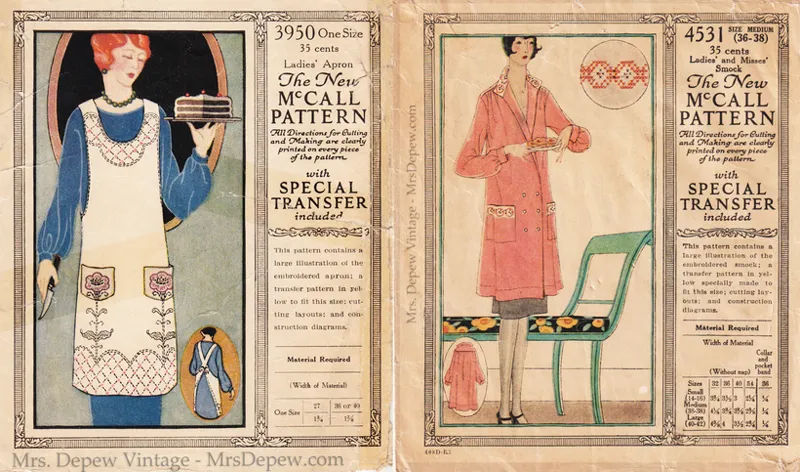
The earliest McCall sewing patterns known to incorporate Kaumagraph transfer designs directly into the same package is the McCall Patterns for Embroidered Garments line, or as I like to call them, The McCall Special.
These special patterns came in a different envelope and were the first McCall patterns ever printed with color illustrations (starting in about 1923) and until about 1928, they had the same ornate framing and wording that stated, "The New McCall Pattern ... with Special Transfer Included."
The patterns were most often for lingerie and lounge garments, with a some aprons and a very small number of ladies' dresses.
There were also several children's outfits, and these seem to be slightly easier for collectors to find.
As you can tell, I have quite a few of these McCall Specials in my collection and it's fair to say that I'm more than a bit obsessed.
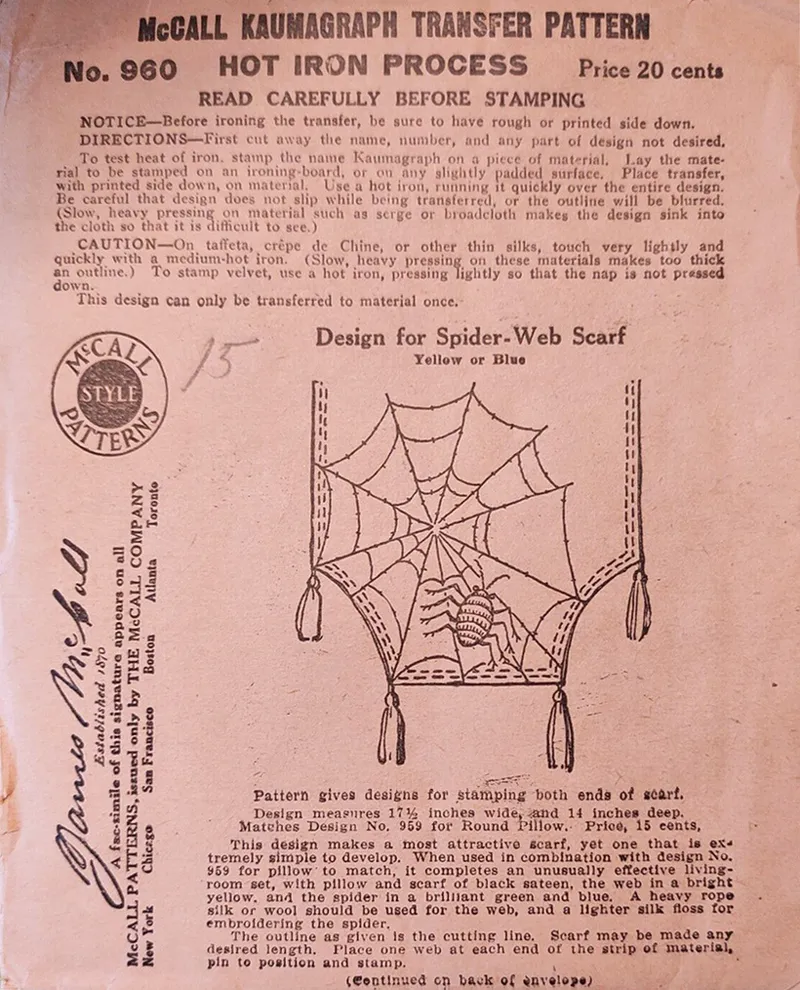
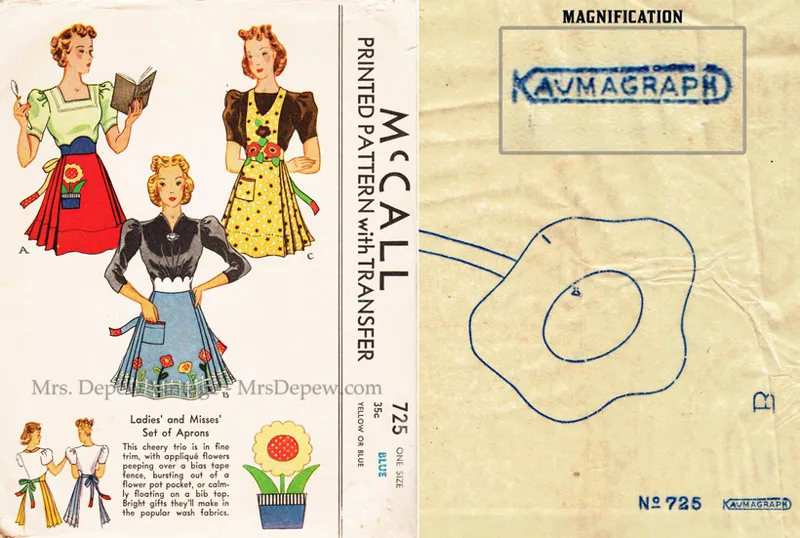
By 1930, the term "Kaumagraph" began to fade from the envelopes, replaced by the simpler "McCall Printed Pattern with Transfer". The transfers were usually printed in either blue or yellow, and the dye compound feels slightly waxy to the touch.
Note that on the pattern above, the envelope isn't marked Kaumagraph, but the transfer sheet is.
McCall also offered multi-color transfers for a time, according to this June 1925 McCall's Magazine ad.
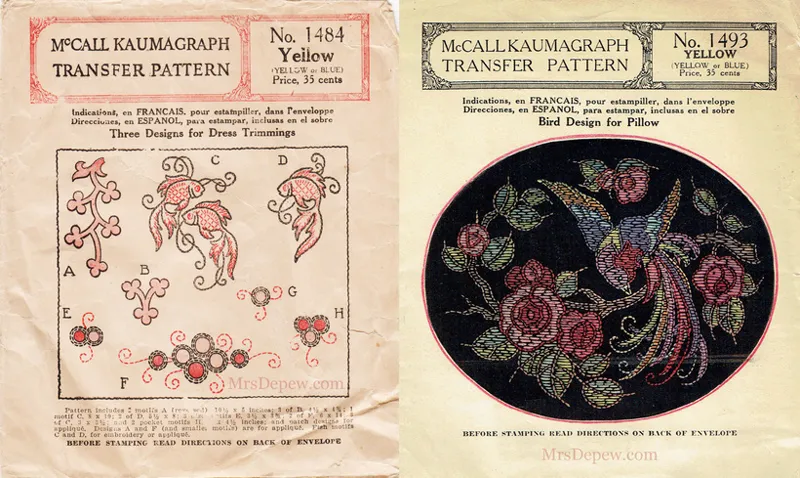
McCall Kaumagraphs were incredibly versatile and the company did a wonderful job of offering a variety of designs for monograms, appliqué, smocking, beading, quilting, stuffed/ embroidered toys & dolls, painted scarves, needlepoint, cross-stitch, lacemaking, and even leatherworking.
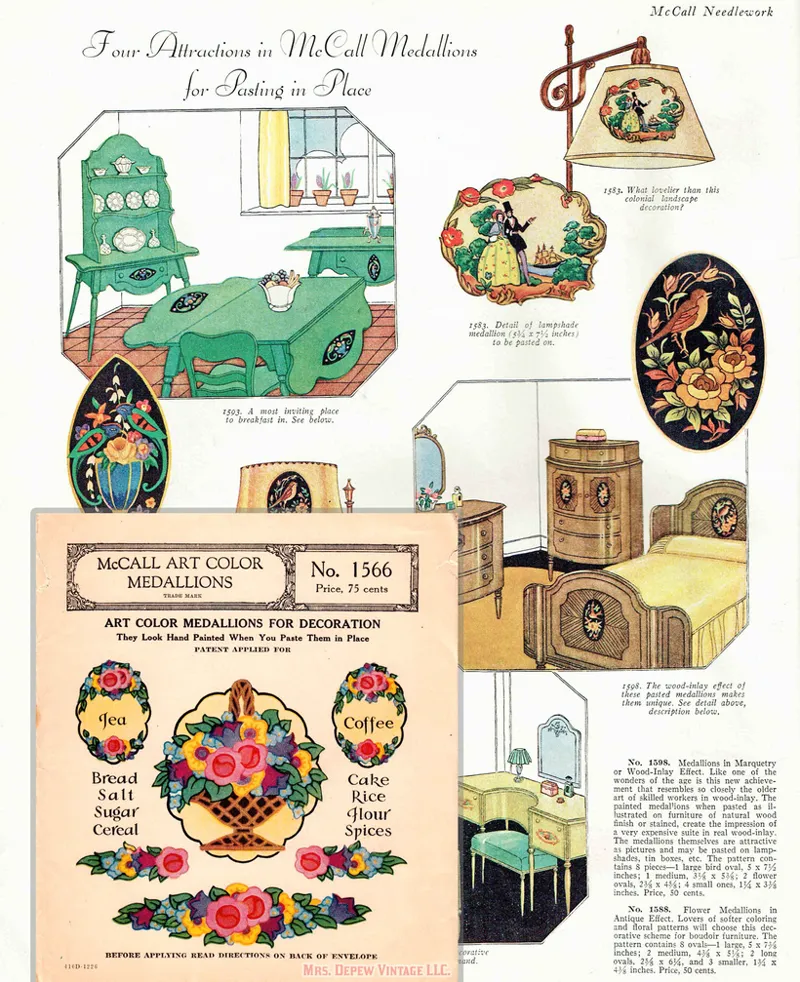
Above: McCall 1566 Art Color Medallions were produced by Kaumagraph Co., but not all envelopes have the name Kaumagraph printed on them. Other designs shown: McCall 1593, 1583, 1598, 1588.
In the later 1920s, McCall and Kaumagraph briefly branched into lithographed art color medallions for home decor. These had a gummed back side, allowing them to be pasted onto furniture, jars, tins, and even fabric lampshades. Their beautiful print quality was likely brought about by Kaumagraph President and co-founder H. R. Monro's previous experience in the lithography business.
Today, the art color medallion transfers are very rare and quite sought-after by some collectors.
Changes in the 1930s
For a time starting around 1930, the name Kaumagraph no longer seems to appear on McCall pattern envelopes, though they were still produced by the Kaumagraph Company.
In the 1939 McCall Complete Needlework counter catalog, patterns were advertised as "Decorative handiwork for women who like to make things for their home, their children, and themselves".
For home, monogrammed towels and embroidered napkins, dishtowels, and tablecloths were popular. For their children, embroidered toys or smocked dress yokes appeared. And for themselves, cheerfully decorative aprons, embroidered handbags, and the 1939 McCall 655 pattern shown above. It included both instructions and pattern pieces for the shirred jackets, and the embroidery designs for two other versions.
For the remainder of McCall's partnership with Kaumagraph Company, the Kaumagraph stamp would be found on the printed transfer sheet itself, but was not always printed on the outer envelope. This can be seen in the late 1930s pattern above.
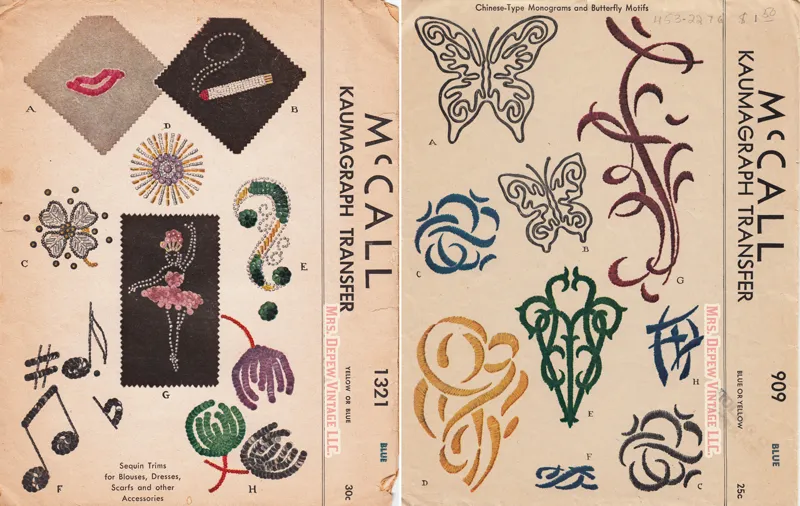
In the late 1940s patterns shown below, Kaumagraph again appears on the envelopes. The design at left beautifully captures the sequined craze that seemed to thrive in late 1940s and early 1950s fashions.
Above Left: Late 1940s McCall Kaumagraph 1321 Sequin Trims for Blouses, Dresses, Scarfs, and other Accessories. Right: McCall 909 Chinese-Type Monogram and Butterfly Motifs.
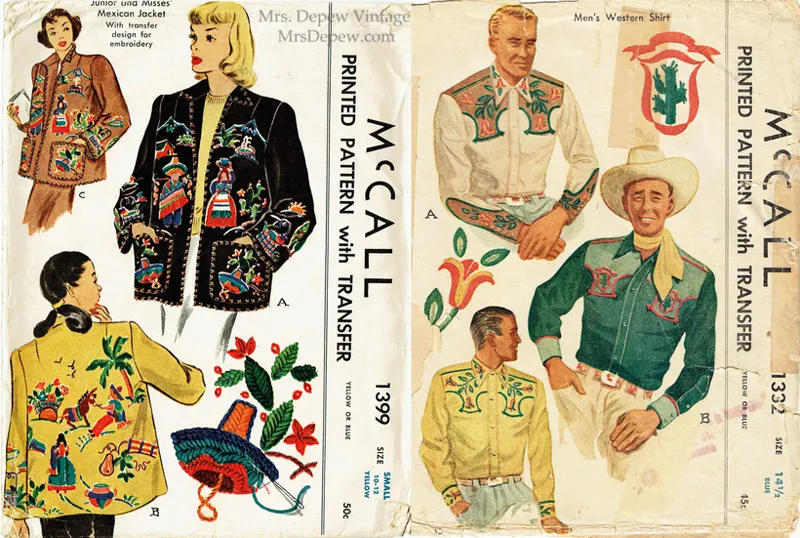
McCall Kaumagraph patterns were popular well into the 1950s, especially during the Western fashion craze that followed in the wake of popular movies starring Will Rogers and John Wayne, and the 100 plus western television shows from 1949 to the 1960s including Bonanza, Rawhide, Maverick, and Zorro.
McCall's sold Western-themed, and occasionally Mexico-souvenir themed patterns for the whole family. These included women's embroidered felt jackets, western shirts, vests, pants, and aprons. Menswear along these lines showed a solid 20 years of mostly shirts with embroidered or appliqué yokes, collars, and cuffs, but little boys could have an entire Will Rogers outfit furnished by Mccall's patterns including shirts, pants, and embroidered and fringed chaps and gauntlets. These all included Kaumagraph transfers of one sort or another.
--For more about vintage western wear sewing patterns, check out this blog post.--
In the 1960s, the desire for embroidered garments began to decline as more women joined the workforce and had less time for the needle arts. Sewing clothing was still very popular but taking the time to ornament one's projects with other needlework was becoming less and less common.
Neither I nor Kaumagraph Co. (now Kaumagraph International) can find the exact date that McCall's ended their decades-long relationship with Kaumagraph and hot iron patterns, though it was likely after the 1980s.
Is there a future for hot iron transfers?
Currently, the home embroidery market is growing by leaps and bounds and has been for the last 20 years as more and more Xennials and Millennials turn back to the hand-made roots of their mothers and grandmothers. I know I am not alone in suggesting that perhaps it is time that McCall's may wish to consider renewing that old relationship to meet the needs of the newest generation of makers.
I have it on good authority that Kaumagraph International is still equipped for the crafting transfer business and ready to pick up where they left off!
Happy sewing!
Sources:
America's Textile Reporter: For the Combined Textile Industries. (1905). United States: (n.p.).
Supreme Court Appellate Division--First Department.. (1920). (n.p.): (n.p.).
Stacker. Best Western TV shows of the '50s.
The Mrs. Depew Vintage LLC. private research pattern archive.
The Vintage4Me2 private research archive, courtesy of Judy Yates.
Textile World. (1928). United States: McGraw-Hill.
Comments (12)
Most of your information is correct. I take issue with your suggestion of carbon paper with perforated patterns. Perforated patterns are also known as prick and pounce ( pin hole ) stencils. In the newspaper & other advertisements for perforated patterns there is almost always a mention of stamping powder either included or for purchase. Some of the earlier circa 1886 needlework (catalog) books even gave recipes for making the powder. Joseph Walker came to America as an employee of the Briggs company to manufacture their transfers. there was an trade agreement between Kaumaugraph and Briggs, that had Briggs leave the American Market and Kaumagraph leave the European. Part of that agreement let Joseph Walker continue to manufacture embroidery patterns under his own label. Which is why Walkers transfer envelopes say since 1879 the date Briggs received their American patent for the hot iron process. If you read the New York Court case KAUMAGRAPH CO. v. STAMPAGRAPH CO and the subsequent appeal you will find that Kaumagraphs method and the Briggs method were identical when Kaumagraph first started making embroidery transfers and trade stamps. Transfer/Trade stamps are used to mark textile fabrics, leathers and other articles with an identifying design. Embroidery patterns are used to outline designs on linen and other goods. Kaumagraph's main business today is still the manufacture of trade stamps.
I have a jacket in the clothing collection I manage that I now believe may be one of these kaumatograph transfers. Can't wait to check!
Ooh, sounds like a fun hunt!
Loved reading about this! Thanks!
My pleasure!
Very interesting. Thank you 😁
I'm so glad you enjoyed it!
Thanks for such a great informative post with so many great illustrations! That kinda mid-late 20s McCalls era (w/“Printo Gravure”😁) is one of my very favorites, and “ladies’ mags” of the 20s-30s have such great eye candy with patterns and embroidery! This also reminded me of a sadly neglected project of mine that started as a solution to a misfit remnant of fabric… This dress -weight, heavy but divinely drapey sueded/sanded silk nabbed for a song, but in a color that washed me out a bit. But the hand of the fabric absolutely to die for, so: embroidery!! I used “The New McCall Pattern” #4831 (view A standing collar) w/some deco geometric transfer patterns around standing collar & cuffs, framing the vertical opening down front of bodice and on the pockets. Surprise surprise I bogged down on so much embroidery! I should dig that out though; I’m still enchanted with the idea of the project 😉 even if life just gets in the way sometimes. Sorry for the long self-indulgent comment but thanks for the reminder to dig that baby out and get to stitching!! ❤️
Are you kidding me? I am So. Here. For the long marvelously self-indulgent comments. I think that's a great part of patreon, getting to know each other better. Please always tell me about your projects. I love hearing about them. :)
McCalls 3201 was such a versatile pattern. I like the embroidered yoke and down the sleeves, but LOVE the beading on the wedding dress! This article makes me so nostalgic for all the time I used to spend embroidering my ripped up jeans in the 70s! I agree that they should re-release iron-on embroidery pattern transfers.
Are they the same company that made the Carousel build transfer?
I'm not familiar with that one. Do you have any kind of reference link I can check out?