





All About Patterns: Tissue Paper Sewing Patterns
Hello my dear friends,
I am slowly adjusting to the smaller field of vision I get to enjoy until things either heal or don't (a fun waiting game has ensued).
I am still having trouble looking at any one thing for very long, making computer work a bit of an interesting challenge, but luckily for me, Microsoft dictation has turned out to be pretty handy!
With my vision slowing down, this seemed like a great time to finally hire someone to help me scan in all of the great magazines and books I have in my giant archive. That has led to me sorting through and rediscovering a lot of great treasures in my archive.
Most recently, I unearthed a small collection of 1939 Mary Brooks Picken Booklets about sewing.
As an all-things Woman's Institute and Mary Brooks Picken collector, I was delighted. As a pattern collector and designer, I was overjoyed! Within these booklets was the answer to every question a customer has ever asked me about sewing with vintage patterns. I knew they were simply too good not to share.
So occasionally, I'll be sharing a page or two of this solid-gold sewing pattern knowledge with you all.
At the beginning of the book All About Patterns, Mrs. Picken goes into great detail about the sewing pattern industry in 1939.
"TISSUE-PAPER PATTERNS
TISSUE-PAPER PATTERS are sometimes called commercial patterns, but are more generally given the name of the manufacturer - Butterick, Vogue, McCall, Pictorial, Simplicity, and so on. Because the tissue paper is not bulky, it allows the many pieces of a pattern to be packaged satisfactorily in an envelope. The tissue is pliable enough to make it easy to adjust a pattern to individual measurements and to use it on fabric for cutting out.
It is unbelievable that the world went along for thousands of years without patterns. They were first made in the eighteen fifties. In the beginning, they were crude, simple patterns in rough paper, and the user paid a rental to cut from them. We all owe thanks to Ebenezer Butterick, an itinerant tailor, who rented his original patterns, or cut the garments himself and charged for the use of the pattern and for his time in cutting.
Custom-made Patterns:
A few firms draft patterns to individual measurements. These are usually expensive, and the styles from which to choose are limited. Except in unusual cases, such patterns are not necessary.
Drafted Patterns:
Before tissue-paper patterns were as perfect as they are now, drafted patterns were largely used, especially by dressmakers. Many women learned intricate systems and made their own patterns. Such systems were often tedious, and a pattern proved expensive in the time it took to make.
Today's tissue-paper patterns give such a wide variety of good styles in perfect accord with the best in readymade clothing that it is a safeguard from the standpoint of fashion and fit to select and use a reliable make of pattern. Learn to adjust the favored make of patterns to your individual measurements, to use patterns readily, and, consequently, to depend upon them.
You should never need a drafted pattern - even if you sew professionally and have customers with difficult figures. A cambric or muslin guide pattern used over a dress form as a check for proportions should prove completely satisfactory. (See page 10.)
Garments Draped Without Patterns:
Designers in the world's fashion markets do drape the fabric on living mannequins and use no patterns, but such persons are artists who are so skilled in handling fabric and in draping and free-hand cutting that they could cut a garment "by eye" and have it conform perfectly to the silhouette of a pattern.
Draper-designers work at this day after day, and some specialize in types of fabric as well as in age and size groups. For example, some work only in wool; others, only in silk; while still others work in synthetics in certain price groups. Some designers work only on "junior miss' dresses; some, on sizes 12 to 18; others, 36 to 44; etc.
These designers may use dozens of yards of fabric to get their original models perfect. Master patterns are made from the original creations of the draper-designers, and these are used for manufacturing the "line." Even the finest dresses are cut from patterns that were cut from the perfected originals.
When you can buy the design in your size in an easy-to-handle tissue-paper pattern at the very low price for which patterns sell, just be grateful that it is so, and follow the instructions intelligently.
Well-cut, well-styled patterns are wonderful values at their price. Many teachers of sewing believe that sewing would gain in prestige if women had to pay a dollar or more for a pattern instead of the average price of forty-five cents.
Then they would use patterns with greater care and take more pride in following the fabric suggestions as well as printed directions for cutting and making, and, consequently, their garments would express the style essentials of the pattern illustrations.
Plain Patterns:
On plain patterns, numbers are perforated to correspond to the sections shown on the pattern layout, to make it easy to identify the various parts. For example, 1 indicates the front of the blouse; 2, the back, and so on. As far as style is concerned, unprinted patterns are just as satisfactory as printed patterns.
Printed Patterns:
About 1920, printed patterns came into use. They are made by Pictorial, McCall, and Excella. The name of each piece is printed on that piece: front, back, side-front, side-back, sleeve, etc. Often details of construction are also printed, and these are helpful in using the pattern and making the garment.
Patterns With Margins:
McCall patterns have an extra margin outside the seam line, which many persons like, saying that it ensures a perfect cutting line. Some, on the other hand, prefer to cut this margin away before laying the pattern on the material.
Newspaper Patterns:
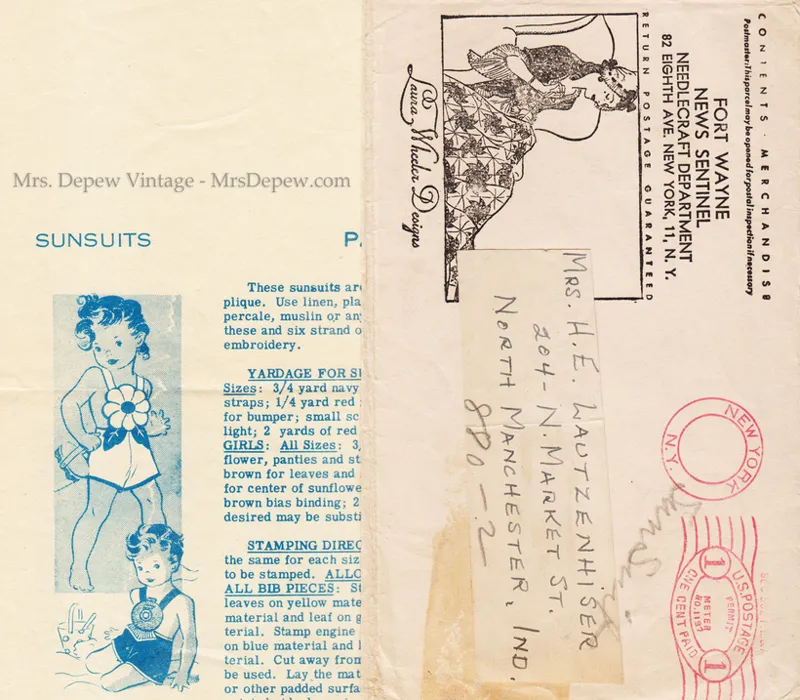
Designs for patterns are shown in many newspapers and magazines and often carry the name of the paper or magazine. Such patterns are usually manufactured by one or another of the well-known companies. They show popular or mass-type designs. Many thousands of such patterns are sold, which proves that, in the main, they must be satisfactory."
The next post in this series, How to Determine Your Figure Type, will hopefully be available in August.
Happy sewing!
Anna
Comments (2)
Marvelous! Thank you.
My pleasure!