
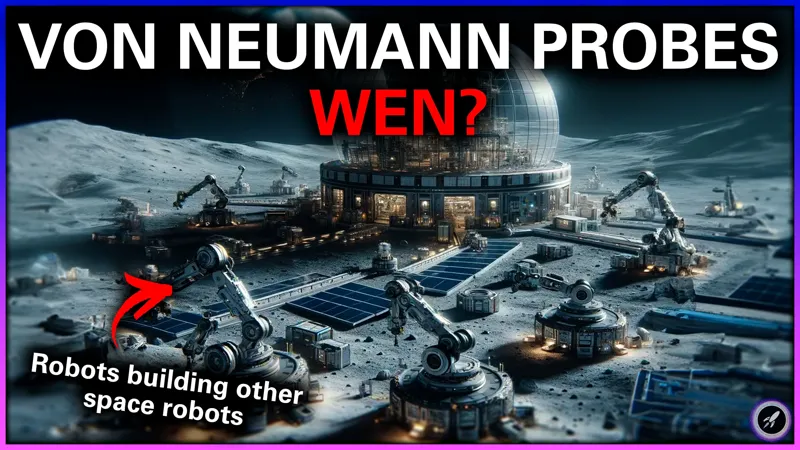
How Close Are We To Self-Replicating Robots Conquering Space?
Self-replicating space robots seems as an obvious way to explore the Universe. How close are we to such a scenario and what do we need to fill outer space with Von Neumann probes? Figuring out with Professor Alex Ellery.
Watch the video here (with no ads) or on YouTube: https://youtu.be/vo863_0SI_o
How Close Are We To Self-Replicating Robots Conquering Space (Vimeo)
Comments (7)
There is a good SciFi series by Dennis E. Taylor on Von Neumann probes. We are Legion.
I would guess the input material is very important
It all seemed reasonable until the mention of aliens and von Neumann probes. Why is it people think that interstellar travel is as easy as going on a road trip? The distances to even the nearest stars are vast and there are no (known) service stations on the way, the chances of any machine still being functional after tens of thousands of years and be able to remember its programming is a good approximation to zero (as my old maths teacher used to say). Personally, I blame it on the use of "light years" as a measure of distance, it seems to be confused with spaceship travel time when in reality it needs to be multiplied by thousands. So, unless we or the aliens can invert a magical FTL drive interstellar travel will never be even remotely practical. Von Neumann probes, Fermi paradox, Dyson spheres, Panspermia - they are all rubbish and should be in the dustbin of history.
What about the tens of thousands of interstellar objects floating through the Solar System right now? Dumb rocks made the journey from star to star. If a civilization is patient, why couldn't they send smart rocks?
Nano vacuum tubes, smaller, faster, tougher - https://www.science.org/content/article/return-vacuum-tube
You need a proofreader
You mean for the description of the video?