
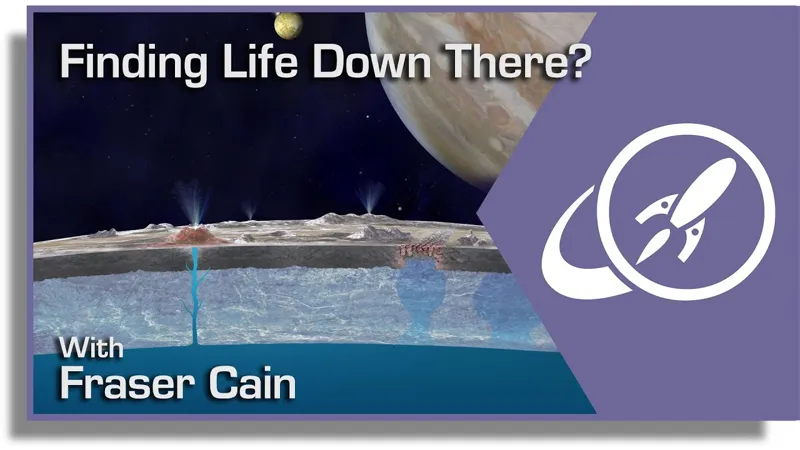
Searching for Life on Europa? Going Under the Ic
We’re now learning that icy worlds seem to be the best places in Solar System where life could be hiding. Worlds like Europa and Enceladus, which have vast oceans of liquid water beneath a shell of water ice.
And just in the last year, astrobiologists announced that hardy forms of Earth life should be able to thrive in these oceans, feeding off hydrogen gas emanating from deep sea vents.
Clearly we need to explore these worlds, to go deep down beneath the ice to explore the ocean depths. But how do you drill through kilometers of ice to reach it?
Comments (10)
What's up with NOAA not allowing Spacex to broadcast?
Kind of old news, but did you see that Osiris-REx had to adjust for outgassing? <a href="https://www.nasa.gov/feature/goddard/2017/mission-status-update-cruising-toward-asteroid-bennu" rel="nofollow noopener" target="_blank">https://www.nasa.gov/feature/goddard/2017/mission-status-update-cruising-toward-asteroid-bennu</a>
Loved this one.
Thanks a lot!
What about all the red stuff on the surface, near the cracks? Any microbial life down the ocean would be lifted with it to the surface, ready to be scoped. A mission to analyze it would be much simpler, faster and chipper than a nuclear submarine-driller that has to work in a unknown environment for years. Plus, it would have a much lower chance of contamination of the subsurface oceans, and launch samples back to earth would not be 100% off the table. Lets do more with less!
Probably a stupid question, can the radiation from Jupiter be used as a power source?
Not easily.
Fraser, will the hydrobots be able to send pictures or video of what they see? Will they have their own light source for pictures? And on a lighter note - how long do scientists work trying to force a name into an acronym they want to use, e.g. ERUOPA?
I was wondering how they would sterilize the space craft prior to entering the oceans. Thanks.
They'll let Jupiter do it. :-)