
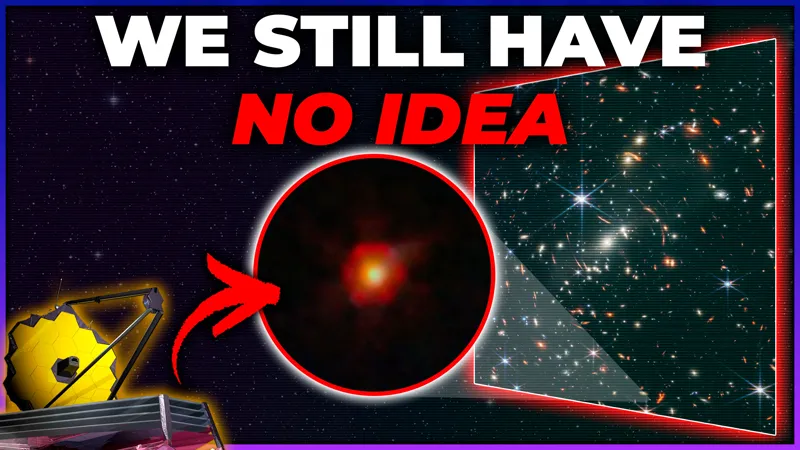

[Interview+] 4 Years In, We Still Have No Idea What JWST's Biggest Discovery Is. Here's Why It's Awesome
BONUS PART STARTS AT 36:41
Watch here (with no ads) or on YouTube: https://youtu.be/zoHtCmCbcEU
🟣 Guest: Dr. Vasily Kokorev https://vasilykokorev.com/
📜 NASA Webb Finds Strongest Evidence Yet for ‘Black Hole Stars’ https://science.nasa.gov/missions/webb/nasa-webb-finds-strongest-evidence-yet-for-black-hole-stars/
James Webb has been operational for over 4 years now. Little red dots are one of its major discoveries so far. Yet, we still have no idea what they are. They could be black holes, supermassive stars or something completely different. Here's why it's awesome for science.
00:00 Intro
01:29 History of LRDs
08:48 What are they?
31:09 Where do we go from here?
36:41 Fartherest object in the Universe
42:40 JWST deep field
46:46 Current obsessions
52:41 Final thoughts
Comments (10)
That was just great, Fraser. So informative, and so full of optimism for the future of Astronomy and Cosmology, and Science in general. Thank you.
1000 hours is not needed, you just want a few 100 hour stares at dark spots in the sky, to get the bright foreground away, and this will allow you to look at the data to see which ones will be the candidates for the 1k hour views, and also mapping the darker areas in much more detail.
Dr. Kokorev is well-spoken and Fraser asks great questions. The problem, which is not going away, is the time-problem, which has been around for decades. Galaxies/globular clusters older than the universe, etc. All you need, really, is about 9 or 10 billion years more time. In that case, these compact systems could be forming stars and making black holes at a rate of about ~0.5 msun/year. So what is in the way of getting 10 more billion years? It's the darn big bang itself. Think about it -- a bare big bang won't work because of density instabilities cause huge black holes, so you have to insert an inflationary period. Now the universe is too flat, so you need to generate "seeds" to form during inflation... on and on. In my humble opinion, you just need to get past the big bang. I have my ideas, but searching is most of the fun so I won't spoil it for you. Good luck! Curt
Roman will find strong lenses JWST can stare at for thousands of hours. Then we'll know better!
What a delightful and mind stretching interview. Once again, I am reminded of how small my tiny brain is. To absorb concepts which are so far beyond what I can comprehend, and just enjoy the wonder of it all, is such a joy. It only adds, here in Finland, to the magic of the night sky.
Hi Fraser and Dr. Kokorev. Fascinating discussion on the 'Little Red Dots' and the black hole seeding problem! The core issue you highlighted is essentially a chronological crisis: the standard ΛCDM model simply doesn't give these "heavy seeds" enough time to grow to such massive proportions by redshift 7 or 8. It forces us to invent extremely rare direct-collapse scenarios just to make the math fit the timeline. But what if the timeline is the problem, not the black holes? I recently published a formal paper proposing an extension to standard cosmology using Quantum Continuum Mechanics that solves this exact JWST anomaly. If we stop treating the vacuum as an empty void and model it as a real, viscoelastic continuous medium (a Closed String Matrix), light traveling across cosmic distances experiences Tensional Wave Fatigue (internal friction). By accounting for this rheological damping, the observed redshift becomes a compound indicator (not just pure kinematic expansion, but also elastic fatigue). This recalibrates the true age of the observable universe to 17.4 billion years. Those extra 3.6 billion years provide the exact thermodynamic and chronological window needed for these supermassive structures and "Little Red Dots" to mature naturally, without breaking the physics of black hole accretion rates. Furthermore, early structures forming from a supercritical volumetric phase transition (a Cosmic BLEVE) naturally create massive primordial nodes from the very beginning. I have detailed the mathematics of this recalibration in my open-access paper (An Inhomogeneous Cosmological Bounce Model Derived from Closed String Matrix Elasticity). I’d be honored if you, Dr. Kokorev, or the community took a look at this mechanical resolution to the JWST maturity anomaly: https://doi.org/10.5281/zenodo.21116078 Best regards, Víctor Fernández Independent Researcher / The Fluid Quantum Mechanics Initiative
Fraser, your interview with Dr. Vasily Kokorev was mesmerizing and absolutely enlightening and that’s what makes what you do the best of its kind!! Your probing and unending curiosity is infectious and inspiring and when you merge that with some of the best minds our world has to offer it’s truly wonderful. I posted this comment hoping that as many people as possible watch and consider subscribing or upgrading their account like I’ve just done because what you do is priceless and all too rare and must be celebrated and shared far and wide!! 🤩👍🙌 Thanks again for all that you do and all that you are 🙏
Hi Fraser, it looks like the usual download option is missing: could you have a look at the issue? Thanks
Excellent. Thank you so much for sharing these interviews with us.
Such a fascinating interview!