

[Q&A+] Eliminating Night Darkness, Voyagers' Lifetime, JWST's Planets
BONUS QUESTION STARTS AT 15:57
Watch the video here (with no ads) or on YouTube: https://youtu.be/1rUTV39wcwM
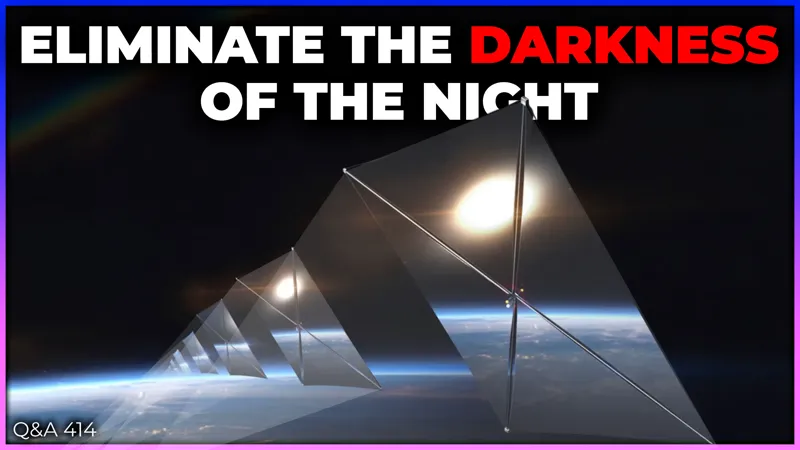
Can we eliminate darkness at night with an orbital reflector? How long do the Voyagers have left? Why didn't JWST inspect some of the potential ocean worlds? And in Q&A+, could we see the Great Attractor unobscured?
00:00 Start
00:26 [@Asmo-RL] Why are Mars and Venus un the habitable zone though clearly uninhabited?
03:52 [@GigaSigma1] Can we put a reflector in orbit to eliminate darkness at night?
07:03 [@MLBrilliance] Can we see the Great Attractor unobscured?
11:01 [@bigglestintin] ow long will voyager 2's power last?
15:57 [@everythingcompute] Why didn't JWST look at Kepler 22B?
20:11 Outro
Comments (3)
V’ger…
Actual questions answered are in a totally different order to the text I'm line.
1:40 We should not be concerned about adding to the net energy budget of the Earth, especially at frigid high latitudes, especially at night. By all objective measures, that's beneficial, just as Arrhenius predicted for the warming effect of CO2 over a century ago. But I agree with your other points: putting giant mirrors into orbit to light the Earth is impractical for many reasons. 20:12 I also mostly agree with you about SpaceX vs. SLS, too. You can't reasonably separate SpaceX from their leaders, Musk and Shotwell. Without their vision and leadership there's no way that incredibly talented team of engineers and other scientists could have accomplished what they've done. But I agree with your other points: I, too, am thrilled that we're FINALLY going back to the Moon, and I'm very thankful that SLS works well. But, in the long term, SLS is a dead end. It is the wrong approach. It is just much, much too wasteful. Musk and SpaceX are trying to do Moon (and Mars!) missions in a way that can be economically feasible in the long term: via in-orbit refueling, and lots or reusable spacecraft, expending nothing except fuel. That approach will eventually make travel to human colonies elsewhere possible for a small fraction of the cost of the Artemis approach, probably at least a full order of magnitude cheaper. SLS works as designed, but the costs are astronomical. Using and discarding a pair of those SRBs costs a cool $400 million, each flight. In addition, they discard $600 million worth of reusable RS-25 engines on every SLS flight. That is horrifically wasteful. That's a cool $1 billion just in SRBs & stage 1 engines, flushed into the sea, each and every flight -- and even that only accounts for 1/4 of the mission cost. That is unsustainable. The longer SLS continues, the longer it will bleed away resources that are needed for other missions. When SLS is eventually cancelled, it will free up a LOT of money for other important science missions. I am also grateful for your ongoing efforts to wean viewers away from YouTube addiction. But Patreon is kind of annoying. For one thing, it doesn't allow linking to comments. That seems like very basic functionality, which it just doesn't support.