
[Interview+] The Limits of The Habitable Worlds Observatory
Watch here (with no ads) or on YouTube: https://youtu.be/M3KZgV-_kks
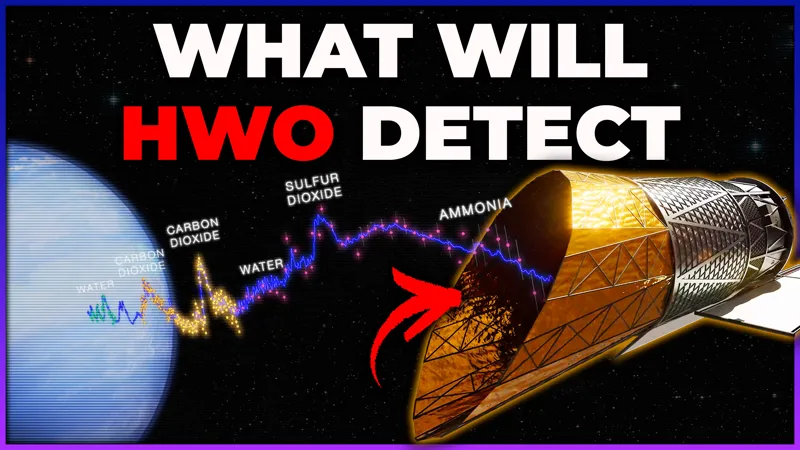
The Habitable Worlds Observatory is our ultimate tool to see an Earth-sized world around a Sun-like star. But what will be the limits of its instruments? What will it realistically be able to see? Finding out the answers in this interview.
👉 HWO interview with Lee Feinberg https://youtu.be/0R3ykUkxH5M
👉 Coronagraph interview with Vanessa Bailey https://youtu.be/HXZMRagv66M
🟣 Guest: Celeste Hagee https://www.celestehagee.com/
📜 Bayesian Analysis for Remote Biosignature Identification on exoEarths (BARBIE) IV: Analyzing CO2 Detections in the Near-IR to Determine the Long-Wavelength Cut-off for the Habitable Worlds Observatory Coronagraph https://arxiv.org/abs/2602.12353
00:00 Intro
01:43 What could HWO see
06:20 Celeste's research
19:06 Findings
28:16 The quest of confirming extraterrestrial life
35:04 Current obsessions
39:00 Final thoughts
Comments (7)
Celeste Hager, thank you I appreciate you and I wish you to continue the amazing journey that you’re on
Very interesting interview. I was always wondering how you get from a measured spectra to its components. The soup metaphor popped into my head as well while she was explaining it. Decomposing a soup into its ingredients. Really laughed when you brought up the same metaphor a few seconds later. :D
That was fascinating! Celeste was a great guest!
Maybe taking suitable spectra of earth from the moon would give us at least an example which we knew what the athmosphere contained. Doing it from the moon allows a more realistic observation rather than doing it in situ or on the ISS.
Excellent interview, greatly appreciated.
Nice work Celeste! Great booking Frasier. There's hope for this world.
I've been interested in this topic 🙂