

[Q&A+] The Next ISS, Europan Life, Heat Death of The Universe
BONUS QUESTION STARTS AT 17:37
Watch the video here (with no ads) or on YouTube: https://youtu.be/olJR9OPYXbo
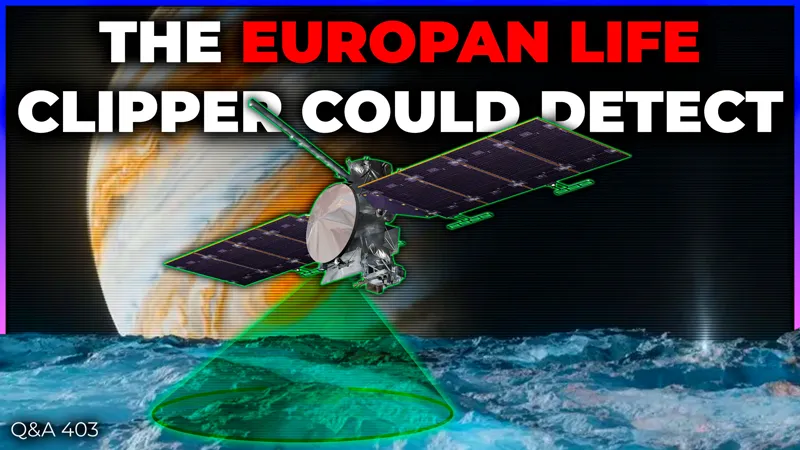
What are the plans for the next space station? What type of Europan life could Europa Clipper detect? Could we spot the rotation of our supercluster? And in Q&A+, is the Moon necessary for life?
00:00 Intro
00:25 [@meesalikeu] What are plans for the next ISS?
02:36 [@wainr777able] Which life Europa Clipper could find?
07:10 [@doogle4144] Could we see the rotation of our supercluster?
09:45 [@willstack6188] Antimatter engines for interstellar travel
13:28 [@nitstyles13] How will the SGL telescope work?
16:12 [@hangmann747tinmann8] Would systems like Jupiter survive the heat death of the Universe?
17:37 [@shashilwow] How crucial is the Moon for life?
19:30 Outro
Comments (6)
Star Trek had always held a lens up to society…true. But in the past it’s a magnifier…this has just been a prescription lens. That is a problem.
question about gravitational lensing: if you could make a tiny little black hole (the question, if you could make that stably, aside) that acts as lens or mirror equivalent for a telescope of a size we have, would it make any difference over conventional telescopes? or does it in the end just come down to the width of the area / spread the light is collected from? rememberimg that interview you did about that space telescope with a thin but wide mirror or your many mentions about virtual mirror size when multiple arrays are combined at the same wavefront... did i understand that right?
Better would be to impart a perpendicular motion on the way out to make it possible to see multiple objects over a long period of time.
What about it
The pro alien lifers seem to be getting out of hand. They are clutching at ever diminishing straws, the latest idea of molecular complexity as a signature is dubious. After all, here on Earth we are surrounded by complex conglomerations of molecules, even the rocks under our feet. Is that custard lump alien life or just a long chain molecule?
When using a telescope that uses the Sun as a gravitational lens that lens could focus on a single point (region). this world require continual movement to keep that point of focus. However, the focus point can move along giving a continually changing focus point (and making good observations might require the telescope to stabilize the focus point for long enough to make adequate photos.