
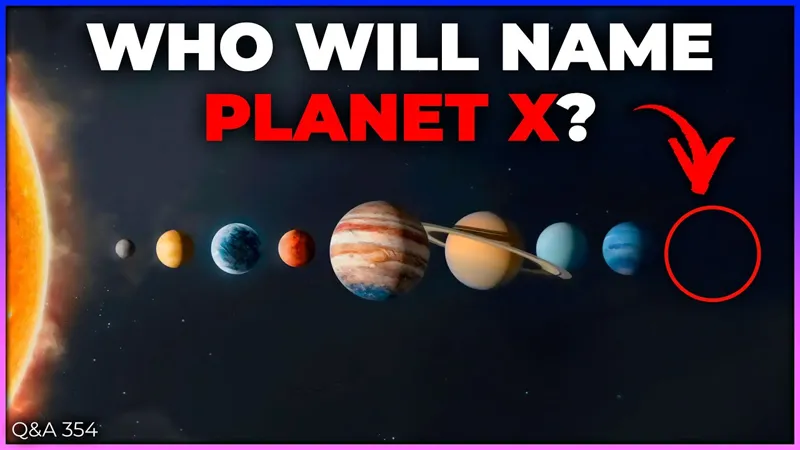

[Q&A+] Naming Planet X, Cats in Space, Stars Blocking Galaxies | Q&A 354
Who will name Planet X if/when it is discovered? How will cats deal with the toilet situation if they go to space? Can a star block an entire galaxy? And in Q&A+ what happens if we find proof that there's no life elsewhere?
Watch the video here (with no ads) or on YouTube: https://youtu.be/wYN5kIKVS58
Here's a link to the full, unedited livstream: https://youtube.com/live/QWAYJvsT3b8
Comments (10)
As I posted in the Live Show - my hypothesis as to why we haven't seen any aliens is a matter of distance /time. There might be a civilization out there that developed radio 5,000 years ago...but if they're 10,000 light years away, we won't 'see' them for another 5,000 years. Of course, being a hypothesis we have no data to confirm or deny it - and thus it'll remain as such until we have some hard data. But following Occam's Razor, I think it's a fairly solid hypothesis that explains the Fermi Paradox without trying a run-around.
I thought your answer to the question about why we want to learn about things outside our galaxy etc was superb, especially the part where you used the analogy of the answer to dark matter being placed in an envelope. “Would you open it?” Curiosity!
Hi Fraser! Forgive me if you’ve addressed this before. How is it images acquired from land observatories such as Rubin, are not distorted by Earth’s atmosphere?
They use a technology called "adaptive optics" which fires a laser into the sky to create an artificial star. They know the star should be a point in the sky, so they use pistons on the telescope mirror to deform it so the artificial star has its expected shape. This allows the telescope to ignore much of the atmospheric turbulence.
When you are investigating a question and you know you really want one answer to be true, but you also want the answer to be correct, I believe you should acknowledge your cognitive bias and be skeptical of your favored answer. When I was 16 years old, an assignment in my English class to read Greek mythology caused me to question my Catholic faith. I realized that what I was reading was the ancient Greek version of my own faith. As I was fairly sure that Apollo is not really pulling the Sun across the sky, I felt secure in believing that their religious beliefs were not factually correct. I tried to come up with a better reason for believing what I was taught in my Catholic elementary school than the ancient Greeks had for their religious beliefs. I decided that they had three reasons for believing in Zeus the way I believed in God. First, it was what they were taught by their parents and their teachers. It was also what most people around them believed. Second, it answered questions that they would otherwise have no way to answer. Why does the Sun move across the sky? Third, it offered the promise of an afterlife in which they would be reunited with their deceased loved ones. I had no other/better reasons for believing in God. It was at that point I became officially agnostic. Forty-one years later, I really find myself wishing that I believed that I would see deceased loved ones again, particularly my mother. Yesterday was the 6th anniversary of my mother's death, so I found myself a little more maudlin than usual. I keep encountering things I'd love to talk to her about. It makes me really wish I still believed in God and heaven. I'd probably be a lot less depressed if I did, but my rational brain keeps telling me the more I want to believe, the more skeptical I should be. I would need real new evidence before I could believe. Sometimes I wish I could make myself believe, but eventually I return to being ever skeptical. As the late Charlie Kirk was wont to say, prove me wrong. You'll need to provide real evidence, though.
What computer programming system does NASA use?
By Uranus (as in the planet discovered by math), you meant Neptune...
You're correct: Uranus was discovered by William Herschel on March 13, 1781, while he was using his homemade telescope. Neptune was discovered through a collaborative effort of mathematics and telescopic observation, rather than pure chance
Where did you go to school? Very high iq's!
Me? I went to University of British Columbia for engineering, and then completed a degree in computer engineering at North Island College.