
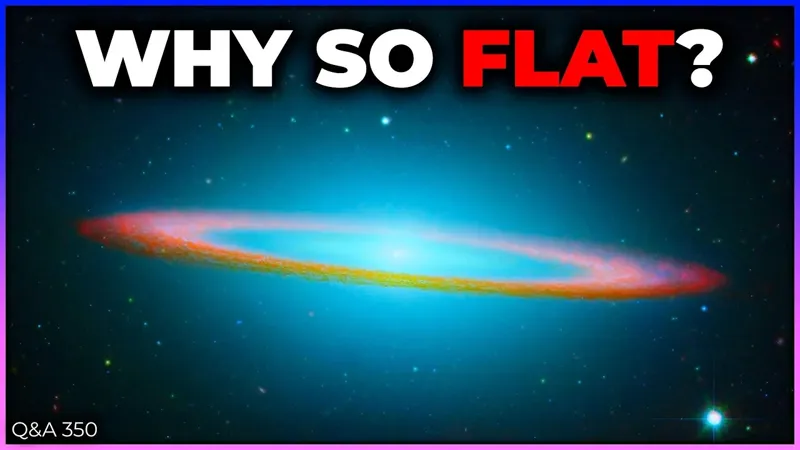

[Q&A+] Flat Galaxies, Future of The Space Race, Mining Mars | Q&A 350
Why are galaxies and star systems flat? What does the future of the space race look like? Are we going to Mars to mine it? And in Q&A+, what sparked my personal interest for space as a kid?
Watch the video here (with no ads) or on YouTube: https://youtu.be/8B5f-LhVWDg
Comments (10)
11:14 - Only reason "we" want to colonise Mars, is the SAME reason "we" set foot on the moon, just to prove "my ideology" (USA/West) is better than "your ideology" (China). Nothing else makes sense. Great show btw.
Hi Fraser, as your touched on, our exploration and habitation of our solar system will occur gradually but will make rapid advancements during periodic and dramatic developments in newer technologies, such as in propulsion or non-propulsion space vehicle travel technologies...as an example.
Colonization of space depends on Imperialism on earth. Imperialism has mostly been replaced by trade agreements except the russian federation. China does not conquer; it buys land and access. So, colonies on the Moon and Mars could be collaborative rather than competitive. Witness the state of science since Rene Descartes proposed it 150 years ago. Discoveries are published and shared outside diplomatic boundaries. The ability to colonize Mars is the SpaceX objective. Should we kill earth, an escape plan would be good. Can anyone foresee successive generations born on Mars? Not yet.
Well, getting humans on 2 planets is worthwhile for longevity, probably more worthwhile to try and create a 'habitat' in space. Start with 20 people :)
Former NASA Administrator Dan Goldin liked to remark that "all kids love two things: dinosaurs and rockets. There aren't any more dinosaurs, but I can show them lots of rockets!" He regularly visited schools around the country, speaking to enthralled children about space. I was amazed at his ability to connect with them, regardless of age or background, and wonder how many careers he set in motion.
I don’t see us colonizing mars. The moon, yeah, but if we can colonize mars, we can just live in space. Probably better. Your station will have windows. Sorry, I’m running this thread. I was wondering did you have the Star Wars guide to the solar system book? I loved it, you’re exactly the same age as me so I’m guessing you had it. // I’ve been listening to your podcast since 2003 at least, my wife was pregnant with my youngest and I was taking night classes in design so I bought a MacBook, the white poly one, it had just come out. So 22+? Unless you skipped a couple years.
You slid by that Oort Cloud comment without explaining the most important bit, why is everything flat, except for the Oort Cloud. I’m guessing rotation rate is too slow and gravity is too weak to offset the random collisions.
Nice job with the recursive pizza shot.
You reminded me of Pizza Planet from Toy Story, Fraser 😄!
Actually it is not easy to grasp why galaxies and solar systems flatten out. If distribution and vectors of particles in the early universe were random and uniform, it doesn't seem likely to get disks. Spheres seem more likely, intuitively. Why does momentum seem to coalesce into disks without some pre-condition that determines that? It's a deterministic universe, right. Obviously over huge amounts of time, millions and billions of years, motions between nearby objects will influence each other to average out those vectors. So intuitively I'd expect some things close together to average out their orbits and end up in a plane, while other objects farther from first group but closer to each other to end up in their own plane, completely irrelevant of the other plane. Oh, and then those 2 planes average out to a new plane. Hmm, maybe I *finally* grasped some intuition of this model - I've been confused about it for years! Hmm. Talking out loud sometimes helps. But see, I haven't heard anyone describe what I just described lol. So I don't even know if it is even remotely close to what universe models are doing lol. Fraser, is there a past interview on this subject?